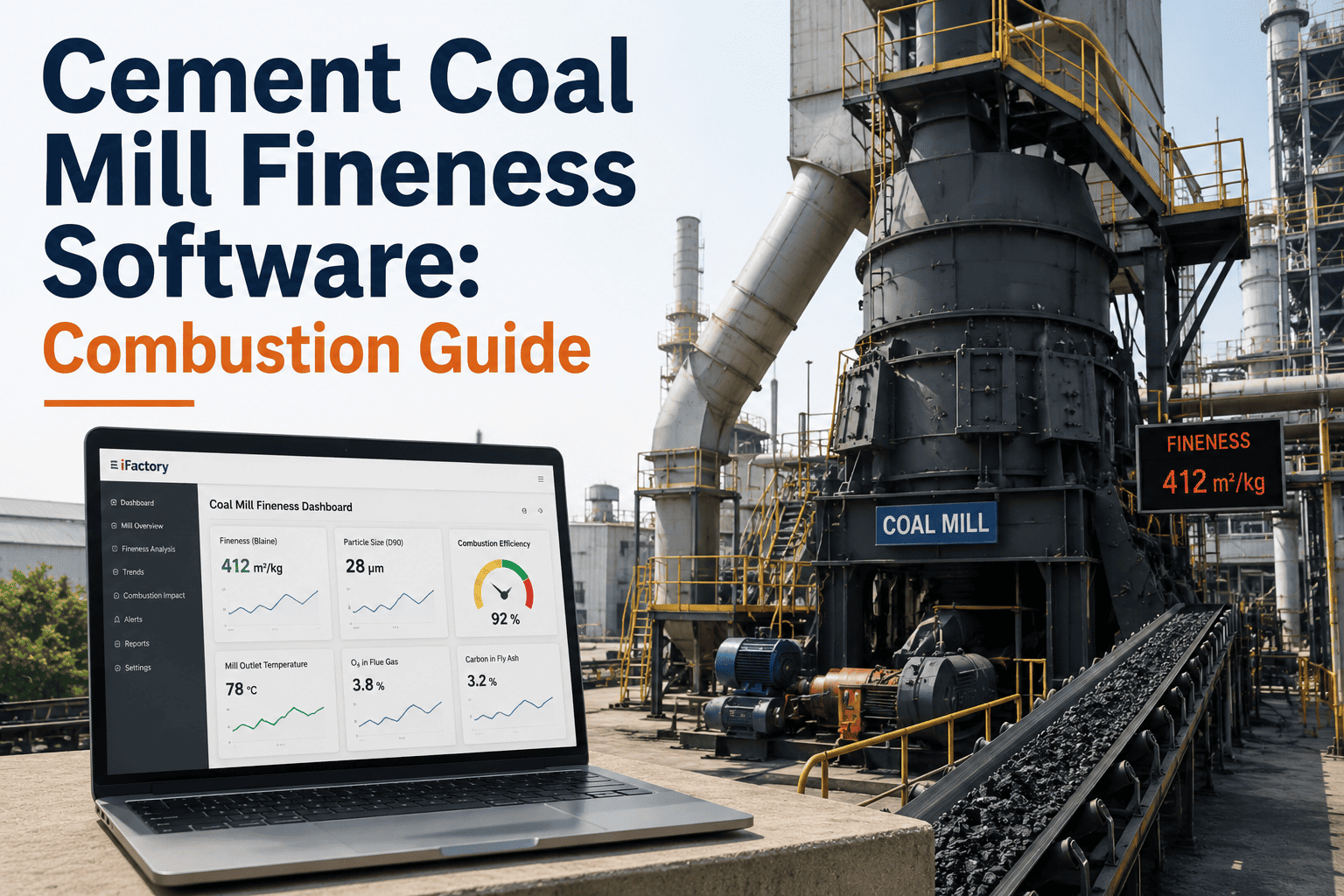
Coal mill fineness is one of the most overlooked variables on a cement plant's cost sheet, yet it quietly decides how much unburnt carbon leaves with your clinker, how stable your flame shape stays, and how many degrees your preheater exit gas temperature drifts on a bad shift. A mill that is running 8% coarse on the 90 micron sieve is invisible on a DCS trend until the kiln starts coating, the burning zone gets lazy, and specific heat consumption creeps upward tonne after tonne. Most plants still check fineness once or twice a shift with a manual sieve test, log it on paper, and move on — by the time the number is reviewed, the mill has already been out of target for hours. See how Oxmaint turns coal mill fineness sampling into a live, trackable discipline instead of a once-a-shift paper entry.
Why Coal Mill Fineness Controls Combustion Quality
Coal fineness decides how fast a particle ignites and how completely it burns inside the burning zone. A particle held on the 90 micron sieve takes measurably longer to combust than one that passes through, and if too many of those coarse particles reach the kiln, the flame stretches, ignition delays, and unburnt carbon starts showing up where it should not — in the clinker, in the preheater dust, and in your fuel bill. Grinding finer is not automatically better either: push fineness too far and mill power consumption climbs, wear rates on classifier and grinding elements accelerate, and fine coal dust becomes genuinely more hazardous to store and transport.
The working target most bituminous coal operations use is somewhere between 88% and 92% passing the 90 micron sieve, adjusted for ash content and volatile matter. High ash or low volatile coals typically need a finer grind to compensate for slower reactivity, while high volatile coals need to stay coarser for safety reasons even though they burn faster. There is no single number that fits every coal blend — which is exactly why fineness needs to be tracked continuously against the coal type actually running through the mill that shift, not against a static specification sheet from three years ago.
Too Coarse, Too Fine, or On Target — What Each Zone Actually Does
Ignition delays as particles need more residence time to reach combustion temperature. Flame stretches toward the burning zone exit, coating and ring formation risk rises at the kiln inlet, and CO spikes appear as unburnt carbon carries through. Preheater exit gas temperature drifts upward as heat that should have transferred stays locked in unburnt fuel.
Particles ignite quickly and burn out fully within the flame envelope. Burning zone temperature holds steady, coating formation stays predictable, and specific heat consumption sits at its achievable minimum for the coal blend in use. This is the band worth defending shift after shift.
Mill power draw and wear rates climb for marginal combustion benefit. Fine coal dust becomes more prone to spontaneous heating in storage and, combined with high volatile matter, raises explosion risk in the mill circuit and coal silo — a genuine safety exposure, not just an efficiency one.
5 Signs Your Coal Mill Fineness Has Drifted Off Target
A slow, steady rise in EGT with no change in kiln feed rate or fuel rate is one of the earliest tells of coarse coal. Unburnt carbon is carrying further into the system than it should, releasing its heat later than intended and letting more of it escape with the exhaust gas instead of the clinker bed.
Coarse particles that haven't fully combusted by the time they reach the kiln inlet leave incomplete combustion signatures on the gas analyzer. Recurring CO spikes without a matching change in raw meal chemistry usually point straight back to the mill's separator setting, not the kiln.
Long, lazy flames from coarse coal deposit heat further down the kiln than the burning zone was designed for, encouraging build-up at the inlet. If ring formation keeps returning within weeks of a clean-out, fineness is worth checking before scheduling another manual chipping job.
Unburnt carbon is wasted fuel by definition — it was purchased, ground, and fed, but never released its full heat value inside the burning zone. A rising kcal/kg clinker trend with stable raw mix chemistry is a strong indicator that fineness, not process control, is the root cause.
Fineness and drying are linked through the same air-swept system. When mill outlet temperature drifts outside the 65–80°C band, moisture in the fine coal changes with it — too dry raises explosion risk, too wet undermines both flowability and flame stability at the burner.
The Fineness-to-Volatile-Matter Rule Every Mill Operator Should Track
Coal fineness and volatile matter content are tied together by a widely used safety rule of thumb: the residue on the 90 micron sieve should not exceed roughly half of the coal's volatile matter percentage. Grind a high-volatile coal too fine relative to this rule and the fine dust fraction becomes considerably more reactive in the mill circuit and downstream silo, raising the risk of spontaneous heating or, in a worst case, a dust explosion event. Grind it too coarse and the combustion problems described above take over instead.
This is precisely why fineness cannot be managed against one fixed number written into a procedure years ago. Every coal delivery carries a different ash, moisture, and volatile matter profile, and the safe, efficient fineness target shifts with it. A CMMS-linked tracking system that stores the current coal's volatile matter alongside the live R90 reading can flag when a mill is grinding outside its safe band for that specific coal — something a static paper checklist has no way of doing.
Coal Fineness Targets and Combustion Outcomes
The table below summarizes how fineness, drying, and safety parameters typically interact across common coal types used in cement kiln firing. Treat these as a starting reference band — always adjust against your own coal's ash, moisture, and volatile matter test results.
| Parameter | Typical Target | If Too Coarse | If Too Fine |
|---|---|---|---|
| 90 micron passing | 88–92% | Delayed ignition, longer flame | Higher mill power draw |
| 200 micron residue | As low as practical | CO at kiln inlet, coating risk | Not typically a fineness issue |
| R90 vs volatile matter | R90 ≤ 0.5 × VM | Long flame, unstable burning zone | Elevated explosion risk |
| Mill outlet temperature | 65–80°C | Wet fine coal, poor flow | Dry dust, higher ignition risk |
| Residual moisture, bituminous | 1.5–2.5% | Flame instability at burner | Spontaneous heating risk |
| Residual moisture, lignite | 0.5–1.0% | Flame instability at burner | Spontaneous heating risk |
Turning Manual Sieve Tests Into a Live Fineness Discipline
Most plants already run 90 micron sieve tests — the gap is almost never the test itself, it's what happens to the number afterward. A reading logged on paper and reviewed once a week cannot stop a coarse grind from running for an entire shift. A CMMS-linked workflow closes that gap in four steps.
Each fineness reading is entered against the specific coal delivery in use, along with its recorded ash, moisture, and volatile matter values — not against a single generic plant-wide target.
The system checks the reading against the safe and efficient range calculated for that coal's volatile matter and ash content, rather than a fixed number that ignores blend variation.
An out-of-band reading generates an immediate alert to the mill operator and shift supervisor with the recommended separator or feed rate adjustment, instead of waiting for the next scheduled review.
Fineness history sits alongside EGT, CO, and specific heat consumption trends in the same dashboard, so plant managers can confirm the correlation instead of treating fineness as an isolated lab number.