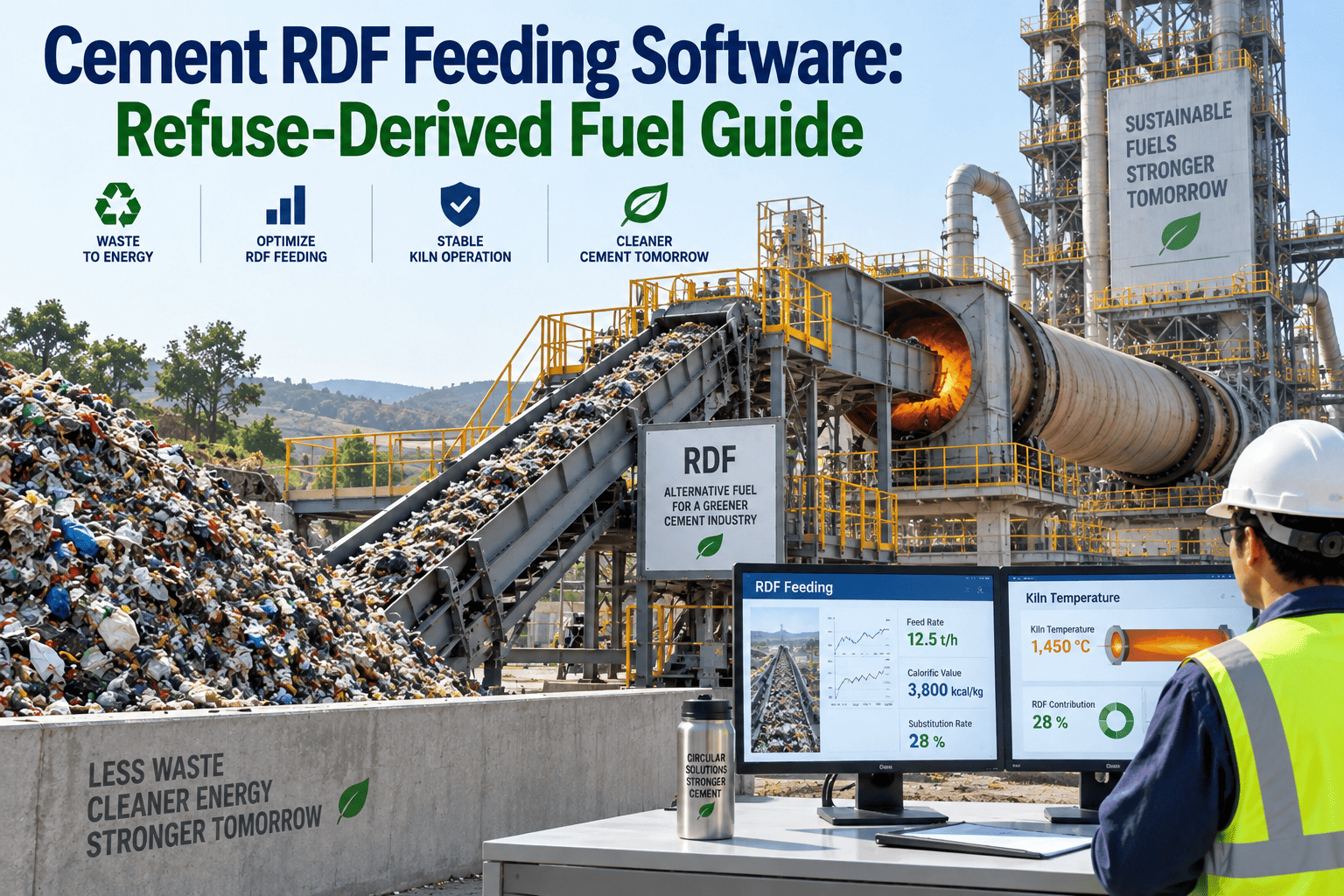
No two truckloads of refuse-derived fuel are the same. One arrives at 10% moisture and burns hot; the next comes in after a rainy week at 25% and cools the flame enough to leave free lime in the clinker. RDF is not a commodity — it is a moving target, its calorific value swinging from 2,500 to 5,000 kcal per kilogram depending on how much plastic, textile, and wet organic matter happens to be in the batch. Every one of those swings ripples straight into kiln stability and clinker chemistry. This guide explains what makes RDF so hard to feed consistently, and how a CMMS keeps the feed system and the fuel-quality record under control. Start managing your RDF feed program with OxMaint free and track feed rate, moisture, and quality drift in one place.
Why RDF Is the Hardest Fuel to Feed Consistently
Coal and petcoke are engineered products with tight, predictable specifications. RDF is the opposite: it is made from municipal, commercial, and industrial waste, so its makeup shifts with the season, the weather, the collection area, and even local recycling habits. A batch heavy in plastics burns hot and dry; a batch heavy in wet organics arrives cold and steamy. The kiln, meanwhile, is a precise thermal system that wants exactly the opposite — a steady, uniform heat input it can hold to a tight profile.
That mismatch is the whole challenge of RDF co-processing. The fuel that lowers cost and carbon is also the fuel hardest to burn steadily, and as substitution rates climb, its variability stops being an occasional upset to ride out and becomes the baseline operating condition. Managing RDF well means managing that variability on two fronts at once: the fuel quality arriving batch by batch, and the mechanical feed system that has to move an abrasive, inconsistent material at a precise, unwavering rate.
What makes these four variables so treacherous is that they move independently and often in combination. A batch can be wet and low in calorific value at the same time, compounding the flame-cooling effect. Another can be dry but high in chlorine, feeding buildup while the burner looks perfectly stable. Because the fuel is blended from whatever waste arrived that week, there is no single specification to design around — only a distribution that shifts constantly. This is precisely why RDF cannot be managed the way a fixed-spec fuel is. It has to be measured as it arrives and tracked as it feeds, so the control room is reacting to what is actually in the batch rather than to an average that stopped being true days ago.
The Prize Behind the Difficulty
If RDF is this hard to handle, why do cement plants worldwide keep pushing their substitution rates higher? Because the payoff is substantial on two fronts that matter more every year. The first is cost. RDF often arrives with a gate fee — the plant is paid to take waste that would otherwise go to landfill — while displacing expensive coal and petcoke. That flips fuel from a pure cost into a partial revenue stream, and the savings compound with every percentage point of substitution.
The second is carbon and circularity. Co-processing RDF diverts waste from landfill, avoids the methane that landfill would have released, and cuts the fossil carbon intensity of every tonne of clinker. Life-cycle studies show meaningful global-warming-potential reductions per kilogram of cement when RDF replaces coal, with the benefit growing once avoided landfill emissions are counted. For a plant under pressure to decarbonize, alternative fuel is one of the few levers available without a complete process redesign.
The catch is that both prizes depend entirely on stability. A plant that feeds RDF erratically gives back its savings in wasted fuel, quality claims, and unplanned downtime. A plant that feeds it precisely captures the cost and carbon benefit while holding clinker quality steady. That is the whole game: the difference between RDF as an asset and RDF as a liability is control, and control comes down to how well the fuel quality and the feed equipment are tracked. As substitution rates rise from a cautious 10% toward 30% and beyond, that control stops being optional and becomes the thing the entire program rests on.
How One Wet Batch Reaches the Clinker
The danger of RDF variability is that a single upstream change propagates all the way to product quality before anyone in the control room can react to it. A wet batch does not announce itself with an alarm — it shows up as a slow flame cooling, then a gradual temperature drift, then a quality problem that the lab confirms only hours later once the clinker has already been made. By the time the free-lime result comes back, the batch that caused it is long gone and hundreds of tonnes of questionable clinker are already in the silo. Tracing that chain, and intercepting it at the earliest possible link, is the entire point of tracking RDF quality at the moment of feeding rather than after the fact. The earlier in this sequence the problem is seen, the smaller and cheaper the correction.
The Equipment RDF Wears Out Faster
RDF is abrasive, heterogeneous, and occasionally contaminated with material it should never contain — a stray piece of metal, a slug of unexpectedly wet organics, an oversized chunk that jams a screw. That combination punishes the feed line far harder than clean, uniform coal ever did. Each stage from receiving to the calciner has its own accelerated wear profile, and a failure anywhere along the chain stops fuel reaching the kiln, which stops the substitution program cold until the line is back. The uncomfortable truth is that standard maintenance schedules built for conventional fuels simply do not match how these assets degrade — they wear by tonnage and abrasion, not by the calendar. A feed line that has processed a heavy month of RDF needs attention that a calendar-based plan will not have flagged. These are the six stages where that mismatch bites hardest.
How a CMMS Keeps RDF Feeding Stable
Running a kiln on alternative fuels adds complexity that manual systems and paper logs cannot absorb. Fuel quality fluctuates batch to batch, feeding systems wear faster, and every variable generates maintenance actions, inspection requirements, and compliance documents that have to be tracked centrally. OxMaint treats the RDF program as its own asset hierarchy — receiving, pre-processing, dosing, and combustion — each with the accelerated wear and permit obligations that standard configurations miss.
The result is a single source of truth for a program that otherwise lives in scattered spreadsheets, control-room screens, and lab reports that never quite line up. When the fuel-quality record, the equipment condition, and the compliance documentation all sit in one platform, the operations team and the quality team finally see the same picture at the same time. A moisture spike logged at receiving is visible to the burner operator before the batch reaches the calciner. A weigh feeder drifting out of calibration raises a flag before it quietly distorts the heat balance. And when a regulator or an internal auditor asks for proof, the per-batch records and inspection history export in minutes rather than being reconstructed after the fact. That shift — from reacting to fuel variability to managing it — is what lets a plant raise its substitution rate with confidence instead of crossing its fingers each time a wetter load comes through the gate.
RDF Feed Risks and Their Early Signals
| Risk | Trigger | Consequence | Early Signal |
|---|---|---|---|
| Flame cooling | High moisture batch | Free lime, weak clinker | Moisture log spike |
| Heat starvation | Low calorific value | Kiln thermal drift | CV sensor drop |
| Preheater blockage | Chlorine and alkali cycles | Unplanned kiln stop | Bypass reading rise |
| Feed rate error | Weigh feeder drift | Unsteady heat input | Calibration deviation |
| Line trip | Injection blockage | Fuel supply cut | Feeder amp anomaly |