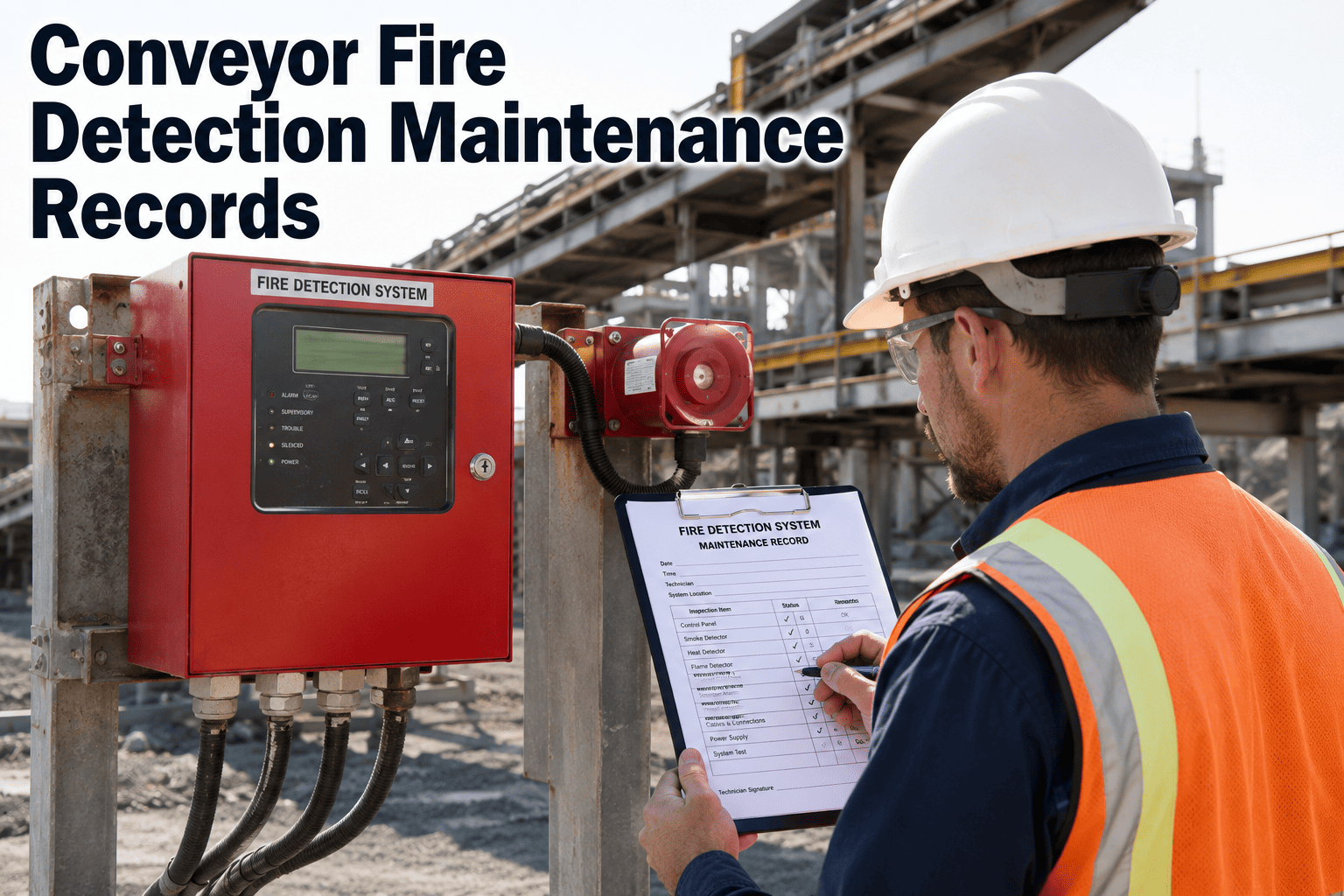
A conveyor belt is one of the few pieces of plant equipment that is also its own fuel. It runs for kilometers, often unattended, and roughly 40% of belt fires start from a single seized roller heating up unnoticed. The fire detection system that guards it only works if it is tested and maintained on schedule — and after an incident the first thing an insurer or fire marshal asks for is the maintenance record, not the equipment. Missing records are grounds for a denied claim and carry OSHA penalties into the five figures per violation. This checklist gives your team an exact, tickable routine — weekly, semiannual, annual, and after-change — built on the NFPA 72 activity structure, so no test is skipped and every check lands in the record. Run it inside OxMaint Compliance Tracking and each ticked item becomes an audit-ready entry.
Conveyor Fire Detection Records Checklist
A tick-by-tick inspection, testing, and records checklist for conveyor fire detection — weekly through annual, aligned to NFPA 72, and audit-ready for the AHJ, the insurer, and the courtroom.
Detection Layers to Cover
A conveyor is rarely protected by one device — a belt fire can travel at up to 20 ft/sec, so plants layer detection. Confirm your checklist covers every layer present on the line before you start.
Weekly / Monthly Visual Checklist
These are the checks facility staff can perform — visual confirmation that the system is present, powered, and unobstructed. Tick them on the weekly-to-monthly cadence NFPA 72 sets for control equipment.
Semiannual Device Inspection Checklist
Twice a year, go deeper than the visual — inspect each device and cable zone for condition and coverage. This is still inspection, not functional testing, and trained staff can perform it.
Annual Functional Test Checklist
The annual is the deep one — qualified technicians verify that every device actually works, not just that it's present. This is where detection is proven end to end, from sensor to shutdown.
After-Change & Reacceptance Checklist
Any repair, modification, or impairment triggers extra checks. Skip these and the record has a gap exactly where a reviewer looks hardest — right after work was done on the system.
How Often to Run Each Group
Intervals shown are common NFPA 72 baselines; your AHJ, insurer, or local fire code can require more. Match each group to its interval and the record shows a layered, defensible routine.
| Group | Frequency | Who | Logged Result |
|---|---|---|---|
| A · Visual | Weekly / Monthly | Facility staff | Trouble clear, devices unobstructed |
| B · Device inspection | Semiannual | Facility staff | Condition, coverage, deficiencies |
| C · Functional test | Annual | Qualified tech | Each device activates, interlock fires |
| C · Sensitivity test | After yr 1, alternate yrs | Qualified tech | Sensitivity within listed range |
| D · Reacceptance | After any change / repair | Qualified tech | Affected + sampled devices verified |
The point is not the exact number — it is that every one of these has a date, a result, and a signature in the record.
What Every Logged Entry Must Capture
A ticked box only proves compliance if the entry behind it is complete. An auditor is asking to see the paper — capture these six for every activity, and miss none.
Why Binders Fail the Audit
The most common cause of a failed fire-safety audit is not a broken detector — it is a record nobody can produce. Running this checklist in OxMaint is the difference between "we did the test" and "here is the test."
What Safety Leaders Say
We passed every fire drill and still nearly failed an audit — not because the detection was bad, but because I couldn't produce the testing history fast enough. After we moved the checklist into a tracked system, the auditor's questions got shorter and my nights before the review got quieter. The record is the whole game.
An insurer once asked for two years of conveyor detection records after a minor incident. Pulling that from binders would have taken a week and still had holes. When every ticked check, deficiency, and corrective action is logged against the device, the claim conversation is over before it starts.
Frequently Asked Questions
How often should each part of this checklist run?
Under NFPA 72 Chapter 14, run the visual group weekly to monthly, the device-inspection group semiannually, the functional-test group annually, and sensitivity testing after the first year and every alternate year thereafter. Any repair or change triggers the reacceptance group. Your AHJ, insurer, or local fire code can require more. Because intervals differ by device, tracking them per asset is the only reliable way to stay current. Book a demo to map intervals to your equipment.
Which items can facility staff do, and which need a technician?
NFPA 72 lets trained facility staff perform the frequent visual checks and the semiannual device inspections — confirming devices are present, undamaged, unobstructed, and in condition. Functional testing, sensitivity testing, interlock verification, and repairs require qualified, competent personnel, often licensed technicians. Every activity, whoever performs it, must be documented with the person's identity and qualification. OxMaint captures who did what on each ticked item automatically. Start free to record sign-off.
What records do I actually need to keep?
A dated record of every inspection, functional test, sensitivity test, and maintenance activity, identifying the specific device, the result, any deficiency found, the corrective action taken, and who performed the work. Under NFPA 72 these records must be retained and available to the AHJ on request. Insurers and courts rely on the same paper, so completeness matters as much as the testing itself — a ticked box without a complete entry behind it won't hold up. Start free to structure your records.
What happens if my inspection records are incomplete?
Incomplete records expose you on three fronts: insurers can deny a fire claim on the grounds of a documented maintenance gap, OSHA can levy penalties up to $16,550 per serious violation, and in litigation the missing records become evidence against you since NFPA 72 is treated as the standard of care. The system can even have worked correctly and you still carry the liability. That is why the record, not just the hardware, is the deliverable. Book a demo to close the gaps.
How does OxMaint turn this checklist into an audit-ready record?
Each group becomes a scheduled digital checklist tied to the specific device, so every visual, inspection, and test fires on its own reminder and logs the result, deficiency, corrective work order, technician, and date as it's completed. Out-of-tolerance or failed items open work orders automatically. When the AHJ or an insurer asks for the history, you export the whole thing in minutes instead of reconstructing a paper trail. The same discipline that satisfies the auditor keeps the detection reliable year-round. Book a demo to see the export.
Turn Every Ticked Box Into Proof You Can Defend
OxMaint runs this fire detection checklist as scheduled digital groups on every device, opens a work order the moment a check fails, and keeps a timestamped, exportable history — so when the AHJ, the insurer, or the courtroom asks for proof, you hand it over in minutes instead of scrambling for a week.