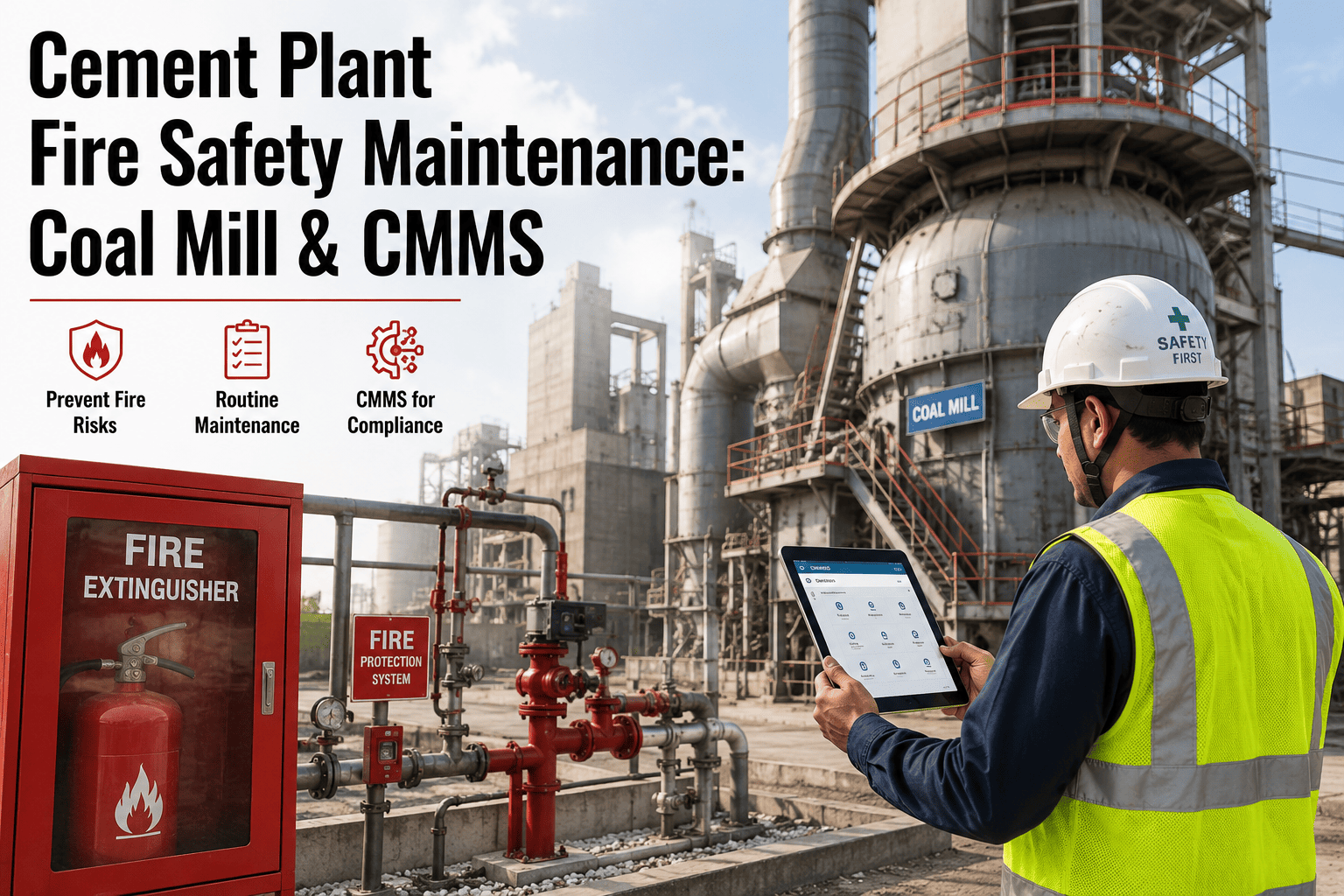
At 3:47 AM, a CO sensor inside a cement plant's coal mill bag filter spiked from 80 ppm to 380 ppm in under four minutes — the unmistakable signature of smoldering combustion before any visible flame. The plant's CMMS-integrated fire and gas detection system fired three simultaneous actions: an SMS to the control room operator, a kiln feed reduction work order to maintenance, and a nitrogen inertization sequence to the bag filter. By 3:55 AM the smoldering pile was suppressed. No injuries. No production loss. The detector that saved the plant had been calibrated 11 days earlier — its calibration certificate logged in OxMaint and traceable back to the gas cylinder lot number. That is what a properly maintained fire and gas detection system looks like in operation. Sign in to OxMaint to schedule your plant's detector calibration cycles, or book a demo to see automated safety system workflows.
72 hrs
Average interval between significant fire incidents at a cement plant somewhere in the world
68%
Of cement industry fires originate in coal handling systems and electrostatic precipitators
73%
Reduction in incident rates at plants running digital fire prevention and detector maintenance programs
14 min
Average emergency response time reduction — from 18 minutes to under 4 — with integrated detection systems
Cement Plant Fire and Gas Hazard Zones — Where Detectors Earn Their Keep
Six zones in a cement plant generate over 90% of all fire and explosion risk. Each zone requires a different detector type, calibration cycle, and inspection workflow. Mismatch any of these and the detector becomes decorative — not protective.
Zone 01
Coal Mill & Bag Filter
Risk Level: Critical
Primary HazardCombustible coal dust, CO from smoldering fires
Detector TypeCO sensors, IR flame, temperature probes
Bump TestDaily before each shift
Full CalibrationMonthly minimum
Zone 02
Coal Storage Bunker
Risk Level: Critical
Primary HazardSpontaneous combustion above 80°C
Detector TypeContinuous CO, infrared thermal scan
Bump TestDaily on entry to area
Full CalibrationQuarterly with shutdown service
Zone 03
Alternative Fuel Handling
Risk Level: Critical
Primary HazardRDF self-heating, plastic vapors, solvent fumes
Detector TypeVOC sensors, multi-spectrum IR flame, CO
Bump TestDaily plus pre-fuel-batch test
Full CalibrationMonthly with new fuel-type onboarding
Zone 04
Electrostatic Precipitator
Risk Level: High
Primary HazardCO accumulation, dust explosion potential
Detector TypeCO continuous monitor, oxygen sensor
Bump TestDaily before shift handover
Full CalibrationMonthly
Zone 05
Electrical Substation
Risk Level: High
Primary HazardTransformer oil fire, cable joint failure
Detector TypeLinear heat detection, smoke aspirating
Bump TestWeekly visual and functional
Full CalibrationAnnual sensitivity test
Zone 06
Kiln Burner Platform
Risk Level: Elevated
Primary HazardCO/CO₂ during startup, fuel oil leaks
Detector TypeCO/CO₂ multi-gas, flame UV/IR
Bump TestDaily at shift turnover
Full CalibrationMonthly
OxMaint · Fire and Gas Detection Maintenance
Are your detectors logged, calibrated, and audit-ready — or are they just installed? OxMaint turns your detector inventory into a verifiable, scheduled maintenance program with automatic compliance tracking.
The Detector Maintenance Frequency Matrix — What Must Happen, How Often, And What Triggers Failure
Bump tests verify response. Calibrations verify accuracy. Visual inspections catch obstructions. Each task has a different frequency and a different failure consequence — and OxMaint enforces every one of them with scheduled work orders.
| Maintenance Task |
Frequency |
What It Verifies |
Standard Reference |
If Skipped |
| Bump Test (Function Check) |
Daily before use |
Sensor responds, alarm activates |
ISEA 2010, OSHA 1910.146 |
Sensor blockage undetected |
| Visual Inspection |
Daily / per shift |
No obstructions, faceplate LED status |
NFPA 72, IEC 60079-29 |
Dust caps missing, alignment drift |
| Span Calibration |
Monthly minimum |
Reading accuracy vs reference gas |
Manufacturer specs |
34-month drift can pass bump tests |
| Zero Calibration |
Before each span cal |
Baseline reading in fresh air |
Honeywell, MSA guidance |
False positives, unwanted alarms |
| Functional Test (Flame Detector) |
Quarterly with test lamp |
Optical sensor responds to flame signature |
NFPA 72, FM Approvals |
Lens contamination, missed fire event |
| Sensor Replacement |
2–5 years per sensor |
End-of-life chemical degradation |
Manufacturer EOL spec |
Sensor too aged to calibrate |
| Logbook Audit |
Monthly |
Every event logged by tag number |
NFPA 1081, IEC 61511 |
Audit failure, regulatory action |
| System-Wide SIL Test |
Annual proof test |
End-to-end SIS function |
ANSI/ISA-61511-1 |
SIL rating invalid, insurance void |
Scroll horizontally to view all columns on smaller screens
Why Detectors Fail — The Five Failure Modes a CMMS Catches Before They Catch You
Detectors do not fail dramatically. They fail silently — drifting, blocked, expired, or simply forgotten. Here are the five failure modes that cause detection systems to miss real fires and gas releases, and how scheduled CMMS workflows prevent each one.
01
Calibration Drift
Sensors gradually shift away from the calibrated reference value due to age and exposure. Industrial Scientific data shows drift can take 34 months before bump tests start failing — meaning a detector reading 50 ppm CO when actual concentration is 100 ppm.
CMMS Prevention
Monthly calibration work orders auto-generated per detector tag. Failed calibrations trigger immediate replacement work orders. Calibration certificates uploaded with gas cylinder lot number traceability.
02
Sensor Poisoning
Catalytic combustible sensors lose sensitivity when exposed to silicone vapors, sulfur compounds, or lead. The detector shows normal function but cannot detect the gas it was installed to find. Common in cement plants near alternative fuel handling areas.
CMMS Prevention
Exposure events logged automatically in detector history. Post-incident calibration triggers when poison exposure is recorded. Sensor replacement scheduled before contamination becomes irreversible.
03
Optical Obstruction
Flame detector lenses accumulate cement dust, oil mist, and condensation in less than 30 days at most cement plant locations. A blocked optical path means an active fire goes undetected even though the detector reports healthy.
CMMS Prevention
Weekly cleaning and visual inspection work orders. Photo evidence required for completion. Test lamp functional checks scheduled quarterly with documented field of view verification.
04
End-of-Life Sensor
Electrochemical and catalytic sensors have finite chemical reservoirs. Most last 2 to 5 years depending on environment. When the reservoir depletes, the detector cannot be calibrated back into specification regardless of bump test results.
CMMS Prevention
Sensor install date and EOL date tracked per asset. Replacement work orders auto-scheduled 60 days before EOL. Procurement integration to order replacements with adequate lead time.
05
Logbook Failure
Detector tested but not documented. Calibration done but certificate filed in the wrong binder. Bump test performed but not signed off. During an audit or insurance claim, an undocumented test is equivalent to no test at all.
CMMS Prevention
Mobile app capture at point of work. Digital signature with technician ID. Photo of detector and test gas cylinder. Calibration certificate auto-attached to asset record. Audit trail by tag number, date, and technician.
06
Wiring & Power Faults
A detector with a corroded terminal, broken loop wire, or failing intrinsic-safety barrier reads as healthy on its own faceplate but never communicates an alarm to the F&G control panel. The fault is invisible until the next loop test — which often does not happen until annual proof testing.
CMMS Prevention
Quarterly loop integrity test work orders. End-to-end signal verification from detector to control panel logged. Barrier and isolator inspection scheduled with detector calibration to share access permits and minimize hazardous-zone entry.
The OxMaint Detector Maintenance Pipeline — From Schedule to Audit-Ready Record
A detector maintenance event is not just a calibration. It is a chain of work orders, evidence captures, and verification steps — each one auto-triggered by the last, leaving a complete audit trail behind every test.
1
Auto-Schedule
Detector tag asset registry generates calibration work orders based on each device's frequency rule. No manual scheduling — the system knows every detector and its next due date.
2
Mobile Dispatch
Technician receives work order on mobile app with location, detector model, last calibration values, and required test gas concentration. No paper, no tribal knowledge dependency.
3
Test & Record
Bump test or calibration performed. Readings entered with photo of detector, gas cylinder serial, and certificate number. Pass or fail is automatically determined against tolerance.
4
Auto-Escalate
Failed test triggers immediate replacement work order, sensor procurement notification to inventory, and supervisor alert. Detector is marked out-of-service until replacement is verified.
5
Audit Archive
Complete history per detector tag — every test, every technician, every certificate — searchable by date range, asset, or compliance standard. Audit-ready in seconds, not weeks.
6
KPI Reporting
Monthly compliance scorecards by zone and detector type — completion rate, failure rate, mean time to repair. Trends fed to plant manager dashboards and shared with regulators on demand.
What an Overdue Detector Looks Like in OxMaint — Before It Becomes a Citation
Most cement plant audits identify the same core failure: detectors with calibrations past due, no documentation of who inspected what when, and no system enforcement when tasks slip. OxMaint solves this with active overdue tracking.
On Schedule
98.5%
Detectors with all maintenance tasks current — the target state for cement plants in audit-ready posture across all monitored zones.
Approaching Due
7-day alert
Automated notifications fire 7 days before any detector calibration goes overdue. Maintenance has time to schedule resources and order test gas without scrambling.
Overdue Critical
Auto-Escalate
Critical-zone detectors that pass their due date trigger supervisor SMS, plant manager email, and dashboard red flag. Cannot be silently ignored — by design.
Trend Visibility
Live Dash
Compliance trend visible per zone, per detector type, per technician. Patterns emerge — which assets need replacement, which technicians need retraining, which zones need closer scheduling.
OxMaint · Cement Plant Safety CMMS
Your fire and gas detectors are only protecting your plant if their maintenance is logged, scheduled, and verifiable. OxMaint converts your detector inventory into a regulator-ready compliance system in 30 days.
NFPA Compliance Coverage — Standards Your Detector Maintenance Program Must Address
Cement plant fire and gas detection compliance does not run on a single standard. It runs on a layered set of NFPA, IEC, and ISA standards — each enforcing a different facet of detection, prevention, and documentation. OxMaint maps maintenance tasks to each standard automatically.
NFPA 68
Explosion Venting
Bin and dust collector venting design — verified through pressure relief inspection workflows tied to bag filter and ESP detectors.
NFPA 69
Explosion Prevention
Inertization and oxygen control systems — connected to coal mill O₂ sensor monitoring and inertization-trigger logic.
NFPA 70
National Electrical Code
Class II hazardous wiring requirements — detector enclosure inspection workflows verify intrinsic safety integrity.
NFPA 72
Fire Alarm and Signaling
Detector inspection and testing frequency — every visual inspection, functional test, and sensitivity check logged per code requirement.
NFPA 654
Combustible Particulate Solids
Combustible dust handling — housekeeping and dust accumulation inspection tied to coal handling and packaging area detectors.
NFPA 1081
Industrial Fire Brigade
Brigade member competency tracking — training currency and recertification dates enforced through CMMS skill registry.
IEC 60079-29
Gas Detector Performance
International gas detection performance standards — calibration documentation maintained to support performance certification.
ANSI/ISA 61511
Safety Instrumented Systems
SIS design and proof testing — annual proof test scheduling and SIL verification logged for full SIS lifecycle compliance.
Frequently Asked Questions — Fire and Gas Detection System Maintenance for Cement Plants
OxMaint · Fire and Gas Detection · Cement Plant Safety CMMS
Every fire and gas detector in your cement plant is either protecting your facility — or quietly waiting to fail an audit. OxMaint puts every detector on a scheduled, documented, audit-ready maintenance program in less than 30 days.
Detector tag asset registry. Calibration scheduling automation. Failed-test escalation. Certificate archive. NFPA and IEC compliance mapping. All built into OxMaint's safety CMMS workflow for cement plants.