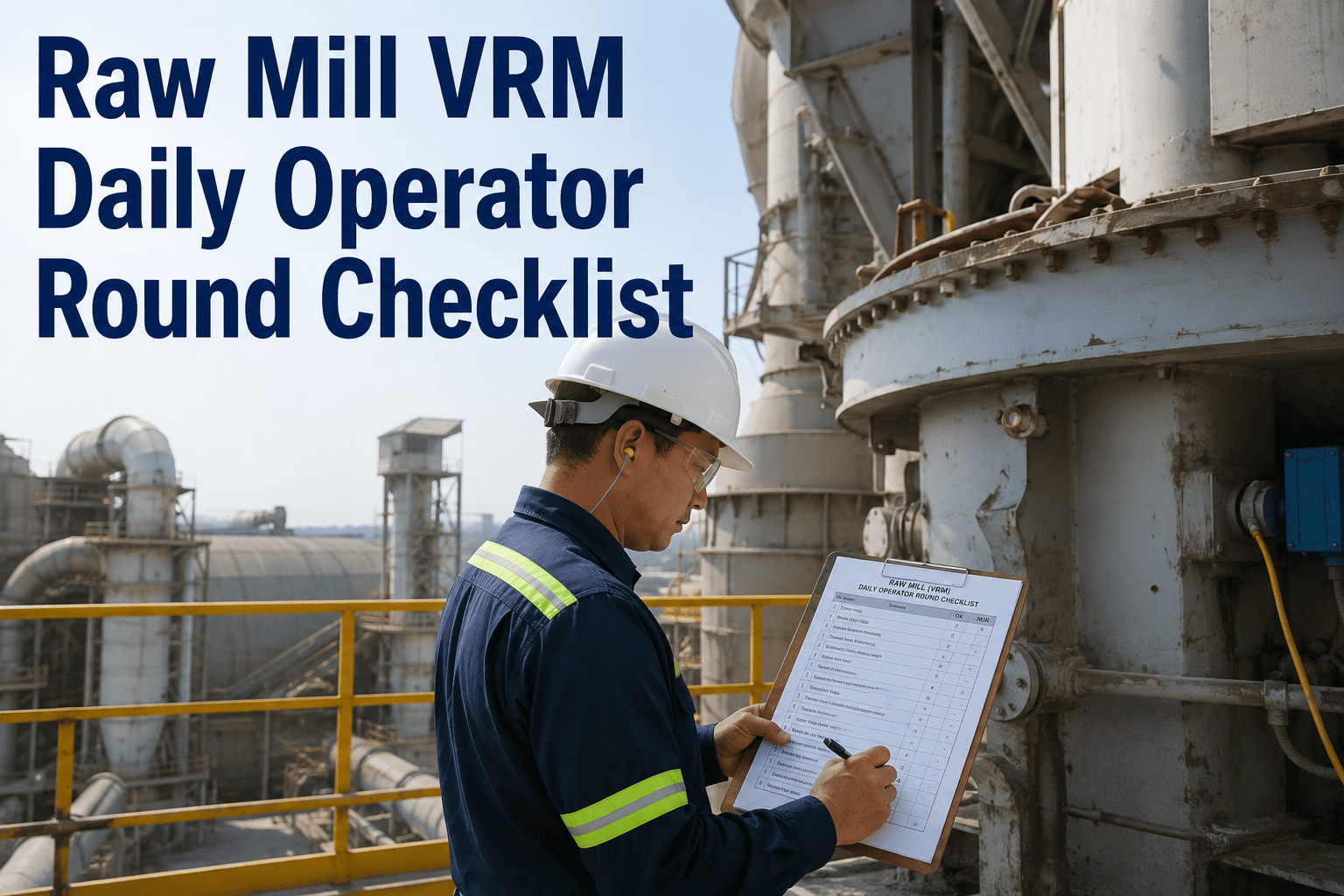
Rotary kilns run 24/7 under extreme heat, mechanical stress, and constant vibration — making daily operator rounds the single most critical maintenance activity in cement, lime, and mineral processing plants. Missing a shell hot spot, an overheating tyre, or a dry girth gear can escalate into a catastrophic failure costing weeks of downtime and millions in repairs. This daily kiln operator round checklist covers every inspection point your operators must verify every shift — shell temperature profiling, tyre migration measurement, girth gear lubrication, bearing temperature, and CMMS sign-off — so nothing goes unrecorded and no defect goes unnoticed. Start managing kiln rounds digitally in Oxmaint or book a walkthrough with our kiln maintenance team.
Why Daily Rounds Matter
What Happens When Daily Kiln Rounds Are Skipped
Shell Failure
72 hrs
Average time from first hot spot detection to shell failure if unmonitored
Tyre Damage
$180K+
Typical cost of tyre replacement due to unchecked migration
Girth Gear Failure
3–6 wks
Unplanned downtime from girth gear seizure due to missed lubrication
Bearing Burnout
48 hrs
Time to irreversible bearing damage when temperature alerts are missed
Inspection Zone Map
5 Critical Kiln Inspection Zones Every Shift
1
Shell Temperature
Infrared scan along full shell length
2
Tyre & Riding Ring
Migration, slip, and creep measurement
3
Girth Gear & Pinion
Lubrication level, wear pattern, backlash
4
Support Bearings
Temperature, vibration, oil level per station
5
Drive & Thrust
Motor current, thrust roller position, alignment
Complete Daily Checklist
Daily Kiln Operator Round — Full Inspection Checklist
Zone 1
Shell Temperature Monitoring
Perform full-length infrared shell scan at start of shift — record peak temperature and location (metres from feed end)
Compare current peak shell temperature against previous shift baseline — flag any increase above 30°C from prior reading
Identify and mark any localised red spot or hot band — note angular position (clock position) and axial position
Check brick lining thickness estimate at hot spot locations — report shell flexing or ovality signs to supervisor
Log all temperature readings in CMMS with timestamp and operator ID — attach thermal image if available
Confirm shell cooling fans (if installed) are operating and directed at flagged zones
Zone 2
Tyre & Riding Ring Inspection
Measure tyre migration (creep) at all tyre stations — record distance travelled per revolution using reference marks
Calculate and log tyre slip rate — alert supervisor if slip exceeds plant-specific limit (typically 15–25 mm/rev)
Inspect tyre and shell pad contact faces for wear, pitting, or cracking — photograph any new damage
Check tyre lubricant (graphite/limestone filler) level between tyre and pad — replenish if below acceptable fill level
Verify retaining ring bolts and filler bar condition — report any loose or missing hardware immediately
Record tyre surface temperature using contact thermometer — compare against baseline for thermal load assessment
Zone 3
Girth Gear & Pinion
Inspect girth gear tooth faces for correct spray lubrication coverage — confirm lubricant visible on full tooth width
Check automatic lubrication spray nozzle alignment and flow — clear any blockage; record spray cycle count from controller
Measure and record girth gear-to-pinion backlash — compare against last week's reading for trend monitoring
Inspect pinion bearing housing for oil leaks, temperature rise, or vibration anomalies
Visually inspect girth gear segments for cracks, broken teeth, or advanced pitting — photograph and report any new damage
Confirm girth gear guard is secured and intact — report any displaced guarding before shift continues
Zone 4
Support Roller Bearings
Record bearing temperature at all roller stations (typically 4–6 stations) using contact thermometer or infrared — log per station
Check oil level in each bearing housing — top up if below sight glass midpoint; record volume added
Inspect oil condition at each station — note any discolouration, foaming, or contamination and report for oil sampling
Verify roller skew position — adjust if roller has migrated beyond allowable thrust limits per station record
Check for unusual vibration or noise at each bearing — use handheld vibration meter if available and record RMS value
Confirm cooling water flow (if water-cooled bearings) — record inlet/outlet temperatures and verify flow rate
Zone 5
Drive System & Thrust Control
Record main drive motor current (amps) from control panel — compare against normal operating range; flag deviations above 5%
Check thrust roller position and contact load — verify kiln is within axial operating limits; adjust if approaching limit
Inspect thrust roller bearing temperature and lubrication — confirm grease nipples are accessible and greased per schedule
Verify reducer oil level and check for leaks around seals — record oil temperature from reducer temperature gauge
Check auxiliary drive engagement (if fitted) — confirm it is in standby mode and capable of emergency operation
Record kiln speed (rpm) from tachometer — log against process setpoint and flag deviations
Sign-off
CMMS Sign-off & Shift Handover
All zone readings entered in CMMS under current shift work order — no field left blank; enter N/A with reason if inaccessible
Any defect found during round raised as corrective work order — defect description, zone, severity, and photo attached
Operator signs off round digitally with timestamp — supervisor counter-sign required for any amber or red defect
Incoming shift operator briefed verbally and in CMMS on all open defects and abnormal readings from current shift
Run Every Kiln Round Digitally — Zero Missed Checks
Oxmaint's mobile-first operator rounds module puts this checklist in your operator's hands on a phone or tablet — with mandatory photo capture, temperature logging, and instant CMMS defect raising. No paper. No missed entries.
Paper vs Digital Rounds
Paper Logbook vs Digital Kiln Rounds — What's the Difference?
| Capability |
Paper Logbook |
Digital Round (Oxmaint) |
| Mandatory field enforcement |
Fields skipped routinely |
Cannot submit with blank fields |
| Temperature trend tracking |
Manual graph — done weekly at best |
Auto-plotted after every shift entry |
| Defect-to-work order linkage |
Separate paper form — often delayed |
Defect raises work order instantly |
| Photo evidence capture |
Not possible on paper |
Mandatory photo at flagged points |
| Shift handover documentation |
Verbal only — no audit trail |
Digital handover with sign-off |
| Historical data retrieval |
Manual binder search — hours |
Searchable by date, zone, or reading |
| Supervisor remote visibility |
Not possible |
Live dashboard from any device |
Key Thresholds Reference
Critical Alert Thresholds for Daily Kiln Rounds
Shell Temperature
Normal
Below 280°C
Alert
280°C – 340°C
Stop Kiln
Above 340°C
Tyre Migration
Normal
Less than 10 mm/rev
Alert
10 – 20 mm/rev
Action
Above 20 mm/rev
Bearing Temperature
Normal
Below 60°C
Alert
60°C – 75°C
Stop Kiln
Above 75°C
Drive Motor Current
Normal
Within ±5% of baseline
Alert
5% – 10% above baseline
Investigate
Above 10% from baseline
Frequently Asked Questions
Daily Kiln Operator Rounds — Common Questions
How often should kiln operator rounds be conducted each shift?
Most plants conduct a full operator round at the start of each shift (every 8 or 12 hours) with abbreviated shell and bearing temperature checks every 2–4 hours. High-output kilns or kilns with known brick wear often increase to full rounds every 4 hours. The key is consistency — missed rounds are the primary cause of undetected shell hot spots.
Schedule rounds automatically in Oxmaint.
What is tyre migration and why does it matter in daily inspections?
Tyre migration (or creep) is the relative movement between the tyre and shell — measured as distance per revolution. Excessive migration accelerates wear on both the tyre inner surface and shell pads, leading to costly replacements. Daily measurement allows early detection of changing shell ovality or tyre fit issues before they become failures.
Talk to our kiln maintenance specialists.
Can CMMS software replace the need for physical kiln rounds?
No — CMMS manages the record-keeping and workflow, but physical rounds by a trained operator remain irreplaceable. A CMMS like Oxmaint ensures every round is documented, defects are immediately raised as work orders, and readings are trended over time. The combination of physical inspection and digital logging is best practice industry-wide.
What should an operator do if a shell hot spot is found during a round?
Immediately record the position and temperature, notify the shift supervisor, and continue monitoring at 30-minute intervals. If the temperature exceeds the plant stop limit or rises rapidly, initiate a controlled kiln stop per the plant emergency procedure. Never leave a confirmed hot spot unmonitored between rounds.
How long should daily kiln round records be retained?
Most plant standards require a minimum of 12 months of daily round records for maintenance trend analysis and insurance purposes. Some regulatory frameworks for process plants require longer retention. Digital records in a CMMS like Oxmaint are retained indefinitely and are searchable by date, operator, or reading value.
Start your free Oxmaint trial.
Digital Kiln Rounds — Enforce Every Check, Every Shift
Oxmaint's operator rounds module digitises this entire checklist with mandatory photo capture, automatic defect-to-work-order creation, and live supervisor dashboards. Built for cement, lime, and mineral processing plants running rotary kilns around the clock.