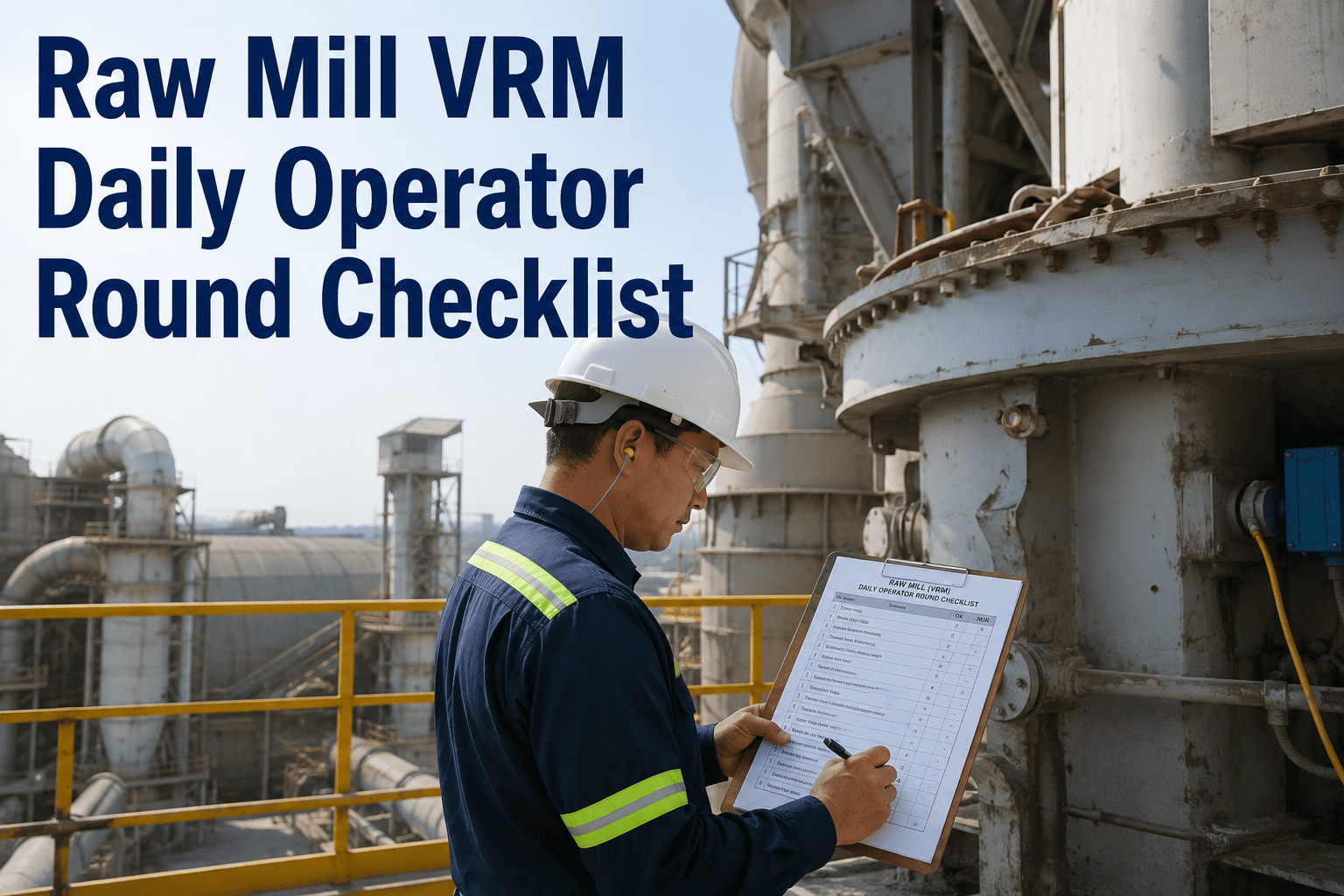
Raw Mill VRM Daily Operator Round Checklist

By Johnson on May 28, 2026

raw-mill-vrm-daily-operator-round-checklist

A vertical roller mill running without a structured daily operator round is a liability waiting to surface — hydraulic pressure creeping beyond tolerance, roller wear accelerating undetected, separator efficiency drifting, and vibration signatures building toward an unplanned trip that shuts down raw meal production for your entire kiln line. Cement plant operators and process engineers know that the VRM is the most process-sensitive piece of equipment in the raw grinding circuit, and its daily health depends entirely on the discipline of the operator round. This checklist covers every checkpoint that matters — hydraulic system, grinding table, roller assembly, separator, motor loads, and CMMS sign-off — structured for the operator walking the mill at shift start and for the maintenance planner reviewing completeness at shift end. Sign up for Oxmaint to run this checklist as a live digital round in your raw mill control room.

6 Inspection zones — hydraulic, table, roller, separator, motor, and safety
30+ Checkpoint items with pass/flag criteria for VRM operators and process engineers
CMMS Every round item logged in Oxmaint — no paper, no memory, no missed readings
Daily Shift-start round with supervisor sign-off before mill startup clearance
HYD
Hydraulic System
TBL
Grinding Table
RLR
Roller Assembly
SEP
Separator
MTR
Motor & Drive
VIB
Vibration
Zone HYD

Hydraulic System — Pressure, Oil Level, Temperature & Accumulator Status

The hydraulic system is the force-delivery mechanism of the VRM — it determines the grinding pressure applied to material on the table through the roller tensioning cylinders. A hydraulic system operating outside design pressure by even 5–8 bar will cause either insufficient grinding (low fineness, high residue) or over-grinding (excessive fines, high mill vibration). Oil temperature outside operating range accelerates seal degradation and bearing failure in the hydraulic pump unit. Every operator round must start here before the mill is cleared for startup. Book a demo to see how Oxmaint logs hydraulic readings against design limits automatically.

HYD Hydraulic System — Daily Operator Round Items Every shift start
Accumulator pre-charge pressure — nitrogen pressure within design tolerance
Check accumulator pre-charge nitrogen pressure using the dedicated gauge at the hydraulic unit. Design pre-charge is typically 60–70% of working hydraulic pressure for nitrogen-charged accumulators on VRM roller tensioning circuits. A pre-charge outside tolerance means the accumulator is not damping pressure spikes effectively — which will appear as mill vibration events that cannot be resolved by process adjustment alone. Log the reading in Oxmaint and raise a corrective work order if outside ±5 bar of design.
Design range: plant-specific. Reading outside ±5 bar: flag for mechanical review before startup.
Hydraulic working pressure — grinding force pressure at design set point per material
Confirm the hydraulic working pressure setpoint matches the material being ground — limestone blend, clay mix, or combined raw meal. VRM hydraulic pressure for raw meal grinding typically ranges 80–140 bar depending on mill size and design, with roller-specific pressure profiles for each material hardness. A pressure setpoint left over from a previous product run is a process deviation that will produce out-of-specification raw meal fineness from the first minutes of operation. Verify in the control system and log in Oxmaint.
Setpoint: confirmed against current material. Any mismatch: correct before startup clearance.
Hydraulic oil level — reservoir level within operating window, no low-level alarm active
Check the hydraulic oil reservoir level using the sight glass or level indicator on the HPU. Operating window is typically between minimum marked level and 80% of maximum — above maximum risks thermal expansion overflow, below minimum risks pump cavitation. An active low-level alarm at mill startup means either a slow internal leak (most common) or an external leak that should be visible on walkdown. Never start a VRM with a low-level hydraulic alarm — log findings in Oxmaint and hold startup pending investigation.
Level: within operating window. Low-level alarm active: hold startup, investigate before clearance.
Oil temperature — HPU oil temperature within operating range before startup
Confirm hydraulic oil temperature is within the operating range specified by the HPU manufacturer — typically 35–55°C for mineral hydraulic oils in VRM applications. Cold oil (below 30°C) will not flow correctly through proportional valves and will produce incorrect pressure response to roller lift commands. The oil temperature should be confirmed as stable within range after the HPU pre-heating cycle completes, before mill startup clearance is issued.
Temperature: 35–55°C (verify plant specification). Below 30°C: run pre-heat cycle before startup.
Zone TBL + RLR

Grinding Table & Roller Assembly — Wear Indicators, Seals & Lubrication

The grinding table and roller assembly are the wear-intensive heart of the VRM — and the components that the daily operator round must inspect most carefully before startup clearance. Roller segment wear that has progressed beyond the wear indicator groove is not a deferred maintenance item — it changes the grinding geometry, increases recirculation, and increases specific power consumption per tonne of raw meal. A table liner crack discovered during daily round costs one planned replacement — the same crack discovered after it propagates to the table structure costs a major repair and an unplanned kiln shutdown.

TBL / RLR Table & Roller — Daily Visual and Instrument Check Every shift start
Roller wear indicator — all rollers within acceptable wear band, no groove-depth alarm
Check roller segment wear indicators on all active rollers — typically a drilled hole or groove at the maximum wear depth limit. When the indicator groove disappears, the segment has worn to replacement thickness. Operating beyond this point changes the rolling radius, increases hydraulic pressure demand, increases specific power, and creates uneven grinding across the table. Log the current wear status of each roller in Oxmaint by roller number so wear progression can be tracked across shifts and a planned replacement window can be opened before the groove is reached.
All rollers: wear indicator visible. Any roller at or beyond indicator: raise replacement work order immediately.
Roller seal condition — dust seal integrity confirmed, no visible meal dust bypass at seal
Inspect the dust seals on all roller arms for visible meal dust bypass — raw meal leaking past the roller seal into the roller bearing cavity will cause accelerated bearing wear and contamination of roller arm lubrication. A small dust bypass visible during inspection is always more advanced internally than the external observation suggests. Document the observation with the Oxmaint mobile app photo attachment and raise a seal inspection work order within the current maintenance cycle.
Seals: no visible dust bypass. Any bypass observed: photograph, log in Oxmaint, raise inspection WO.
Table liner condition — no visible cracks, loose segments, or raised edge profiles
Inspect accessible table liner segments for cracks, chipped leading edges, loose segment bolts, or any raised lip at the segment joint that would disrupt the material bed. A raised table liner joint causes a vibration impulse every revolution of the grinding table — this appears in the vibration trend data as a rotationally-correlated frequency spike and is often misdiagnosed as a process vibration event until a physical inspection confirms the liner condition. Log findings by segment number in Oxmaint.
Table liners: no cracks or raised joints. Any loose bolt or cracked segment: hold startup, raise emergency WO.
Roller Inspection Log — Per Roller Entry
Roller Wear Indicator Seal Status Arm Lube Level Action Required
Roller 1 Visible No bypass Within range None
Roller 2 At limit No bypass Within range Plan replacement
Roller 3 Visible Minor bypass Check required Raise seal WO
Roller 4 Visible No bypass Within range None
Zone VIB

Vibration Monitoring — Trip Limits, Trend Review & Root Cause Classification

Mill vibration is the most informative real-time signal available from a running VRM — and the one most frequently mismanaged. An operator who responds to a high vibration alarm by reducing hydraulic pressure and feed rate has addressed the symptom. An operator who logs the vibration value, checks the trend, correlates it with the last feed change, and raises an Oxmaint note before the next shift has created the data trail that prevents the same event next week. Sign up for Oxmaint to log vibration readings and trend patterns alongside your daily operator round.

Normal Operating Band
Below 5 mm/s
Stable grinding, material bed consistent, hydraulic pressure at setpoint. No action required — log reading and continue.
Caution Range
5–8 mm/s
Investigate feed consistency, mill differential pressure, and hydraulic pressure. Log in Oxmaint with process conditions at time of reading.
High Alarm
8–12 mm/s
Operator intervention required. Increase feed rate or adjust hydraulic pressure. Notify shift supervisor. Log in Oxmaint as a process event.
Trip Threshold
Above 12 mm/s
Mill auto-trip or manual trip required. Root cause investigation mandatory before restart. Log trip event in Oxmaint with timestamp and pre-trip conditions.
VIB Vibration Round — Daily Readings and Trend Check Every shift, every 2 hours during operation
Mill body vibration reading — current value logged against shift-start baseline
Record the mill body vibration reading from the vibration transmitter on the mill housing at shift start and log in Oxmaint. Compare the reading to the previous shift's baseline logged value — a step-change increase of more than 2 mm/s between shifts without a corresponding process change (feed change, product change, startup from cold) is a mechanical signal, not a process signal, and requires a physical inspection before the cause is attributed to process parameters. The Oxmaint trend view for vibration readings is available on the supervisor dashboard.
Shift-start reading: logged in Oxmaint. Step-change vs previous shift above 2 mm/s: raise inspection flag.
Vibration trend — 7-day trend reviewed for progressive increase pattern
Review the 7-day vibration trend in Oxmaint at the weekly round — not just the current reading. A VRM operating at 6 mm/s today may seem acceptable, but if the trend shows 3.5 mm/s one week ago, 4.2 mm/s five days ago, and 5.8 mm/s yesterday, the progressive increase is a maintenance signal that predicts a vibration trip within the next operating period if the cause is not identified. Progressive trends require a mechanical inspection of roller seals, table liners, and accumulator pre-charge before the trend becomes a trip event.
Weekly trend: reviewed by shift supervisor. Progressive increase trend identified: raise mechanical inspection WO.
Zone SEP + MTR

Separator & Motor — Speed, Differential Pressure, Amps & Bearing Temperature

The dynamic separator in a VRM determines product fineness — separator speed directly controls the cut point at which particles are returned to the table versus passed to the filter. An operator round that checks hydraulic and vibration but skips separator speed verification against the current fineness target is producing raw meal that may be out of specification from the first hour of the shift. Motor amperage monitoring on both the main mill drive and the separator is the fastest-response indicator of grinding efficiency and material throughput available during normal operation.

SEP / MTR Separator and Motor — Shift Round Verification Shift start + 2-hourly during operation
Separator speed setpoint — confirmed against current product fineness target
Verify the separator speed setpoint in the DCS matches the target for the current raw meal specification — typically expressed as residue on 90-micron sieve. Separator speed is the primary control variable for fineness in a VRM with a dynamic separator — if the speed was adjusted during the previous shift for a feed material change and not restored, the current shift will produce off-specification material without any alarm activating. Log the confirmed setpoint in Oxmaint against the current product recipe.
Separator speed: confirmed against product recipe in Oxmaint. Any discrepancy: correct before startup clearance.
Main drive motor amps — running current within design range, no sustained overload
Record the main drive motor running amperage at steady-state grinding conditions and log in Oxmaint. Motor amps on a VRM main drive reflect the combined effect of grinding pressure, feed rate, and material grindability — a sustained 10% increase in running amps without a corresponding feed rate increase indicates either increased material hardness (feed blend change) or increased internal recirculation (wear-related). Flag any sustained amps increase exceeding 8% above the established baseline for the current operating recipe.
Running amps: logged at steady state. Sustained increase above 8% from baseline: flag for process review.
Mill differential pressure — pressure drop across mill within process window for current feed rate
Check mill differential pressure (inlet to outlet across the mill housing) against the process window for the current feed rate and mill airflow. For a VRM in raw meal grinding, differential pressure typically runs 30–60 mbar depending on mill size and airflow conditions. Differential pressure significantly outside the process window at the same feed rate and fan speed indicates a change in internal recirculation load — typically caused by a change in material grindability, a change in the recirculation path, or a filter differential pressure issue affecting mill airflow.
Differential pressure: within process window. Deviation above 15% from expected at current feed: notify process engineer.
Your VRM round is only as good as the record behind it — and paper records fail audits.

Oxmaint turns every hydraulic reading, vibration value, and separator check into a timestamped digital record linked to the mill equipment tag — accessible to your process engineer in real time and to your auditor on demand. No paper, no Excel, no missing shift logs.

Daily Round Summary

What a Complete VRM Daily Round Looks Like — Zone by Zone

01
HYD
Hydraulic Check
Accumulator pre-charge, working pressure setpoint, oil level, oil temperature. Duration: 8–10 minutes. Block startup if any item fails.
02
TBL
Table Inspection
Liner condition, segment bolt torque check, dam ring height. Duration: 5–7 minutes. Any crack or loose bolt: emergency WO.
03
RLR
Roller Round
Wear indicator per roller, seal condition, arm lubrication level, roller arm pivot check. Duration: 10–12 minutes. Log by roller number.
04
VIB
Vibration Baseline
Record shift-start vibration reading. Compare to previous shift. Check 7-day trend weekly. Duration: 3 minutes. Flag step-changes.
05
SEP
Separator Check
Speed setpoint vs product recipe, bearing temperature, gearbox oil level, cage condition if accessible. Duration: 5–6 minutes.
06
MTR
Motor & Drive
Main drive amps at steady state, motor bearing temperatures, gearbox oil level and temperature, differential pressure vs process window.
FAQ

Raw Mill VRM Daily Round — Operator Questions

How often should the VRM daily operator round be completed?

The full VRM daily round should be completed at every shift start before mill startup clearance is issued — typically every 8 or 12 hours depending on your shift rotation. During operation, vibration readings and motor amps should be logged every 2 hours. Oxmaint allows you to configure round frequency and generate automated reminders on the operator mobile device. Sign up for Oxmaint to set round schedules and automated reminders for your VRM operating team.

What causes sudden VRM vibration increases after a stable operating period?

Sudden vibration increases after stable operation are most commonly caused by a change in feed material grindability (feed blend change without a hydraulic pressure adjustment), a degraded accumulator pre-charge losing pressure damping effectiveness, or roller seal failure allowing meal dust into the roller bearing cavity. Log the vibration value, pre-trip process conditions, and feed blend data in Oxmaint before starting root cause analysis. Book a demo to see how Oxmaint records pre-event process data for root cause review.

Can Oxmaint track VRM hydraulic readings against design limits automatically?

Yes — Oxmaint allows you to configure min/max limits for every numerical round reading including hydraulic working pressure, accumulator pre-charge, oil temperature, and motor amps. Any reading entered outside the configured limit generates an immediate flag in the planner's dashboard and can trigger an automatic corrective work order creation. This eliminates the manual comparison of readings to design limits that paper-based rounds require.

How do I track roller wear progression across multiple shifts in Oxmaint?

Each VRM roller can be configured as a separate equipment sub-component in Oxmaint with its own wear indicator status field updated at each daily round. The wear trend across shifts is visible in the equipment history view — allowing you to project the replacement date based on observed wear rate and plan the roller segment change within a planned maintenance window rather than as a forced outage. Sign up for Oxmaint to configure roller wear tracking for your mill.

What is the correct response when a roller seal bypass is observed during the daily round?

A roller seal bypass observed during the daily round should be photographed using the Oxmaint mobile app, logged against the specific roller number, and a corrective work order raised for seal inspection within the current maintenance cycle. The mill can continue operating with a minor seal bypass, but the roller bearing cavity should be checked for meal contamination at the next available access opportunity. A severe bypass causing visible meal accumulation on the roller arm requires immediate inspection before the next startup.

Every VRM Round. Every Reading. Every Shift. All in Oxmaint.

Raw mill operators who complete every daily round item and log every reading in a structured CMMS see fewer unplanned trips, longer roller segment life, and cleaner process audit records than teams running on paper. Oxmaint brings your entire VRM daily round into one mobile-first platform built for the plant floor.
Share This Story, Choose Your Platform!