Of all the daily measurements taken on a rotary kiln, tyre migration is the one that speaks most directly to the kiln's mechanical health. A tyre moving too fast signals a load imbalance, a worn shell pad, or a misset support roller. A tyre barely moving signals under-lubrication or a roller skew problem working in the wrong direction. This guide covers how to measure, interpret, and act on kiln tyre migration and creep data — and how OxMaint's preventive maintenance platform turns raw daily readings into a predictive early-warning system with remaining useful life projections.
Kiln Tyre Migration & Creep Measurement: How CMMS Catches Failures Early
Daily migration readings, retainer block wear, surface wear patterns, and CMMS-tracked tyre life with RUL projection — the complete tyre monitoring playbook for cement and lime kilns.
What Is Kiln Tyre Migration?
The kiln tyre (also called the riding ring) sits on shell-mounted pads but is not fixed — it floats axially, creeping forward and back relative to the kiln shell with every revolution. This relative movement, called migration or creep, is intentional: it distributes contact stress across the tyre bore and prevents the shell pad from welding to the tyre under heat and load.
Daily Migration Measurement — Step by Step
Tyre migration measurement is a five-minute daily task that requires only paint and a tape measure. When performed consistently and logged in a CMMS, these readings become the most powerful early-warning dataset your maintenance team has.
Apply a paint mark at corresponding positions on both the tyre outer face and the kiln shell. Marks must be at the same circumferential position (use a fixed clock-position reference such as 12 o'clock as viewed from the feed end).
At shift start, measure and log the axial distance between the paint mark on the tyre and the mark on the shell. Record in the CMMS work order with time stamp and technician name.
Return at the same time the following day with the kiln at the same rotational position reference. Measure displacement between the two marks. This is the 24-hour migration rate.
Enter the reading into the CMMS. The system compares against configured alert and action thresholds, triggers a flag if exceeded, and adds the data point to the tyre's RUL trend chart automatically.
Migration Rate Thresholds — Visual Reference
Log Migration Readings from Mobile — No Paper, No Spreadsheet
OxMaint generates a daily tyre migration check work order for each pier, captures readings with timestamp and technician ID, fires threshold alerts automatically, and plots the 30/90/180-day trend to project remaining tyre life.
Retainer Block Wear — Measurement and Limits
Retainer blocks prevent uncontrolled axial migration beyond the design range. When migration rates climb out of the normal band, retainer blocks absorb the excess axial force — and wear rapidly. Unchecked retainer wear eventually allows the tyre to contact the shell directly, causing severe damage in hours.
Surface Wear Pattern Diagnosis
The wear pattern on the tyre bore and shell pad contact surface is a diagnostic fingerprint. Visual inspection during any brief kiln stop reveals what the migration numbers confirm — and sometimes reveals problems that migration rates alone miss.
| Wear Pattern | What It Indicates | Immediate Action | CMMS Entry |
|---|---|---|---|
| Uniform polish across full bore width | Healthy tyre-shell contact geometry | Continue monitoring | Normal reading logged |
| Edge loading — one side of bore | Axis misalignment or roller skew imbalance | Roller skew check within 48 hrs | Flag for alignment review |
| Pitting or spalling on bore surface | Lubrication failure, surface fatigue | Increase lube frequency; inspect bore at next stop | Corrective WO issued |
| Circumferential grooves or ridges | Scale or debris trapped in contact zone | Inspect tyre bore clearance and scale removal | Maintenance WO issued |
| Welding / seizure marks on pad | Lubrication failure under sustained load | Stop kiln at first opportunity; inspect shell pads | Emergency WO issued |
RUL Projection — How CMMS Extends Tyre Life
Remaining useful life (RUL) projection for kiln tyres is not possible without consistent, timestamped measurement history. When daily migration readings and periodic wear measurements are captured in a CMMS, trend analysis reveals the trajectory months in advance — enabling planned replacement during a scheduled stop rather than emergency replacement after failure.
Tyre Monitoring Inspection Checklist
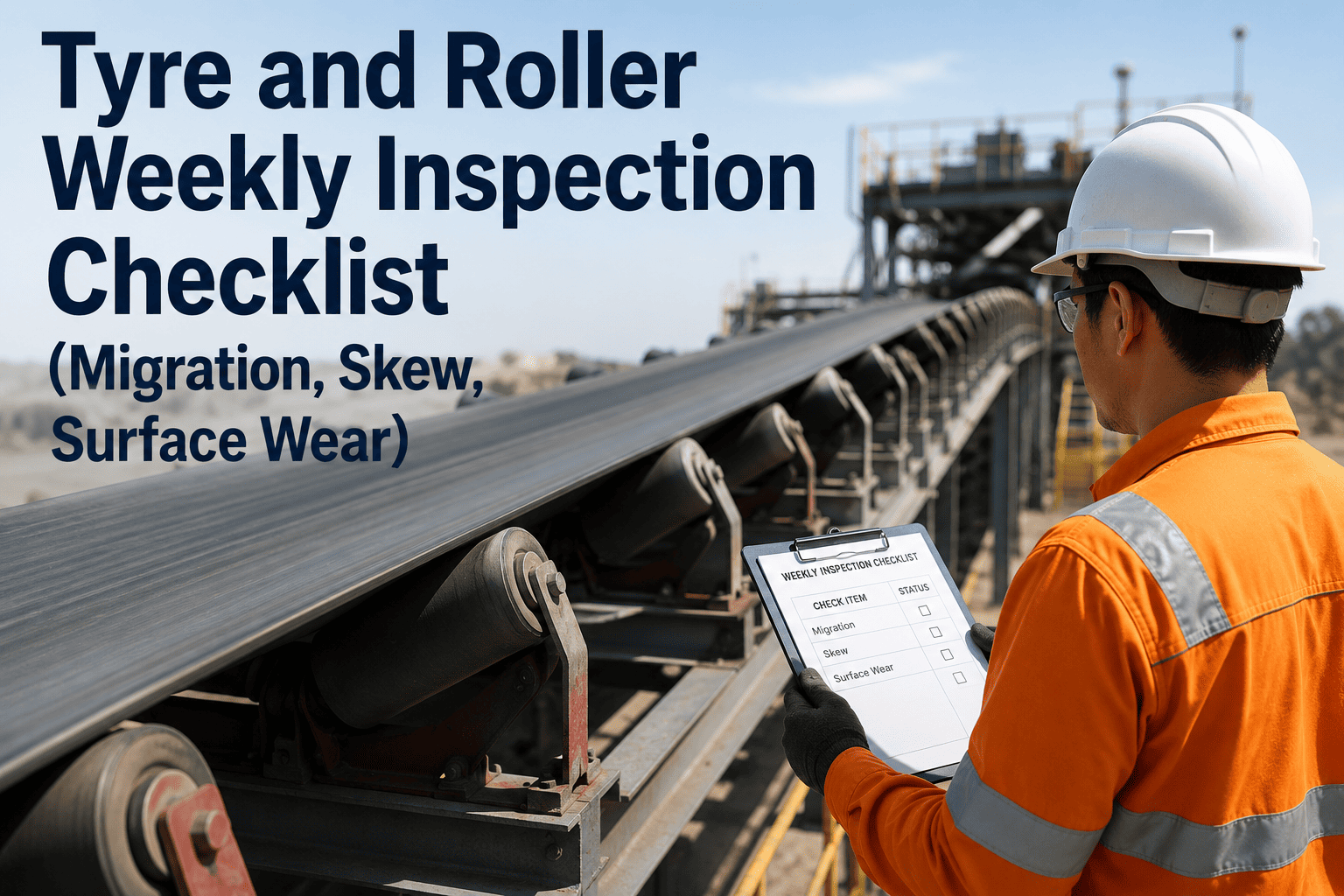
This checklist covers the full tyre monitoring program for a multi-pier rotary kiln. Log every reading in your CMMS with technician name and timestamp. OxMaint auto-generates and routes these work orders by pier.
Frequently Asked Questions
Turn Daily Tyre Readings Into a Predictive Maintenance Program
OxMaint makes it easy: daily mobile work orders, auto-threshold alerts, CMMS-trended RUL projections, and replacement planning — all from readings your team already takes. Start free or book a 30-minute walkthrough tailored to your kiln configuration.