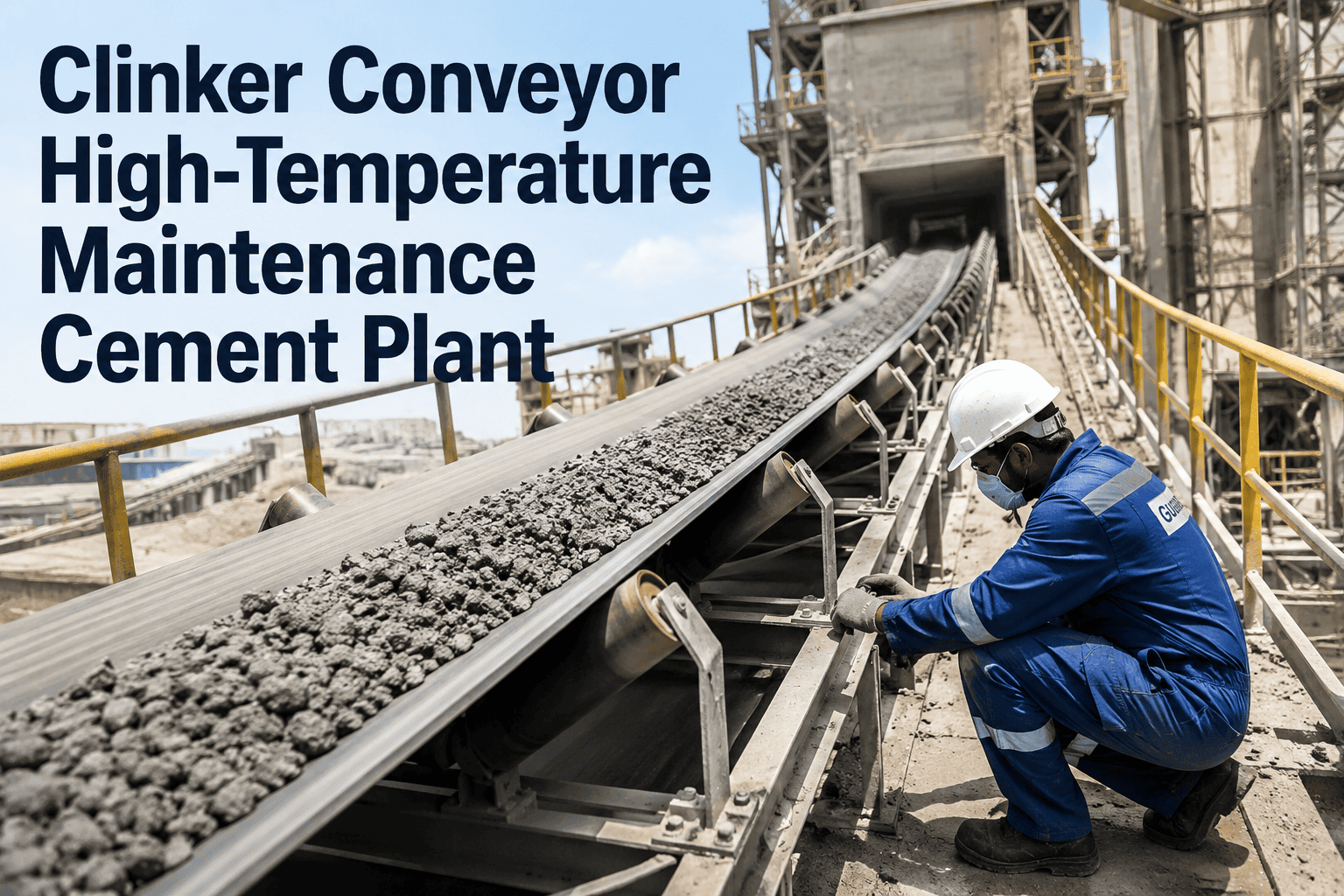
Clinker conveyors run at 150–300 °C and absorb some of the harshest thermal and abrasive punishment anywhere in a cement plant, which is exactly why reactive fix-on-failure maintenance quietly drains six-figure budgets every year. A disciplined CMMS-driven program — combining the right heat-resistant belt, deep pan PM routines, and drag chain wear tracking — typically cuts unplanned clinker conveyor downtime by 30–45 % and extends component life by 1.5–2×. This guide lays out the inspection cadence, selection criteria, and PM checklists that reliability engineers actually use on the clinker belt and deep pan circuits between the cooler and the cement mill. Ready to operationalize it? Start Free Trial and template the workflows below in under an hour.
Why does the same 12 metres of clinker conveyor burn through 40 % of your maintenance budget?
Between the grate cooler discharge and the cement mill feed, clinker handling sees continuous 150–300 °C thermal shock, abrasive fines ingress, and chain elongation that quietly compounds shift after shift. A CMMS-structured PM program reclaims that loss — typically within one quarterly maintenance cycle.
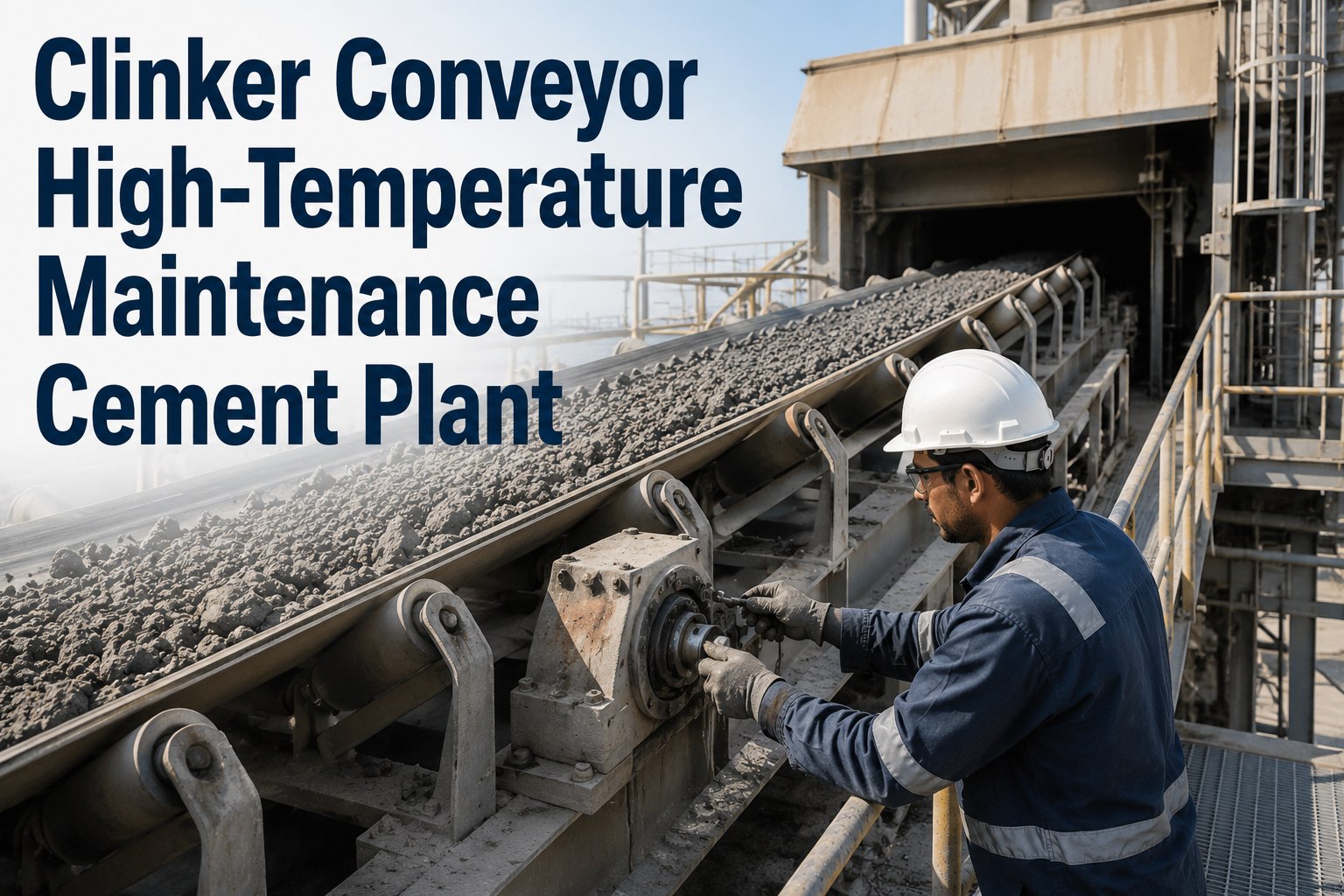
A clinker conveyor is not a belt conveyor — treat it as thermal equipment
Standard EP conveyor belting rated to 80 °C will harden, crack, and delaminate within 3–6 weeks under 200 °C clinker. Heat-resistant grades (T150, T200, T250) extend that window 6–12×, but only when paired with correct idler metallurgy and spillage control.
Sustained above 180 °C, standard EP fabric loses 60 % of tensile strength within 500 operating hours.
At 12 mm pin pitch elongation, chain jump-off risk on the sprocket exceeds 1 in 4 cycles.
Plants running CMMS-driven PM on clinker conveyors report $1.40–1.70/t — a 30–45 % reduction.
A 4,200 tpd plant in South Asia replaced failed EP belting on a 38 m clinker belt every 7 weeks at $11,400 per changeout — roughly $84K/yr in belting alone plus 36 hours of cooler-line downtime. After switching to T200 heat-resistant belting with weekly infrared thermography and a CMMS-tracked 90-day idler rotation, belt life extended to 14 months and annual belting spend dropped to $28K.
High-temperature belt selection — match the class to the measured clinker temperature, not the nameplate
The cheapest compliant belt is rarely the cheapest belt. Selecting one class above your 95th-percentile clinker temperature typically pays back within one belt change cycle.
| BELT CLASS | MAX CONTINUOUS TEMP | PEAK SURGE | COVER COMPOUND | TYPICAL SERVICE LIFE* | BEST FIT |
|---|---|---|---|---|---|
| EP / NN Standard | 80 °C | 100 °C | Natural / SBR | 3–6 weeks | Not suitable for clinker |
| Heat-Resistant T150 | 150 °C | 170 °C | SBR + CR blend | 4–7 months | Clinker < 150 °C post-cooler |
| Heat-Resistant T200 | 200 °C | 220 °C | EPDM, aluminium-surfaced cover | 10–16 months | Standard clinker belt service |
| Heat-Resistant T250 | 250 °C | 300 °C | EPDM + ceramic bead top | 14–22 months | Short hot-clinker spur direct off cooler |
| Steel Cord Heat HR-SC | 200 °C cont. | 250 °C | EPDM over steel cord | 18–30 months | Long centres > 60 m, high tension |
*Service life assumes 16 hr/day operation, 150 mm lump size, and PM-compliant idler condition. Field results vary ±30 % with spillage control quality.
Where Trated is the belt class limit, T95th is the 95th-percentile measured clinker temperature, and Sfines is the fraction of carrying surface covered by retained fines (0.0–0.4). If Sfines exceeds 0.3, expected life drops by roughly half regardless of belt class.
Three conveyor types, three different maintenance rhythms
Clinker handling is rarely one conveyor — it is a chain of belt, deep pan, and drag circuits, each with its own failure signature. The matrix below sets the inspection cadence a CMMS should enforce.
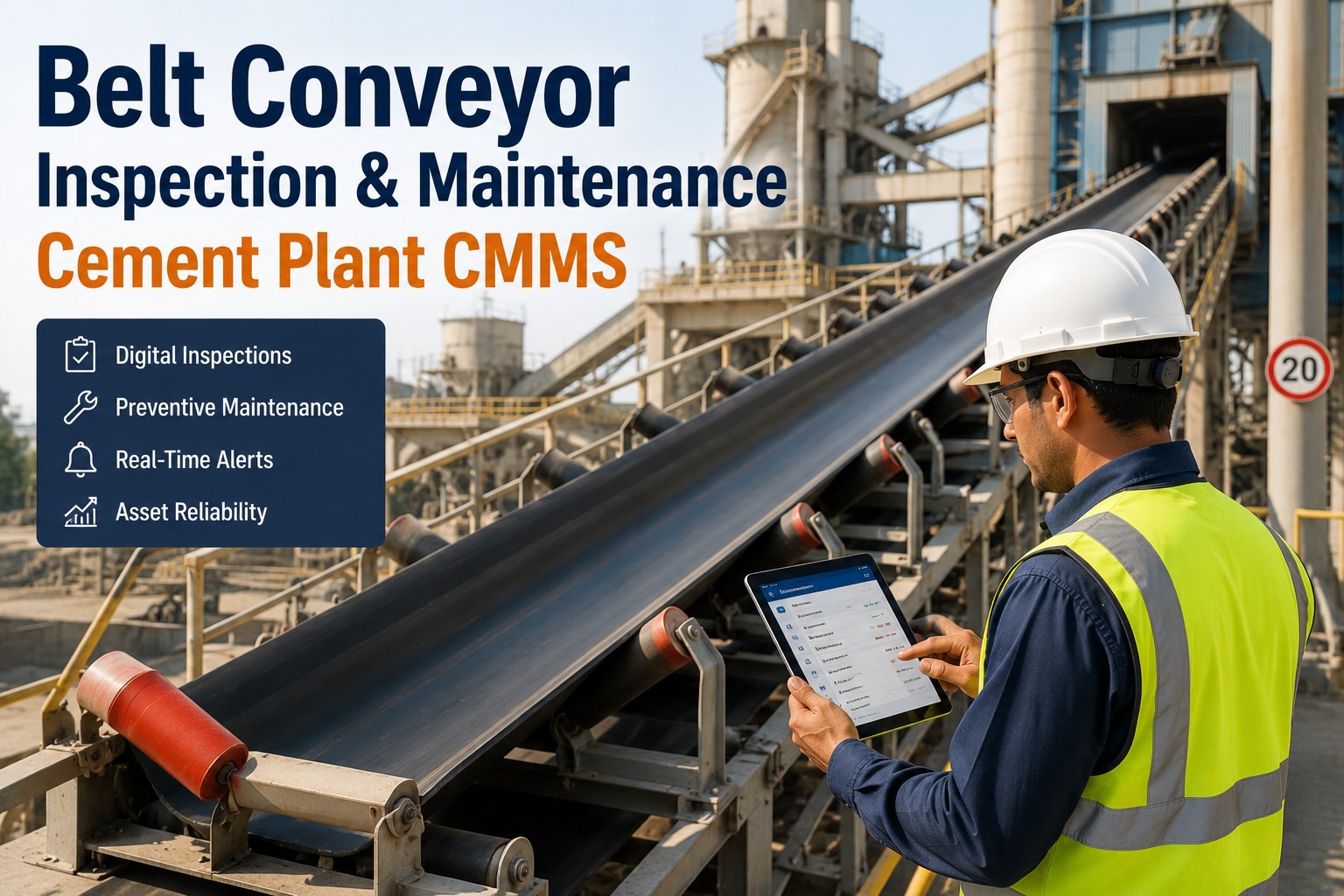
Belt, idler, and thermography focus
Weekly IR scan of all carrying-side idlers — flag any bearing housing above 95 °C for replacement at next outage. Biweekly belt surface temperature mapping along the centreline; a 20 °C step change between idlers indicates a seized roll grinding the cover. Monthly cover-depth gauge at 5 fixed stations; retire belt when minimum cover reaches 1.5 mm.
Chain elongation and pan wear focus
Measure chain pitch every 500 operating hours using a 10-pitch gauge; log in CMMS and trigger chain replacement at 3 % elongation — never wait for jump-off. Quarterly ultrasonic thickness on pan floor at the discharge curve, where abrasive recirculation is highest. Replace pan wear plates at 50 % nominal thickness, not 0.
Flight, sprocket, and tail-tension focus
Weekly visual of flight bolts — one missing bolt per square metre is the discard trigger for the entire flight set. Monthly sprocket tooth profile gauge; replace sprockets in pairs when tooth gap opens beyond +1.5 mm. Tail shaft tension logged every shift; a slow drift upward over two weeks signals chain stretch approaching discard.
Daily, weekly, and monthly inspection checklists — pre-built for CMMS rollout
Copy these directly into the CMMS work-order templates. Each item is observable in under two minutes by a trained operator or fitter; total daily route for a 4-conveyor clinker circuit is roughly 22 minutes.
DAILY (PRE-SHIFT, ~6 MIN)
- Walk belt line for spillage at transfer chute — photograph and log kg estimate.
- Listen at each idler station for squeal, grind, or thump.
- Check tail-pulley scrape plate clearance — set to 3 mm.
- Verify belt tracker centred ±25 mm at head pulley.
- Confirm cooler discharge temperature on DCS matches last IR reading.
WEEKLY (~25 MIN)
- Full IR thermography sweep of all idler bearings and gearmotor.
- 10-pitch chain elongation measurement on deep pan and drag circuits.
- Belt cover-depth gauge at five fixed stations; trend in CMMS.
- Skirt rubber seal inspection — replace if gap exceeds 8 mm.
- Lubricate idler bearings per OEM schedule (high-temp grease NLGI-3).
- Tail-tension reading on drag chain; log drift from baseline.
MONTHLY (~2 HR DURING SHORT OUTAGE)
- Ultrasonic thickness on pan floor at discharge curve — four points.
- Sprocket tooth-profile gauge on head and tail — both circuits.
- Take-up travel check; if at 85 % of stroke, schedule re-tension.
- Vibration analysis on gearmotor and drive shaft — ISO 10816 trend.
- Chute liner thickness at clinker impact zone — replace at 50 %.
- Review 30-day IR and elongation trends; trigger PM overrides.
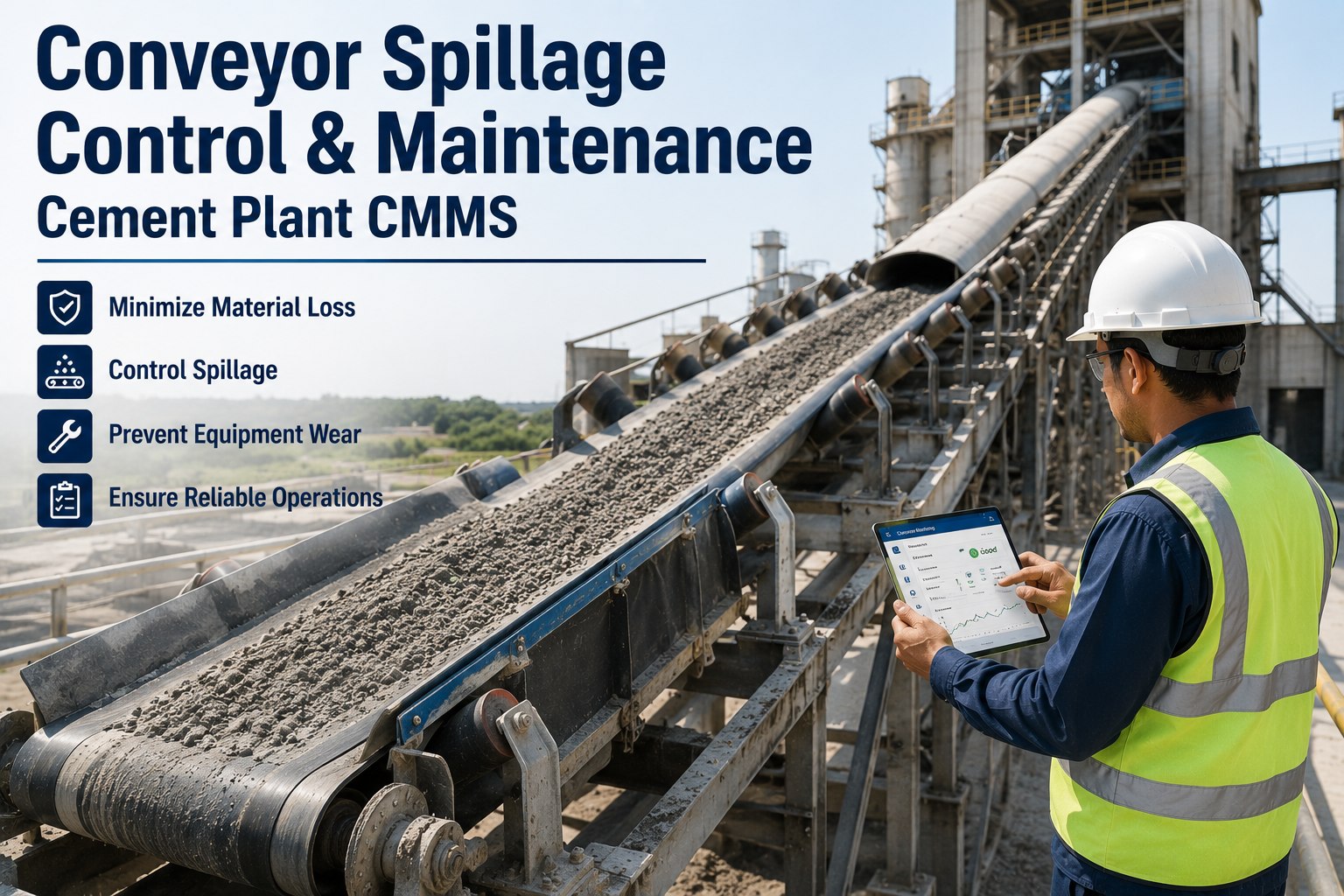
Clinker spillage is a maintenance cost disguised as a housekeeping problem
Every kilogram of clinker that escapes the belt does three things: it abrades the return side, it bakes into the idler seals, and it forces the next outage to start an hour early for clean-up. Containment is reliability.
Skirtboard seal geometry
Set skirt gap at 6–8 mm with 60-Shore-A nitrile sealing strip. Replace every 90 days — a worn skirt lets 2–4 kg of fines per metre escape per shift.
Impact cradle at load zone
Replace standard idlers at the clinker drop point with a 1.2 m impact cradle. Cuts idler bearing failures at that station by 70 % and extends belt cover life 2×.
Return-side plough and scraper
Install a primary urethane scraper plus a secondary spring-loaded blade. Combined with a return plough, this cuts carryback from ~3 % to under 0.5 % of belt load.
High-temp idler specification
Specify idlers with C3 clearance bearings, labyrinth seal, and high-temp NLGI-3 grease rated to 180 °C. Standard idlers in clinker service last 4–7 months; these last 18–24.
Roll out a CMMS-tracked clinker conveyor PM program in one afternoon
Import the checklists, formulas, and cadence above as ready-made work-order templates. Trigger overrides automatically when IR readings or chain-elongation logs breach limit.
The payback math for a CMMS-driven clinker conveyor program
Use the table below as a sanity check against your own asset register. Numbers assume a 4,200 tpd kiln with two clinker belt conveyors, one deep pan, and one drag chain — a typical mid-size configuration.
| COST / SAVINGS LINE | REACTIVE BASELINE | CMMS PM PROGRAM | ANNUAL DELTA |
|---|---|---|---|
| Belt replacements (parts + labour) | $84,000 | $28,000 | +$56,000 |
| Idler replacements | $31,500 | $14,200 | +$17,300 |
| Drag chain + sprocket set | $22,000 | $13,800 | +$8,200 |
| Unplanned outage hours (cooler line) | 52 hrs @ $4,200/hr | 14 hrs @ $4,200/hr | +$159,600 |
| Spillage clean-up labour | $18,000 | $5,400 | +$12,600 |
| CMMS subscription + admin | — | $9,600 | −$9,600 |
| NET ANNUAL SAVINGS | — | — | +$244,100 |
With a typical $4K–8K setup cost (CMMS configuration, sensor add-ons, training), the program above pays back in 0.2–0.4 months — well inside the first quarterly maintenance cycle.
Clinker conveyor high-temperature maintenance — the questions reliability teams actually ask
How hot is too hot for a standard conveyor belt on clinker service?
Anything above 80 °C continuous is out of spec for standard EP or NN belting. In real clinker service you should specify at minimum a T150 (SBR/CR blend) belt for post-cooler conveyors, and T200 (EPDM) for any belt taking clinker directly off the grate cooler discharge where surges to 220 °C are common. Pairing the right belt class with weekly IR thermography typically extends cover life 6–10× versus standard belting.
What is the discard criterion for a clinker conveyor drag chain?
Replace the chain at 3 % elongation measured over 10 pitches, not when it jumps the sprocket. Beyond 3 % the sprocket tooth profile no longer matches the chain pitch, so a new chain on worn sprockets will fail within weeks — always replace chain and sprockets as a set. Log every measurement in the CMMS so the trend is visible; a 0.4 %/month drift is normal, anything faster signals an alignment or lubrication problem.
How do I justify the CMMS cost to plant management for clinker conveyor PM?
Frame it in downtime hours, not software price. A single unplanned 8-hour cooler-line outage at a 4,200 tpd plant costs roughly $34,000 in lost production. A CMMS subscription plus the inspection labour to run the program typically costs $9K–12K/year — less than one avoided outage. Use the worked-economics table above as a template and substitute your own tpd, $/hr, and historical failure frequency.
Should we move clinker by belt, deep pan, or drag chain — which is cheapest to maintain?
It depends on temperature and layout. For clinker below 150 °C and horizontal runs under 60 m, a T150/T200 belt is usually cheapest per tonne. For 200–300 °C clinker or steep inclines, deep pan conveyors handle the heat better and contain spillage more effectively. Drag chains are best for short, hot, low-capacity spur feeds. A hybrid layout — hot clinker on a short deep pan, then transfer to belt below 150 °C — is often the lowest whole-life-cost arrangement.
How quickly can we deploy a CMMS-tracked PM program on our clinker conveyors?
Most plants are live in 1–2 weeks: import the asset register, load the daily/weekly/monthly checklist templates from this guide, set the IR-temperature and chain-elongation thresholds, and assign routes to existing fitters. You can Book a Demo to see the templates pre-loaded and mapped to a typical clinker circuit, then replicate them on your asset list.
Stop firefighting clinker conveyor failures — start preventing them
Deploy the inspection cadence, belt-class matrix, and chain-elongation triggers in this guide as ready-made CMMS work orders. Most plants see the first avoided outage within 60 days.
Free 14-day trial · No credit card