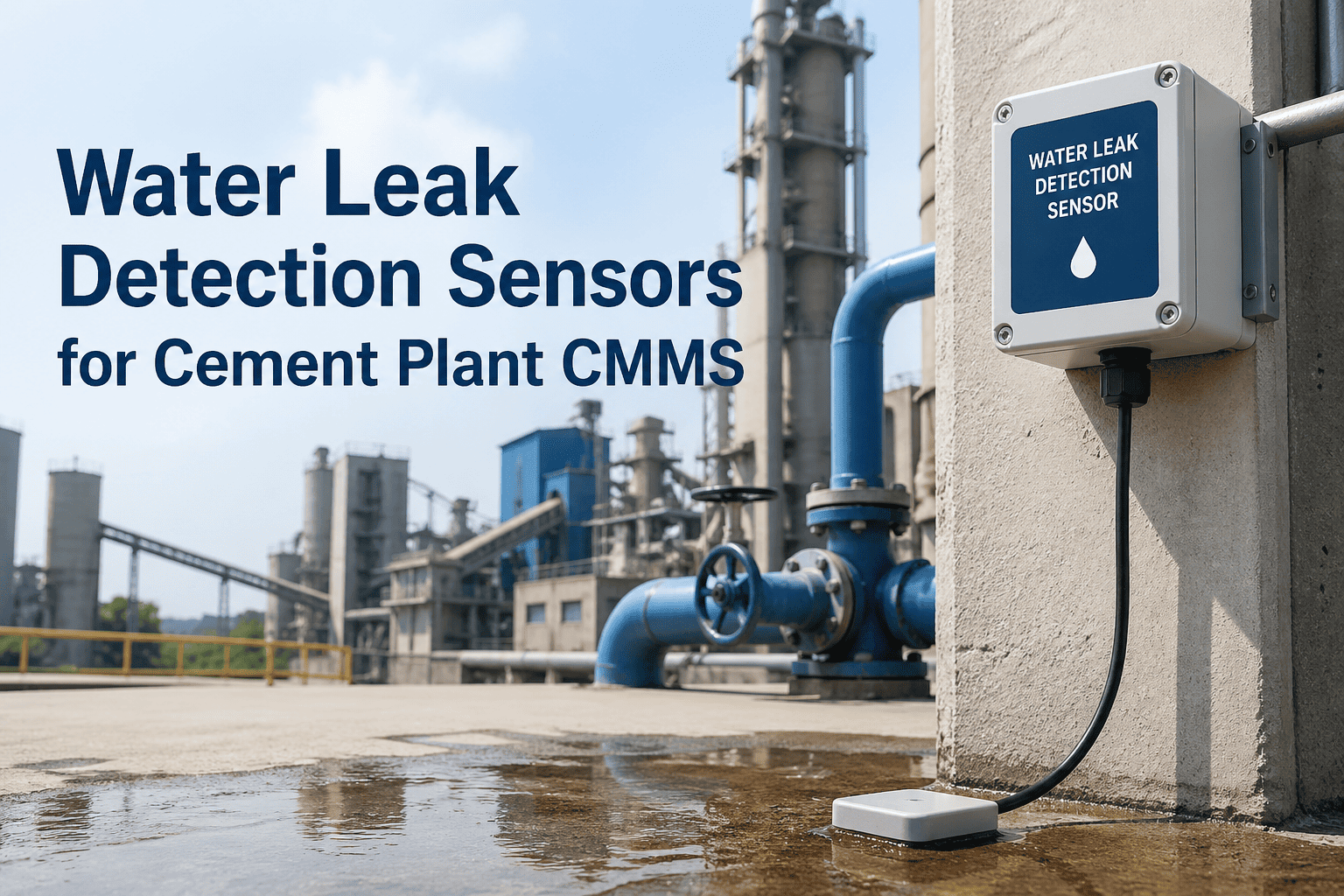
A pinhole leak in a kiln support roller cooling line at a 5,000 TPD cement plant looks insignificant when it starts — a slow drip, maybe a litre per hour, often hidden behind the kiln housing where nobody walks during a shift. Six hours later, that drip has become a steady stream. Twelve hours later, the bearing temperature alarm finally trips because cooling water flow has dropped below the threshold needed to dissipate the 1,400°C radiant heat from the kiln shell. By the time maintenance reaches the bearing, the babbitt has already smeared. Industry data shows a single rotary kiln stoppage costs $150,000 to $300,000 per day in lost clinker production, and emergency bearing replacements add 40–80% premium over planned repair costs. The pinhole that should have triggered a $500 work order has now become a $400,000 unplanned shutdown. IoT water leak detection sensors integrated with a CMMS turn that escalation cycle into a 30-second alert and an auto-generated work order — catching the leak at hour zero, not hour twelve. Cement plants deploying integrated leak detection across cooling water systems report 60–75% reductions in water-related unplanned downtime within the first 12 months, and the technology integrates directly with OxMaint's cement plant CMMS platform for automatic work order generation the moment a sensor fires.
Case Study · Cement Plant Water Systems
When a Drip Becomes a Disaster — and How IoT Sensors + CMMS Stop It at Hour Zero
Real-time leak detection on kiln bearings, cooler systems, mill jackets, and gas conditioning lines — feeding work orders directly into your maintenance team's queue before the drip becomes damage.
$300K
Per day lost during unplanned kiln stoppage
12 hrs
Typical drip-to-damage escalation window
30 sec
Sensor-to-work-order time with CMMS integration
The Escalation
From Pinhole to Plant Shutdown — A 12-Hour Failure Cascade
This is how a small cooling water leak on a kiln support roller becomes a $400,000 unplanned event. Each hour of delayed detection multiplies both the equipment damage and the production loss. The line below shows where IoT-CMMS integration breaks the cascade.
0h
Hour 0 — Leak Begins
Pinhole forms in cooling line; ~1 L/hour
Repair cost: $400–$800
IoT sensor detects moisture · CMMS auto-generates work order · Technician dispatched
2h
Hour 2 — Without Sensors
Leak grows to 5–8 L/hour; pooling on floor unseen behind kiln housing
Repair cost: $1,200–$2,500
No detection · No alert · Walk-around inspection scheduled for next shift
6h
Hour 6 — Flow Degrades
Cooling water pressure drops 15–20%; bearing temp begins rising
Repair cost: $8,000–$15,000
SCADA shows pressure anomaly but no clear cause flagged
10h
Hour 10 — Bearing Stress
Support roller bearing at 95°C; lubricant breakdown begins
Repair cost: $45,000–$90,000
Alarm trips · Maintenance investigates · Source still unidentified
12h
Hour 12 — Catastrophic
Babbitt smears · kiln stop forced · 3–5 day repair window
Total cost: $400K–$1.5M
Emergency shutdown · Production lost · Refractory damage risk
Stop the Cascade Before Hour Two
See Live Leak Detection Wired Into a Cement Plant CMMS
Book a 30-minute demo with our cement industry team. We'll show you exactly how IoT moisture, flow, and pressure sensors trigger automatic work orders inside OxMaint — including the wiring diagrams from real kiln cooling installations.
The Sensor Stack
Four Sensor Types That Cover Every Leak Failure Mode in a Cement Plant
No single sensor catches every leak scenario. The cement plants achieving the strongest results combine all four — point sensors at high-risk drip zones, cable sensors along long cooling runs, flow meters on supply mains, and pressure sensors on closed-loop returns. Each one feeds the same CMMS work order engine.
01
Point Moisture Sensors
Best for: Kiln bearing housings, gearbox sumps, motor floor zones
Triggers when probe contacts liquid. Sub-second response, IP66 industrial rating, withstands cement dust ingress. Reports wet-state to gateway via wireless mesh — no plant wiring required for retrofit.
Response timeLess than 1 second
CoverageSpot — 10–30 cm radius
Use caseDrip pans, low points, floor zones
02
Cable Leak Sensors
Best for: Long cooling water headers, mill jacket runs, cooler fan plenum
Detects moisture anywhere along its length and reports the exact distance from origin. A 50-metre cable replaces dozens of point sensors and identifies leak location to within 1–2 metres — critical when cooling lines run 80+ metres along a kiln.
Response time2–5 seconds
CoverageLinear — up to 100 m per run
Use casePipe routes, header runs, trenches
03
Inline Flow Meters
Best for: Cooling water supply mains, makeup feeds, return loops
Continuous flow measurement compared against expected baseline. A 5–8% sustained flow increase between supply and return confirms a leak somewhere in the loop — even when it has not yet reached a sensor probe. Works as the network-wide leak indicator.
Response time5–10 minutes (averaged)
CoverageNetwork-wide imbalance detection
Use caseSystem mains, distribution headers
04
Pressure Transmitters
Best for: Closed-loop bearing cooling circuits, gas conditioning return
Monitors line pressure against expected operating envelope. A sustained pressure drop with no commanded valve change indicates loss of containment somewhere in the circuit. Particularly valuable for closed-loop systems where flow imbalance is harder to read.
Response timeLess than 30 seconds
CoverageClosed-loop circuit integrity
Use caseBearing loops, sealed circuits
The Integration Architecture
How a Sensor Trip Becomes a Work Order in 30 Seconds
The value of leak detection is not the sensor — it is the unbroken chain from physical detection to maintenance action. Here is the data path inside a cement plant running OxMaint as the CMMS layer.
Step 1
T+0 sec
Sensor Detects Moisture
Point sensor at kiln support roller #2 fires wet-state signal to local LoRaWAN or cellular gateway. Battery-powered sensor needs no plant wiring.
Step 2
T+5 sec
Gateway Routes to Cloud
Gateway pushes signal with sensor ID, location tag, and timestamp to OxMaint's cloud endpoint. Encrypted payload, deduplication on retry.
Step 3
T+12 sec
CMMS Validates and Maps
OxMaint matches sensor ID to asset (Kiln #1, Support Roller #2, Cooling Circuit A), pulls criticality rating, applies routing rules.
Step 4
T+18 sec
Work Order Auto-Generated
Priority-1 WO created with asset details, sensor reading, last PM date, parts kit list, isolation procedure attached, escalation timer started.
Step 5
T+30 sec
Mobile Alert to On-Shift Tech
Push notification to mechanical lead's mobile with one-tap acceptance, GPS routing to asset, and full WO context. Shift supervisor and reliability engineer cc'd.
Where to Deploy First
Six High-Risk Leak Zones in Every Cement Plant — Ranked by Cost of Failure
A typical 1 million tonne/year cement facility consumes hundreds of thousands of litres of water daily, primarily for machine cooling and gas conditioning. These are the six zones where leak escalation carries the highest equipment damage risk and where sensor deployment delivers the fastest payback.
| Risk Rank |
Leak Zone |
Failure Mode |
Cost of Escalation |
Recommended Sensor Mix |
| 1 |
Kiln Support Roller Cooling |
Bearing seizure, babbitt smear, forced kiln stop |
$400K–$1.5M |
Point + Pressure |
| 2 |
Vertical Roller Mill Gearbox Jacket |
Lube oil contamination, gearbox replacement |
$500K–$1.2M |
Point + Cable |
| 3 |
Clinker Cooler Fan Bearing Cooling |
Fan trip, kiln output reduction, hot clinker overflow |
$80K–$200K |
Point + Flow |
| 4 |
Gas Conditioning Tower Spray |
Baghouse over-temp, filter bag damage, emission breach |
$60K–$180K |
Flow + Pressure |
| 5 |
Compressor Cooling Loop |
Compressor trip, instrument air loss, plant-wide control issues |
$40K–$120K |
Cable + Pressure |
| 6 |
Raw Mill Drive Cooling |
Drive thermal trip, raw mill stoppage, kiln feed disruption |
$25K–$80K |
Point + Flow |
The Return on a Single Avoided Kiln Cooling Failure
1
Major event avoided per year
Conservative — most plants average 2–4 leak-driven cooling failures annually before sensor deployment
$450K
Median direct cost per avoided event
Production loss + emergency parts premium + labour + secondary equipment damage
$35K
Annual sensor + CMMS investment
40 sensors covering 6 priority zones + OxMaint subscription + integration setup
12.8x
First-year ROI from one avoided event
Payback typically reached within 4–6 months of full deployment
"
We had been tracking water consumption monthly and assumed our cooling system was tight. Then we installed cable leak sensors along the kiln bearing supply lines as a pilot — and within three weeks, the system flagged two slow leaks we had never seen on the SCADA. One was a flange weeping behind the kiln housing where nobody walks. The other was a corroded fitting on the return side of support roller #3. Total water loss across both was probably 80 litres an hour. Neither would have shown up on monthly meter readings. The point is not that the sensors found leaks — it is that the leaks had been there for months, slowly degrading equipment we thought was healthy. The sensor-to-CMMS integration is what changed our reactive culture. Once a work order auto-creates from a sensor trip, you cannot lose it in a notebook or a verbal handover. It is in the queue, time-stamped, with the asset attached.
Engr. Rajiv Kothari, M.Tech (Industrial Engineering)
Head of Reliability — UltraTech Cement (Andhra Pradesh Plant) · 18 Years Cement Industry Maintenance · Certified Maintenance & Reliability Professional (CMRP) · Specialist in IoT-CMMS integration for kiln line cooling and lubrication systems
Frequently Asked Questions
Do we need to rewire the plant to install IoT leak sensors?
How does the sensor know which asset the leak belongs to?
Each sensor is tagged to a specific asset in OxMaint during commissioning — Kiln #1, Cooler Fan #3, Mill #2 gearbox jacket. When the sensor trips, OxMaint maps the ID to the asset record, pulls criticality, and routes to the right technician group. The work order arrives with the full asset history and PM record attached.
Can these sensors handle cement plant dust and temperature?
Industrial-grade leak sensors used in cement deployments are IP66 or IP67 rated, sealed against dust and humidity, and rated for sustained ambient temperatures up to 60–70°C. For high-radiant-heat zones near the kiln shell, shielded mounting brackets keep the sensor body within its operating envelope while the probe contacts the leak zone.
Will integration affect our existing SCADA or DCS systems?
No. OxMaint operates as the CMMS layer alongside SCADA — not replacing it. Sensors can feed both the DCS for real-time control alarms and OxMaint for work order generation simultaneously. Most plants run a parallel architecture so process operators see live alarms while maintenance gets actionable work orders.
Start a free trial to see the parallel SCADA-CMMS architecture in action.
What happens if the sensor itself fails or its battery dies?
Each sensor sends a heartbeat signal every 15–60 minutes. If OxMaint stops receiving heartbeats from a sensor, it auto-generates a low-priority work order to inspect or replace the unit. Battery levels are reported with each heartbeat, so replacements are scheduled before failure rather than discovered after a missed leak event.
How long does a typical 6-zone deployment take to show payback?
Cement plants deploying integrated leak detection across the six priority zones report payback within 4–6 months on average — driven primarily by avoided unplanned kiln stoppages and reduced emergency repair premiums. The first detected leak that would have escalated typically pays for the entire deployment.
Cement Plant Water Leak Detection · OxMaint
Every Cooling Leak in Your Plant Is Already Costing You — You Just Cannot See Them Yet
IoT sensors find the leaks. OxMaint turns every detection into a work order in your team's hands within 30 seconds. The first event you avoid pays for the entire deployment several times over — and most plants avoid two to four every year.