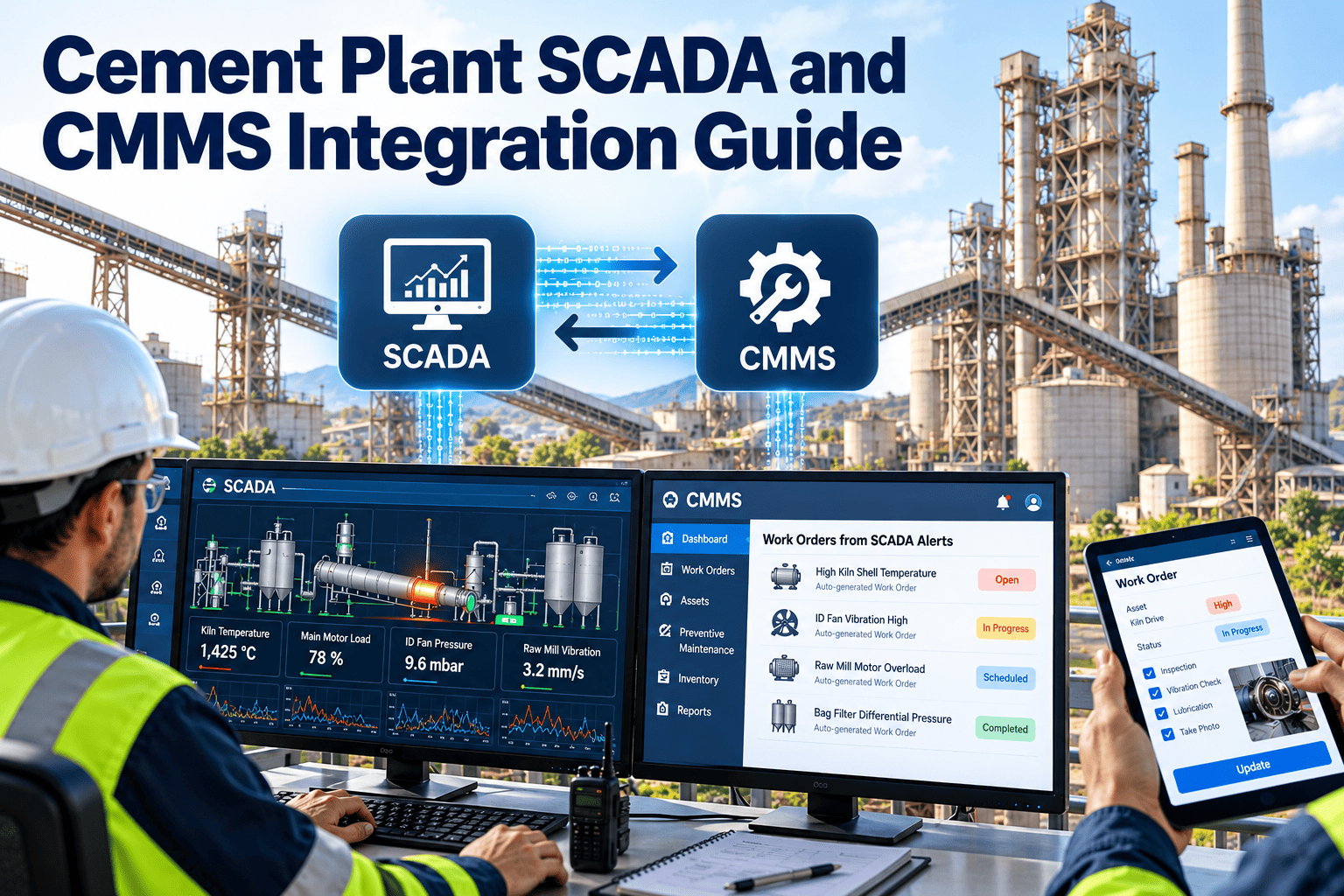
A cement plant in Georgia needed to connect 47 different data sources—PLCs from three vendors, legacy Modbus sensors, and new wireless vibration monitors—to their cloud-based maintenance platform. Direct cloud connections weren't feasible: legacy devices lacked internet capability, bandwidth limitations couldn't support raw data streams, and IT security required network segmentation. Industrial edge gateways solved the problem by aggregating data locally, converting protocols, and transmitting processed data to Oxmaint CMMS over secure connections. This guide covers gateway selection, configuration, and integration for cement plant data collection.
Edge gateways are the critical link between plant floor equipment and cloud analytics platforms. They translate industrial protocols (Modbus, OPC-UA, Profinet) into formats cloud systems understand, process data locally to reduce bandwidth, and maintain connectivity during network disruptions. For cement plants with diverse equipment across sprawling facilities, properly configured edge gateways determine whether IoT data actually reaches your maintenance platform. Book a demo to see how Oxmaint integrates with industrial edge infrastructure.
Industrial Edge Gateway Setup for Cement Plant Data Collection
Step-by-step configuration for protocol conversion, edge processing, and cloud integration with Oxmaint.
What Edge Gateways Do
Industrial edge gateways serve four critical functions in cement plant data collection.
Protocol Translation
Convert industrial protocols (Modbus RTU/TCP, OPC-UA, Profinet, EtherNet/IP) into cloud-friendly formats (MQTT, REST API, AMQP). Enable legacy equipment to communicate with modern platforms.
Data Aggregation
Collect data from multiple sources—PLCs, sensors, analyzers—and consolidate into unified data streams. Reduce the number of cloud connections and simplify data management.
Edge Processing
Process data locally before transmission. Calculate averages, detect anomalies, and filter noise at the edge. Reduce bandwidth requirements and enable faster local responses.
Store-and-Forward
Buffer data locally during network outages. When connectivity restores, buffered data syncs automatically. Prevent data loss from intermittent connections.
Supported Protocols
Cement plants use diverse equipment with various industrial protocols. Edge gateways must support your specific protocol mix.
Modbus RTU/TCP
Legacy sensors, drives, and analyzers. Most common protocol in cement plant instrumentation. Serial (RTU) and Ethernet (TCP) variants.
OPC-UA
Modern standard for industrial interoperability. Secure, platform-independent communication with PLCs, SCADA, and historians.
Profinet/Profibus
Siemens ecosystem standard. Real-time communication for drives, I/O modules, and automation controllers.
EtherNet/IP
Rockwell/Allen-Bradley standard. Common in North American cement plants with ControlLogix systems.
MQTT
Lightweight messaging for IoT sensors. Publish-subscribe model ideal for wireless sensors and cloud integration.
BACnet
Building automation standard. Used for HVAC, compressor controls, and facility management systems.
Connect Your Equipment to Oxmaint
Oxmaint integrates with industrial edge gateways for seamless data collection from all your cement plant equipment.
Gateway Setup Steps
Follow this process to deploy industrial edge gateways for cement plant data collection. Oxmaint provides integration documentation for all major gateway vendors.
Inventory Data Sources
Document all equipment and protocols requiring connectivity. Identify PLCs, sensors, analyzers, and existing SCADA connections. Note protocol types, IP addresses, and register maps.
Select Gateway Hardware
Choose gateways supporting your protocol mix. Consider industrial ratings (temperature, vibration, dust), port counts, and processing capacity for edge analytics.
Plan Network Architecture
Design network segmentation separating OT (operational technology) from IT networks. Configure firewalls, VLANs, and secure tunnels for cloud connectivity.
Configure Data Collection
Set up protocol drivers for each data source. Configure polling rates, register addresses, and data types. Test connectivity to each device before proceeding.
Configure Cloud Integration
Set up connection to Oxmaint platform. Configure MQTT broker, API credentials, and data mapping. Enable store-and-forward for network resilience.
Validate and Monitor
Verify data flows correctly to Oxmaint. Check data quality, transmission latency, and buffer operation. Establish gateway health monitoring.
Cement Plant Deployment Zones
Distribute gateways across plant areas based on equipment density and network topology.
Quarry Area
Crushers, conveyors, and mobile equipment. Often requires ruggedized gateways with cellular backup.
Raw Mill Area
Ball mills, VRMs, and classifiers. High sensor density with vibration, temperature, and power monitoring.
Kiln Area
Kiln drive, preheater, and cooler systems. Critical equipment requiring reliable, low-latency data collection.
Finish Mill & Packing
Cement mills, silos, and packaging lines. Mix of process control and packaging equipment protocols.
Configuration Best Practices
Follow these guidelines for reliable gateway operation in cement plant environments.
Polling Rate Optimization
Match polling rates to data requirements. Vibration analysis may need 1-second intervals; temperature monitoring often works at 1-minute intervals. Over-polling wastes bandwidth and processing.
Buffer Sizing
Size local storage for expected outage duration. A gateway collecting 1,000 points per second needs significant buffer for multi-hour outages. Plan for worst-case connectivity scenarios.
Data Filtering
Filter noise and redundant data at the edge. Deadband settings prevent transmitting unchanged values. Calculate statistics locally rather than sending raw high-frequency data.
Security Hardening
Disable unused services and ports. Use certificate-based authentication for cloud connections. Keep firmware updated and monitor for security advisories.
Redundancy Planning
Consider redundant gateways for critical areas like kiln monitoring. Hot standby configurations ensure data collection continues if primary gateway fails.
Documentation
Maintain configuration backups and change logs. Document register mappings, network settings, and integration parameters. Enable faster troubleshooting and recovery.
Need Help with Gateway Integration?
Oxmaint support team assists with gateway configuration and data integration for cement plant equipment.
Oxmaint Integration
Oxmaint CMMS receives edge gateway data through multiple integration methods.
MQTT Integration
Gateways publish sensor data to Oxmaint MQTT broker. Lightweight, efficient protocol ideal for high-frequency sensor data streams.
REST API
HTTP-based data submission for gateways with API support. Simple integration with standard web protocols and JSON data formats.
OPC-UA Server
Oxmaint acts as OPC-UA client, pulling data directly from gateway OPC servers. Ideal for SCADA-integrated environments.
Oxmaint Agent
Lightweight software agent installed on gateway handles data formatting, buffering, and secure transmission to Oxmaint cloud.
Frequently Asked Questions
Start Collecting Equipment Data Today
Oxmaint integrates with your edge gateway infrastructure for comprehensive cement plant equipment monitoring.