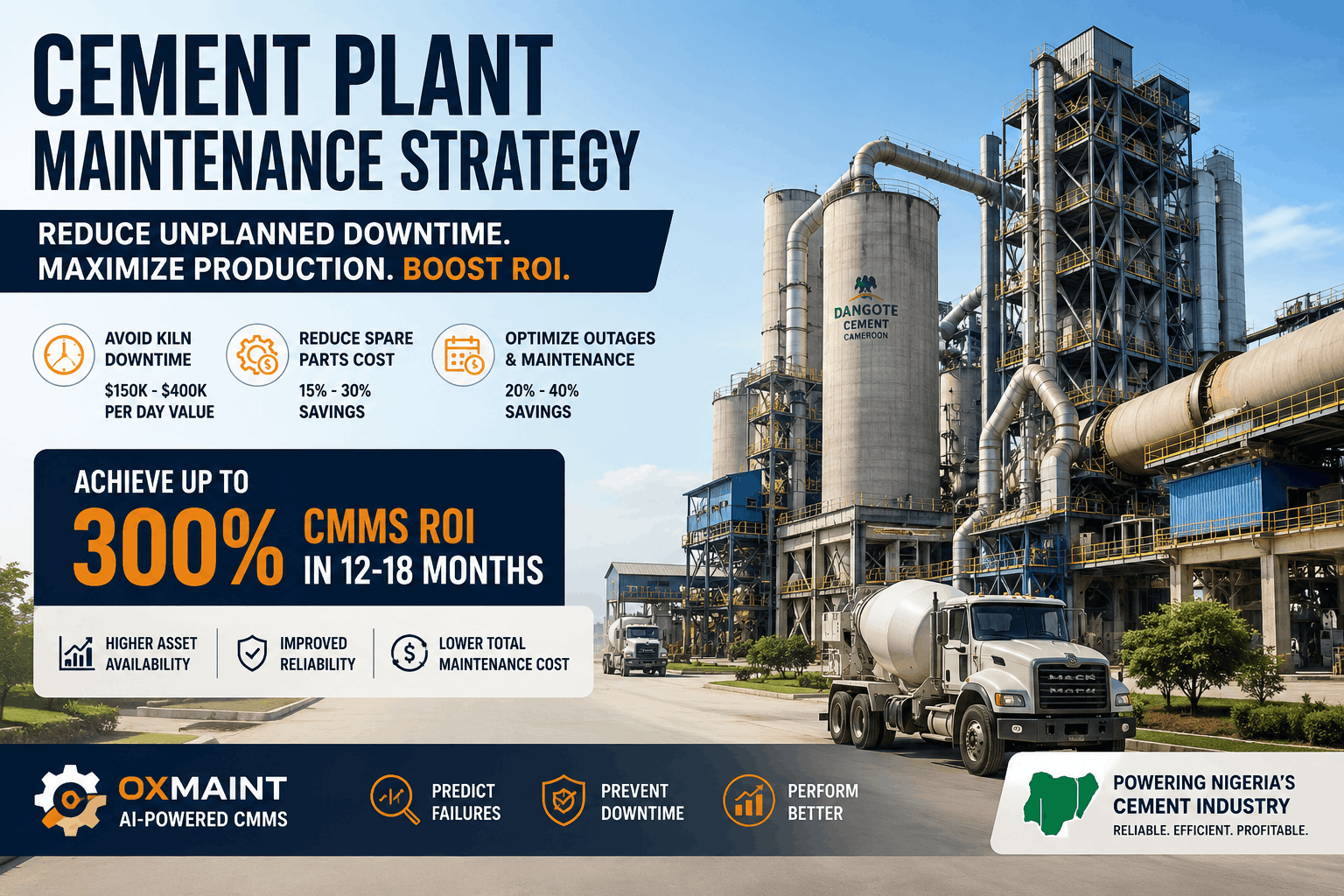
Japanese & South Korean Cement: Advanced Maintenance & Automation
By roy on March 23, 2026
Japan and South Korea operate the world's most technically advanced cement plants — average kiln availability exceeds 94% in Japan versus a global benchmark of 79%, achieved not through larger maintenance teams but through systematic condition monitoring, AI-assisted fault prediction, and zero-unplanned-stop operational philosophies that have been refined over four decades. Both markets face the same structural challenge: aging plant infrastructure combined with severe skilled workforce contraction — Japan's cement sector has lost 38% of its experienced maintenance engineers since 2010, and South Korea faces a similar demographic cliff. The response has been aggressive automation, digital twin deployment, and CMMS integration that converts institutional knowledge into system-encoded PM programs before it retires. Book a demo to see how Oxmaint integrates with advanced automation environments in high-performance cement plants.
Global & RegionalJapanese & South Korean Cement: Advanced Maintenance & Automation8–10 min read
94%
average kiln availability in Japan versus 79% global benchmark — a 15-point operational gap
38%
of experienced Japanese cement maintenance engineers lost since 2010 due to workforce contraction
4.2x
lower cost per maintenance event at Japanese plants using AI-triggered predictive interventions versus reactive
Zero
unplanned kiln stops recorded at Taiheiyo Cement's Ofunato plant over a 26-month monitoring period
Japan and South Korea: Two Markets, One Operational Philosophy
Japan and South Korea have arrived at the same destination through different paths. Japan's cement industry — consolidated around Taiheiyo, Sumitomo Osaka, and UBE — has been investing in predictive maintenance infrastructure since the early 2000s, driven by earthquake resilience requirements and the high cost of skilled labour. South Korea's industry — led by Ssangyong, Asia Cement, and Hanil Cement — has followed a faster digital transformation trajectory since 2018, accelerated by the Korean government's smart manufacturing mandate. Both now operate at a level of maintenance sophistication that the rest of the world is building toward.
Japan
56 MTPA capacity · 3 major groups
94%
Kiln Availability
2003
Predictive PM Started
82%
Sensor Coverage Rate
Japan's zero-unplanned-stop philosophy evolved from earthquake resilience engineering — plants needed to restart safely and quickly after seismic events. This drove deep investment in continuous condition monitoring, digital twin models for kiln shell and bearing systems, and CMMS integration that makes every sensor reading actionable within minutes. Taiheiyo, Sumitomo Osaka Cement, and UBE now operate plants where the maintenance team receives predictive work orders before any physical symptom is detectable by field inspection.
South Korea's smart manufacturing mandate accelerated cement plant digitalization from 2018 onward — government subsidies for IIoT deployment, AI integration, and digital twin systems drove a rapid adoption cycle across the industry. Ssangyong Cement's Donghae plant became a reference site for Korean Industry 4.0 cement maintenance, deploying vibration sensors on all rotating assets connected directly to a CMMS that generates condition work orders autonomously. The goal — zero unplanned stops — mirrors Japan's operational philosophy but arrived a decade later.
Ssangyong Cement · Asia Cement · Hanil Cement · Sungshin Cement · Lafarge Korea
Integrate Advanced Condition Data Into One Zero-Downtime CMMS
Advanced Maintenance Technologies: Equipment by Equipment
Japanese and South Korean cement plants apply condition monitoring techniques at a depth and frequency that exceeds global practice. The six asset classes below show how the Japan and South Korea approach differs from standard global maintenance programs — and what the performance gap looks like in measurable terms.
Rotary Kiln — Digital Twin Model
VibrationThermalAI Analytics
Japanese plants run full digital twin models of kiln shell geometry — shell deformation, refractory thickness mapping, and trunnion load distribution updated continuously. Bearing replacement is scheduled based on modelled stress cycles, not calendar intervals. Advance warning: 10–14 weeks before physical failure symptoms.
Japan kiln availability: 94% vs 79% global
Ball Mill — Acoustic Emission Monitoring
VibrationAcoustic
Korean plants use acoustic emission sensors on ball mill shells to monitor grinding media charge level and liner wear progression in real time — eliminating manual mill sound checks. AI pattern recognition distinguishes between charge-level variation and genuine liner damage signals with 94% accuracy.
Liner prediction accuracy: 94% via acoustic AI
VRM Gearbox — Continuous Oil Analysis
Oil AnalysisAI Analytics
Japanese VRM operators run continuous online oil analysis rather than periodic laboratory sampling — particle counters and viscosity sensors connected directly to the CMMS generate automatic work orders when contamination trends exceed AI-calculated thresholds. Oil change decisions are condition-driven, not calendar-driven.
Online oil monitoring: Continuous vs quarterly
Preheater — Robotics Inspection
ThermalRobotics
Taiheiyo and Sumitomo deploy autonomous drone inspection inside preheater towers during brief maintenance windows — mapping cyclone cone wear, buildup thickness, and refractory condition without human confined-space entry. Inspection data routes directly to Oxmaint asset records for trend comparison.
Drone inspection time: 4 hrs vs 3-day manual
Drive Motors — MCSA Fault Detection
MCSAThermal
Motor Current Signature Analysis (MCSA) is standard practice at Korean cement plants — detecting rotor bar defects, eccentricity, and bearing faults through current waveform analysis rather than vibration alone. MCSA provides 6–8 weeks advance warning on motor faults that vibration analysis only detects at 2–3 weeks.
MCSA advance warning: 6–8 weeks vs 2–3 vibration
Clinker Cooler — AI Temperature Mapping
ThermalAI Analytics
Korean plants apply AI-powered thermal camera arrays across the full cooler length — generating real-time grate temperature maps that identify hot spots, snowman formation, and grate warping before they cause production disruption. AI models distinguish between operational variation and genuine fault signatures with less than 3% false positive rate.
AI false positive rate: Under 3%
The Zero-Downtime Technology Stack: How Japan Does It
Japan's cement industry zero-downtime performance is not the product of a single technology — it is the result of a layered stack where each component eliminates a specific gap in the fault detection and response chain. The stack below shows the four-layer architecture that separates Japanese kiln availability from the global average.
Layer 4 — Decision
CMMS Auto Work Order Generation
Every alert from every sensor layer routes to Oxmaint — generating a condition work order assigned to the correct technician with full asset history, prior readings, and recommended intervention attached. No manual translation from alert to action. Average time from anomaly detection to work order creation: under 8 minutes.
Under 8 min · anomaly to work order
Layer 3 — Intelligence
AI Pattern Recognition and Fault Classification
Machine learning models trained on 15–20 years of Japanese cement plant failure data classify incoming sensor signals against known failure mode patterns — distinguishing genuine fault progression from operational noise. Output: fault type, severity, predicted time-to-failure, and recommended action — delivered to CMMS as a structured alert. Book a demo to see Oxmaint's AI analytics integration.
94% fault classification accuracy · 12-week lead time
Layer 2 — Sensing
Multi-Sensor Continuous Condition Monitoring
Vibration sensors on all rotating assets. Thermal cameras on kiln shell, cooler, and electrical panels. Online oil analysis on gearboxes. MCSA on all drive motors. Acoustic emission on ball mill shells. All sensors feeding data continuously via OPC-UA — no periodic manual readings, no coverage gaps between sampling intervals.
82% sensor coverage · continuous not periodic
Layer 1 — Foundation
Digital Asset Registry and PM Baseline
Every asset — kiln, mill, fan, motor, gearbox, crusher — registered with full specification, condition history, and OEM maintenance data in Oxmaint. PM schedules encoded from 20+ years of institutional knowledge. The registry is the foundation — without it, sensor data has no asset context and AI alerts have no maintenance history to reference.
KS Korean Standards specifications, Ministry of Trade Industry and Energy smart factory mandate, KECO environmental compliance, KOSHA industrial safety requirements
Encode Your Best Engineers' Knowledge Before It Retires
Japan's zero-downtime performance is built on 20 years of institutional knowledge encoded into PM programs and condition thresholds — not on having more engineers. Oxmaint converts your maintenance team's expertise into system-encoded work orders that outlast any individual. Book a demo to see how Oxmaint captures and encodes institutional maintenance knowledge.
How Oxmaint Powers Zero-Downtime Maintenance Programs
Platform Overview
Four capabilities define what separates Japanese and Korean cement plant maintenance from global practice — multi-sensor integration that routes all condition data to a single asset record, AI-calibrated thresholds that distinguish fault signals from operational noise, institutional knowledge encoding that outlasts workforce attrition, and zero-downtime analytics that make the performance gap visible and manageable. Oxmaint delivers all four through a single connected platform with OPC-UA integration, condition scoring registry, and automated work order generation on threshold breach.
All sensors routed to one asset record · no manual data entry
Japanese and Korean plants run vibration, thermal, MCSA, acoustic emission, and online oil analysis sensors simultaneously — but the performance gap closes only when all sensor streams converge on a single asset record. Oxmaint integrates with all sensor types via OPC-UA and REST API, routing every reading to the correct asset record and automatically generating condition work orders when any threshold is breached. No manual data transfer, no inter-system delays, no alert-to-action gap. Book a demo to confirm OPC-UA integration with your plant's sensor network.
Oxmaint's zero-downtime analytics dashboard tracks kiln availability, unplanned stop count, mean time between failures, and PM compliance rate in real time — flagging deviations from target before they compound into scheduled availability loss. Japanese plant managers review this dashboard at the start of every shift as the primary operational decision tool. The dashboard surfaces which assets are trending toward threshold breach and which PM tasks are approaching overdue — with enough lead time to intervene without disrupting production. Book a demo to see the zero-downtime analytics dashboard configured for your plant's KPI targets.
03
Condition Scoring Registry with Asset-Specific Baselines
Asset-specific thresholds · deviation from baseline not absolute limits
Global alarm thresholds like ISO 10816 set absolute vibration limits that apply to all similar assets regardless of their specific operating characteristics. Japanese plants outperform because their thresholds are asset-specific — each kiln trunnion, each mill drive, each fan bearing has its own baseline and its own deviation threshold. Oxmaint's condition scoring registry stores individual asset baselines from the first 60–90 days of monitoring and calculates deviation thresholds that are statistically calibrated to each asset's normal operating signature — not a generic industry standard.
04
Institutional Knowledge Encoding Against Workforce Attrition
38% engineer attrition in Japan · knowledge outlasts the individual
Japan has lost 38% of its experienced cement maintenance engineers since 2010 — and each departure takes with it decades of asset-specific diagnostic knowledge that no sensor can replicate. Oxmaint's PM program and condition scoring registry encode this knowledge into the system: the specific vibration signature that precedes a trunnion bearing failure on a particular kiln, the oil analysis trend that signals gearbox wear at a specific mill, the thermal pattern that indicates refractory thinning at a particular shell section. When the engineer retires, the knowledge stays. Book a demo to see how Oxmaint's knowledge retention module is configured for cement plant asset expertise.
Japan and South Korea vs Global Cement Maintenance Benchmarks
Kiln availability at Japanese plants using full zero-downtime stack versus 79% global average94%
Kiln availability at South Korean plants post-smart-factory deployment versus 79% global average91%
Sensor coverage rate across all rotating and thermal assets at leading Japanese cement plants82%
Reduction in unplanned maintenance events within 18 months of full Oxmaint zero-downtime program deployment76%
PM compliance rate at Japanese plants using automated work order generation versus manual PM scheduling88%
Reduction in false positive alerts when asset-specific baselines replace global ISO threshold limits74%
Frequently Asked Questions: Advanced CMMS for Japan and South Korea Cement Plants
QDoes Oxmaint integrate with OPC-UA sensor networks already installed at Japanese and Korean cement plants?
Yes. Oxmaint integrates natively with OPC-UA and REST API sensor networks — routing vibration, thermal, MCSA, acoustic emission, and online oil analysis readings directly to asset records without manual data entry. For plants already running vibration monitoring or thermal camera systems, integration is completed within the initial 14-day deployment window. Book a demo to confirm integration with your plant's specific sensor infrastructure.
QHow does Oxmaint support the JIS and KS standards compliance requirements for Japanese and Korean cement maintenance documentation?
Oxmaint's PM templates are configurable to JIS and KS standard inspection intervals and documentation requirements. Every completed work order generates a timestamped, technician-attributed compliance record — providing the audit trail required for JIS and KS standard certification audits. Book a demo to review JIS and KS compliance template configuration.
QHow does Oxmaint address the workforce knowledge retention challenge as experienced Japanese and Korean maintenance engineers retire?
Oxmaint encodes institutional knowledge into the PM program and condition scoring registry — asset-specific baselines, diagnostic thresholds calibrated to each asset's normal operating signature, and maintenance procedures built from experienced engineer input. When an engineer retires, their diagnostic knowledge remains in the system as encoded PM tasks and condition thresholds. Book a demo to see the knowledge retention module in action.
QWhat is the implementation timeline for Oxmaint at a technically advanced Japanese or Korean cement plant with existing sensor infrastructure?
Plants with existing OPC-UA sensor networks typically complete Oxmaint integration — asset registry, PM templates, sensor connection, and condition baseline configuration — within 21 days. The primary setup task is asset registry build and threshold calibration, not hardware deployment. Sensor data routes to Oxmaint from day one of go-live. Book a demo to map the integration timeline for your plant's specific sensor architecture.
QWhat ROI case should a VP of Operations present for upgrading to Oxmaint at a plant already running condition monitoring software?
The ROI case at advanced plants is not sensor coverage — it is alert-to-action speed and cross-asset correlation. Plants running disconnected condition monitoring software average 3–6 weeks from anomaly detection to work order creation. Oxmaint reduces this to under 8 minutes through automatic work order generation on threshold breach — closing the gap that allows developing faults to become unplanned stops between review cycles. Book a demo to model the ROI of closing the alert-to-action gap at your plant.