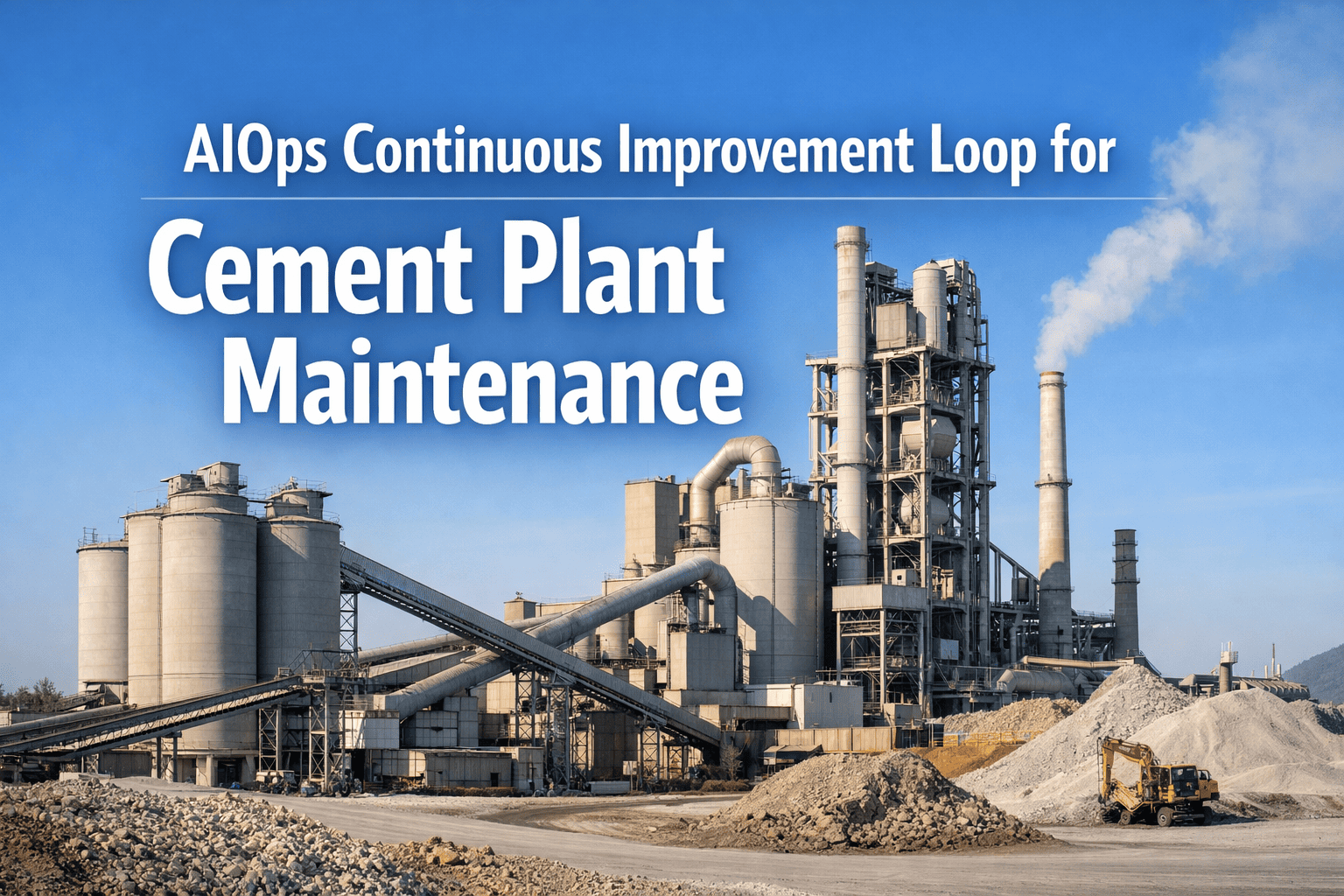
AIOps Continuous Improvement Loop for Cement Plant Maintenance

By Johnson on April 16, 2026

cement-plant-aiops-maintenance-continuous-improvement-loop-cmms

Most cement plants invest in predictive maintenance tools and see an initial improvement — then plateau. Downtime drops in month three, stabilises in month six, and by month twelve the gains are no longer compounding. The reason is almost always the same: the AI model was trained once and never updated. Every failure event that goes uncaptured, every near-miss that is not fed back into the system, every seasonal wear pattern that is not logged — all of it is wasted intelligence that your maintenance operation never learns from. Start a free trial on Oxmaint and activate the AIOps continuous improvement loop that makes your cement plant maintenance measurably smarter every single month — not just in the first quarter of deployment.

Quick Answer

AIOps continuous improvement in cement plant CMMS means every failure event, successful prediction, near-miss, and work order outcome automatically retrains the AI model — so detection accuracy, RPN scoring, and maintenance scheduling improve month-over-month without manual re-engineering. Plants running closed-loop AIOps frameworks achieve compounding reliability gains that plateau-based predictive maintenance deployments never reach.

82%
Cement plants experience unplanned downtime every 3 years — most running static AI models that do not learn from each event
$2.1M
Verified savings at a South Asia cement plant within 8 months of deploying closed-loop AI maintenance with CMMS feedback integration
98.5%
PM compliance rate achieved when AIOps continuously adjusts inspection schedules based on actual asset condition and feedback data
Q×Q
Compounding accuracy improvements quarter over quarter — what closed-loop AIOps delivers that one-time trained static models cannot

The Plateau Problem — Why Most Predictive Maintenance Stops Improving

A cement plant deploys vibration monitoring on the kiln main drive. The AI flags a bearing anomaly. The maintenance team intervenes. The kiln runs. The plant manager declares predictive maintenance a success. Six months later, the model is still making the same types of predictions with the same accuracy. It has not learned that kiln bearing failures on this specific unit accelerate faster during high-clinker campaigns. It has not absorbed the near-miss on the raw mill that was caught by an operator, not the AI. It has not updated based on the three work orders that were completed incorrectly and re-opened. The model is frozen at the day it was deployed. This is the plateau — and it is where most cement plant AI investments stall.

Static AI vs AIOps Continuous Improvement
Static Predictive Maintenance AI
Trained once — accuracy fixed at deployment date
Does not learn from confirmed failures or near-misses
Work order outcomes not fed back into the model
Seasonal and campaign wear patterns require manual retraining
False positive rate stays constant — alert fatigue grows
Reliability gains plateau after month 3–6
AIOps Continuous Improvement Loop in Oxmaint
Model retrains automatically after every confirmed event
Near-misses and operator observations fed into learning pipeline
Every closed work order updates failure probability scores
Seasonal patterns learned from rolling 24-month operational data
False positive rate decreases month-over-month as model refines
Reliability gains compound continuously — no plateau
Stop Running Maintenance on a Model That Stopped Learning Six Months Ago

Oxmaint's AIOps framework retrains on your cement plant's live failure data, work order history, and sensor trends automatically — no data science team required. Book a demo to see continuous model improvement running on real cement plant data.

The 5-Stage AIOps Continuous Improvement Loop

AIOps in cement plant maintenance is not a single tool — it is a closed feedback architecture where every stage feeds intelligence back into the previous stages, making the entire system progressively more accurate. Oxmaint implements this loop across five stages that run continuously without manual intervention.

AIOps Loop
Runs every shift
01
Sense
Live sensor data, SCADA feeds, and manual inspection logs captured continuously across kiln, mill, conveyor, and cooler assets
02
Predict
AI model scores each asset for failure probability and generates ranked work orders — Detection, Occurrence, and Severity updated from live data
03
Act
Maintenance team executes work orders — intervention outcome, parts used, actual fault found, and repair time all captured in Oxmaint CMMS
04
Validate
AI compares its prediction against actual outcome — confirmed prediction, false positive, missed fault, or near-miss, each tagged and categorised
05
Learn
Model retrains automatically using validated outcomes — thresholds recalibrated, failure mode weights adjusted, plant-specific patterns incorporated
Each cycle feeds back to Stage 01 — the loop never stops

What Each Feedback Signal Teaches the AI Model

Confirmed Failure Event
What happened: AI predicted bearing degradation. Technician found and replaced a failing bearing. Confirmed match.
What the AI learns: The specific vibration frequency pattern that preceded this failure on this asset type at this plant. Detection threshold tightened. Lead time for this failure mode extended.
Missed Failure (Near-Miss)
What happened: Crusher stoppage occurred. Operator noticed the warning sign. AI did not flag it. Logged in Oxmaint as undetected event.
What the AI learns: The sensor pattern that was present but below threshold before this fault. Occurrence probability for this failure mode on this asset class updated upward. Coverage gap flagged for sensor review.
False Positive Work Order
What happened: AI raised a Critical work order. Technician inspected the asset. No fault found. Work order closed as false alarm.
What the AI learns: The signal pattern that triggered the false positive. Threshold adjusted. Plant-specific noise profile updated. Alert fatigue reduced for the maintenance team over subsequent weeks.
Repair Outcome Data
What happened: Planned bearing replacement completed during shutdown window. Parts consumed, time taken, and post-repair sensor baseline logged.
What the AI learns: Post-repair asset health baseline for this unit. Actual replacement interval vs scheduled interval. Spare parts consumption rate updated for procurement optimisation.

Monthly Performance Trajectory — AIOps vs Static Model

Month Static Model — Accuracy AIOps Loop — Accuracy AIOps Advantage Unplanned Events Avoided (AIOps)
Month 1–2 68% — initial calibration 68% — same starting baseline Equivalent at launch 1 of 3 predicted correctly
Month 3–4 68% — model unchanged 76% — 12 feedback events absorbed +8% accuracy 2 of 3 predicted correctly
Month 5–6 68% — plateau confirmed 83% — seasonal patterns learned +15% accuracy 3 of 4 predicted correctly
Month 9–12 68% — deteriorating vs new failure modes 91% — plant-specific failure library built +23% accuracy 9 of 10 predicted correctly

4 CMMS Data Streams That Power the Learning Loop

01
Work Order Closure Data

Every closed work order in Oxmaint — fault confirmed, parts used, repair method, re-open rate, and technician observation notes — feeds directly into the AI model's occurrence probability calculations for that failure mode and asset. A raw mill roller bearing replaced ahead of schedule because the AI caught early degradation becomes a training data point that improves the model's lead time for the next detection on the same asset class. Start a free trial to connect your work order closures to the AI learning pipeline.

02
Inspection Checklist Observations

Mobile inspection rounds completed in Oxmaint capture technician observations — unusual sounds, temperature feels, visual anomalies — as structured data. When a technician notes "elevated temperature at girth gear lubrication point" on a digital checklist, that observation is correlated against sensor readings from the same time window and incorporated into the AI's contextual awareness for that asset. Human senses catch signals that instruments miss — AIOps captures both.

03
Production KPI Correlation

Cement mill output rate, kiln specific heat consumption, and raw mill throughput are not just production metrics — they are indirect condition indicators. A kiln running at 10% above target throughput for three consecutive shifts generates measurably higher mechanical stress on the main drive. Oxmaint's AIOps layer correlates production KPIs with asset condition trends in real time, adjusting failure probability scores when production is outside normal operating bands. Book a demo to see production KPI to maintenance risk correlation in Oxmaint.

04
Shift Handover Narrative Mining

Digital shift handover logs in Oxmaint capture the informal maintenance intelligence that traditionally lives in operators' heads and evaporates at every personnel change. NLP processing of handover notes extracts structured failure indicators — equipment names, abnormal behaviours, timing patterns — and feeds them into the AI model as additional data points alongside sensor readings. The result is a system that learns from every shift, not just from sensor anomalies that cross configured thresholds.
Compounding Value — What Gets Better Every Month

Month 4–6
Plant-Specific Patterns Emerging
AI distinguishes this plant's kiln from fleet-average behaviour
False positive rate down 40% from month 1 baseline
Detection lead time extends from hours to days for known failure modes
Month 7–12
Seasonal Intelligence Activated
Monsoon / summer / winter wear rate differences factored into predictions
Campaign vs steady-state operating mode distinction learned
Spare parts consumption predictions accurate to within 8% of actual
Month 13–24
Deep Asset Intelligence
Remaining useful life predictions with 90%+ confidence for critical assets
Maintenance budget forecasting accurate to within 12% of actual annual spend
Unplanned events reduced 48–65% versus pre-AIOps baseline

Frequently Asked Questions

Oxmaint's AIOps loop shows measurable accuracy improvement within 60–90 days as the first 8–15 feedback events are absorbed. By month 6, most plants see detection accuracy 12–18 percentage points above the initial deployment baseline. The compounding effect accelerates after month 6 once seasonal patterns begin to be captured. Book a demo to review accuracy trajectory data from similar cement plant deployments.
No. Oxmaint's continuous improvement loop is fully automated — work order closures, inspection outcomes, and sensor trend validations feed the model without any manual data science intervention. Reliability engineers see the output (improved predictions, adjusted thresholds) without needing to manage the underlying ML pipeline. Start a free trial to see the automated retraining pipeline in action.
New assets are onboarded using Oxmaint's industry failure mode library as the initial baseline — cement plant templates for kilns, mills, crushers, and conveyors provide starting Occurrence and Detection scores. The AIOps loop then begins collecting plant-specific data for the new asset, transitioning from library-informed to plant-specific predictions within 4–6 months of operation. Book a demo to see the asset onboarding and baseline calibration process.
Yes. Oxmaint integrates with existing SCADA and DCS historian data via OPC-UA, MODBUS, REST API, and MQTT. Most cement plants achieve DCS historian to Oxmaint integration within 4–8 weeks without replacing any existing control infrastructure. All sensor data, alarm histories, and process KPIs flow into the AIOps learning pipeline automatically. Start a free trial and connect your first SCADA data feed within days.
Every model update, threshold change, and prediction validation in Oxmaint is timestamped and immutable — creating a full audit trail of how maintenance decisions were made and why. This directly satisfies ISO 55000 clause 6.2 asset management plan evidence requirements and MSHA inspection documentation standards for equipment condition assessment. Book a demo to review Oxmaint's compliance documentation outputs.
Your Cement Plant Maintenance Should Get Smarter Every Month — Not Just in Month One

Share This Story, Choose Your Platform!