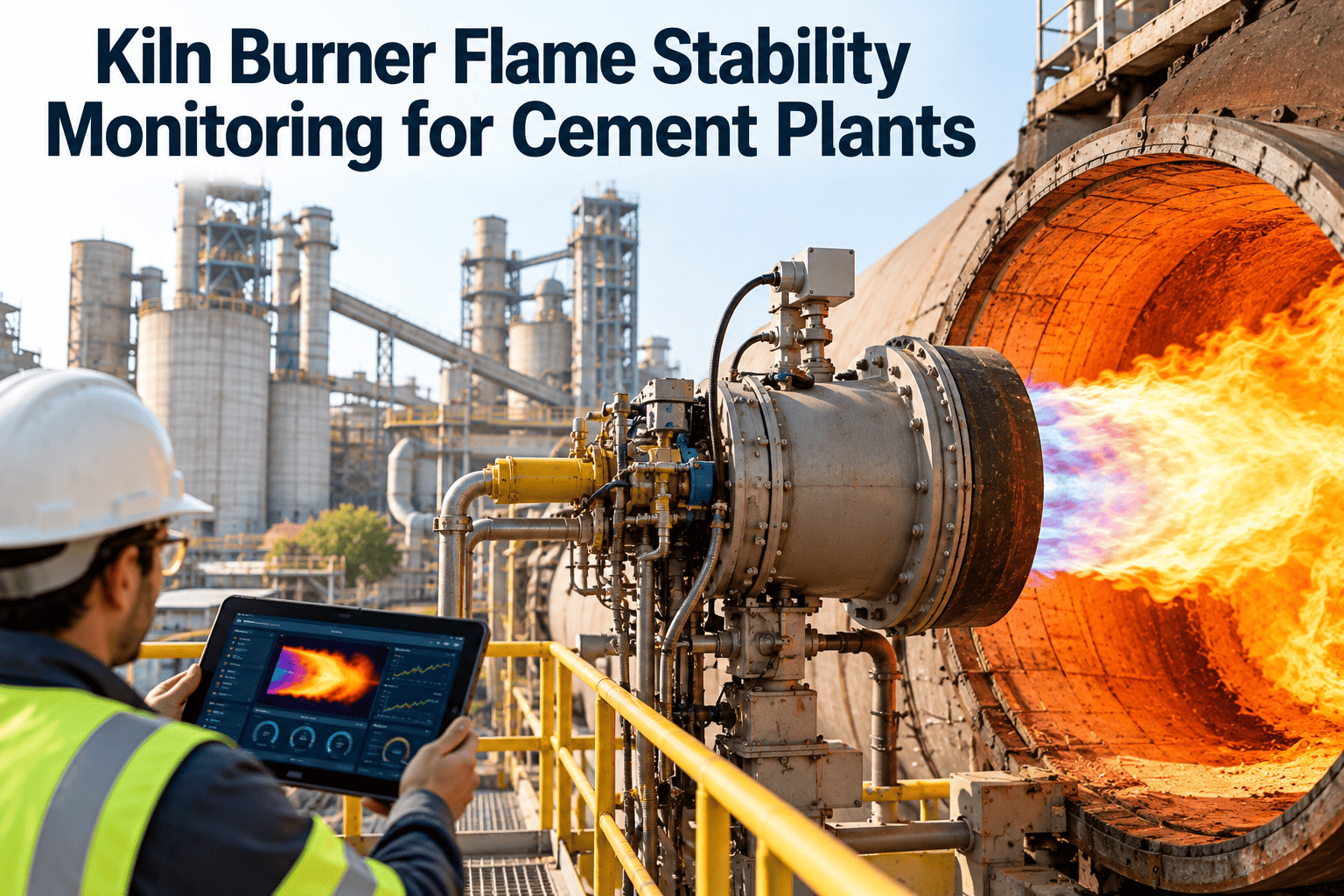
The kiln burner is the single most influential component in a cement plant's heat economy — flame shape, coating stability, and specific heat consumption all trace back to its condition. A burner degraded by just 8 mm of tip wear can push fuel consumption up 2–4% and shorten refractory campaigns by weeks. This guide covers kiln burner and combustion system maintenance end-to-end: primary air pipe integrity, burner tip inspection, flame shape optimization, fuel line reliability, and the CMMS-driven maintenance program that keeps performance aligned with heat balance targets. Ready to digitize your burner PM? Start Free Trial.
Is a distorted flame quietly burning 4% of your fuel budget every single day?
Kiln burner degradation rarely triggers an alarm — it shows up as rising specific heat consumption, shorter refractory campaigns, and unstable coating. A structured PM program protects flame geometry, tip clearance, and primary air delivery before deviation turns into dollars lost.
Burner & Combustion Maintenance Checklist
Each inspection tier below maps to a failure mode observed in operating cement kilns. Tier 1 runs daily during shift rounds; Tier 2 aligns with monthly stops; Tier 3 requires a planned kiln outage with the burner withdrawn to the floor.
Daily Operational Checks
- Flame shape & attachment observed via kiln camera — no impingement on coating
- Primary air fan motor current within ±5% of baseline amperage
- Coal/coke conveying pressure stable, no pulsation in fuel line
- Burner cooling fan running, nozzle temperature below 250 °C
- NOx trend within 10% of setpoint — early indicator of flame drift
Monthly Targeted Service
- Primary air pipe internal build-up cleaned, axial/radial swirler vanes inspected
- Burner tip protrusion measured — reference pin to cooler nose, ±10 mm tolerance
- Fuel line flexible hoses leak-tested, wear-back elbows thickness-checked
- Alternative fuel (AF) channel inspected for bridging, rope, or slag accumulation
- Refractory castable on burner nozzle inspected, minor patching applied
Annual Outage Overhaul
- Burner fully withdrawn, tip removed, nozzle orifice measured with pin gauges
- Primary air duct pressure-tested — target leakage below 3% of design flow
- Coal channelity verified, annular gap within ±0.5 mm of drawing
- Swirler assembly replaced if vane erosion exceeds 1.5 mm
- Full heat balance re-run, flame re-tuned to coating and SHC target
| Component | Inspection Frequency | Reject Criterion | Failure Mode |
|---|---|---|---|
| Burner tip nozzle | Monthly / Annual | Orifice wear > 3 mm | Flame asymmetry, CO spike |
| Primary air pipe | Monthly | Build-up > 15% of flow area | Axial momentum loss, long flame |
| Swirler vanes | Annual outage | Vane erosion > 1.5 mm | Reduced recirculation, poor ignition |
| Fuel line elbows | Monthly | Wall thickness < 3 mm | Pulverized fuel leak, fire risk |
| AF channel liner | Quarterly | Slag deposit > 10% blockage | AF feed instability, flame pulsation |
| Nozzle refractory | Monthly / Annual | Crack or spall > 50 mm | Burner body overheating, distortion |
The Economics of Burner Drift
Burner degradation compounds quietly. A 3 mm wear on the coal nozzle tip widens the annular gap, reducing exit velocity, lengthening the flame, and shifting the burning zone toward the kiln inlet. The cost shows up in three places: fuel, refractory, and coating instability.
A 50 kcal/kg-clinker drift on a 4,000 tpd kiln at $3.20/Gcal = ~$746K/year in avoidable fuel cost.
Maintain M between 0.6–0.9 for pulverized coal. Below 0.5 the flame detaches; above 1.0 it shortens excessively and risks impingement.
A 4,200 TPD Plant Recovers $1.1M in 11 Months
A mid-sized integrated plant in South Asia operated a 14-year-old multi-channel burner with no formal PM history. Specific heat consumption had crept from 880 to 942 kcal/kg-clinker over 18 months. The refractory campaign in the burning zone had fallen from 12 months to 8. The root cause was never a single failure — it was accumulated drift.
Burner withdrawn, tip orifice measured at 4.1 mm oversize. Primary air leakage estimated at 9%. Swirler vanes eroded beyond 2 mm. SHC locked at 942 kcal/kg-clinker.
New nozzle assembly installed, swirler replaced, primary air duct sealed. Burner re-centered to kiln axis within 0.3 mm. Flame re-tuned to a 6% O₂ exit baseline.
Alternative fuel feed stabilized after AF channel cleaning and liner replacement. AF substitution rate raised from 12% to 24% without flame pulsation or CO excursion.
OxMaint CMMS deployed with 47 burner-specific PM triggers — daily flame check, weekly tip camera review, monthly air pipe inspection. Work orders auto-generated from trend deviations.
SHC back to 884 kcal/kg-clinker. Burning zone refractory campaign projected at 13 months. Net documented savings: $1.1M across fuel reduction and deferred refractory spend.
Stop estimating burner condition. Start tracking it.
Deploy OxMaint CMMS to digitize every kiln burner inspection, trend SHC against tip wear, and trigger PM before flame drift costs you another dollar in fuel.
What Plant Maintenance Leaders See
From a 3.2 MTPA integrated plant running two dry-process kilns with 30–38% alternative fuel substitution.
"Before OxMaint our burner PM lived in a spreadsheet that no one opened between outages. Within four months we caught a primary air duct leak and a 3 mm tip deviation that would have cost us a refractory campaign. The SHC trend dashboard alone paid for the platform."
"Alternative fuel substitution only works if the burner tip and AF channel are maintained to spec. We went from 22% to 34% AF rate without a single unscheduled kiln stop — entirely a maintenance discipline story."
— Process Manager, 4,200 TPD KilnKiln Burner Maintenance FAQ
How often should the burner tip be inspected in a cement kiln?
Burner tip condition should be visually verified monthly through the kiln camera and physically measured during every planned kiln stop. A full withdrawal with pin-gauge measurement of the orifice should occur at least once per year. High-AF kilns or those firing petcoke above 70% may require inspection every 6 months due to elevated erosion rates.
What specific heat consumption penalty indicates burner degradation?
A sustained SHC rise of 20–50 kcal/kg-clinker above the established baseline typically signals burner drift — usually tip wear, primary air leakage, or swirler erosion. When the deviation exceeds 30 kcal/kg-clinker, withdraw and inspect the burner before refractory damage compounds the cost. You can Book a Demo to see how OxMaint trends SHC against burner PM history automatically.
Can alternative fuel use increase burner maintenance frequency?
Yes. AF channels are prone to slagging, bridging, and rope formation that disturb fuel delivery and flame symmetry. Plants above 25% AF substitution should clean and inspect the AF channel quarterly, and the burner tip and swirler every 6 months. AF also introduces chlorine and alkali cycles that accelerate nozzle refractory degradation.
What is the ideal primary air momentum ratio for a pulverized coal flame?
For pulverized coal, maintain a momentum ratio (M) between 0.6 and 0.9. Below 0.5 the flame becomes lazy and elongated, risking afterburning and CO spikes. Above 1.0 the flame shortens aggressively and may impinge on the burning zone coating. Re-measure M whenever fuel type, primary air fan speed, or tip geometry changes.
How does a CMMS improve kiln burner reliability?
A CMMS like OxMaint captures every burner inspection as structured data — tip measurements, photos, flame observations, SHC readings — and links them to work orders and trend charts. This converts "experience-based" maintenance into a traceable PM program with automatic triggers, so deviations are caught before they escalate. Get started with a Start Free Trial to digitize your burner PM in under a week.
Protect Every Flame, Every Shift, Every Kilogram of Clinker
OxMaint gives your maintenance team the inspection templates, trend dashboards, and automated PM triggers needed to keep kiln burner performance locked to your heat balance targets — no more drift between outages.
Free 14-day trial · No credit card