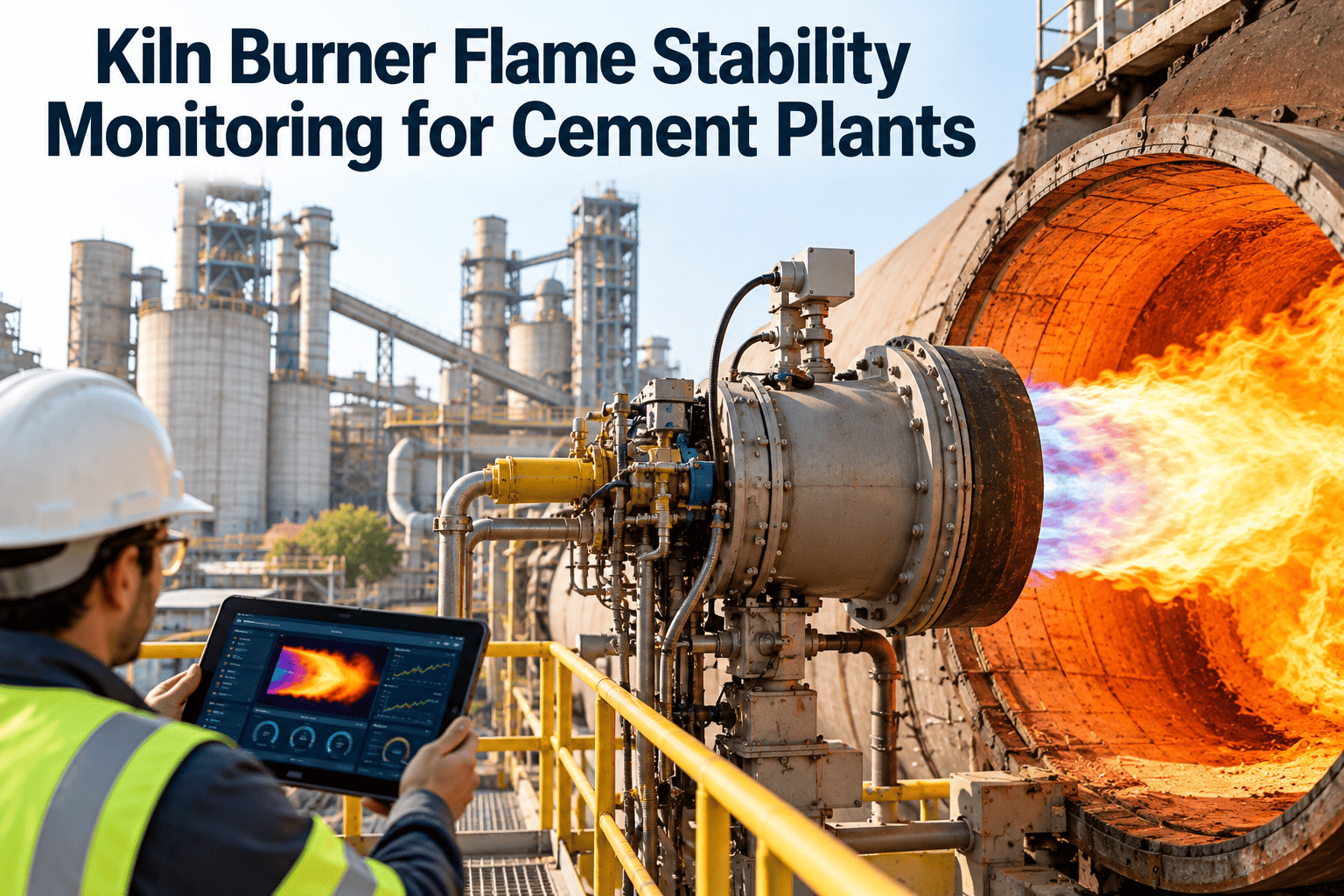
A kiln burner that is even slightly out of tune costs a plant real money without ever tripping an alarm — a long, lazy flame pushes back-end temperature up, a burner set too close to the charge triggers sulfur circulation and coating, and primary air run too high simply throws heat away as sensible loss. None of this requires new capital; it requires disciplined tracking of flame momentum, primary air percentage, and burner-to-brick clearance against a documented baseline. This guide walks through the four-factor tuning framework operations teams use to hold specific energy consumption steady between shutdowns, and how a CMMS turns burner settings into a tracked, repeatable record instead of an operator's private notebook — starting with your kiln's own combustion data.
When was your burner setting last verified against a momentum target — not just "how the flame looks"?
Flame momentum, primary air percentage, and burner position drift shift-to-shift unless they're logged and checked against a documented target range.
Burner setting is judged by eye far more often than by number
Most kiln control rooms still rely on an operator's visual read of the flame — color, length, and shape — rather than a logged momentum and primary-air calculation checked against a documented target.
- 01Primary air fan settings get adjusted shift-to-shift with no record of what changed or why
- 02Burner pipe position — axial and swirl damper settings — is rarely logged against a specific fuel mix or AF substitution rate
- 03Coating and ring-formation events are treated as raw-mix problems long before burner alignment is ever checked
Four factors govern flame quality — Alignment, Dryness, Air, Momentum
Optimum Flame Theory reduces kiln burner tuning to four checkable factors. Getting all four right, and documenting each, is what separates a repeatable tuning discipline from guesswork.
Burner position on-axis
Burner should sit on the nose ring, parallel to kiln axis. Push in up to 0.5m for front-end coating, pull out up to 0.5m for an overly long flame.
Fuel moisture control
Coal and petcoke moisture should stay under 1%; alternative fuel moisture above roughly 0.02 kg water/kg clinker needs the AF injection point moved further into the kiln.
Back-end oxygen level
CO begins rising once kiln-back-end oxygen drops near 1.5% for coal flames — roughly 1% higher for petcoke — setting the practical floor for combustion air.
Specific flame momentum
A function of kiln oxygen, secondary air temperature, and burning-zone thermal load — the single parameter most responsible for flame shape and stability.
What the flame is telling you, and where to look first
Most flame symptoms map back to one of two adjustable settings — primary air percentage or burner position — rather than a raw-mix or fuel-quality issue.
| Symptom observed | Likely cause | Adjustment to check first |
|---|---|---|
| Long, lazy flame reaching the riser | Insufficient flame momentum or burner pulled too far out | Increase axial primary air share; pull burner in toward nose ring |
| Front-end coating and ring formation | Burner positioned too far into the kiln, local reducing conditions | Push burner in up to 0.5m; verify sulfur circulation at kiln inlet |
| High CO with normal oxygen reading | Poor fuel-air mixing or momentum below the stability threshold | Check specific momentum against the 7 N/MW guideline for the burner type |
| Rising specific heat consumption, stable clinker quality | Primary air percentage creeping upward, throwing away sensible heat | Re-verify primary air % against the 8–14% target band for the burner design |
Turn flame symptoms into a logged, repeatable adjustment
A CMMS-linked burner record ties every axial and swirl setting change to the shift, the fuel mix, and the resulting kiln back-end reading.
What changes when burner settings are logged against the asset
| Dimension | Operator's notebook | CMMS-linked burner record |
|---|---|---|
| Setting history | Lost at shift change, rarely reviewed | Every axial/swirl adjustment logged against date, shift, and fuel mix |
| Diagnosing recurring coating | Re-investigated from scratch each time | Prior burner position changes visible alongside coating event history |
| AF ramp-up decisions | Based on operator memory of "what worked last time" | Cross-referenced against logged momentum and back-end oxygen at similar TSR |
| Burner refurbishment timing | Tied to a fixed calendar interval | Tied to tip wear inspection data linked to the burner asset record |
Cement kiln burner tuning — five common questions
What is a good target for flame momentum on a cement kiln burner?
A widely cited practical minimum is 7 N/MW for a stable flame, though the exact optimum depends on kiln oxygen, secondary air temperature, and burning-zone thermal load specific to your kiln.
What primary air percentage should a conventional burner run?
Conventional burners typically run 8–14% primary air as a share of total combustion air; low-primary-air burner designs target under 10% to raise flame temperature and cut heat loss.
How far should the burner be repositioned to fix coating issues?
Standard practice is up to 0.5 meters in either direction — pushed in toward the nose ring for front-end coating, pulled out for an excessively long flame.
Can burner tuning alone reduce specific heat consumption?
Yes — correcting primary air percentage and flame momentum recovers wasted sensible heat without any capital investment, though gains are typically incremental rather than dramatic on their own.
How do we start logging burner settings against our kiln asset?
Most plants begin by recording axial and swirl damper positions alongside each shift's fuel mix and back-end oxygen reading. Schedule a Demo and we'll show you the setup.
Give every burner adjustment a record, not just a memory
Log flame momentum, primary air percentage, and burner position against your kiln asset so every shift tunes from the same documented baseline.
Free trial · No credit card required