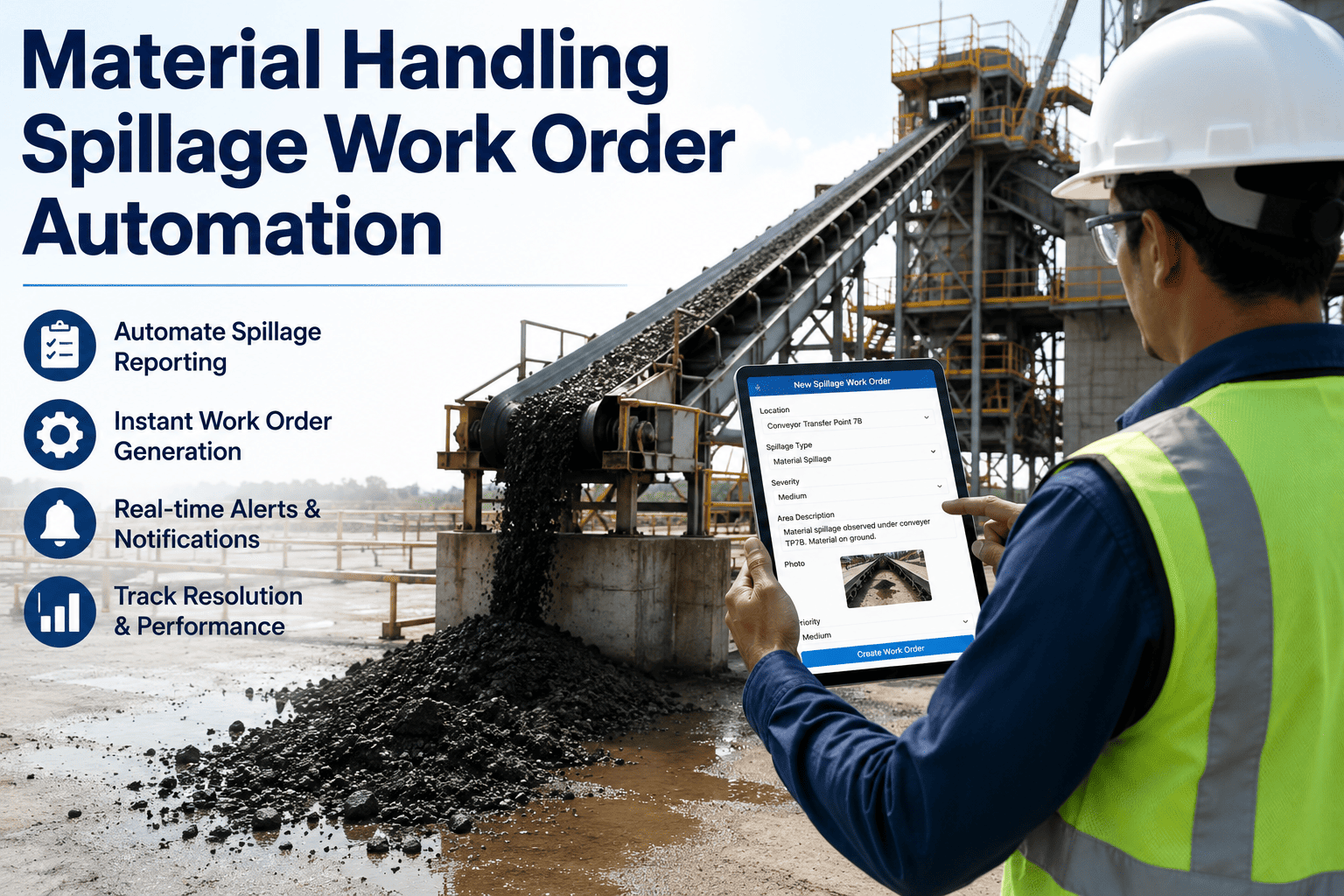
Spillage at a transfer chute or belt discharge point rarely gets logged as a maintenance issue until it has already become a safety hazard or a housekeeping complaint. An operator notices material building up under a conveyor, mentions it at shift handover if they remember, and by the time anyone with a shovel and a work order shows up, the pile has grown, the walkway is blocked, and the root cause — a worn skirt seal or a misaligned chute liner — is still sitting there creating the next pile. OxMaint turns that spillage observation into an automated work order the moment it is reported. Sign in to OxMaint to automate spillage reporting across your material handling circuit.
Why Spillage Is Expensive
The Real Cost Of Unmanaged Material Spillage
40%
of conveyor and material handling issues are missed by manual inspection rounds, according to industrial CMMS deployment data
2x
faster resolution reported by plants using digital checklists with photo documentation compared to paper-based reporting
31 → 10
conveyor-caused unplanned stops per year at one plant after structured spillage and idler inspection replaced reactive housekeeping
Before And After
How Spillage Reporting Changes With Automated Work Orders
Without Automation
Operator notices spillage, mentions it verbally or writes it in a logbook that may not be read for hours
No photo, no location detail — the cleanup crew has to search the area to find the actual pile
Root cause, such as a worn skirt seal, is never linked to the cleanup, so the same spot spills again next week
No record exists to show which transfer points spill repeatedly over time
With OxMaint Automation
Operator submits a spillage report from their phone at the exact location, with a photo, in under a minute
A work order is created instantly and routed to the cleanup crew with the exact chute or belt segment identified
Recurring spillage at the same location automatically flags the transfer point for a root cause inspection
Every spillage event builds a searchable history per asset, showing which points need permanent fixes
Turn Every Spillage Observation Into A Tracked Work Order
OxMaint captures spillage reports with location and photo the moment they happen, routes them to the right crew, and builds the history that shows you which transfer points need a permanent fix.
Where Spillage Happens Most
Material Handling Zones That Need Structured Spillage Tracking
Transfer Chutes And Chute Lips
Worn or misaligned liners let material escape the chute path, building up underneath and around the transfer point.
Belt Skirting And Loading Zones
Degraded skirt rubber lets fines and fragments spill continuously along the sides of the belt right after loading.
Discharge And Head Pulley Areas
Carryback that is not cleaned by belt cleaners accumulates on the return side and drops along the full belt run.
Stockpile And Reclaim Points
Overfilled hoppers and reclaim feeder overflow create spillage that is often the last to be noticed and reported.
Mobile Reporting In Practice
From Spillage Sighting To Cleanup Work Order
1
Operator or inspector spots spillage during a walkthrough and opens the OxMaint mobile app or scans the nearest asset QR code.
2
A photo is taken directly from the phone camera, automatically tagged with location, asset, and timestamp.
3
The report is submitted with a short description and severity rating, no desktop login required.
4
A work order is generated automatically and routed to the cleanup crew, with root cause flagged if the location has a spillage history.
What Changes For Your Team
The Impact Of Structured Spillage Work Order Automation
For Operations And Housekeeping
Cleanup requests take under a minute to submit and reach the crew immediately, not after a shift handover
Photo evidence means the crew arrives already knowing the scale and exact location of the spillage
Safety hazards near walkways get flagged and resolved faster because reporting friction is removed
For Maintenance And Reliability
Recurring spillage at the same chute or skirt location is visible from history, pointing directly to the root cause component
Skirt seal, liner, and belt cleaner replacement can be scheduled proactively instead of reacting to the same pile every week
Housekeeping labour hours spent on repeat cleanup drop once the underlying wear component is finally addressed
Operations Team Experience
What Changed After Spillage Reporting Was Automated
We had the same three transfer points spilling material every single week and nobody had connected the dots because each cleanup was logged separately, if it was logged at all. Once we started capturing every spillage report with a photo and location, the pattern was obvious within a month. We replaced two skirt seals and a chute liner, and those three spots have not spilled since.
Maintenance Supervisor
Cement Plant, Raw Material And Clinker Handling Circuit
Warning Signs
Signs Your Plant Needs Automated Spillage Tracking
The Same Spot Keeps Reappearing On The Cleanup List
If a supervisor can already name the three chutes that spill every week without checking a report, the root cause has never actually been fixed.
Cleanup Labour Hours Are Rising, Not Falling
A growing housekeeping workload with no matching drop in spillage events usually means crews are treating symptoms instead of causes.
Safety Near-Misses Near Spillage Areas
Slip hazards near walkways that never make it into a formal report are the clearest sign that reporting friction is too high right now.
No One Can Answer Which Point Spills Most
If that question has to be answered from memory rather than a report, there is no data trail supporting a fix.
Root Cause Linking
How Repeated Spillage Gets Connected To Its Cause
1
Every spillage report is tagged to the exact chute, skirt, or transfer point where it occurred, not just a general area of the plant.
2
OxMaint tracks how often that specific location generates a report, building a frequency history over weeks and months.
3
Once a location crosses a repeat threshold, it is automatically flagged for a root cause inspection rather than another routine cleanup.
4
The inspection finding, whether a worn seal or a liner replacement, is logged against the asset so the fix and the spillage history stay connected permanently.
The Shift
Where Most Plants Start vs Where They End Up
Manual Reporting Era
Spillage mentioned verbally or in a logbook that is read inconsistently
Cleanup happens without ever identifying the worn component behind it
No way to show leadership which points cost the most in repeat labour
Automated Tracking Era
Every report captured with photo, location, and timestamp in under a minute
Recurring locations flagged automatically for a permanent fix, not another cleanup
A documented history supports capital requests for skirting and liner upgrades
Common Questions
What Plant Teams Ask About Spillage Work Order Automation
Do operators need special training to report spillage through OxMaint?
No. The mobile reporting form is designed to be filled in under a minute — take a photo, add a short note, select severity, and submit. Most operators are comfortable using it after a single walkthrough demonstration. Book a demo to see the mobile reporting flow.
How does OxMaint know a spillage location has a recurring problem?
Every spillage report is tagged to a specific asset or chute location, and OxMaint tracks the frequency of reports at that location over time. Once a threshold is crossed, the system flags the location for a root cause inspection rather than another routine cleanup. Sign in to view spillage history by location.
Can spillage work orders be prioritised differently from other maintenance requests?
Yes. Spillage near a walkway or emergency exit can be configured to raise a higher priority than spillage in a low-traffic area, so the cleanup crew addresses safety-relevant locations first without waiting for a planner to manually re-rank the queue. Sign in to configure spillage priority rules.
Does this replace the need for a housekeeping cleaning schedule?
No, it complements it. Routine housekeeping schedules stay in place for planned cleaning, while spillage automation catches the unplanned events between those scheduled rounds and connects repeat events to the maintenance root cause. Book a demo to see how the two workflows work together.
Can spillage data be used to justify equipment upgrades like new skirting or chute liners?
Yes. The spillage history report shows cleanup frequency, labour hours, and location trend per asset, which gives reliability engineers documented evidence to support a capital request for permanent fixes instead of relying on anecdotal complaints. Sign in to generate a spillage history report.
Stop Cleaning The Same Spillage Every Week
Automated spillage reporting connects every cleanup to its root cause, so your team fixes the worn seal or liner once instead of shovelling the same pile month after month.