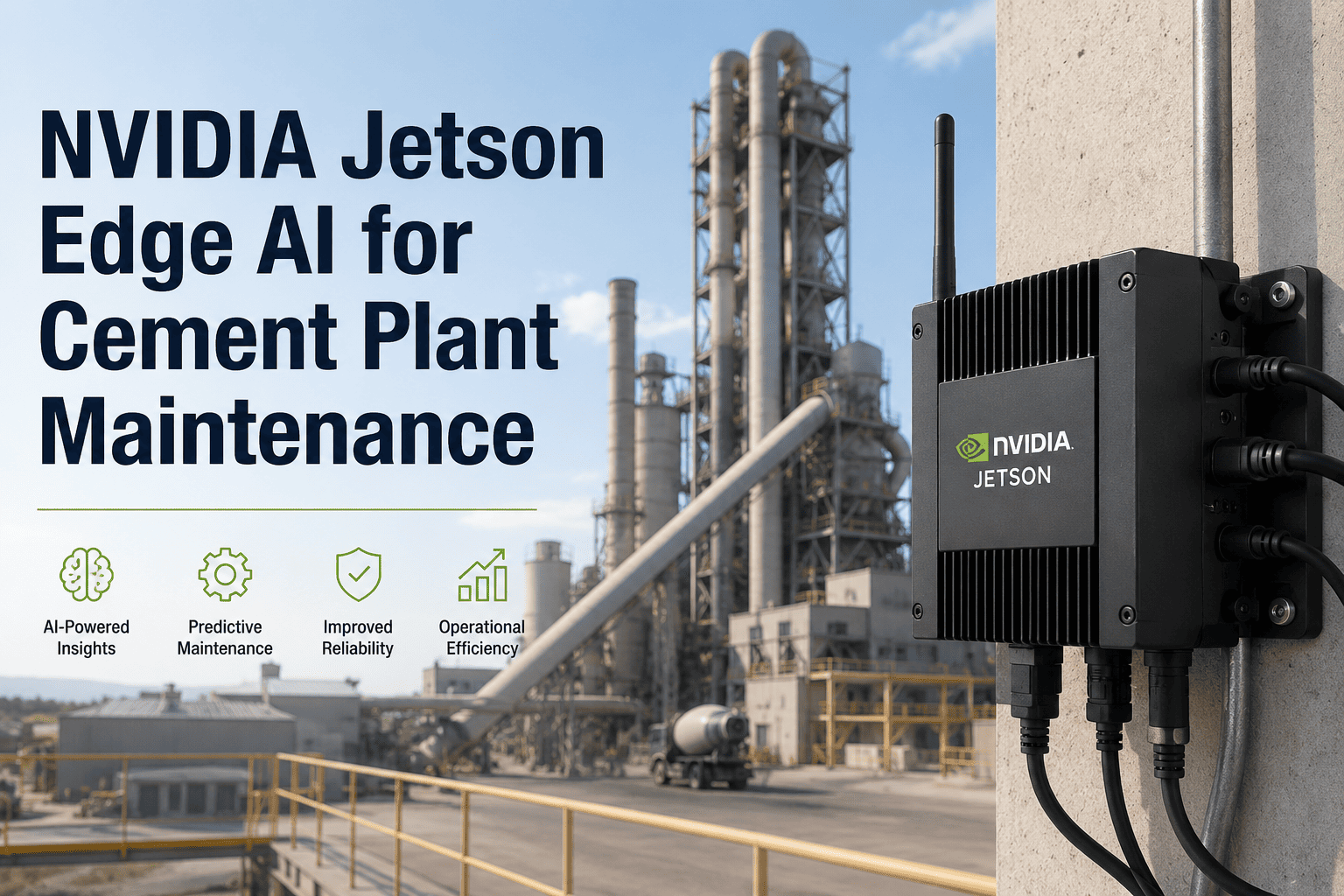
A single high-frequency vibration sensor on a cement mill bearing streams 25,600 samples per second — that is 2.2 billion data points per day from one sensor alone. A typical cement plant runs 50 to 200 critical assets with vibration, thermal, current, and pressure monitoring across each. The resulting data volume is measured in terabytes per day. Standard CPU infrastructure cannot process this in real time — it processes it retrospectively, in reports, after the failure window has already closed. GPU-accelerated inference changes the equation entirely. NVIDIA GPU compute processes thousands of cement plant sensor streams simultaneously, scoring multivariate anomalies in under 200 milliseconds — so the AI decision happens while the asset is still operating, not after it has stopped. Start an OxMaint free trial to see GPU-accelerated anomaly detection on your plant's actual sensor streams, or book a 30-minute demo to understand the infrastructure architecture for your facility.
OxMaint AI · NVIDIA GPU-Accelerated · Cement Plant
GPU-Accelerated Anomaly Detection
for Cement Plants
NVIDIA-powered inference servers process thousands of sensor streams simultaneously — delivering sub-second anomaly scoring across kiln, mill, and cooler assets that CPU-based systems cannot match in real time.
200ms
Edge inference latency — sensor to anomaly score
22 TB
Daily sensor data from 50 sensors on 200 assets
4–6×
Diagnostic precision with multi-sensor GPU fusion vs. single-sensor analysis
10 weeks
Typical time to production-confidence AI alerts from deployment
The Data Volume Problem
Why CPU Infrastructure Cannot Deliver Real-Time Cement Plant Anomaly Detection
The gap between what cement plant sensor infrastructure generates and what traditional analytics platforms can process in real time is the reason most "predictive maintenance" systems end up as retrospective reports. GPU compute closes that gap.
Processing architecture
Sequential — one sensor stream at a time
Throughput on 200-asset cement plant
Processes 15–30 minutes behind real time
Multivariate model inference
Too slow for real-time correlation analysis across 50+ sensors per asset
Anomaly detection timing
Retrospective — next report cycle
Failure window
Alert may arrive after the fault has progressed to the damage stage
Processing architecture
Massively parallel — thousands of sensor streams simultaneously
Throughput on 200-asset cement plant
Real-time — inference completed within 200ms of sensor reading
Multivariate model inference
Full correlation matrix analysis across all sensors every inference cycle
Anomaly detection timing
Live — alert generated within seconds of anomaly emergence
Failure window
Detection occurs in the earliest developmental stage — 14–42 days before failure
Architecture
The OxMaint GPU Inference Architecture for Cement Plants
OxMaint's AI infrastructure is designed for the specific data environment of cement manufacturing — high sensor density, continuous operation, and zero tolerance for detection latency that costs production uptime.
Layer 1 — Sensor Data Ingestion
DCS & SCADA streams via OPC-UA
Condition monitoring sensors — vibration, temperature, current
Process historian data feeds
Lab and quality data (LIMS)
↓
Layer 2 — Edge Inference (NVIDIA Jetson / IGX Thor)
Sub-200ms anomaly scoring at the plant floor level
Operates independently of cloud connectivity
TensorRT-optimized inference models per asset class
Latency-critical decisions stay on-premise
↓
Layer 3 — Cloud Training & Model Refinement
Nightly model retraining on new operational data
Cross-asset pattern learning across the full plant portfolio
Anomaly classification refinement from maintenance outcomes
Updated models deployed to edge devices automatically
↓
Layer 4 — CMMS Action (OxMaint)
Anomaly score above threshold triggers work order auto-generation
Pre-populated with asset, severity, recommended action, and parts
Mobile delivery to maintenance team within seconds of detection
Full audit trail from sensor reading to maintenance response
OxMaint orchestrates edge and cloud inference in a unified pipeline — latency-sensitive decisions at the edge, heavy model training in the cloud. The cement plant team sees a single dashboard and a single work order queue, regardless of where the inference runs.
Asset Coverage
GPU Inference Performance Across Cement Plant Asset Classes
GPU acceleration delivers the most pronounced advantage on assets with high sensor density and complex failure signatures — precisely the assets that cause the highest downtime cost when they fail without warning.
| Asset Class |
Sensor Streams Processed |
GPU Inference Latency |
Detection Lead Time |
Downtime Cost Avoided |
| Rotary kiln main drive |
24 simultaneous streams |
180ms per inference cycle |
18–35 days |
$20K–$50K per hour |
| Vertical Roller Mill (VRM) |
18 simultaneous streams |
160ms per inference cycle |
21–42 days |
$180K–$420K per event |
| Preheater ID fan |
12 simultaneous streams |
140ms per inference cycle |
14–28 days |
245 TPH kiln feed loss per trip |
| Cement ball mill |
16 simultaneous streams |
155ms per inference cycle |
15–30 days |
$180K–$420K per event |
| Compressor systems |
10 simultaneous streams |
130ms per inference cycle |
12–25 days |
$3K–$8K per incident |
| Belt conveyor drives |
8 simultaneous streams |
120ms per inference cycle |
10–20 days |
Full production line stoppage |
Your Sensor Data Is Already Telling You About the Next Failure.
The Question Is Whether Your Infrastructure Is Fast Enough to Listen.
OxMaint's GPU-accelerated inference layer processes your existing sensor streams in real time — no new hardware on most plants, and anomaly alerts active within 10 weeks of deployment.
Deployment Model
On-Premise vs. Cloud GPU Inference: Choosing the Right Architecture
Cement plants have specific infrastructure constraints — legacy DCS systems, limited WAN bandwidth, and data sovereignty requirements — that determine which GPU inference deployment model is appropriate. OxMaint supports both.
Best for most cement plants
Hardware
NVIDIA Jetson AGX Orin or IGX Thor deployed at plant level
Inference latency
Sub-200ms — no WAN dependency for anomaly scoring
Data sovereignty
Raw sensor data never leaves the plant network
Connectivity requirement
Intermittent cloud connectivity sufficient — edge operates independently
Best for
Kiln, mill, and fan assets where millisecond response prevents cascade failures
Best for model training
Hardware
NVIDIA DGX systems for heavy multivariate model training
Use case
Nightly model retraining and cross-plant pattern learning
Data volume handled
Full terabyte-scale historical sensor datasets for deep learning
Model deployment
TensorRT-optimized models pushed to edge devices after each training cycle
Best for
Building and refining anomaly detection models from accumulated plant data
OxMaint operates both inference paths in a unified system. Edge handles the real-time scoring that prevents failures. Cloud handles the training that makes the models smarter over time. The cement plant team manages one platform and one dashboard across both.
FAQs
NVIDIA GPU AI for Cement Plants: Technical Questions Answered
Does our cement plant need to purchase NVIDIA GPU hardware to use OxMaint's AI anomaly detection?
Not necessarily. OxMaint's cloud-based inference handles most cement plant deployments without on-premise GPU hardware. On-premise edge GPU hardware (NVIDIA Jetson or IGX) provides the lowest latency and the highest data sovereignty, but is typically deployed only on the highest-criticality assets where sub-second response matters most. Most plants start cloud-first and add edge hardware selectively as high-value use cases are validated.
Book a sizing conversation to understand the right architecture for your plant.
What is NVIDIA TensorRT and why does it matter for cement plant AI inference?
TensorRT is NVIDIA's high-performance deep learning inference library. It optimizes trained AI models to run as efficiently as possible on NVIDIA GPU hardware — typically reducing inference time by 2–5× compared to unoptimized models. For cement plant applications, TensorRT optimization is what makes sub-200ms anomaly scoring possible across dozens of simultaneous sensor streams on a plant-floor edge device. OxMaint deploys TensorRT-optimized models on all edge hardware as standard.
How does GPU-accelerated inference handle network outages at the cement plant?
Edge inference operates independently of cloud connectivity. If WAN connection drops, the NVIDIA edge device continues scoring anomalies from local sensor streams and queuing work orders locally. When connectivity is restored, data and alerts synchronize with the OxMaint CMMS. This architecture is specifically designed for the connectivity reality of cement plants in remote or infrastructure-constrained locations.
See the offline-capable architecture in a free trial.
How many sensor streams can a single NVIDIA Jetson AGX Orin handle in a cement plant deployment?
A Jetson AGX Orin running TensorRT-optimized multivariate inference models can process 400–600 simultaneous sensor streams at sub-200ms latency — sufficient for full coverage of a single large cement plant's critical assets. For plants with higher sensor density or multiple production lines, IGX Thor provides additional compute headroom. OxMaint's implementation team sizes edge hardware based on the specific sensor inventory of each plant during deployment planning.
How does OxMaint use GPU acceleration differently from standard SCADA alarm systems?
SCADA alarms compare individual sensor values to fixed thresholds — a CPU-level task requiring minimal compute. GPU acceleration is what enables multivariate deep learning inference: simultaneously processing the correlation matrix across all sensors for an asset, scoring the combined pattern against a learned normal baseline, and generating an anomaly score that reflects the relationship between sensors — not just their individual values. This is computationally intensive in a way that threshold alarms are not, which is why GPU acceleration produces a qualitatively different class of detection result.
Book a demo to see the technical difference in detection output.
OxMaint · NVIDIA GPU AI · Cement Plant
Real-Time. On-Premise. Sub-200ms.
The Anomaly Detection Your DCS Can't Deliver.
OxMaint's NVIDIA GPU-accelerated inference layer connects to your existing sensor infrastructure and delivers multivariate anomaly scoring in real time — across kiln, mill, fan, and compressor assets simultaneously. Most cement plants are generating production-confidence AI alerts within 10 weeks of sensor integration.