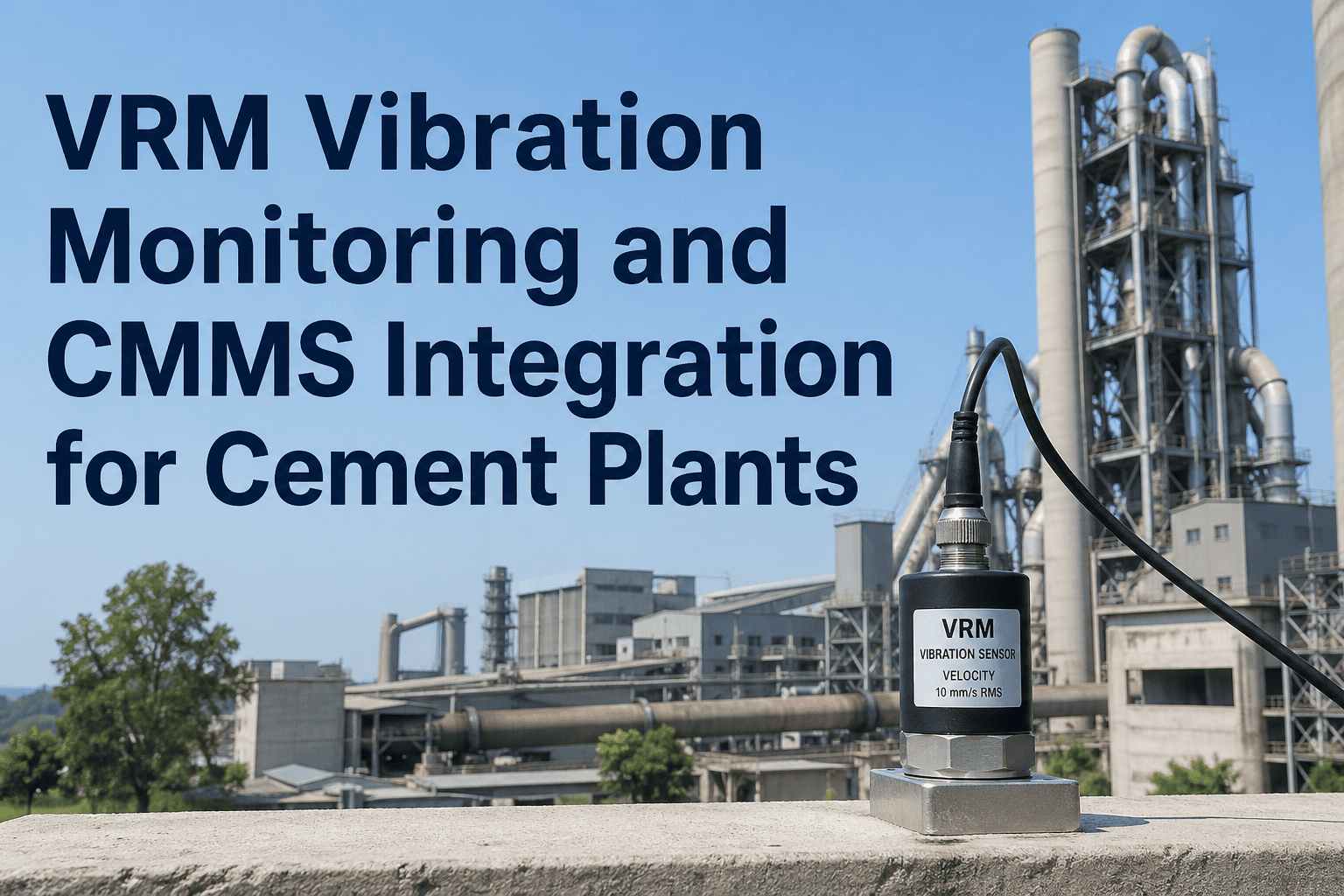
A cement mill rarely fails without warning. Trunnion bearings run hotter, gear mesh energy climbs, and vibration creeps up weeks before a trip or a forced stop. The difficulty is separating a real mechanical fault from the constant noise of grinding media, feed changes and mill filling. This guide explains how to build vibration anomaly detection for ball mills, vertical roller mills and their drives, and how a cement plant CMMS turns each alert into a tracked repair.
Grinding and Milling / Vibration Condition Monitoring
Cement Mill Vibration Anomaly Detection Guide
Learn where to measure, what patterns matter and how to act early on bearing, gear and drive faults before they stop clinker or cement grinding.
Motor
Gearbox
Pinion and girth gear
Mill shell
Trunnion bearings
P1 Motor DE and NDE
P2 Gearbox input and output
P3 Pinion bearings
P4 Girth gear mesh
P5 Trunnion bearings
Why Mill Vibration Is Harder to Read Than It Looks
What creates normal noise
- Grinding media impact inside the shell
- Changes in mill filling and material bed depth
- Feed rate swings and fineness set point changes
- Separator and fan loading in the same circuit
- Very low shaft speed on large ball mills
What indicates a real fault
- Sustained rise at a defined component frequency
- New sidebands around gear mesh frequency
- Bearing defect tones appearing in envelope spectra
- Vibration that stays high under stable operating conditions
- Vibration paired with rising bearing or oil temperature
A single overall vibration number cannot tell these apart. Anomaly detection works when the data is compared against the right operating state, and when frequency content is reviewed, not only amplitude.
Which Mill Types and Components Need Monitoring
Reading the Spectrum: Common Fault Signatures
High 1x running speed, mostly radial
Imbalance or bent shaft
Common on fans and separators with build-up or uneven wear. Check for material deposits before assuming a mechanical defect.
High 2x, axial component present
Misalignment
Typical at couplings between motor, gearbox and pinion. Often follows foundation movement or thermal growth.
Gear mesh frequency with sidebands
Gear wear or tooth damage
Sidebands spaced at shaft speed show modulation. Growth in sideband count and amplitude suggests progressing damage.
Bearing defect tones in envelope spectrum
Rolling element bearing defect
Early stage faults show in high-frequency envelope data long before overall levels change.
Many harmonics, raised noise floor
Mechanical looseness
Look at baseplate bolts, soft foot, cracked grout and loose bearing housings.
Erratic high peaks with process instability
Process-driven vibration
On vertical mills this often points to bed instability, feed variation or foreign material, not machine damage.
Process Cause or Mechanical Fault? A Decision Path
1
Confirm the operating state
Check mill load, feed rate, separator speed and any recent set point changes.
2
Compare against the same state
Match the reading to baseline data recorded under similar conditions.
3
Look at frequency content
Component-specific tones point to a fault, while broadband noise may follow the process.
4
Add temperature and lubrication data
Rising bearing temperature or oil contamination strengthens the case for a mechanical cause.
5
Decide and record
Raise an inspection or corrective work order, or log the alert as process-related with the reason.
Building Baselines by Operating State
One fixed alarm limit produces false alarms during start-up and missed faults during steady running. Separate baselines for each state fix both problems.
Start-up and ramp
Empty running
Steady full load
Feed change
Product change
Liner or media change
- Record baselines after maintenance, when the machine is known to be in good condition
- Capture spectra and trends at repeatable speed and load ranges
- Re-baseline after liner changes, media top-ups, gear replacement or major realignment
- Store each baseline with its date, operating state and the person who approved it
A Tiered Alarm Model That Operators Trust
Normal
Within baseline. Continue routine readings.
Watch
Trend moving away from baseline. Increase reading frequency and review spectra.
Alert
Confirmed fault pattern. Plan an inspection and parts for the next stop.
Danger
Severe or rapidly rising. Consult operations about a controlled shutdown.
Machine severity guidance in standards such as the ISO 20816 series, which replaced ISO 10816 for many machine classes, provides a starting point. Site-specific baselines and manufacturer limits should refine it.
Turn Vibration Alerts Into Planned Repairs
Track every alert, inspection and corrective job on the same asset record.
From First Defect to Failure: The Warning Window
Faults develop through stages. The time between the earliest detectable sign and functional failure gives maintenance teams room to plan.
Stage 1
Early defect
High-frequency envelope data or ultrasonic readings show a change. Overall vibration still looks normal.
Stage 2
Defect tones grow
Spectral peaks and harmonics become clear. Lubrication and alignment should be reviewed.
Stage 3
Overall levels rise
Trend crosses alert limits. Parts, labor and a stop window need to be secured.
Stage 4
Heat, noise, damage
Temperature rises and noise is audible. Failure can follow quickly, so action is urgent.
Sensor and Data Practices That Improve Detection
Mount sensors rigidly on machined pads, close to bearing load zones
Use sensors rated for low frequencies on slow-speed ball mill components
Keep measurement points and directions consistent for every reading
Record speed and load with each reading to allow comparison
Protect cables and junction boxes from heat, dust and vibration
Combine vibration with temperature, oil analysis and thermography
Train analysts, for example to recognized certification schemes such as ISO 18436-2
Review sensor health, since a failed sensor looks like a quiet machine
Where Oxmaint Supports the Response
Oxmaint is maintenance management software. It does not replace your vibration analyzers or online monitoring systems, it manages what happens after they flag a problem.
Asset records
Structure each mill, drive, gearbox, bearing and fan with location, documents and repair history.
Inspection routes
Use mobile checklists for walk-around readings, temperature checks, noise notes and lubrication points.
Corrective work orders
Raise a job from a confirmed alert, assign it, record findings and close it with the actual cause.
Preventive maintenance
Schedule alignment checks, grout and bolt inspections, oil sampling and sensor verification.
Inventory
Link critical spares such as bearings, pinions and couplings to the assets that use them.
Reporting
Review repeat failures, response times and open alerts on dashboards for reliability and operations.
To see how these workflows can connect with your monitoring data, ask about integration options in a product demo.
Metrics for a Vibration Monitoring Programme
Alert-to-inspection time
How long a confirmed alert waits before someone looks at the machine.
Confirmed fault ratio
Share of alerts that inspection proves real. A low ratio points to poor baselines.
Unplanned mill stops
Trip and breakdown events by cause, tracked against monitored and unmonitored assets.
Planned vs emergency work
A rising planned share suggests problems are being found early.
Repeat failure rate
Same asset and mode returning after repair, which points to missed root cause.
Monitoring coverage
Share of critical mill assets with working sensors or route-based readings.
Vertical Roller Mill Vibration: Special Considerations
Vertical mills add a layer of process-driven vibration that ball mill teams rarely face. Stable bed formation is as important as bearing condition.
Bed instability
Uneven feed, moisture swings or fineness changes can make the material bed unstable, raising mill body vibration without any machine damage.
Metal contact
Tramp metal or an empty table can cause sharp impacts. Review feed, magnetic separation and metal detection records after spikes.
Hydraulic system
Pressure fluctuations, accumulator problems and worn seals change roller loading and affect vibration. Read pressure trends alongside vibration.
Roller and table wear
Worn or damaged grinding surfaces alter the grinding profile and increase vibration. Combine wear measurements with trends.
Main gearbox
Heavy load makes gear health critical. Vibration, oil debris and temperature together give the clearest picture.
Ball Mill Drive Checks That Prevent Vibration Problems
- Verify pinion to girth gear contact pattern and backlash at planned stops
- Check lubrication of the open gear, including spray pattern, grease or oil quality and coverage
- Inspect couplings for wear, misalignment and elastomer condition
- Confirm foundation bolts, baseplates and grout are sound, since looseness raises vibration across the drive
- Review trunnion bearing oil supply, filters, temperature and any leaks
- Look for cracked liners or loose liner bolts that change shell behavior and noise
- Record all findings against the specific asset so trends are visible after each shutdown
Alignment and lubrication work is unglamorous, but it removes a large share of avoidable vibration. Track these tasks as preventive jobs so they are not skipped when stops are short.
Combine Vibration With Other Condition Data
Bearing temperature
Confirms whether a vibration change is accompanied by extra friction or lubrication problems.
Oil analysis
Wear metals, contamination and viscosity show internal gear and bearing condition that vibration may not reveal alone.
Thermography
Finds hot bearings, electrical connections and cooling issues around drives and motors.
Motor current
Changes in load can explain vibration shifts and highlight drive or process problems.
Acoustic checks
Experienced operators notice changes in mill sound that prompt closer inspection.
Process records
Feed, fineness and separator data help decide whether vibration is process or mechanical.
Records That Support Audits and Reliability Reviews
- Dates and results of each vibration survey or route, tied to the asset and measurement point
- Alarm limits and baselines with the reason for any change
- Actions taken after every alert, including work order numbers and outcomes
- Calibration and health checks for portable analyzers and permanent sensors
- Root cause conclusions for major failures and the corrective actions agreed
- Training records for those who collect and interpret the data
Good records make it possible to answer a simple question after any stoppage: what did we see, what did we do, and did it work. Reviewing that answer with operations after each major stop builds shared trust in the alerts, and makes it easier to secure stop windows for the next repair.
Before and After: Reactive Grinding vs Condition-Based Grinding
Reactive
- Bearing failure discovered at a trip
- Spares ordered after the stop begins
- Repair scope guessed under pressure
- Findings rarely recorded in detail
- Same fault returns months later
Condition-based
- Trend flags the fault weeks ahead
- Parts and crew arranged before the stop
- Scope based on measured evidence
- Cause and remedy recorded on the work order
- Follow-up readings confirm the fix
Common Mistakes in Mill Vibration Programmes
One limit for everything
A single alarm value ignores load and speed. It causes nuisance alarms during start-up and hides faults during steady running.
Alerts without owners
If nobody is responsible for reviewing and acting, alerts pile up and trust in the system falls.
Ignoring sensor health
Loose mounts, damaged cables and drifted sensors create false readings or a dangerously flat trend.
No feedback loop
If repair findings never return to the analyst, baselines and alarm rules never improve.
Most of these problems are organizational rather than technical. Clear ownership, agreed response times and a habit of feeding repair findings back to the analyst matter more than the choice of sensor brand or software.
A Practical First 60 Days
Weeks 1-2
Choose critical assets
List mill drives, gearboxes, fans and hydraulic units. Rank them by production impact and failure history.
Weeks 3-4
Define points and routes
Mark measurement points, directions and frequency. Register each point against the asset record.
Weeks 5-6
Capture baselines
Record readings in healthy, stable states and store speed, load and date with each one.
Weeks 7-8
Set alert rules and owners
Agree watch, alert and danger actions, and connect them to inspection and corrective work orders.
Frequently Asked Questions
What is vibration anomaly detection on a cement mill?
It compares live vibration against baselines for the same operating state and flags meaningful deviations.
Can vibration monitoring work on slow ball mills?
Yes, with low-frequency sensors and careful setup. Temperature and lubrication data add important context.
How do we avoid false alarms on vertical roller mills?
Use state-based baselines and review process data first.
Book a demo to see the alert workflow.
Do we need online sensors or are route readings enough?
Critical, fast-changing assets suit online sensors, while routes cover the rest. Many plants use both.
How does Oxmaint help after an alert?
Catch Mill Faults While There Is Still Time to Plan
Bring inspections, alerts, spares and repairs for your grinding circuit into one maintenance platform.