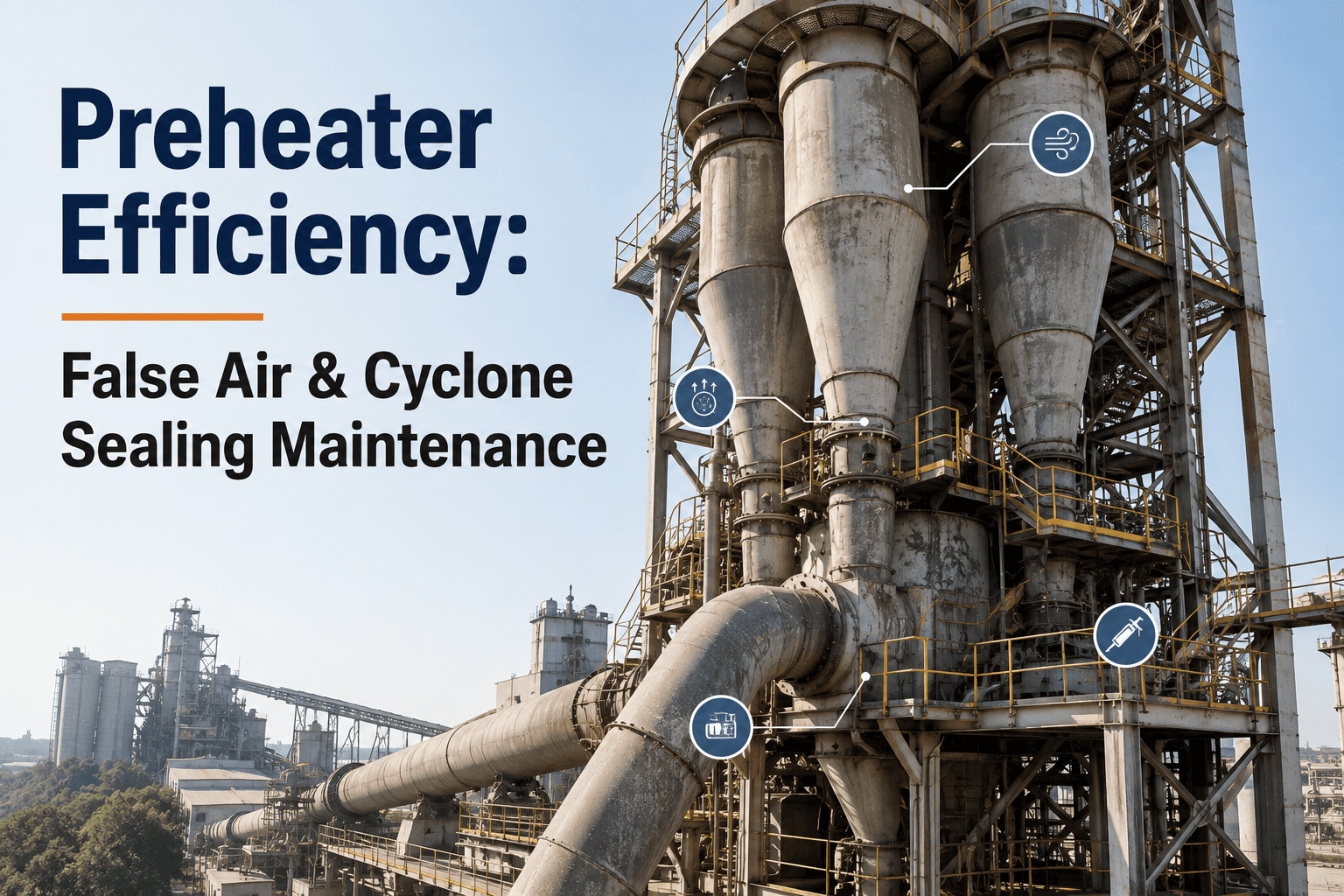
False air ingress is the single most underestimated energy drain in a cement plant preheater system — every 1% of unwanted ingress into the string raises specific heat consumption by roughly 3–4 kcal/kg clinker, which compounds across a 330-day campaign into millions of rupees. Most maintenance teams chase kiln coating and refractory wear while barely instrumented flaps, dip tubes, and expansion joints silently bleed hot gases and combustion efficiency. A disciplined, CMMS-driven tightness program — combining monthly O2 mapping, scheduled flap-valve service, and dip-tube inspection — typically recovers 8–12 kcal/kg clinker in under a quarter. Start your preheater efficiency program with a free Start Free Trial of Oxmaint and turn invisible losses into measurable savings.
How much heat is your preheater quietly losing to false air?
For every 1% of false air ingress, specific heat consumption rises 3–4 kcal/kg clinker. A 5,000 TPD line with unmaintained cyclone flaps and dip tubes typically bleeds 10–15 kcal/kg — translating to roughly $420,000 of wasted fuel each year. Oxmaint's preheater tightness module makes the loss visible and the fix trackable.
per 1% false air ingress
Quantify the leak before you fix it
Industry benchmark for preheater exit O2 on a well-sealed 5-stage string sits at 2.0–2.5%. Anything above 3.5% at the ID fan inlet signals measurable false air — and most plants running without a CMMS-tracked sealing program operate closer to 4.5–6%.
Baseline preheater exit O2 and CO2
Sample gas at the preheater exit (stage 5 cyclone top) during stable kiln operation — 90–105% production load, meal feed stable ±2%. Record O2, CO2, and exit temperature every 30 seconds for one hour. The Oxmaint CMMS auto-logs this against kiln feed rate and fuel rate so the baseline is auditable, not anecdotal.
Map O2 stage-by-stage top-down
Using sampling ports on each cyclone gas outlet, measure O2 from stage 1 (top) down to stage 5. A tight string shows a gradual 0.3–0.5% rise per stage. A sudden jump of 1.0%+ between two stages pinpoints the leaky cyclone — usually a failed flap valve, eroded dip tube, or torn expansion joint at that stage.
Calculate ingress percentage per stage
Compare each stage's measured O2 against the theoretical combustion O2 (typically 1.5–2.0% at the kiln feed end). The delta, divided by (21 − measured O2), gives false-air percentage for that stage. Flag any stage above 4% ingress for immediate maintenance scheduling in the CMMS work-order queue.
Example: Stage 3 measures 4.8% O2 against a 2.2% baseline → (4.8 − 2.2) ÷ (21 − 4.8) × 100 = 16.0% false air at that stage. That single leak adds roughly 4.8 kcal/kg clinker to your fuel bill until it is sealed.
The cyclone tightness checklist every crew should run quarterly
A structured 10-point sealing inspection — scheduled and tracked in Oxmaint — catches 90% of false-air sources before they escalate into refractory or fan-amperage problems. Each item below maps to a CMMS task template with photo evidence and sign-off.
Flap Valves & Flap Seats
- Inspect flap-to-seat contact across all 4–5 cyclone stages
- Measure flap clearance — replace if >3 mm
- Verify counterweight travel and pivot-arm wear
Dip Tubes & Immersion Pipes
- Inspect dip tube thickness — schedule replacement at 50% wear
- Check for erosion, cracking, or partial collapse
- Confirm gas seal between dip tube and cyclone roof
Expansion Joints
- Visually inspect bellows for tears, pinholes, hot spots
- Thermographically scan duct connections during operation
- Replace seals on a 18-month interval, not on failure
Inspection Doors & Ports
- Re-gasket every access door after each opening
- Torque bolts to spec — log in CMMS per door ID
- Thermo-scan closed doors under load for leakage
From one-off fixes to a 12-month tightness schedule
A preheater sealing program only pays back when it is repeatable. Oxmaint turns the checklist above into a recurring, auditable schedule — with O2 trend charts, work-order triggers, and fuel-savings reports tied to each completed task.
Baseline & diagnostic audit
Full O2 stage-mapping across all 5 cyclones. Thermographic scan of ducts, expansion joints, and doors. Identify top 5 leak sources and log baseline specific heat consumption (kcal/kg clinker). Typical finding: 4.5–6% exit O2 and 2–3 stages above 8% ingress.
Critical-seal intervention
Replace failed flap valves on the two worst-performing stages. Re-gasket all inspection doors. Repair or replace one torn expansion joint. Target: bring exit O2 down from 5.5% to 3.5% within 30 days. Expected heat recovery: 4–6 kcal/kg clinker.
Dip tube & secondary seal program
Scheduled dip-tube replacement on stages showing >50% wear. Remaining flap valves serviced. Exit O2 target: 2.8–3.2%. Cumulative heat recovery reaches 7–9 kcal/kg clinker. ID fan amperage typically drops 3–5%, freeing capacity for production increases.
Steady-state & continuous monitoring
Monthly O2 checks become a 15-minute CMMS-routine. Quarterly thermographic scans. Exit O2 holds at 2.2–2.6%. Total program delivers 10–12 kcal/kg clinker reduction — on a 5,000 TPD line firing $90/t coal, that is $300K–$360K per year in recovered fuel.
A 5,000 TPD plant recovered $340K in fuel — here is the math
A North African cement producer tracked their preheater sealing program in Oxmaint over six months. Below is the before/after picture, with every figure tied to a CMMS work order and a fuel-consumption trend.
| Metric | Before (Month 0) | After (Month 6) | Delta |
|---|---|---|---|
| Preheater exit O2 | 5.8% | 2.4% | −3.4 pts |
| Specific heat consumption | 847 kcal/kg clk | 835 kcal/kg clk | −12 kcal/kg |
| ID fan amperage | 412 A | 388 A | −5.8% |
| False air ingress (avg all stages) | 14.2% | 4.1% | −10.1 pts |
| Annual fuel cost (5,000 TPD, $90/t coal) | $13.71M | $13.37M | −$340K/yr |
| Program cost (parts + labor + CMMS) | — | $48K | Payback < 2 months |
recovered
achieved
period
savings
Stop guessing. Start measuring every kilocalorie.
Oxmaint's preheater module turns O2 readings, flap-valve service, and dip-tube inspections into one auditable tightness program — with fuel-savings reports your plant manager will actually read.
Preheater false air & cyclone sealing — answered
How much does 1% false air really cost a cement plant?
Each 1% of false air ingress raises specific heat consumption by roughly 3–4 kcal/kg clinker. On a 5,000 TPD line operating 330 days per year, that single percentage point equals about $28,000–$35,000 in extra coal annually — and most unmaintained strings carry 8–14% combined ingress across all stages, so the real bleed is closer to $250K–$400K per year.
Which preheater components leak the most false air?
Cyclone flap valves are the #1 culprit — they cycle thousands of times per day and wear unevenly against their seats. Dip tubes rank second because hot-meal erosion thins the wall until gas short-circuits. Expansion joints, inspection-door gaskets, and sampling-port plugs round out the top five. A stage-by-stage O2 map pinpoints which to fix first; Oxmaint logs each finding against the asset for trend analysis.
How often should we inspect and seal cyclone flaps?
A best-practice program inspects flap-to-seat contact every quarter, replaces worn flaps at a 3 mm clearance threshold, and does a full dip-tube thickness check during every kiln shutdown (typically every 10–12 months). The CMMS should auto-schedule these tasks from the baseline O2 reading — you can see the full scheduling template when you Start Free Trial.
What exit O2 level should a well-sealed preheater run at?
Target 2.0–2.5% O2 at the preheater exit on a 5-stage string under stable load. Anything above 3.5% indicates measurable false air; 4.5%+ means a stage likely has a failed seal. Pair the O2 reading with a CO2 cross-check — if O2 rises while CO2 drops between stages, you have confirmed ingress rather than a combustion-tuning issue.
Can a CMMS actually prove the fuel savings from sealing work?
Yes — Oxmaint ties each completed sealing work order to a timestamped O2 reading and a kiln fuel-rate trend, so you can plot specific heat consumption before and after the intervention. Most plants see a measurable 3–6 kcal/kg drop within two weeks of a critical-seal repair. Book a walkthrough of the reporting module at Book a Demo to see a live savings dashboard.
Recover 10–12 kcal/kg clinker in one quarter
Deploy Oxmaint's preheater tightness program across your full string — stage-by-stage O2 mapping, scheduled flap and dip-tube service, and fuel-savings reports your CFO can audit.
Free 14-day trial · No credit card