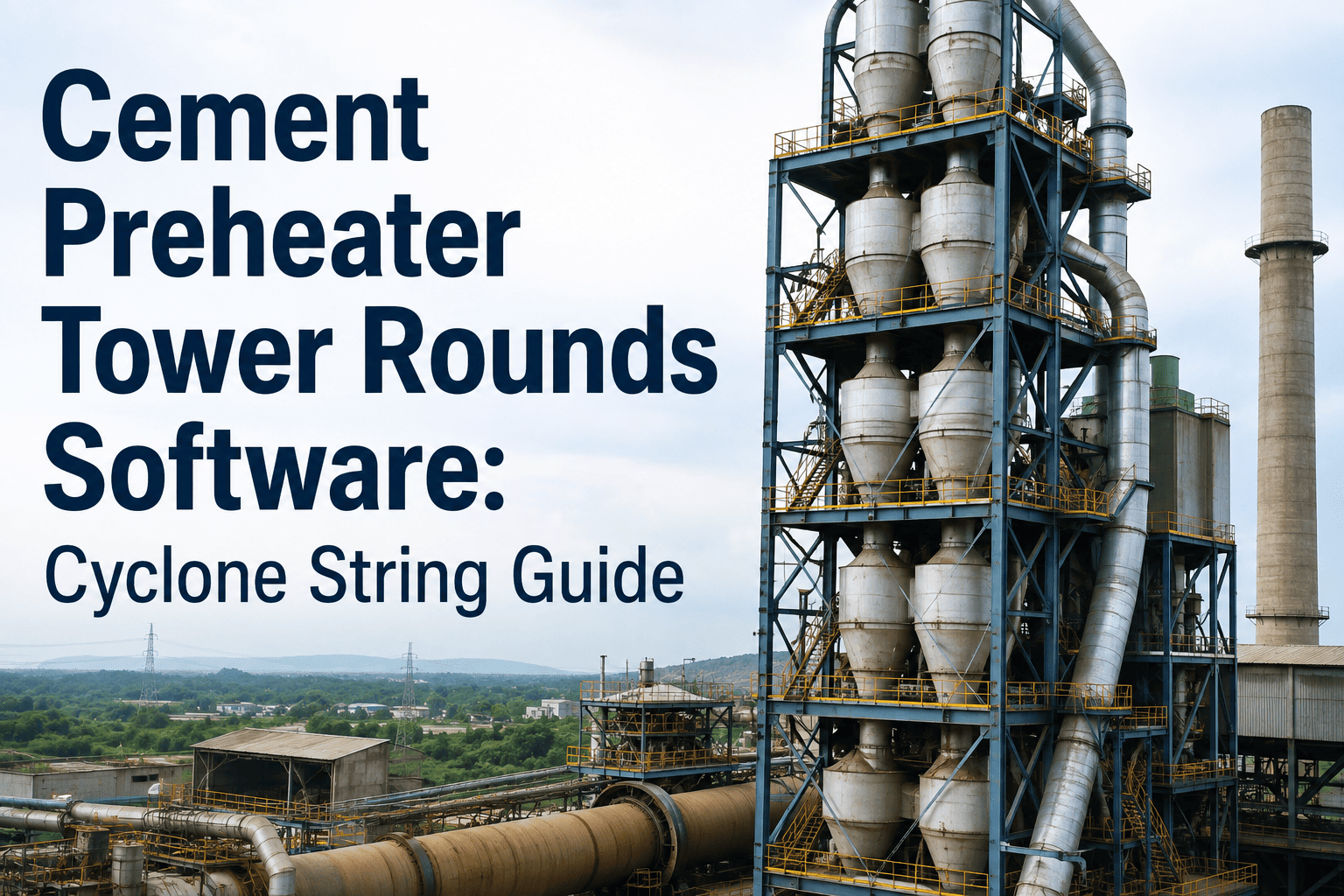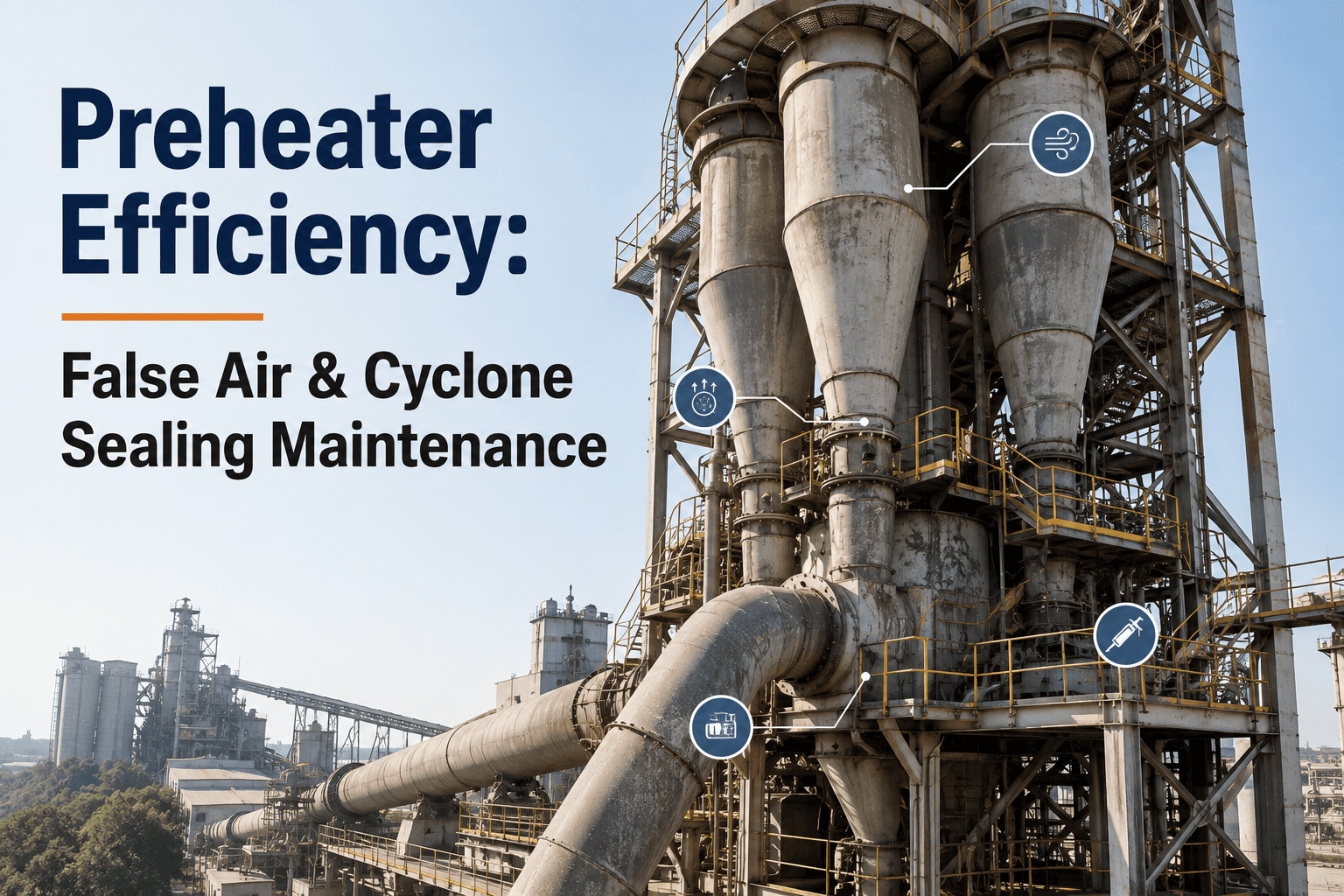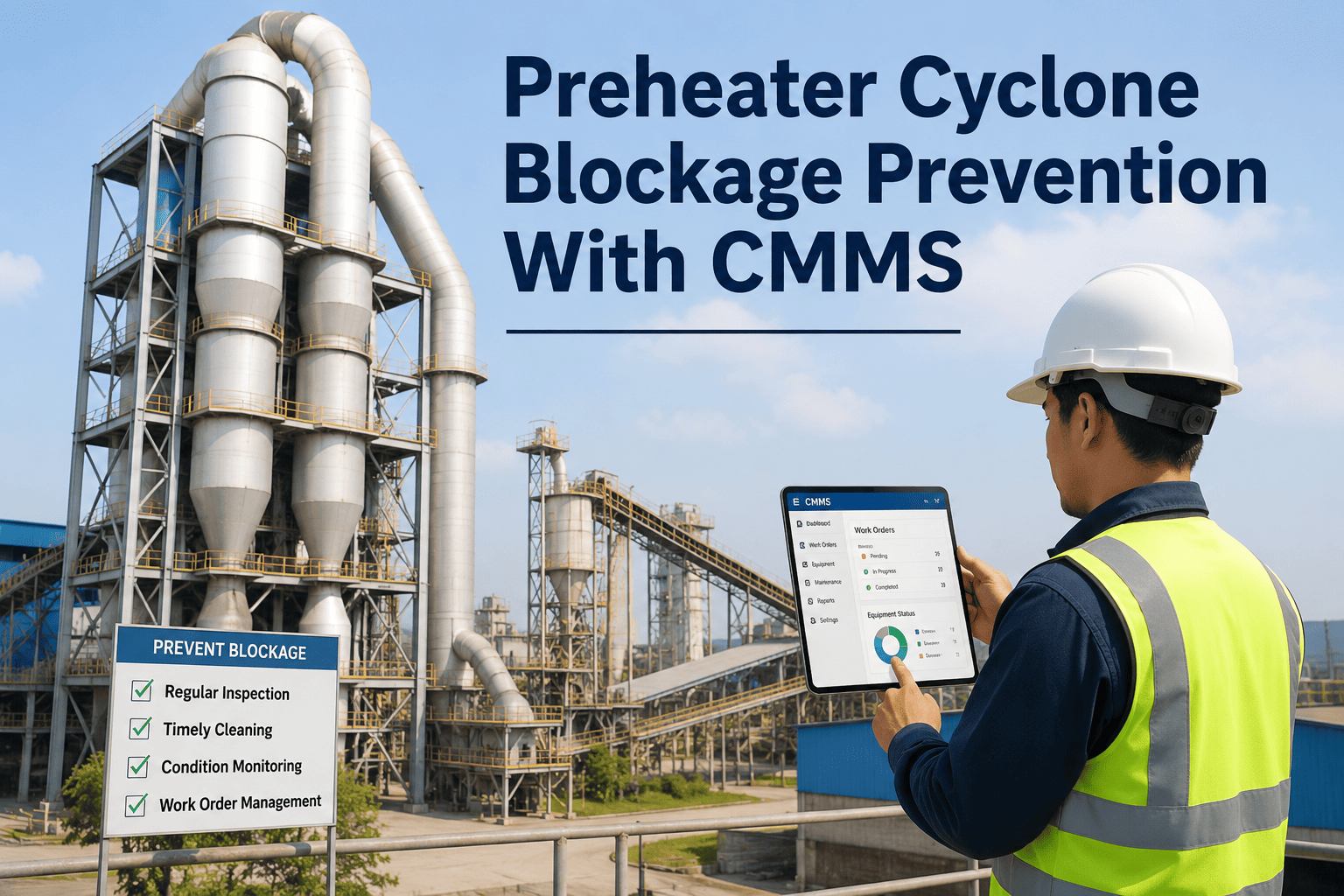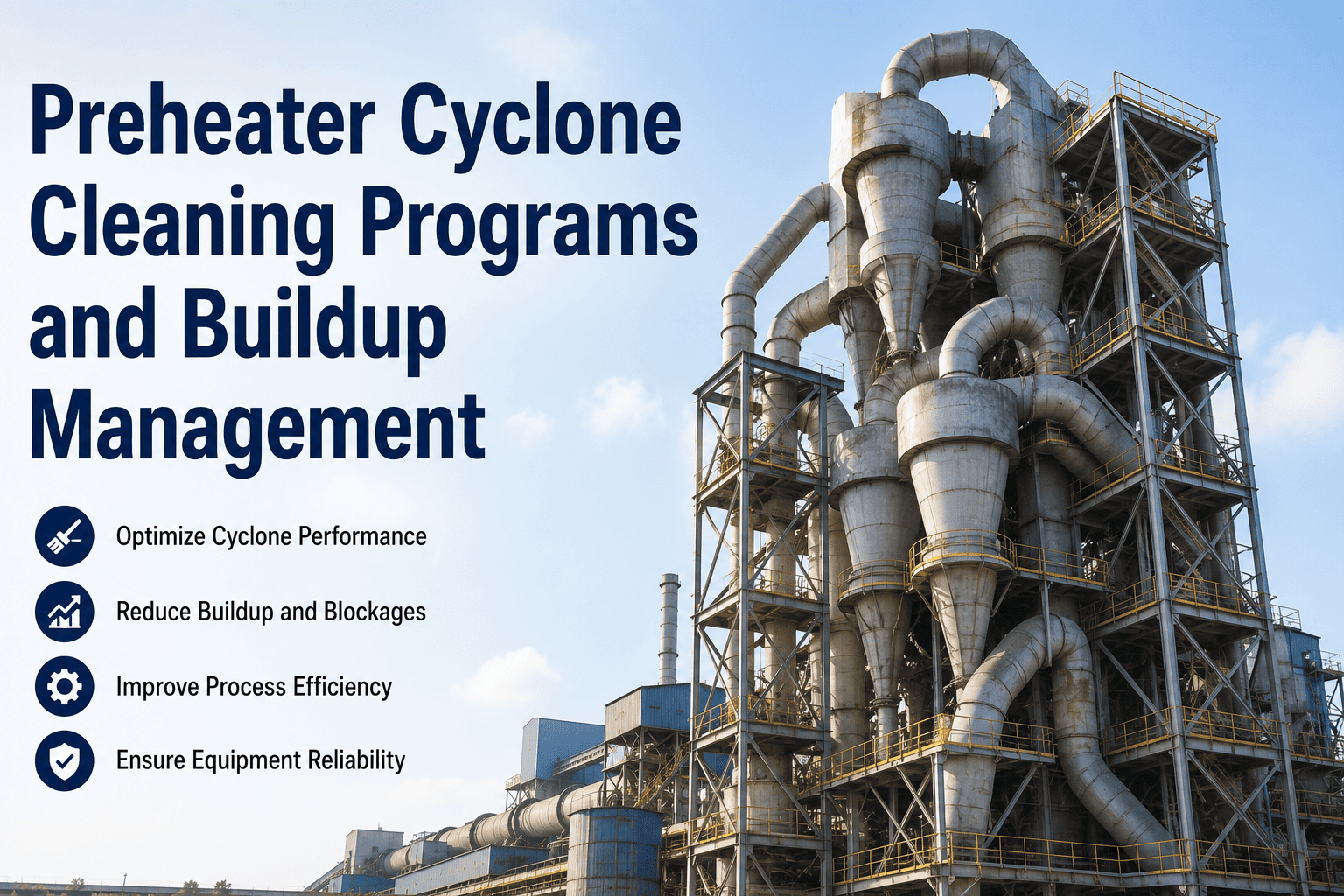
Preheater tower buildup, cyclone jams, and dip tube failures account for a disproportionate share of unplanned kiln stops in modern cement plants — and every hour spent cleaning a choked stage four cyclone is lost clinker production at 80–120 tonnes per hour. This guide translates field maintenance practice into a CMMS-driven work order structure: cyclone inspection cadence, flap valve sealing, false air detection, high-pressure gun cleaning protocols, and the shutdown checklists that defend preheater run factor. Schedule a Start Free Trial to operationalize the protocols below inside a purpose-built cement CMMS.
PREHEATER MAINTENANCE GUIDE
Is a single choked cyclone stage quietly costing your plant 1,400 tonnes of clinker every month?
A 4-stage preheater losing draft to false air and buildup drops kiln throughput 4–7 percent and pushes specific heat consumption up 25–40 kcal per kg of clinker. A disciplined cyclone and dip tube maintenance program — structured in a cement CMMS — recovers that loss within one shutdown cycle.
WHY PREHEATER MAINTENANCE DOMINATES RUN FACTOR
The Real Cost of Ignoring Cyclone Buildup and Dip Tube Erosion
At a 5,000 TPD kiln, every hour of unplanned preheater downtime equals roughly 200 tonnes of lost clinker — and the damage compounds when buildup forces gas bypassing, raising exit temperatures and stressing the ID fan.
INSPECTION & MAINTENANCE CHECKLIST
Tiered Cyclone and Dip Tube Inspection Program
Cyclone maintenance runs on three cadences: shift-level walkdowns, weekly condition checks, and shutdown deep inspections. Each tier feeds the CMMS as a recurring work order with attached checklists, photos, and torque values.
Operational Walkdown
- Log pressure drop across each stage — flag any delta exceeding 10 mbar from baseline.
- Inspect stage 1 and stage 2 exit gas temperatures; deviations above 30°C indicate re-entrainment.
- Listen for flap valve chatter — metallic impact signals a worn seat or broken counterweight.
- Verify ID fan amperage trend is stable — a 5 percent climb over a shift often precedes a stop.
Condition & Seal Checks
- Run high-pressure gun (HPG) cleaning on stage 3 and 4 walls if buildup exceeds 150 mm at probe points.
- Inspect dip tube lower edge with bore scope — record remaining thickness; reject below 6 mm.
- Test flap valve seal by observing dust fall during 10-second feed cut — continuous fall = worn seal.
- False air survey: O2 at preheater exit should stay below 4 percent; above 6 percent means a leak path.
Deep Inspection & Rebuild
- Ultrasonic thickness mapping of dip tubes at 8 clock positions; replace any tube with 40 percent wall loss.
- Remove refractory at cyclone cone and inspect shell for sulfation cracking — log every weld in the CMMS.
- Rebuild flap valves with new seat rings and counterweight springs; set closing torque to OEM spec.
- Calibrate all pressure transmitters and thermocouples against a reference — drift above 2 percent is a defect.
FAILURE MODE TABLE
Common Preheater Defects, Symptoms, and CMMS Action
Use this table as the failure-mode seed list for your preheater asset hierarchy. Each row should map to a trigger condition, a work order template, and an assigned technician role inside the CMMS.
| Defect / Failure Mode | Leading Indicator | Corrective Action | Trigger Threshold |
|---|---|---|---|
| Cyclone wall buildup (stages 3–4) | Pressure drop rising 8–12 mbar over baseline | HPG cleaning wall wash, then acoustic cleaner check | ΔP > 10 mbar above baseline |
| Dip tube erosion / partial collapse | Stage exit temperature climb, fine dust carryover | Bore-scope inspection, schedule replacement at next stop | Wall thickness < 6 mm at any probe point |
| Flap valve seat wear | Continuous material fall during feed cut test | Replace seat ring, re-set counterweight, torque to spec | Dust fall > 3 seconds after feed cut |
| False air ingress at expansion joint | O2 at preheater exit above 5 percent | Thermographic survey, re-pack joint with ceramic fiber | O2 > 6 percent or exit temp swing > 25°C |
| Refractory spalling at cone | Hot spots on shell thermography, red patch visible | Gunning repair at next 24-hour stop; full castable at major | Shell temp > 280°C at any cone location |
| ID fan blade imbalance from dust carryover | Vibration trend rising on fan bearing housing | Online cleaning, then dynamic balancing at next stop | Vibration > 4.5 mm/s RMS |
WORKED EXAMPLE
A 4,000 TPD Plant Recovers 11 Run-Factor Points in One Quarter
A North African cement plant running a 4-stage inline calciner preheater logged 14 unplanned stops in 12 months — nine traced to stage 3 and stage 4 cyclone buildup and three to dip tube collapse. After deploying a CMMS-backed cyclone maintenance plan, the plant recovered measurable run factor within the first quarter.
Baseline (Before CMMS)
Stops per year: 14 unplanned
Mean downtime per stop: 22 hours
Lost clinker: ~28,000 tonnes/yr
Estimated cost: $1.18M annually
Preheater run factor: 81.4 percent
Intervention (Q1)
Shift walkdown checklists deployed in CMMS — 3 readings per shift, auto-flagged.
Weekly HPG cleaning scheduled when ΔP crosses 8 mbar — triggered automatically.
Dip tube thickness log created — every probe point photographed and trended.
Flap valve feed-cut test added as a 7-day work order on all stages.
Result (Q1 End)
Stops in quarter: 2 (down from 3.5 average)
Mean downtime per stop: 9 hours
Recovered clinker: ~3,900 tonnes in Q1
Preheater run factor: 92.6 percent (+11.2 points)
Annualized savings: ~$660K projected
BUILDUP PREVENTION FORMULA
The Pressure-Drop-to-Feed Ratio That Predicts a Jam
Buildup rarely surprises a well-instrumented plant. The pressure-drop-to-feed ratio (PDFR) trends upward 24 to 72 hours before a cyclone jams. When the ratio exceeds 1.35, schedule HPG cleaning within the next shift.
These formulas should be configured as calculated fields in the CMMS, triggering work orders automatically when thresholds are crossed — not left to operator memory.
Turn Preheater Maintenance From a Firefight Into a Run-Factor Defensible Program
Oxmaint CMMS structures your cyclone inspection cadence, dip tube thickness logs, flap valve tests, and HPG cleaning triggers in one cement-specific platform — with mobile work orders, photo evidence, and automatic threshold alerts.
PREHEATER MAINTENANCE FAQ
Frequently Asked Questions
How often should preheater cyclone dip tubes be inspected for thickness?
Dip tube thickness should be logged every 6 months at minimum using ultrasonic measurement at 8 clock positions per tube. In plants burning high-sulfur or high-alkali fuels, increase to quarterly. Any probe point reading below 6 mm wall thickness should trigger a replacement work order at the next planned stop. A CMMS auto-generates these work orders when thickness readings are entered, so nothing slips through.
What is the acceptable false air level in a preheater tower?
Oxygen at the preheater exit should remain below 4 percent in a well-sealed system. Readings above 6 percent indicate a significant leak path — typically at expansion joints, flap valve seats, or manway gaskets. Each 1 percent increase in false air adds roughly 8–12 kcal/kg to specific heat consumption. Schedule a thermographic survey within 24 hours if O2 exceeds 5 percent, and repair leaks at the next available window. Start Free Trial to set automated O2-threshold alerts on every preheater stage.
When should high-pressure gun (HPG) cleaning be triggered?
Trigger HPG cleaning when stage pressure drop exceeds 10 mbar above the established baseline, or when the Pressure-Drop-to-Feed Ratio (PDFR) crosses 1.35. Cleaning should target the stage showing the deviation, not the entire tower — blind cleaning wastes refractory life and shutdown hours. Weekly HPG runs on stages 3 and 4 are common at plants with high chloride or sulfur cycles.
How long should a preheater flap valve last before replacement?
A well-maintained flap valve on a lower cyclone stage typically lasts 18 to 30 months. Seat rings wear faster than the flap itself and are usually replaced at every major shutdown. The most reliable predictor is the feed-cut dust fall test — if material continues to fall for more than 3 seconds after a feed cut, the seal is compromised and the valve needs service within the next planned stop.
Can a CMMS really reduce preheater unplanned stops by 50 percent?
Yes — when the CMMS is configured with the right trigger conditions, inspection cadences, and work order templates. Plants that move from paper-based or spreadsheet maintenance to a CMMS-backed cyclone program typically cut unplanned preheater stops 40 to 60 percent in the first 12 months. The key is automating threshold-based work orders (pressure drop, O2, vibration) so cleaning and inspection happen before the defect escalates. Book a demo to see the preheater template configured live.
STOP LOSING CLINKER TO CYCLONE BUILDUP
Deploy a Preheater Maintenance Program That Defends Your Run Factor
Join cement plants using Oxmaint CMMS to structure cyclone inspections, dip tube tracking, flap valve tests, and HPG cleaning — all in one platform with mobile work orders, photo evidence, and automatic alerts.
Free 14-day trial · No credit card