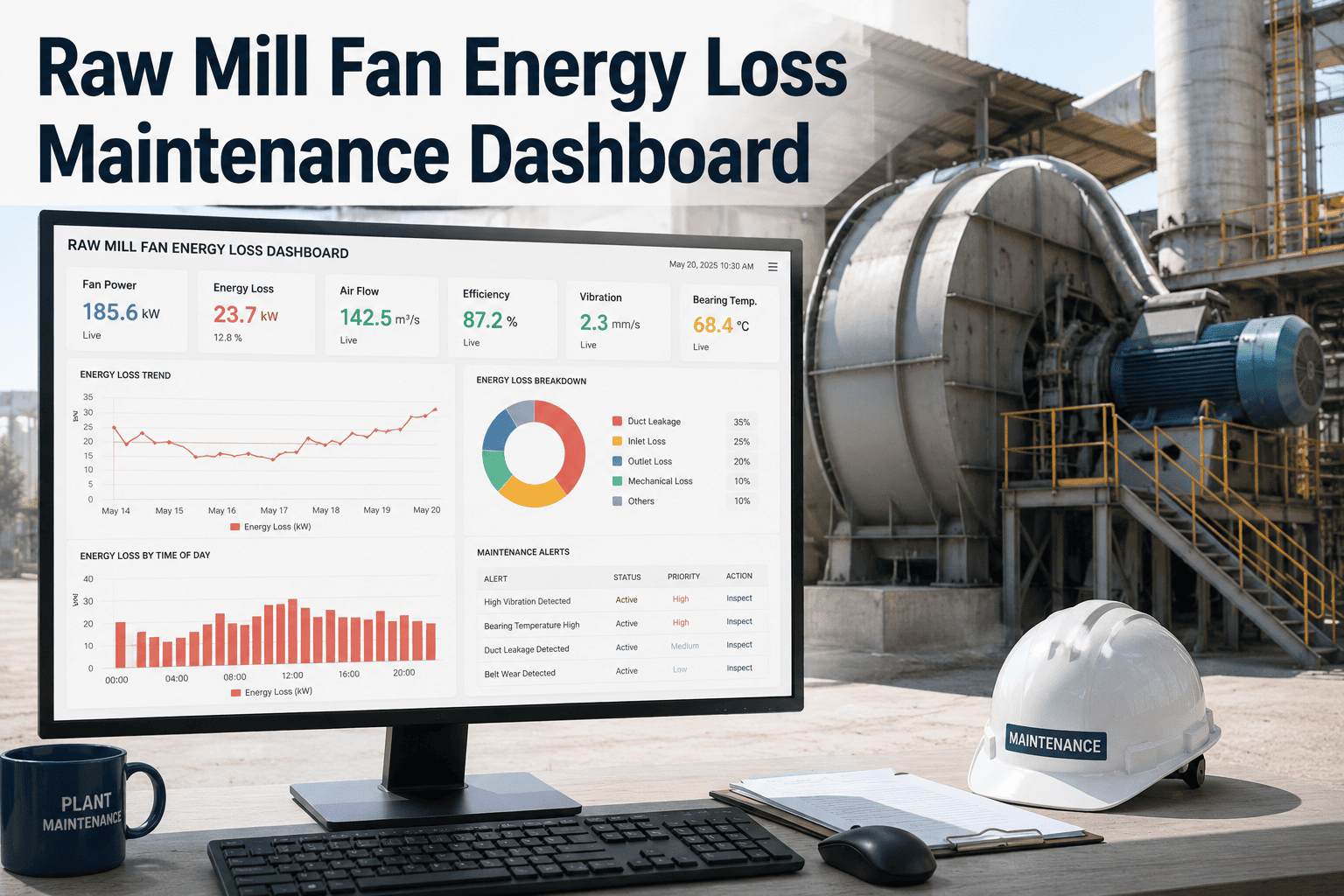
The raw mill grinding circuit is the single largest electrical load in cement raw material preparation, drawing 4,000 to 7,000 kW on a typical mid-size plant and representing $1.8 to $2.8 million a year in electricity cost. The mill fan alone can account for a third of that draw, and fan power follows a cubic relationship with speed — meaning a fan running just 10% faster than the process actually requires burns roughly a third more energy for zero production benefit. Most plants have the meter to see this waste but no maintenance workflow connecting it back to a specific bearing, damper, or blade condition. Oxmaint's AI analytics and reporting module closes that gap for raw mill fan energy.
Raw Mill Fan Energy Loss Maintenance Dashboard
Fan systems consume 30 to 50% of a cement plant's electrical energy. When a raw mill fan runs inefficiently, the loss shows up on the power bill weeks before it shows up as a maintenance complaint — unless the dashboard is watching both at once.
Four Ways a Raw Mill Fan Quietly Wastes Energy
A fan does not need to be broken to be wasteful. Most of the recoverable energy loss on a raw mill fan happens while the fan is running normally, passing every operator walkaround, and simply working harder than the process requires. CMMS-driven inventory management ensures the right replacement part is on hand the moment a mechanical loss is confirmed.
Damper Throttling Instead of Speed Control
Fixed-speed fans with damper-based flow control waste enormous energy compared to VFD-driven speed matching. Reducing fan speed by 20% cuts power by nearly 50% — the reverse is equally true when a damper is left partially closed.
Blade Buildup and Erosion
Material buildup on fan blades disrupts aerodynamic profile, forcing the fan to draw more current to move the same air volume — a gradual efficiency loss that rarely triggers a maintenance alarm on its own.
Bearing Drag
Early-stage bearing wear increases friction losses well before vibration reaches an alarm threshold, adding a steady energy penalty that accumulates across every hour of continuous operation.
Oversized Operating Margin
Fans set to run above actual process requirement as a safety margin, and never revisited after commissioning, waste energy continuously — often the single largest recoverable loss on the list.
A Fan Speed Reduction of 20% Cuts Power by Nearly 50%
Oxmaint's energy dashboard tracks fan specific energy against a configurable baseline and flags deviations as maintenance triggers — before the loss compounds across another billing cycle.
The Dashboard View — Fan Health Meets Energy Data
This is the structure of the raw mill fan dashboard Oxmaint builds for plant reliability and energy teams — mechanical condition and electrical consumption on one screen, not two separate systems that never talk to each other.
The Investigation Workflow When SEC Deviates
A specific energy deviation on its own is just a number. The value comes from what happens in the next few hours — and that is where a maintenance-linked dashboard outperforms a standalone energy meter.
Frequently Asked Questions
How much of a cement plant's energy bill comes from fans specifically?
Fan and blower systems typically consume between 30 and 50 percent of a cement plant's total electrical energy, making them the single largest electrical load category in the facility. On a plant using around 100 kWh per tonne of cement, fans alone can account for 30 to 50 kWh of that total — which is why fan efficiency is consistently the highest-return energy measure available to cement operators. Start free in Oxmaint to see your fan energy breakdown.
Can a fan be running normally and still be wasting significant energy?
Yes, and this is the core problem a dashboard solves. A fan can pass every vibration and temperature check while still running with a partially throttled damper, blade buildup, or an operating speed set higher than the current process actually requires — none of which trigger a mechanical alarm, but all of which show up clearly in specific energy data over time.
What is the payback period for VFD retrofits on raw mill fans?
VFD retrofits on large cement plant fans operating under damper control commonly deliver 500,000 to 1,500,000 kWh in annual savings per unit, with payback periods typically under 18 months. The exact payback depends on the fan's current control method, part-load operating profile, and local electricity rates, but damper-controlled fans are consistently the fastest payback candidates. Critical spares stockout prevention also matters during a VFD retrofit project to avoid extending the outage window.
How does Oxmaint distinguish an energy deviation caused by production changes from one caused by equipment wear?
The dashboard cross-references specific energy deviations against production rate and raw material composition data logged from the same period. If throughput and feed characteristics are unchanged while specific energy has risen, the system rules out process-driven causes and directs the investigation toward mechanical factors like damper position, bearing condition, or blade wear. Book a demo to see this correlation logic for your raw mill.
Does fixing fan energy loss actually reduce maintenance costs too, or only electricity costs?
Both. The same conditions that waste energy — bearing drag, imbalance, and blade erosion — are also the early stages of mechanical failure modes that eventually require unplanned repair. Catching them through an energy deviation alert typically means the maintenance intervention happens weeks earlier than it would through vibration monitoring alone, converting what might have been a reactive repair into a planned one.
Connect Fan Health and Energy Data Before the Next Billing Cycle
One dashboard for fan vibration, temperature, damper position, and specific energy consumption — with automatic work orders when the numbers drift.