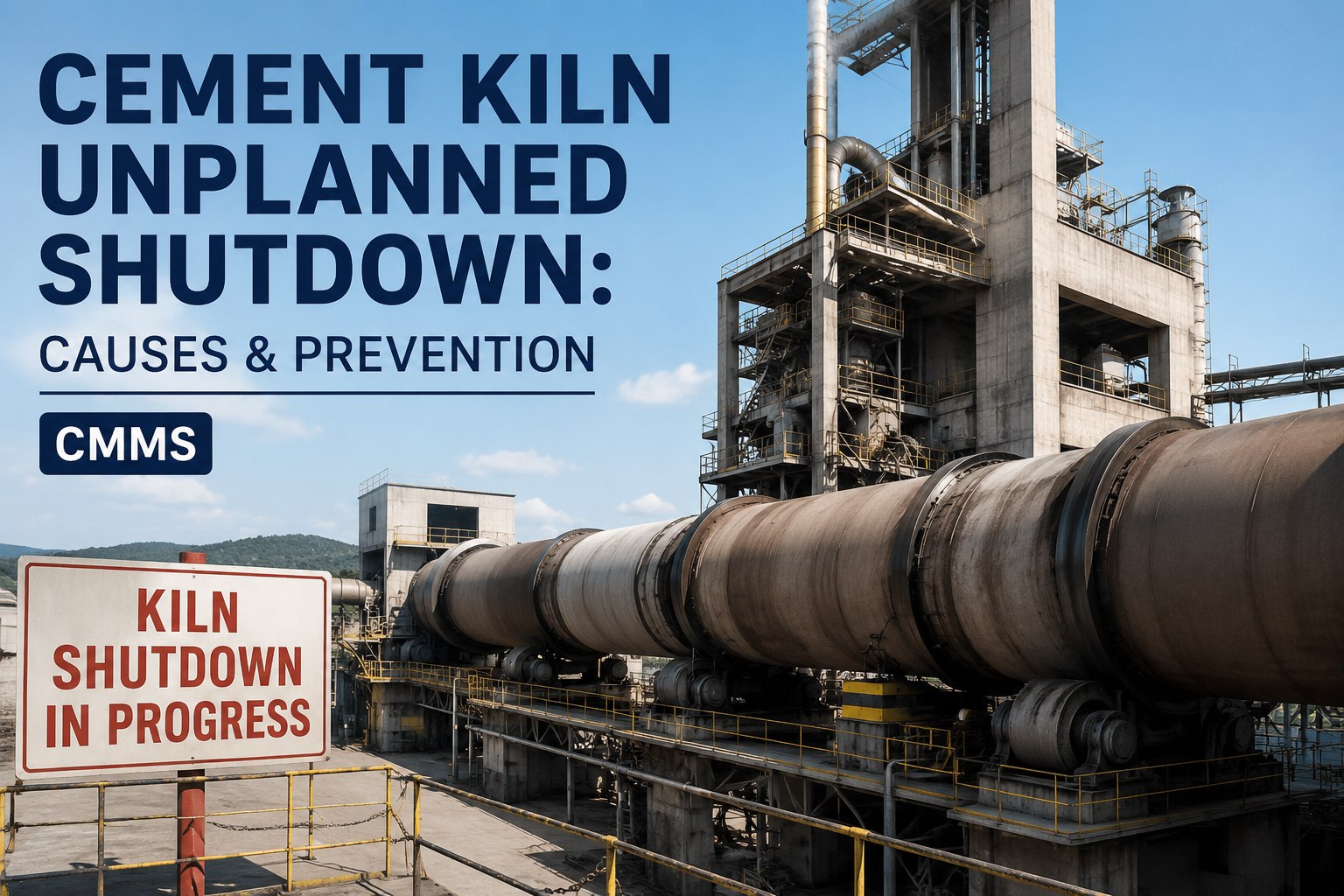
It's 2:43 AM when the kiln drive motor seizes. Within minutes, the entire production line grinds to a halt. Raw meal backs up in the preheater tower, clinker cooling stops, and the cement mill sits idle. By the time the emergency maintenance crew arrives, diagnoses a failed bearing, and sources a replacement, 14 hours of production have been lost—costing the plant over $280,000 in lost output alone. The root cause? A vibration anomaly first detected three months ago but buried in a paper logbook that no one reviewed. Industry research shows that cement plants lose between 5–10% of total production capacity to unplanned downtime every year, yet facilities using CMMS-driven predictive maintenance cut these losses by up to 50%. This guide breaks down the biggest downtime drivers in cement manufacturing and shows how a modern CMMS transforms reactive firefighting into proactive reliability.
Cement plants that transition from reactive to predictive maintenance using a CMMS see measurable improvements within the first quarter—fewer emergency shutdowns, faster mean time to repair, and dramatically lower spare parts costs. Start your free OXmaint trial to begin tracking equipment health and eliminating unplanned stops across your entire production line.
Top Causes of Unplanned Downtime in Cement Plants
Kiln & Pyroprocessing: The #1 Production Killer
The rotary kiln is the heart of every cement plant, and its failure triggers the most expensive downtime events. A single unplanned kiln stop can take 24–72 hours to recover from—including cooldown, repair, and the slow ramp back to operating temperature at 1,450°C.
| Problem | Check | Solution |
|---|---|---|
| Refractory Failure | Shell temperature scan; thermal imaging for hot spots >350°C | Schedule brick replacement during planned shutdown; monitor with IR cameras |
| Kiln Shell Hot Spots | Continuous shell scanner data; visual red spots at night | Reduce feed rate; apply coating spray; plan emergency relining |
| Girth Gear Wear | Backlash measurement; oil analysis for metal particles | Adjust pinion alignment; re-lubricate; plan gear replacement |
| Thrust Roller Misalignment | Kiln migration pattern; hydraulic pressure on thrust rollers | Realign support rollers; adjust thrust roller contact |
| Preheater Cyclone Blockage | Pressure drop across stages; temperature spikes | Air cannon activation; manual rodding; investigate raw mix chemistry |
Crusher & Raw Mill Breakdowns
Crushers and raw mills operate under extreme abrasion and impact loads. Without condition monitoring, wear components fail catastrophically rather than being replaced during planned maintenance windows.
| Problem | Check | Solution |
|---|---|---|
| Hammer/Liner Wear | Thickness measurements; output particle size increase | Rotate or replace hammers; schedule liner change at 60% wear |
| Bearing Failure | Vibration analysis (velocity >7mm/s); bearing temperature rise | Replace bearing and seals; check lubrication schedule |
| Separator Malfunction | Product fineness drift; separator speed/current anomalies | Inspect vanes and rotor; recalibrate separator settings |
| Feed Chute Blockage | Material flow sensors; increased motor amperage on mill | Clear blockage; install air cannons or vibrators; check moisture |
| Drive Belt/Coupling Failure | Belt tension and alignment; coupling inspection for wear | Replace belt or coupling; realign drive components |
Conveyor & Material Handling Issues
| Problem | Check | Solution |
|---|---|---|
| Belt Tear/Splice Failure | Visual inspection; belt rip detection sensors | Emergency vulcanization; install rip detection system |
| Pulley Misalignment | Belt tracking; mistracking sensors at head/tail pulleys | Laser-align pulleys; adjust idler frames; retension belt |
| Bucket Elevator Jam | Motor current spike; belt slip detection | Clear jammed material; inspect bucket bolts; check tension |
| Dust Collector Failure | Differential pressure across bags; emission readings | Replace damaged bags; check pulse jet system; inspect dampers |
| Screw Conveyor Wear | Throughput drop; motor amperage increase; noise change | Replace flights and trough liner; check hanger bearings |
Manual inspection rounds miss 40% of conveyor issues that automated monitoring catches. Facilities using digital checklists with photo documentation through CMMS platforms resolve material handling problems twice as fast. Sign up for free and digitize your conveyor inspection rounds today.
Electrical & Motor Failures
Cement plants rely on hundreds of motors—from the massive kiln drive to small auxiliary pumps. A single motor failure at a critical point cascades across the entire production process.
| Problem | Check | Solution |
|---|---|---|
| Motor Overheating | Winding temperature; ambient conditions; load percentage | Clean cooling fins; check ventilation; reduce load or upsize motor |
| VFD/Drive Faults | Fault codes; input/output voltage; heat sink temperature | Reset drive; replace cooling fans; check cable shielding |
| Insulation Breakdown | Megger test (insulation resistance <1MΩ indicates failure) | Rewind motor or replace; improve environmental protection |
| Cable Degradation | Thermal imaging of cable runs; insulation resistance testing | Replace damaged sections; improve cable tray routing |
| Power Quality Issues | Voltage sags, harmonics, power factor readings | Install power conditioning; add harmonic filters; check capacitor banks |
How CMMS Reduces Unplanned Downtime: The Framework
Quick Diagnostic Reference: Cement Plant Equipment
Want this diagnostic checklist built into your team's mobile devices with automatic work order creation? Book a personalized demo and we'll show you how cement plants cut diagnostic time by 60% and never lose a paper checklist again.