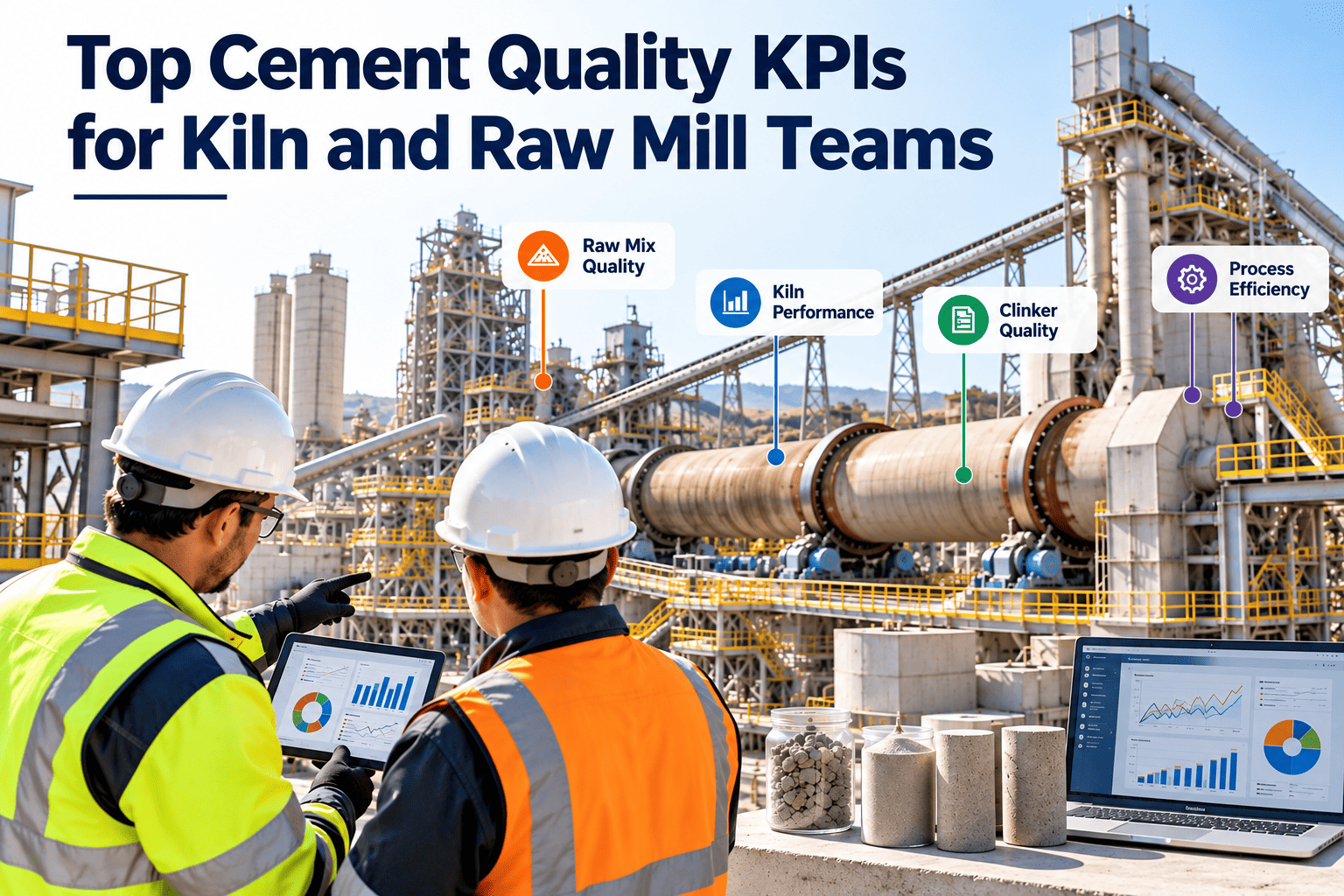
Clinker quality is decided long before the cement mill, starting with how consistently the raw mill and kiln run. Chemistry swings, unstable feed and equipment faults all show up later as free lime spikes, higher fuel use and variable strength. Kiln and raw mill teams need a small set of quality KPIs that operations and maintenance can both read. This guide covers those KPIs and the equipment behind them, using maintenance management software to close the loop.
Top Cement Quality KPIs for Kiln and Raw Mill Teams
Connect raw meal consistency, kiln stability and clinker quality to the equipment that controls them, so quality problems are fixed at the source.
Two Teams, One Quality Chain
The raw mill controls what enters the kiln, and the kiln converts it into clinker. Variation created upstream is expensive to correct downstream.
- Raw meal chemistry and fineness
- Feed proportioning accuracy
- Moisture and drying performance
- Mill availability and stable throughput
- Clinker free lime and phase balance
- Burning zone stability and coating
- Fuel feed and flame shape
- Kiln availability and run factor
Raw Mill KPIs
| KPI | What It Tells You | Equipment to Check When It Drifts |
|---|---|---|
| Raw meal fineness (residue on sieve) | Grinding quality and burnability | Separator, roller or ball charge wear, classifier settings |
| Lime saturation factor deviation | Chemical consistency of kiln feed | Weigh feeders, sampling system, analyzer, proportioning controls |
| Silica and alumina module deviation | Stability of burning conditions | Feeder calibration, additive dosing, material handling |
| Raw meal moisture | Drying efficiency and flow behavior | Hot gas supply, dampers, dryer sections |
| Raw mill availability | Ability to build and maintain feed stock | Main drive, mill internals, fans, lubrication systems |
| Blending silo homogenization | Reduction of chemical variation before the kiln | Aeration, blowers, extraction and gates |
Standard deviation of key chemistry values over a defined period is often more informative than the average.
Kiln KPIs
Link Quality Excursions to Equipment Work
Record the inspection, repair and calibration history that explains why a KPI moved.
How an Equipment Fault Becomes a Quality Problem
Without a link to maintenance records, the team treats step four as a process issue and never revisits step one.
Quality-Critical Equipment and Inspection Focus
- Weigh feeders and dosing systems: calibration, belt condition, load cells and material flow.
- Online analyzers and samplers: cleaning, calibration, sample transport and reference checks.
- Raw mill classifiers and separators: wear parts, rotor condition and vane settings.
- Kiln burners: nozzle condition, air flows and alignment.
- Kiln seals and shell: false air, hot spots and coating behavior.
- Fuel feeding systems: feeder accuracy and blockage detection, especially for alternative fuels.
- Kiln feed systems: elevators, air slides and flow control devices.
- Blending silo aeration: blower condition and distribution of air.
Before and After: Reactive Versus Connected Quality Control
- Quality alarms handled only by process changes
- Calibrations done when someone remembers
- Repairs logged with minimal detail
- Same variation returns after each fix
- Quality excursions trigger equipment checks
- Calibrations scheduled and tracked
- Repairs recorded with cause and parts
- Recurring issues reviewed and eliminated
Setting Targets That Teams Can Use
Where OXMAINT Helps Kiln and Raw Mill Teams
OXMAINT manages the maintenance activities that protect quality, rather than the laboratory or process control system itself.
Checklist for a Weekly Quality and Reliability Review
- Review variation in raw meal modules and fineness
- Check free lime and liter weight trends
- List overdue calibrations on feeders and analyzers
- Review kiln stops and their causes
- Confirm open corrective work on quality-critical assets
- Check fuel feed stability and blockage events
- Identify repeat issues for root cause analysis
- Assign actions with owners and dates
Sampling and Analysis Reliability
Quality KPIs depend on trustworthy samples and measurements. A flawed sampler can send both teams chasing problems that do not exist.
- Inspect automatic samplers for blockages, worn cutters, air leaks and timing issues.
- Check sample transport lines and preparation equipment for contamination or carryover.
- Calibrate online analyzers against laboratory reference results on a defined schedule.
- Track analyzer availability and record downtime reasons.
- Verify laboratory equipment such as balances, mills and XRF instruments through routine checks.
- Keep records of calibration and standard samples so results can be defended if questioned.
Alternative Fuels and Kiln Quality
Higher use of alternative fuels can change flame behavior, volatile cycles and burning conditions. Quality teams need the equipment behind those fuels to be stable.
Blending Silo and Kiln Feed Equipment
The last equipment before the kiln can remove or add variation. Do not overlook it when raw meal quality is inconsistent.
KPI Response Playbook
| Trigger | First Checks | Likely Follow-Up Work |
|---|---|---|
| Raw meal chemistry variation increases | Feeder weights, sampler and analyzer, additive dosing | Calibration, sampler repair, feeder belt or load cell work |
| Residue on sieve rises | Separator speed and condition, mill wear, airflow | Wear part replacement, separator repair, fan inspection |
| Free lime variation increases | Feed rate, fuel feed, burner, false air | Burner inspection, seal repair, feeder checks |
| Kiln drive current rises or fluctuates | Coating, ring formation, drive condition | Shell scan, drive inspection, cleaning plan |
| Frequent short kiln stops | Trips, blockages, utility interruptions | Root cause analysis, instrument and electrical checks |
| Raw mill availability falls | Main drive, lubrication, hydraulic and mechanical wear | Planned overhaul and spare parts review |
Coating, Rings and Clinker Quality
- Track kiln shell temperature scans regularly to spot lining loss and coating changes.
- Record cleaning events and cyclone blockages as asset history, not just operating notes.
- Review feed chemistry and fuel changes before sudden coating events.
- Monitor kiln drive current and torque trends alongside operating changes.
- Inspect air cannons, poke holes and cleaning equipment before they fail.
- Compare the pattern of events across kiln campaigns to find repeated causes.
Treating each coating or ring event as a case study with a recorded cause builds knowledge that outlasts staff changes.
Documentation and Traceability for Quality
- Calibration dates and results
- Equipment changes and settings
- Repairs affecting quality equipment
- Operating events and stoppages
- Supports root cause analysis
- Explains quality excursions to customers
- Helps with quality system audits
- Preserves knowledge across shifts
Cooperation Between Process, Quality and Maintenance
Quality problems often sit between departments. Clear roles and a shared review routine avoid finger pointing.
Raw Mill Wear and Its Effect on Fineness
- Track roller and table wear profiles and compare against the replacement criteria set by the supplier.
- For ball mills, monitor liner condition, media size distribution and charge level.
- Check separator vanes, rotor speed and sealing, since leakage lowers efficiency.
- Review hydraulic system pressure and accumulator condition on vertical mills.
- Watch mill vibration, differential pressure and motor power for changes that signal wear or imbalance.
- Plan wear part replacements by measured wear, not only by calendar.
Predictable wear management keeps fineness stable between overhauls, which supports kiln feed consistency.
Kiln Instrumentation That Quality Depends On
| Instrument | Used For | Common Problem | Maintenance Task |
|---|---|---|---|
| Kiln inlet gas analyzer | Oxygen and CO control | Blocked probe, slow response | Probe cleaning, calibration gas checks |
| Burning zone pyrometer | Temperature trend | Dust or lens fouling | Lens cleaning, alignment check |
| Kiln drive current meter | Load and coating signal | Scaling error | Verification against reference |
| Kiln feed weigh system | Production and heat balance | Load cell drift | Calibration and mechanical inspection |
| Fuel flow meters and feeders | Heat input control | Wear, buildup, bridging | Inspection, calibration, cleaning |
Weekly Kiln and Raw Mill Review Questions
- Which quality KPI moved outside its band this week, and what was the first equipment check?
- Are any analyzers, samplers or feeders overdue for calibration or inspection?
- Did any stoppage, trip or blockage coincide with a quality excursion?
- Which corrective work orders on quality-critical assets remain open, and why?
- Are spare parts for burners, load cells and separator components available?
- What changed in feed, fuel or operating strategy that might explain the trend?
- Which repeated issue should be sent for root cause analysis?
Quality Excursion Case Template
A consistent template turns each event into reusable knowledge for the next shift and the next kiln campaign.
Training Operators to Report Equipment Signs
- Teach operators which sounds, smells, temperatures and vibrations deserve a report.
- Give them a simple way to log observations from the control room or the field.
- Feed back results so they see that reports lead to action.
- Use shift handover notes to carry open observations to the next crew.
- Recognize good reports in team meetings to build the habit.
Metrics That Show the Connection Is Working
- Fewer quality excursions traced to uncalibrated feeders, samplers or analyzers.
- Shorter time from a KPI alert to a closed corrective work order.
- Higher calibration completion rate on quality-critical instruments.
- Lower repeat failure rate on burners, feeders and separator components.
- More stable kiln run factor between planned stops.
- A growing library of recorded root causes that new engineers can search.
Frequently Asked Questions
Build Quality From Reliable Equipment
Give kiln and raw mill teams a single place to schedule, record and review the work that keeps quality on target.