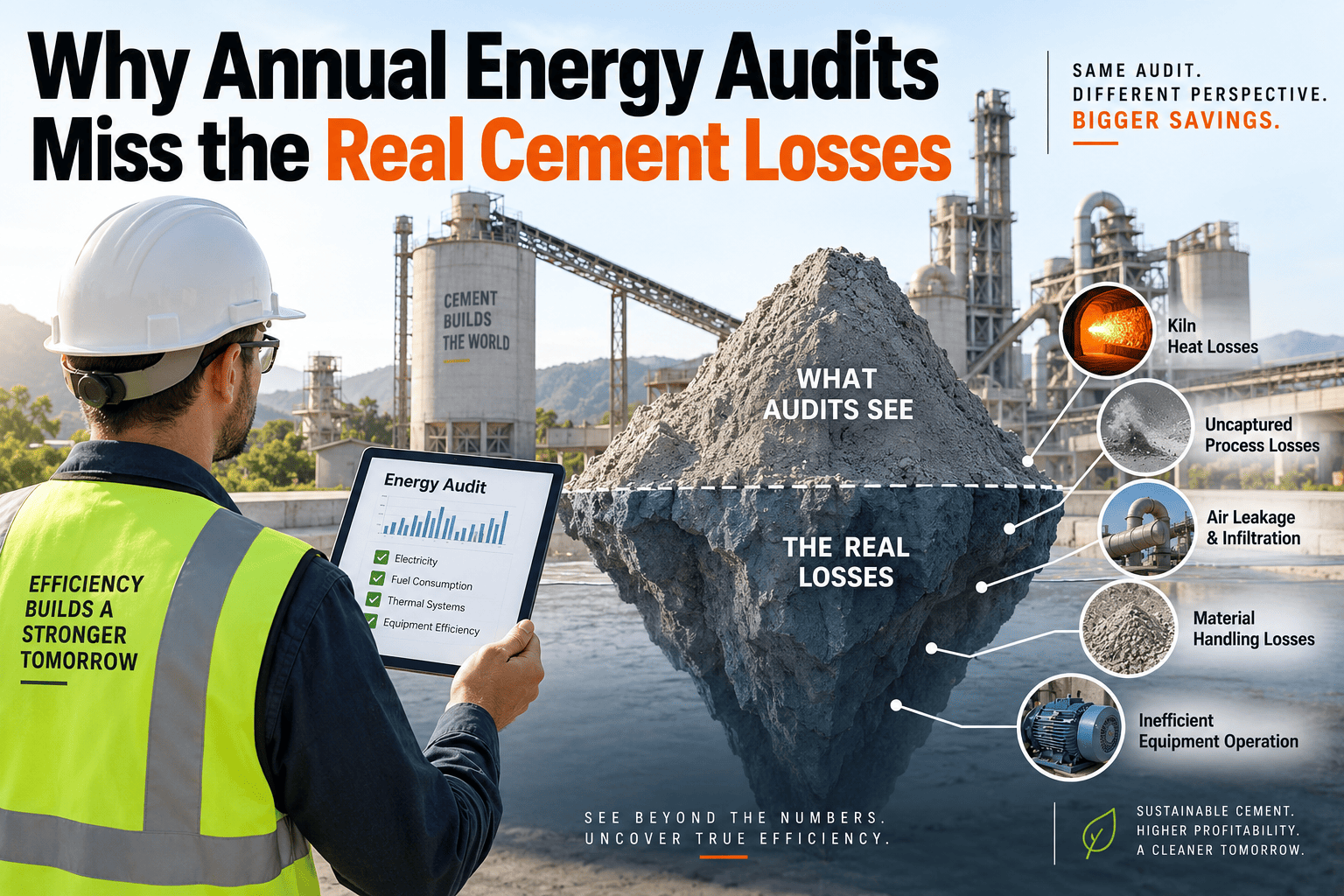
An annual energy audit is still the standard way most cement plants find out where power and fuel are being wasted, and for one week a year it works well: a team walks the raw mill, kiln drive and compressor house with power analyzers and comes back with a report full of real findings. The problem is what happens in the other fifty-one weeks, when a motor can drift 10 percent above its design specific energy consumption, a compressor can idle through every kiln stop, and nobody notices until the next audit finally catches up with a full year of accumulated waste a workflow that tracks energy drift continuously, not once a year, is what closes that gap — see how Oxmaint connects meter data to maintenance action.
Findings captured
Drift begins, unmeasured
Drift compounding, still unmeasured
Cumulative loss finally visible
What the Numbers Actually Look Like
Electrical energy is a smaller share of a cement plant's total energy bill than thermal fuel — typically around 11 to 12 percent of total input — but it is the share most directly tied to equipment condition rather than raw material chemistry, and grinding circuits alone can account for close to 40 percent of that electrical load. That combination makes it the part of the energy bill where maintenance-driven waste hides best, and where continuous monitoring pays off fastest.
Four Places Where an Annual Audit Structurally Can't Keep Up
None of the four patterns below are exotic. Every plant reliability engineer has seen a version of each one. What they share is that a once-a-year measurement window will only ever catch them by coincidence.
Annual Audit vs. Continuous Monitoring, Side by Side
| Dimension | Annual Energy Audit | Continuous CMMS-Linked Monitoring |
|---|---|---|
| Frequency | Once a year, sometimes less | Ongoing, asset by asset |
| Idle-time visibility | Estimated from a short spot-check window | Tracked continuously against the production schedule |
| Drift detection | Cumulative number seen once a year | Trend visible as it develops, week over week |
| Response to a finding | Report delivered weeks later, often as a static PDF | Work order generated and assigned automatically |
| Verification of fixes | Rechecked at the next annual cycle, if at all | Tracked to closure with before/after readings on record |
Closing the Gap Without Replacing the Audit
The annual audit still matters — it is usually the only point in the year where a plant gets a structured, whole-system measurement from someone outside daily operations. The fix is not to eliminate it but to stop treating it as the plant's only source of energy visibility for the other fifty-one weeks.
What an Audit Methodology Actually Covers
A properly run electrical energy audit is more than a walk-through with a power analyzer. It typically follows a structured sequence: pulling twelve to twenty-four months of historical meter data to establish a baseline, measuring voltage, current, power factor and harmonic distortion at the subsystem level, modeling where losses concentrate against design specifications, and reporting a prioritized set of findings. Each of those phases produces real, useful information — the limitation isn't the methodology, it's the frequency with which it gets repeated.
Audit teams following an ISO 50001-aligned approach will usually rank findings by payback period, separating quick operational fixes — recalibrating a damper, adjusting a changeover sequence — from capital projects like a ball mill to vertical roller mill conversion. The quick fixes are exactly the category that benefits most from continuous tracking, because they are cheap to correct but easy to let slip back to the old baseline once the audit team has left the site.
Why Findings Quietly Expire
An audit report is a static document, and static documents lose relevance the moment operating conditions change. A recommendation to recalibrate a damper is only actionable if someone owns it, schedules it, and confirms the fix held. Without that ownership loop, audit findings tend to sit in a binder until the next audit cycle rediscovers the same issue — sometimes with a different consultant, under a different name, at a higher severity than it was the first time.
Who Should Own the Gap Between Audits
In many plants, the annual energy audit is commissioned by a sustainability or utilities function, while the equipment that actually causes the losses — mills, fans, compressors — is owned day to day by the maintenance department. That split in ownership is part of why findings stall: the team that receives the audit report often isn't the same team with a wrench in hand to act on it.
Closing that gap works best when energy tracking becomes a maintenance KPI rather than a separate sustainability initiative running in parallel. A motor drifting above its design specific energy consumption is, functionally, the same kind of early-warning signal as a rising vibration trend — both point at a mechanical condition that a work order can fix. Treating energy drift as a maintenance signal, tracked in the same system as PM schedules and failure history, is what turns audit findings from an annual report into an ongoing discipline.
A Realistic Starting Point
Plants that have never run continuous energy monitoring before don't need to instrument every motor in the facility on day one. A practical rollout starts with the two or three assets that carry the largest electrical load — usually the raw mill and finish mill drives, and the primary ID fan — since that is where a small percentage improvement translates into the largest absolute savings. Once that baseline is working and generating real work orders, expanding coverage to compressors, secondary fans and utility circuits is a natural next step rather than a separate project.
What Continuous Tracking Changes About the Next Audit
A plant that has been running continuous monitoring for a year walks into its next annual audit with a very different starting position than one that hasn't. Instead of the consultant discovering a full year of accumulated drift from scratch, the audit team can validate a baseline that has already been tracked, focus their week on the deeper structural questions a spot measurement can't answer — like whether a capital upgrade to a classifier or a drive would pay back — and spend less time re-finding problems the plant's own data already flagged months earlier. The audit becomes a deeper diagnostic exercise instead of a rediscovery exercise, which is a better use of both the consultant's time and the plant's money.