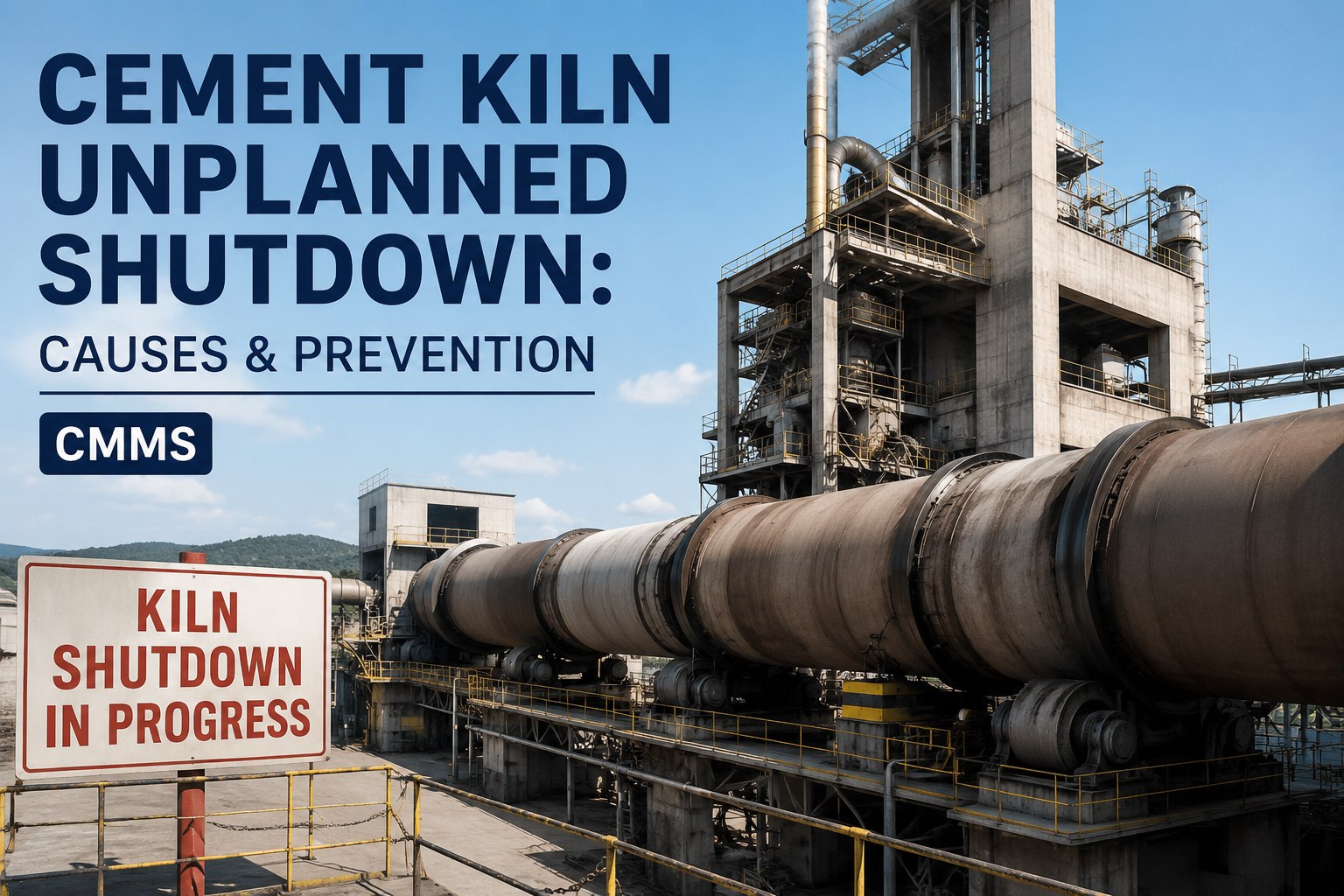
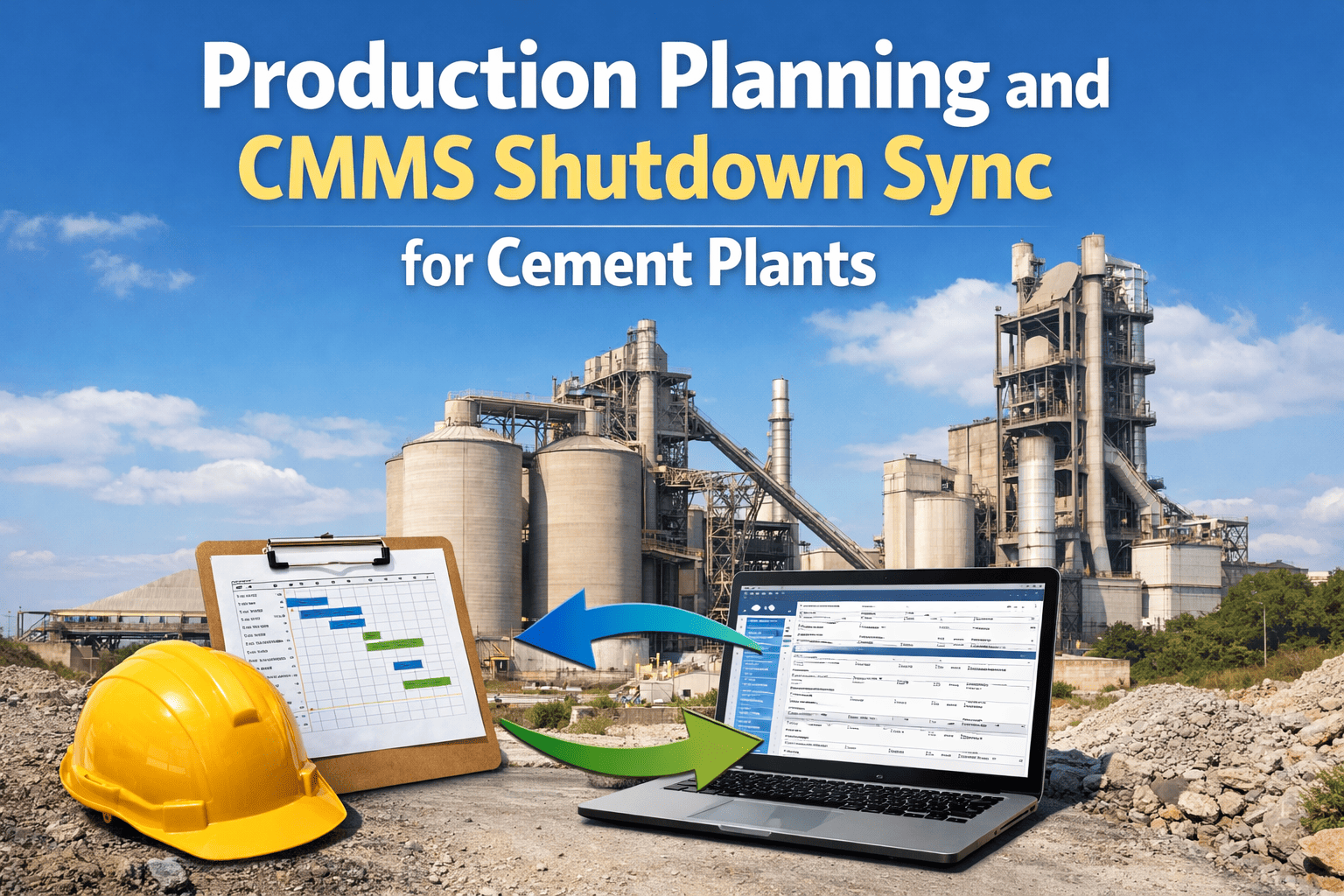
World-class cement plants plan 85%+ of their maintenance work before the week starts — not after equipment fails. Yet most plants still run at 55–60% planned work ratios, which means nearly half of all maintenance hours are being consumed by reactive firefighting that costs 4–6 times more per event than a scheduled intervention. This guide covers exactly how CMMS-driven weekly, monthly, and annual maintenance planning frameworks eliminate schedule conflicts, pre-position spare parts, and give kiln managers a rolling 12-week visibility horizon that reduces reactive repair to under 15% of total maintenance hours. Sign up free on OxMaint to activate a cement-ready CMMS with pre-built PM schedules for kilns, mills, and crushers — or book a 30-minute demo to see how leading cement plants have moved from paper-based planning to digital precision.
Cement Plant Operations / Maintenance Planning
Cement Plant Maintenance Planning: Weekly to Annual CMMS Framework
From rolling 12-week schedules to annual shutdown coordination — how cement plants move from reactive firefighting to 85%+ planned maintenance using CMMS-driven planning at every time horizon.
85%+
Planned work ratio — world-class target
40%
Downtime reduction in 12 months
$28K/hr
Avg. cost of unplanned kiln stop
12-week
Visibility horizon with CMMS
Why Most Cement Plants Are Structurally Reactive — And What It Costs
A cement plant spending $8.50 per tonne on maintenance may look controlled on paper — while sitting in the bottom quartile globally. The real measure is not what you spend but what that spend buys in kiln availability and planned work ratio. Plants below 60% planned work are structurally reactive: failures drive the maintenance schedule, not the other way around.
55%
Typical planned work ratio at paper-based cement plants
Reactive Zone
→
72%
Plants 6 months into CMMS-driven planning
Transitioning
→
85%+
World-class target — CMMS full deployment
World-Class
4–6×
Reactive vs. Planned Cost
Emergency repairs cost 4 to 6 times more per event than a scheduled intervention. Every hour of unplanned kiln downtime costs $6,000–$17,000 in lost clinker output.
68%
Missed PM Shutdowns
68% of unplanned kiln shutdowns trace directly to missed preventive maintenance tasks that existed on a paper schedule nobody checked before the shift started.
25%
Top vs. Bottom Quartile Gap
Top-quartile cement plants outperform peers by up to 25% in asset uptime — a gap driven entirely by maintenance program maturity, not equipment age or geography.
The Three Planning Horizons Every Cement Plant Needs
Cement plant maintenance planning operates at three distinct time horizons — and each one requires different information, different decisions, and different outputs. A CMMS connects all three into a single live system, so that an annual shutdown decision made in January automatically shapes what appears on the weekly work order board in November.
WEEKLY
Rolling 7-Day Execution Plan
Horizon: Current week + 2 weeks forward
The weekly plan is the operational frontline. It answers one question: what work gets done this week, by whom, and with what parts already staged? A world-class weekly plan is issued by Friday for the following Monday — locking in 85%+ of all maintenance hours before the first shift starts. CMMS auto-generates the weekly work order list from PM triggers, outstanding corrective work, and priority flags set at the planning meeting.
PM work orders triggered by time or meter readings
Corrective work from prior-week inspections
Spare parts confirmed in stock before job release
Technician skill routing matched to each work order
Permit-to-work pre-issued for confined space and HV work
MONTHLY
Rolling 4-Week Coordination Plan
Horizon: Current month + 2 months forward
The monthly plan bridges weekly execution and annual strategy. It coordinates maintenance windows with the production schedule, manages contractor mobilisation, and ensures that long-lead spare parts are ordered before they are needed — not after. The monthly planning meeting should be a 60-minute decision session with maintenance and operations present, producing a signed-off schedule with no ambiguous ownership.
Maintenance window alignment with production demand forecasts
Contractor pre-qualification and mobilisation planning
Long-lead spare parts purchase order generation
Equipment outage windows reserved in production calendar
KPI review: PM compliance, MTBF, planned-to-reactive ratio
ANNUAL
12-Month Rolling Master Plan
Horizon: 12 months with 6-month detail
The annual plan is the financial and strategic backbone of maintenance. It coordinates major kiln shutdowns 6 months in advance, integrates capital expenditure planning, and builds the business case for resources. Direct shutdown costs for a mid-size plant run $1.5M–$3M. Every day of unplanned extension costs $350,000–$500,000. The annual plan exists to make that number predictable, not a surprise.
Major kiln and mill shutdown scope definition
Refractory campaign end-of-life forecasting
Capital expenditure planning linked to asset condition data
Regulatory inspection and certification calendar
Annual maintenance budget build from work order history
See All Three Planning Horizons in One Dashboard
OxMaint connects your weekly work orders, monthly coordination plan, and annual shutdown schedule into a single live system — so every planning decision at every level is visible to maintenance, production, and plant management simultaneously.
The Weekly Planning Cycle — What World-Class Plants Do on Friday
The Friday planning meeting is the single most important maintenance ritual in a top-quartile cement plant. It is not a status update — it is a work commitment. Every job on the following week's plan has a technician, a parts kit, a permit status, and a time slot. If it is not ready by Friday, it does not go on the plan.
1
Monday–Tuesday: Close Last Week, Identify New Work
All completed work orders are closed with actual labour hours and parts consumed. Outstanding corrective work from inspection routes is captured and prioritised. CMMS auto-generates the PM trigger list for the following week based on calendar and meter-based schedules.
2
Wednesday: Parts Verification and Procurement
The planner verifies spare parts availability in the CMMS against the following week's planned work order list. Parts not in stock trigger immediate purchase orders for the fastest delivery that meets the planned job date. No job is committed without confirmed parts.
3
Thursday: Permit Pre-Application and Skill Routing
Permits to work for high-risk jobs — confined space entry, hot work, high voltage isolation — are pre-applied and cleared. Technicians are matched to jobs by skill code in the CMMS to ensure the right trade is assigned to each task before Monday morning.
4
Friday: Planning Meeting and Schedule Lock
A 60-minute joint session with maintenance and production. The draft schedule is reviewed against planned production windows. Conflicts are resolved before the week starts — not at 6 AM on Monday when the kiln operator and the maintenance supervisor are arguing at the control room door. Schedule is locked and issued to all supervisors and technicians via CMMS mobile.
Asset-Specific PM Intervals — What the Data Says
Generic maintenance checklists are how plants miss critical failure signatures on high-value equipment. Each major cement plant asset has its own failure modes, manufacturer-recommended intervals, and condition-based trigger logic. Below is the PM interval framework that CMMS planning should enforce — not suggest.
| Asset |
Daily / Shift |
Weekly |
Monthly |
Annual / Major |
| Rotary Kiln |
Shell temp scan, tyre temp, drive current, roller contact check |
Girth gear backlash, lubrication pressure, roller alignment visual |
Refractory hot-spot mapping, thrust roller load measurement, kiln axis survey |
Full refractory reline (campaign-based), shell ovality measurement, tyre creep correction |
| Vertical Roller Mill |
Vibration reading, differential pressure, bearing temps |
Roller wear measurement, table liner condition, separator blade inspection |
Hydraulic pressure calibration, wear rate trending, gear oil sample |
Roller tyre replacement, table segment replacement, complete hydraulic service |
| Clinker Cooler |
Grate plate temperature, drive current, fan airflow |
Grate plate visual, seal condition, crusher hammer check |
Grate plate wear measurement, airflow balance check, seal replacement cycle |
Full grate plate replacement programme, cooler crusher service, refractory inspection |
| Raw Mill / Ball Mill |
Bearing temperatures, motor current, partition grate check |
Liner wear visual, ball charge estimate, seal air check |
Liner measurement survey, ball charge top-up, girth gear contact pattern |
Full liner replacement, ball charge recalculation, trunnion bearing inspection |
| Preheater / Calciner |
Cyclone pressure drops, blockage monitoring, refractory temp |
Refractory hot-spot scan, gas duct expansion joint check |
Cyclone wear measurement, dip tube inspection, damper function check |
Full refractory inspection and repair, cyclone wear tile replacement, tertiary air duct service |
| Conveyor Systems |
Belt tension, idler noise, drive motor current |
Idler replacement (seized), belt splice inspection, chute liner check |
Belt tracking survey, full idler roll inspection, drive gear oil sample |
Belt replacement (wear life), complete idler set, drive reducer service |
Annual Shutdown Planning — The 6-Month Countdown
Plants that begin shutdown planning less than 90 days out spend 35% more on expedited parts and contractor premiums. Starting 6 months ahead is not a luxury — it is the difference between a $1.8M shutdown and a $2.7M shutdown for exactly the same scope of work.
Month 6
Scope definition: all deferred work, refractory campaign assessment, capital items. Contractor pre-qualification begins. Long-lead parts (girth gear, tyres, major bearings) ordered.
Month 4
Scope freeze. No new work without plant manager approval after this point. Contractor packages issued. Critical path identified — kiln refractory almost always drives the timeline.
Month 3
All parts confirmed on site or delivery dates secured. CMMS shutdown work order package built. Contractor inductions scheduled. Production plan locked around shutdown window.
Month 1
Final readiness review. All work orders printed and kitted. Safety permits prepared. Resource schedule confirmed with no conflicts. CMMS tracking activated for shutdown execution.
Week 1
Real-time shutdown execution tracked in CMMS. Critical path progress updated shift by shift. Any delay triggers automated re-scheduling across dependent tasks. Management visibility on day 1.
Post-Shutdown
Within 2 weeks: formal post-shutdown review. Actual vs. planned comparison auto-generated from CMMS. Lessons captured digitally and fed forward to next planning cycle. Institutional knowledge preserved.
The 6 KPIs That Separate Top-Quartile from Average Cement Plants
Most cement plant managers know their maintenance budget number. Very few know whether it is competitive. These six KPIs — tracked automatically in a CMMS — tell you exactly where your plant sits and what to fix first.
Planned Maintenance Ratio
Industry avg: 60%
World-class: 85%+
The single most important maintenance KPI. Plants below 60% are structurally reactive — failures drive the schedule, not the plan.
Kiln Availability Rate
Industry avg: 88%
World-class: 92%+
Every percentage point of kiln availability is worth $1.5M–$4M in annual clinker output at a 1 MTPA facility.
PM Compliance Rate
Industry avg: 70%
World-class: 95%+
The percentage of scheduled PM tasks completed on time. CMMS mobile work orders push PM compliance above 95% by eliminating missed paper routes.
Maintenance Cost per Tonne
Industry avg: $6–10/t
World-class: under $6/t
The competitive cost position metric. CMMS links every work order to production volume — calculating cost per tonne automatically, not from spreadsheets.
Mean Time Between Failures (MTBF)
Improves 30–50% post-CMMS
Tracked per asset type
Measures how long equipment runs between failures. Rising MTBF confirms the PM programme is preventing failures — not just responding to them.
Mean Time to Repair (MTTR)
Avg reduction: 44%
31 days → 13 days
Driven by spare parts availability, skill routing, and documented repair procedures — all CMMS-managed. A 44% MTTR reduction is achievable within 6 months of deployment.
Track All 6 KPIs Automatically — No Spreadsheets
OxMaint calculates your planned maintenance ratio, PM compliance, MTBF, MTTR, and maintenance cost per tonne in real time — and benchmarks each metric against cement industry targets. Your first benchmarking dashboard goes live within 60 minutes of signup.
Where Planning Breaks Down — The 4 Most Expensive Mistakes
Planning failure is not a people problem — it is a system problem. These four failure patterns show up repeatedly at plants where the maintenance plan and the execution system do not share live data.
01
Scheduling Shutdowns Against Calendar Dates, Not Condition Data
A kiln reline scheduled 9 months in advance against a fixed calendar date — not the rolling production forecast. By the time the conflict with a major dispatch commitment is visible, contractors are already mobilised and the date cannot move. CMMS planning must connect shutdown windows to live production forecasts, not static calendar slots.
02
Releasing Work Orders Without Confirming Parts Availability
A technician travels to the job, finds the part is not in the storeroom, raises a requisition, and waits 3 days for delivery. That job consumed 4 hours of labour time to produce zero maintenance output. CMMS-integrated storeroom management stops this by blocking job release until parts are confirmed available or staged for delivery.
03
Scope Creep That Extends Shutdown Duration by Days
Without a hard scope freeze date, work requests keep arriving through the shutdown itself — from operations, engineering, and suppliers all seeing the equipment open for the first time. Every additional day of unplanned extension costs $350,000–$500,000. A signed scope freeze 4 weeks before shutdown start is non-negotiable.
04
Post-Shutdown Knowledge Lost Before the Next Cycle
No formal post-shutdown review within 2 weeks means institutional knowledge walks out the door with retiring workers and departing contractors. Plants using paper-based systems repeat the same planning mistakes every annual cycle. CMMS captures actual vs. planned data automatically — turning every shutdown into a planning improvement for the next one.
Frequently Asked Questions
What is the target planned maintenance ratio for a cement plant?
World-class cement plants maintain 85%+ planned work ratios, meaning 85% of all maintenance hours are scheduled in advance. Plants below 60% are structurally reactive. CMMS-driven planning typically moves plants from 55–60% to 75%+ within the first 6 months of deployment.
How far in advance should a major cement plant kiln shutdown be planned?
Major annual shutdowns should begin planning 6 months in advance with scope definition and long-lead parts procurement. Plants that start planning less than 90 days out spend 35% more on expedited parts and contractor premiums — a predictable and avoidable cost.
How does a CMMS improve weekly maintenance planning in cement plants?
A CMMS auto-generates the weekly PM trigger list, confirms spare parts availability before releasing work orders, routes work to technicians by skill code, and issues mobile work orders directly to field technicians. The result is a locked, executable weekly plan issued by Friday for Monday — before any reactive work can displace it.
What is the typical ROI of CMMS deployment at a cement plant?
US cement plants using OxMaint report $1.4M+ in avoided downtime costs in year one, driven by 2–4 fewer unplanned kiln stops. The CMMS investment typically pays back within the first avoided shutdown event, with additional returns from reduced emergency procurement and maintenance labour efficiency gains.
Can a CMMS integrate with SAP and DCS systems already running in the plant?
Yes. OxMaint integrates bi-directionally with SAP, Oracle, and Dynamics for work order and procurement sync, and connects to DCS and process historians via OPC-UA, MQTT, and REST API. Standard SAP integrations configure in 2–4 weeks, not months.
From Paper Schedules to a 12-Week Visibility Horizon
OxMaint gives cement plant maintenance teams CMMS-driven planning at every horizon — weekly work order automation, monthly KPI dashboards, and annual shutdown coordination in one platform. Pre-built cement plant templates are active from day one — no configuration project required.