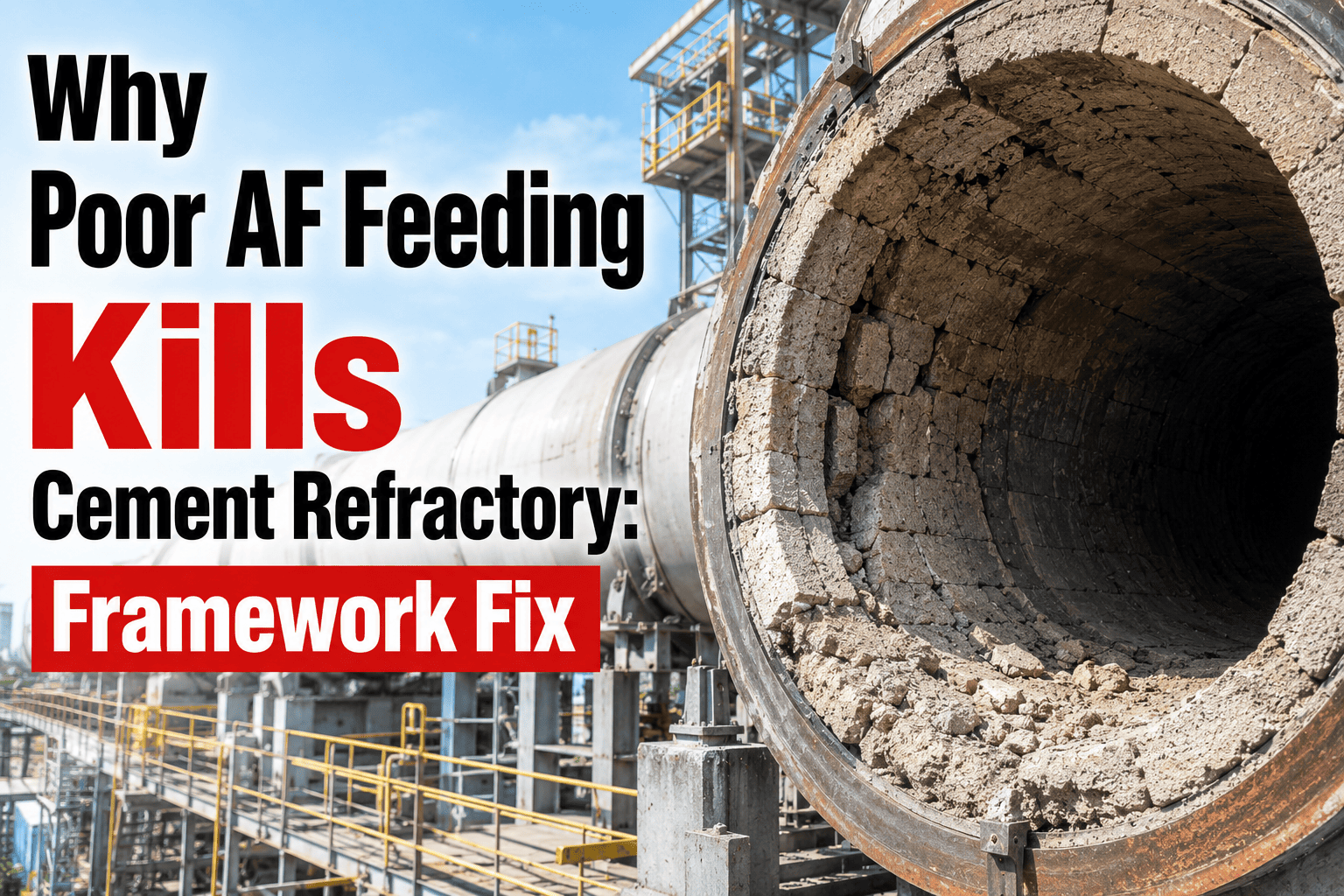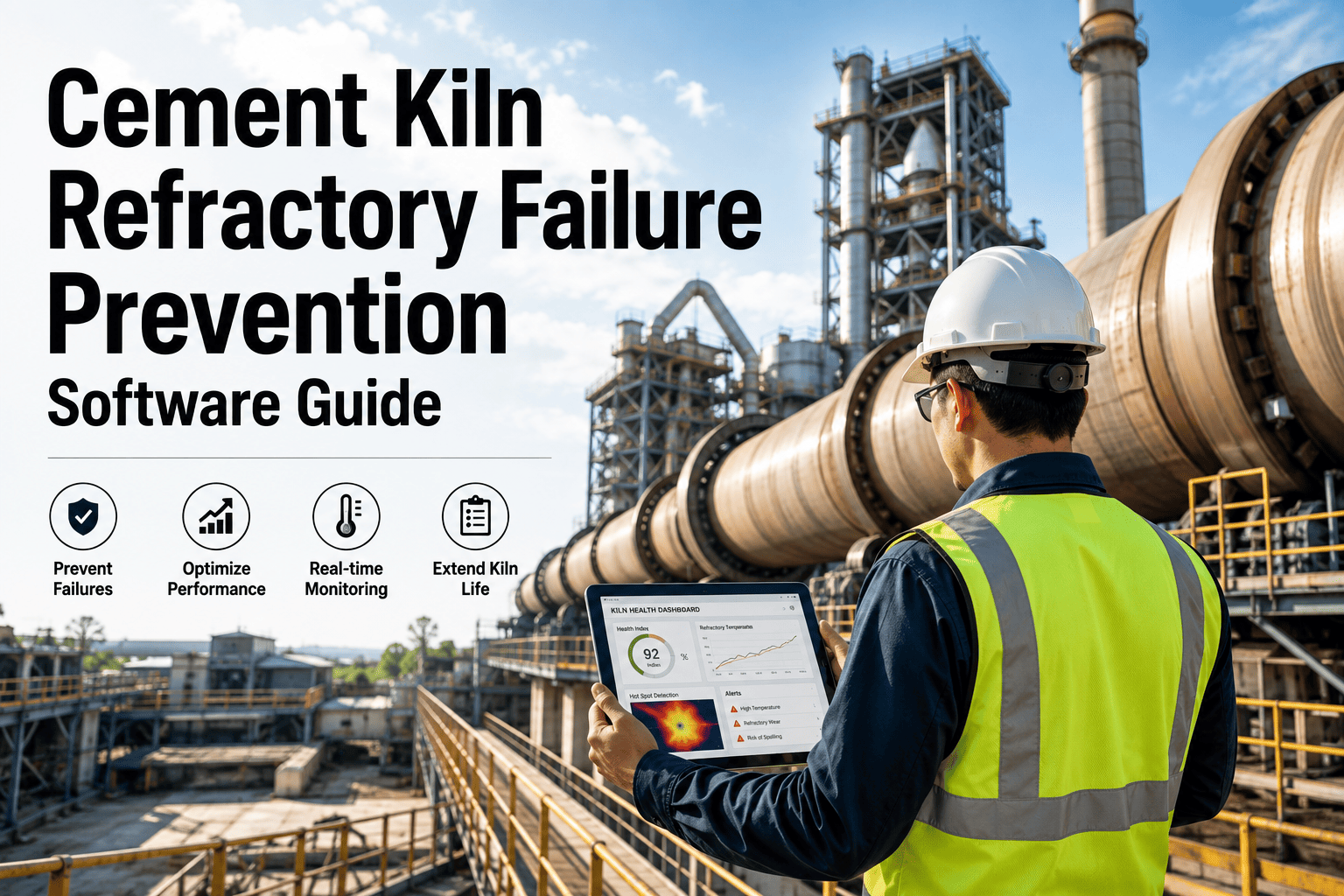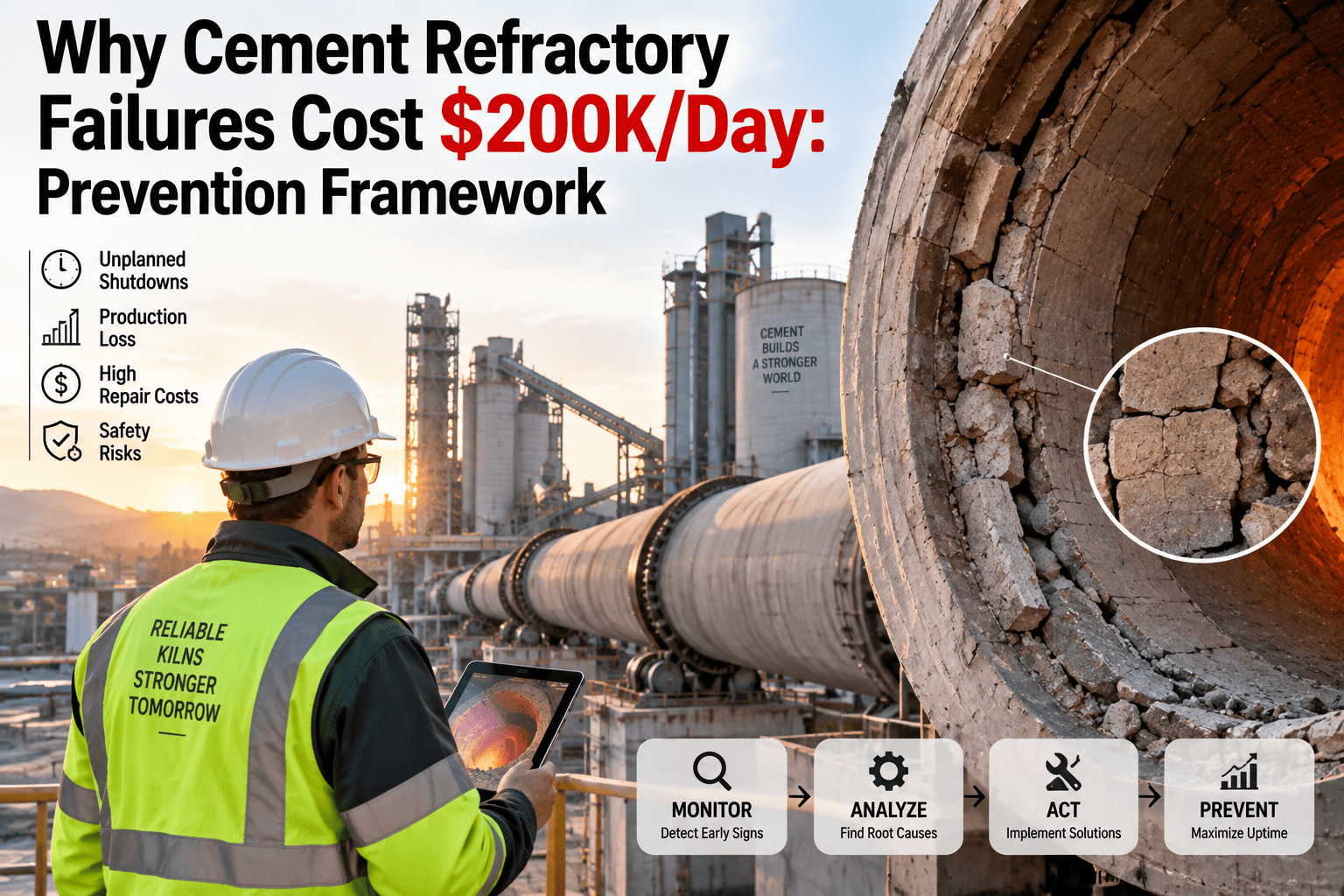
When a cement kiln's refractory lining fails without warning, the repair invoice is rarely the largest number on the page. A kiln that stops producing clinker stops the entire plant behind it, and the daily cost of that silence — lost clinker margin, idle crews, cooling and reheating cycles, expedited brick freight — routinely reaches into six figures per day. What makes refractory failure worth a dedicated prevention framework is that the wear leading up to it is almost never sudden. It is measurable, gradual, and largely invisible to anyone relying on an annual inspection window.
The real anatomy of a $200K-per-day refractory failure — and the framework that prevents it
Break down where the cost of an unplanned reline actually accumulates, then build the wear-signal discipline that converts an emergency shutdown into a planned outage on your own calendar.
Why the daily number is so much larger than the repair quote
Plants that budget refractory purely as a materials line item consistently underestimate failure exposure by an order of magnitude. The brick is the cheapest part of the event.
Lost clinker production
A mid-size kiln producing 4,000-5,000 tonnes of clinker per day generates the bulk of a plant's margin. Every stopped day removes that contribution entirely while fixed costs continue.
Cooling and reheating time
A kiln cannot be entered hot. Controlled cooldown and subsequent reheat consume days at each end of the repair, and neither produces a single tonne of clinker.
Emergency versus planned labour
Refractory contractors mobilised at short notice command premium rates, and crew availability during an unplanned window is rarely what it would be for a scheduled outage.
Expedited material freight
Specialised basic and high-alumina brick carries long lead times. Emergency procurement means air freight or substitution with a less suitable grade that shortens the next campaign.
Downstream cascade
Raw mill, coal mill, and finish grinding schedules all key off kiln availability. A stopped kiln disrupts the entire production plan, not just the pyro line.
Thermal shock to the next campaign
Every unplanned cooling and reheating cycle stresses the remaining lining, quietly shortening the life of brick that was otherwise healthy.
The same repair, two completely different events
The brick specification, the crew size, and the physical work of a reline barely change between a planned and an unplanned outage. Nearly every cost difference comes from timing and the loss of choice that surprise imposes.
| Factor | Planned reline | Unplanned failure |
|---|---|---|
| Timing control | Scheduled into a low-demand window | Whenever the lining gives way |
| Brick procurement | Normal lead time, correct grade | Expedited freight or grade substitution |
| Contractor rates | Negotiated in advance | Short-notice mobilisation premium |
| Scope bundling | Combined with other kiln work | Refractory only; other work deferred again |
| Production plan | Absorbed into the annual plan | Commitments missed, stock drawn down |
| Remaining lining | Replaced at end of useful life | Healthy brick stressed by forced cooling |
Framed this way, the objective of a prevention programme is not to make refractory last indefinitely. It is to move the reline date into a column the plant controls, and to know that date far enough ahead that procurement and scheduling still have options.
Three ways a lining actually dies
Refractory rarely fails for one reason. Understanding which mechanism dominates in a given kiln zone determines which signal is worth monitoring there.
Coating loss and thermal attack
The protective clinker coating in the burning zone is what shields the brick from peak flame temperature. When coating stability breaks down — through fuel switching, flame shape change, or feed chemistry drift — the exposed brick wears rapidly.
Thermal shock cracking
Rapid temperature swings from unplanned stops, unstable kiln operation, or frequent flame interruptions create stress cracks that propagate through the brick over successive cycles. Damage accumulates rather than appearing at once, so a campaign shortened by cycling looks like premature brick failure unless stop frequency is recorded.
Chemical and alkali attack
Alkalis, chlorides, and sulphates circulating in the kiln penetrate brick porosity and react internally, causing spalling that removes lining thickness from behind the working face. This mechanism is particularly associated with alternative fuel use, which often raises the circulating load of these compounds.
Put your kiln's wear signals on one screen
Shell temperature scans, thickness records, and campaign history tracked against your own zone map rather than a filing cabinet.
Four layers that turn an emergency into a scheduled outage
The framework below is deliberately layered — each stage catches what the previous one misses, and no single measurement is relied on alone.
Shell temperature scanning
Continuous infrared shell scanners or scheduled handheld thermography establish a temperature profile along the kiln length. Rising local temperature is the earliest practical indicator that coating or brick thickness is being lost behind that point.
Measured thickness at every entry
Every time the kiln is cold and entered for any reason, residual brick thickness is measured at fixed reference points and logged against the zone map. Opportunistic measurement during unrelated stops builds the wear-rate dataset at no extra downtime cost.
Operating-condition logging
Unplanned stop count, fuel changes, alkali and chloride levels in feed, and burner adjustments are logged against the campaign, because these are the inputs that explain why one campaign runs longer than the last.
Projected reline date review
Each quarter, the measured wear rates and projected end-of-campaign dates are reviewed against the plant's planned outage calendar, with brick procurement lead time worked backwards from the projection.
Not every metre of lining deserves the same attention
Wear rates vary enormously along the kiln. Monitoring effort should follow that variation rather than spreading evenly across the whole barrel.
| Zone | Dominant stress | Relative wear rate | Monitoring priority |
|---|---|---|---|
| Burning zone | Peak thermal load, coating instability | Highest | Critical |
| Upper transition | Thermal gradient, shock cycling | High | Critical |
| Lower transition | Gradient plus mechanical abrasion | Moderate to high | High |
| Kiln inlet | Alkali attack, mechanical erosion | Moderate | High |
| Kiln outlet / nose ring | Thermal shock from cooler air | Moderate | High |
| Calcining / preheat section | Lower temperature, chemical exposure | Low | Routine |
A practical consequence of this distribution is that the burning zone and upper transition generally dictate campaign length for the whole kiln. Lining elsewhere may still have substantial life remaining when the critical zones reach their limit, which is why partial relines targeted at the high-wear sections often make more sense than replacing the full barrel on a fixed cycle.
Where a maintenance system carries the framework
Most of the data in this framework already exists somewhere in a cement plant. The failure is almost always in continuity — records scattered across scanner software, contractor reports, spreadsheets, and individual memory.
Zone-mapped asset structure
The kiln is registered not as one asset but as a set of zones, so thickness readings, brick grades, and campaign dates attach to the specific section they describe.
Inspection records that persist
Thickness measurements and thermography results live against the zone permanently, so a wear rate survives staff turnover and contractor changes.
Threshold-triggered work orders
A shell temperature trend or a thickness reading crossing a defined limit generates an inspection work order automatically rather than depending on someone noticing.
Campaign history and comparison
Completed campaigns are retained with their operating conditions, letting a plant compare why one lining lasted longer and feed that back into brick selection.
Procurement lead-time linkage
Projected reline dates tie to inventory and purchasing records, so long-lead brick is ordered against a forecast rather than against an emergency.
Outage planning integration
Projected end-of-campaign dates sit alongside the plant's other planned maintenance so reline work is bundled into an existing window where possible.
Why good refractory intentions stop producing results
Nearly every cement plant has attempted some version of structured refractory tracking. The reasons these efforts decay are consistent enough to be worth naming directly.
Data captured but never trended
Thickness readings get written down at each outage and filed. Without two readings compared across known operating hours, the plant holds measurements but no wear rate, and therefore no projection.
Knowledge held by one person
A single experienced engineer often carries the kiln's entire refractory history informally. When that person moves on, the plant restarts from a blank campaign record regardless of how many years it has operated.
Scanner data siloed from maintenance
Shell thermography frequently lives in a standalone system that process staff watch and maintenance staff never see, so a rising trend produces an operator comment rather than a work order.
Projections that miss procurement reality
A forecast produced four weeks before end of campaign is technically correct and practically useless when the required brick grade carries a longer lead time than that.
Operating conditions never logged
Without a record of unplanned stops, fuel changes, and feed chemistry, every shortened campaign gets blamed on the brick supplier and the real driver repeats itself next campaign.
No owner for the quarterly review
Monitoring layers generate data continuously, but if nobody is accountable for reviewing projections against the outage calendar, the framework produces information that changes no decision.
Frequently asked questions
How much advance warning does shell temperature monitoring realistically give?
It depends on the mechanism. Gradual coating loss and progressive thinning often show as a trend weeks in advance, while a sudden mechanical failure or severe thermal shock event can give very little. That is why thickness measurement and operating-condition logging sit alongside it rather than behind it.
We only enter the kiln during planned outages. Is that enough measurement?
It is a workable minimum, but plants get far better wear-rate data by measuring opportunistically during any cold stop, whatever its cause. Two readings separated by known operating hours are what produce a usable projection.
Does a shorter campaign always mean the brick was the problem?
Rarely. Unplanned stop frequency, feed chemistry, and burner condition usually explain more campaign-to-campaign variation than brick grade does. Logging operating conditions against each campaign is what makes that distinction visible.
How far ahead should reline brick be ordered?
Work backwards from your supplier's quoted lead time for the specific grades in your critical zones, then add margin. The projection review is designed to sit far enough ahead of the forecast date that normal freight remains an option. You can Schedule a Demo to see projection and inventory linked.
Where should a plant with no existing records start?
Begin with the burning zone and upper transition only. Establish the zone map, record thickness at the next cold entry, and start trending shell temperature. Expanding to the full barrel is easier once one zone is producing reliable wear rates. Get Started to build your first zone map.
Choose the date your kiln stops — before it chooses for you
Every unplanned reline was preceded by weeks of measurable wear that nobody was tracking. Build the record that turns the next one into a planned outage.
Free 14-day trial · No credit card