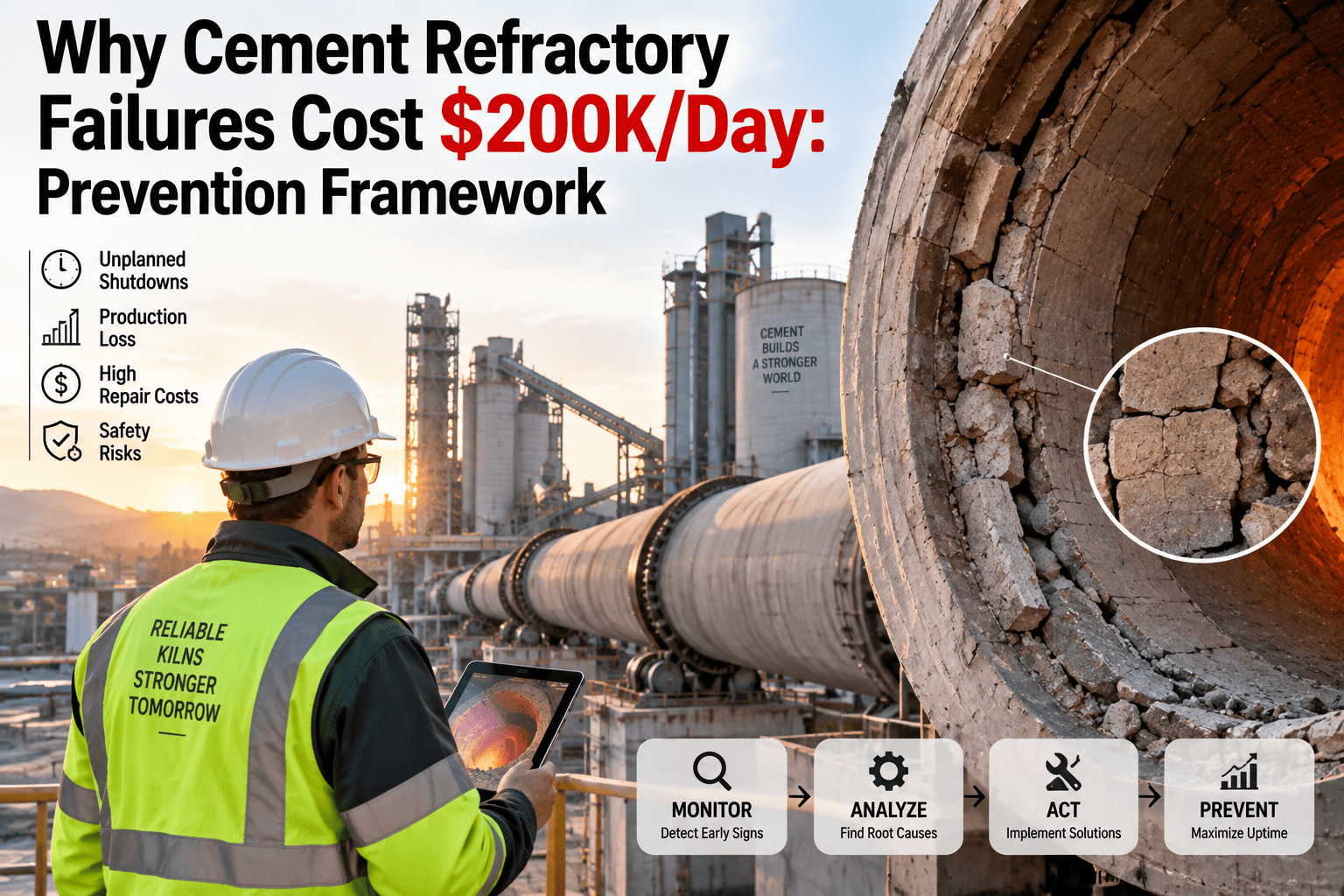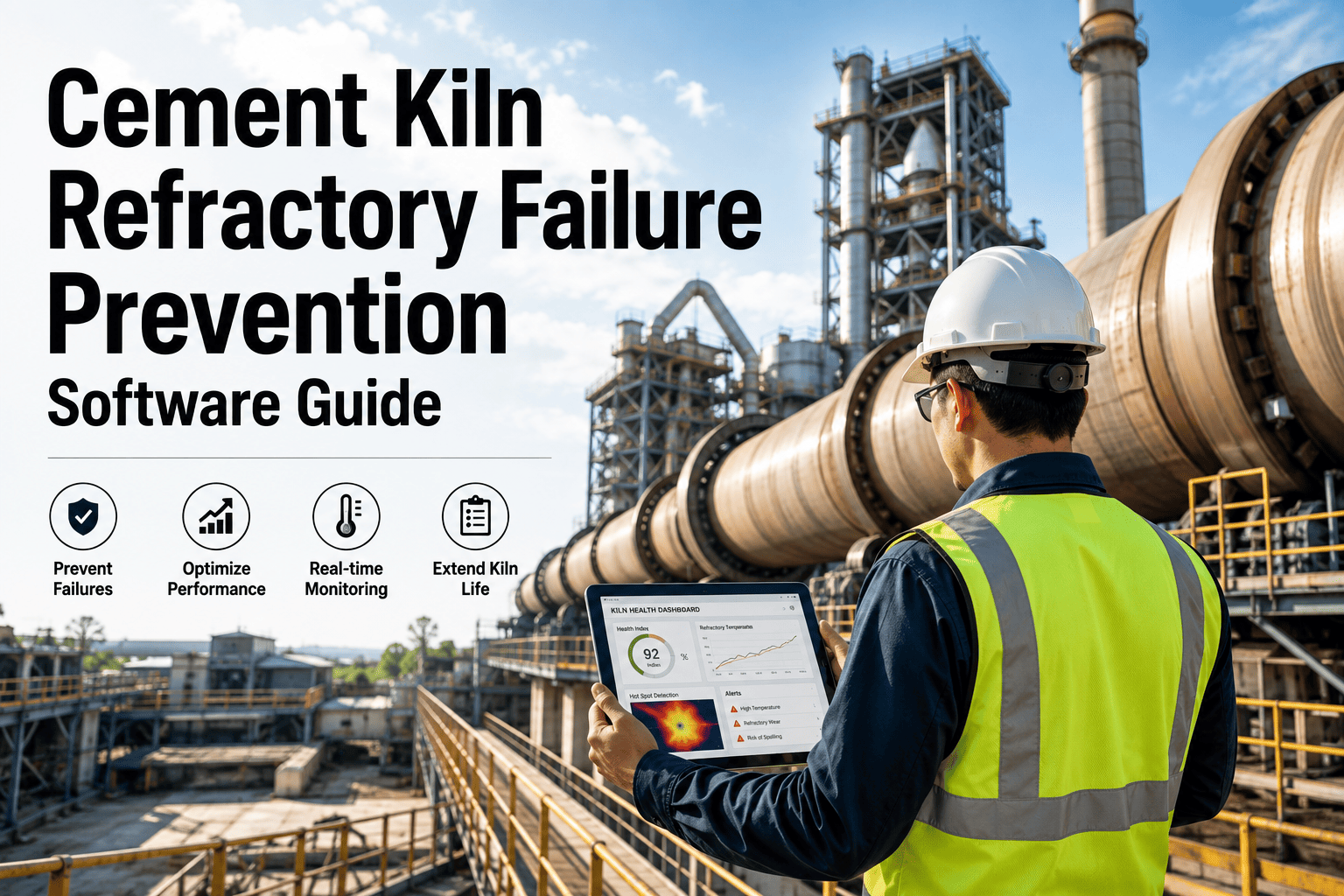
A cement kiln's refractory lining is the one component nobody thinks about until it fails, and when it does, the bill is measured in millions, not thousands. Burning zone brick collapse, coating loss, or a thermal shock crack that propagates through the shell can force a campaign shutdown lasting two to four weeks, with relining costs alone running $1-3 million before production loss is even counted. Refractory wear is gradual and largely invisible from the control room — shell temperature, brick thickness, and coating stability all drift for weeks before anyone notices a problem. Tracking these signals continuously, rather than waiting for the annual inspection window, is what turns an emergency reline into a planned one. OxMaint's refractory tracking module logs shell temperature scans, brick wear estimates, and coating stability trends against your kiln's zone map automatically.
Cement Kiln Refractory Failure Prevention Software
Track burning zone brick wear, coating stability, and thermal shock exposure across every kiln zone before a hot spot forces an unplanned shutdown that can cost $1-3 million in relining and lost production.
Why Refractory Fails: Coating Loss, Thermal Shock and Chemical Attack
Refractory brick in the burning zone survives by holding a stable clinker coating over its hot face — the coating, not the brick itself, is the real thermal barrier once the kiln is at operating temperature. Coating stability depends on burner flame shape, kiln feed chemistry, and rotation continuity; a flame that shifts position, or a feed with an unstable liquid phase, can strip coating off in a matter of hours. Once coating is lost, the exposed brick face sees direct flame radiation and burning zone gas temperatures of 1400-1450°C, and wear rate accelerates sharply. Thermal shock is the second major failure mode — an unplanned kiln stop followed by a fast cooldown, or a fast restart before the shell has stabilised, creates differential expansion between brick layers that cracks and spalls the hot face. Chemical attack from alkali, sulfate, and chloride cycling adds a third, slower wear mechanism, particularly in the kiln inlet and lower cyclone stages where volatile condensation concentrates these compounds against the refractory surface.
These three mechanisms rarely act alone. A kiln that trips on a feed interruption loses coating from the sudden gas temperature drop, and the same event usually triggers a rushed restart under production pressure, layering thermal shock directly on top of the coating loss. Alkali cycling in the inlet, meanwhile, tends to worsen whenever kiln stops become more frequent, since each stop-start cycle changes the volatile circulation pattern through the preheater and inlet seals. This is why refractory failure so often looks sudden from the outside even though the underlying wear had been building for weeks — the visible event is usually the last of several compounding stresses, not a single cause acting in isolation.
Reading the Warning Signs: Shell Temperature and Coating Trend Thresholds
Shell temperature scanning, whether by fixed thermocouple array or a periodic infrared scan walk, is the earliest and cheapest signal of refractory condition available on a running kiln. A stable coating keeps the shell surface temperature within a predictable band for that zone; any localised hot spot rising above the surrounding shell by 30-50°C usually means coating has thinned or dropped away at that point. The table below is the threshold framework most reliability teams apply to burning zone shell scans.
| Shell Temp (Local) | Coating Condition | Wear Trend | Action Window |
|---|---|---|---|
| <300°C | Stable, healthy coating | Normal, slow wear | Continue standard scan interval |
| 300-350°C | Coating thinning | Elevated wear starting | Increase scan frequency, monitor flame |
| 350-400°C | Coating largely lost | Rapid brick wear active | Plan spot repair within days |
| 400-450°C | Brick exposed directly | Severe, accelerating loss | Schedule shutdown repair urgently |
| >450°C | Brick near failure | Shell damage risk | Immediate kiln stop required |
A single scan reading against this table only tells part of the story — the rate of change matters just as much as the absolute number. A spot sitting steadily at 320°C for months is far less urgent than one that reached 320°C after climbing 60°C in a single week, even though both fall in the same "coating thinning" band. Reliability teams that log every scan against the same fixed grid of points along the shell, rather than spot-checking wherever looks hottest that day, build a trend history that makes this rate of change visible instead of guessed at.
Catch the Hot Spot Before It Becomes a Shutdown
OxMaint logs zone-by-zone shell temperature trends, coating stability history, and brick campaign age against your kiln map, flagging drift long before it turns into an emergency reline.
Planning Refractory Campaigns Instead of Reacting to Them
Refractory management works best as a campaign plan, not a repair log. Every zone has a brick specification and an expected campaign life; tracking actual shell temperature trend and known repair history against that expected life lets a reliability team forecast the next reline window months ahead, order brick with adequate lead time, and schedule the shutdown during a planned production window rather than an emergency one. This same tracking also catches the slower chemical-attack wear in the kiln inlet and chain sections, zones that rarely get the same scanning attention as the burning zone but that fail just as expensively when a chain system or inlet seal gives way unexpectedly.
A campaign plan also changes how procurement and contractor scheduling work. Refractory brick, particularly specialised burning zone compositions, often carries lead times of six to ten weeks from order to delivery, and skilled bricklaying crews are typically booked well in advance across a region during peak reline season. A reliability team working from a forecasted reline window months out can lock in both brick supply and labour on favourable terms, while a team reacting to a sudden failure is negotiating from a position of urgency on both fronts simultaneously — which is reflected directly in the cost gap between a planned and an emergency reline.
Case Study: A Planned Reline Instead of a 3-Week Emergency Stop
The team credited the weekly cadence itself as much as the technology behind it — moving from monthly to weekly scans cut the maximum possible blind spot from roughly four weeks down to seven days, which was enough to catch the wear rate while it was still a localised repair rather than a zone-wide problem. They have since extended the same weekly routine to the kiln inlet section after recognising that chemical attack wear there had never been tracked with the same discipline as the burning zone.
Frequently Asked Questions — Kiln Refractory Failure Prevention
Plan Your Next Reline Instead of Reacting to One
OxMaint tracks shell temperature, coating stability, and brick campaign age across every kiln zone in one dashboard, giving your team months of lead time before a $1-3M emergency reline becomes unavoidable. Free to start.