Regulators do not ask whether your trailers were cold. They ask you to prove it, with written procedures, training records, and temperature evidence that can be found quickly. Operations that rely on paper logs and memory tend to discover the gap during their first inspection or customer audit. This guide explains what the FDA's sanitary transportation rule and the upcoming food traceability rule expect from cold chain delivery, and how equipment records kept in maintenance management software support the proof.
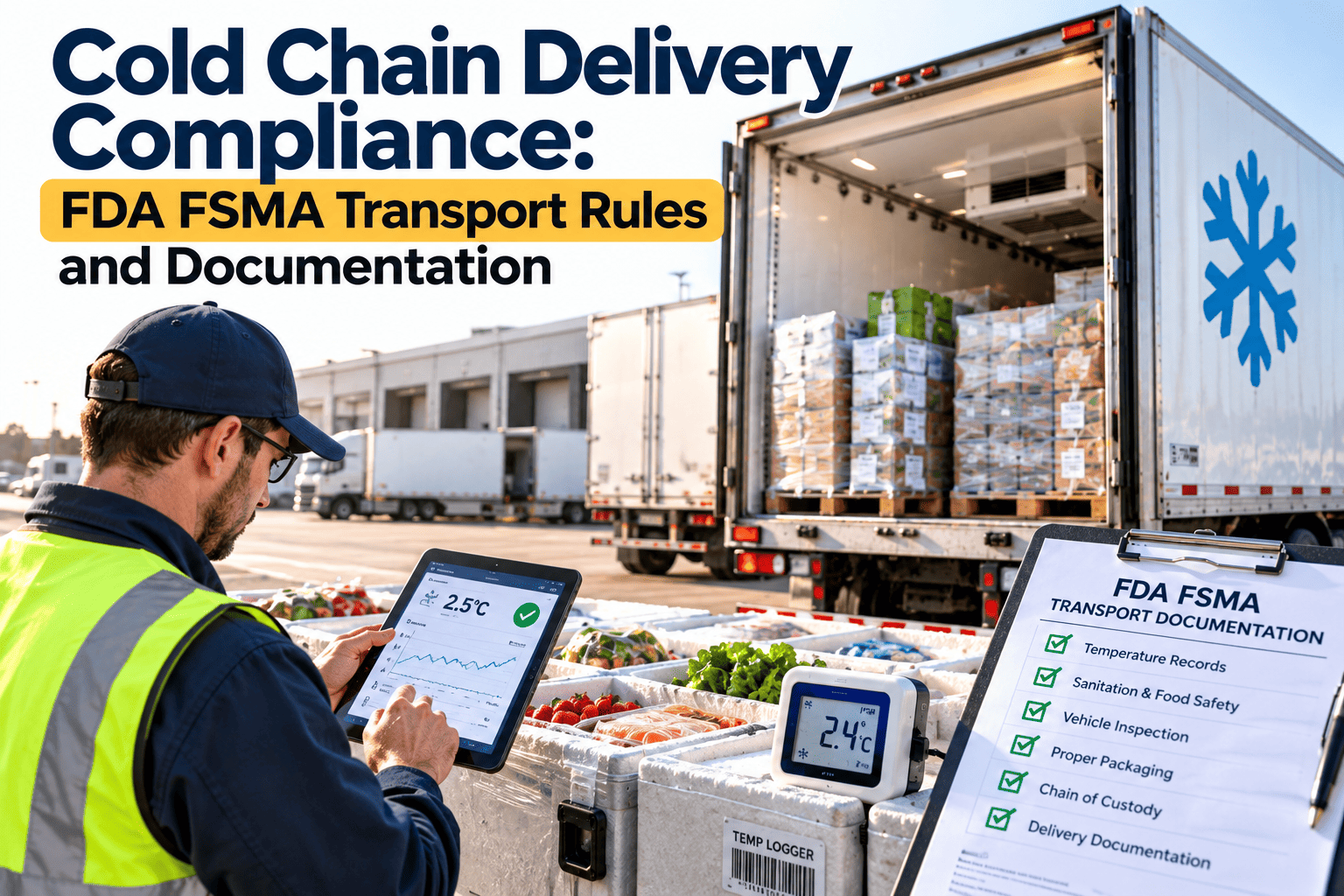
Cold Chain Delivery Compliance: FDA FSMA Transport Rules and Documentation
Compliance is the ability to show, on request, that temperature-sensitive food stayed under control from loading to delivery. The strongest programs turn that proof into a routine byproduct of maintenance, inspection, and monitoring.
What the sanitary transportation rule requires
The FDA's Sanitary Transportation of Human and Animal Food rule sits in 21 CFR Part 1, Subpart O. It covers vehicles and equipment, transportation operations, training, and records. Temperature control is required where it is necessary to keep food safe, not for quality or marketability alone.
- Shippers must specify in writing the operating temperature a carrier needs to maintain for food that requires temperature control for safety
- Carriers must pre-cool refrigeration units when specified and be able to demonstrate that temperature was maintained
- Vehicles and equipment must be in sanitary condition and suitable for the food they carry
- Carrier personnel must be trained in sanitary transportation practices, and training must be documented
- The rule takes a flexible approach to monitoring devices, so the method must be appropriate and defensible rather than prescribed
Who is responsible for what
The rule assigns duties to several parties, and one company may fill more than one role. Written agreements decide who performs each task, so ambiguity here becomes an audit finding later.
| Role | Core duties | Records to hold |
|---|---|---|
| Shipper | Specify temperature and cleanliness needs, check vehicle suitability, develop temperature procedures | Written instructions, agreements, and procedures |
| Loader | Verify that the vehicle is appropriate, pre-cooled if required, and free of problems before loading | Loading checks and pre-cool confirmation |
| Carrier | Keep equipment sanitary and temperature control working, train personnel, prove control in transit | Procedures, training, temperature and sanitation records |
| Receiver | Assess condition on arrival and note temperature or sanitation concerns | Receiving inspection and exception notes |
Two rules, two dates, one operation
Cold chain teams often confuse the sanitary transportation rule with the food traceability rule. They address different questions and run on different timelines.
- Focus on vehicles, temperature control, training, and records
- Already in effect for covered parties
- Records generally retained for 12 months under the rule
- Records stored away from the site must be producible within 24 hours
- Focus on lot codes, key data elements, and critical tracking events
- Applies to foods on the Food Traceability List
- Compliance date is July 20, 2028
- Records must be provided to FDA within 24 hours of request
The documents a cold chain program should be able to produce
An inspector or customer auditor will usually ask for a short list of items. Having them organized by vehicle, shipment, and date makes the difference between a quick answer and a scramble.
Turn equipment records into audit-ready evidence
See how inspections, PM schedules, and work orders can keep refrigeration equipment history organized by vehicle and date.
Pre-cooling and loading verification
Many excursions begin before the doors close. A documented loading check protects the carrier as well as the shipper, because it shows the unit and the product were ready.
Training records that stand up to review
Carriers must document training for personnel engaged in transportation operations. A training entry that lacks a date, a topic, or a name is easy to challenge.
| Role | Typical topics | Record should show |
|---|---|---|
| Drivers | Sanitary practices, temperature checks, handling excursions, cargo area condition | Name, date, topic, and trainer |
| Loaders and dock staff | Pre-cool verification, product handling, load patterns | Name, date, topic, and trainer |
| Maintenance technicians | Refrigeration service, sensor calibration, sanitation of equipment | Training dates and equipment covered |
| Dispatch and quality staff | Excursion response, record retrieval, deviation decisions | Training dates and scenarios practiced |
Which system holds which record
Cold chain compliance rarely lives in one application. The goal is to know where each type of evidence is stored and how to pull it together quickly.
| System | Primary evidence | Typical gap |
|---|---|---|
| Temperature monitoring or telematics | In-transit readings, alarms, location | No link to equipment condition or repair history |
| Transportation or warehouse system | Shipment, lot, and receiving data | Little detail on vehicle sanitation or service |
| Maintenance management system | Inspections, PM history, work orders, calibration records | Does not capture lot-level or in-transit temperature data |
| Quality or document system | Procedures, agreements, training | Not tied to individual vehicles or trips |
Cross-docks, handoffs, and third-party carriers
Every handoff is a point where responsibility can blur. Compliance programs that cover subcontracted carriers and cross-dock operations are more resilient than those that stop at company-owned vehicles.
- Temperature data is not passed from one carrier to the next
- Product waits on a dock with no record of exposure time
- Subcontractors are not required to share inspection records
- Receivers reject loads without documenting the reading
- Agreements that specify data sharing and record formats
- Dock dwell limits with timestamps at each handoff
- Minimum inspection and calibration standards for partners
- A shared exception form for receivers and carriers
Where cold chain compliance usually breaks down
Most failures are not dramatic. They are small process gaps that leave no evidence when it is needed.
How to respond when temperature goes out of range
A documented response matters as much as the reading. Decide the steps in advance so drivers and dispatchers do not improvise.
Equipment condition is part of the compliance record
Temperature control depends on refrigeration units, door seals, insulation, airflow, and sensors. If maintenance history is missing, a deviation looks like negligence rather than an equipment failure that was managed.
| Asset or system | Maintenance activity | Compliance value |
|---|---|---|
| Refrigeration unit | Scheduled service, fault code review, defrost and airflow checks | Shows the unit was capable of holding temperature |
| Temperature probes and loggers | Calibration checks and replacement tracking | Supports the accuracy of recorded data |
| Doors, seals, and insulation | Inspection and repair of leaks and damage | Reduces excursions and explains root causes |
| Cargo area interior | Cleaning, sanitation inspection, and defect repair | Documents sanitary condition before loading |
| Power and fuel systems | Preventive service and inspection | Prevents unit shutdowns during transit |
Digital record integrity: what makes electronic logs credible
Electronic records are only as persuasive as their controls. Auditors look for evidence that data was captured automatically and not altered later.
- Time-stamped entries with the name of the person or device that created them
- An audit trail that shows any change, who made it, and why
- Role-based access so only authorized people can edit or approve records
- Backups and a retention schedule that protects records for the full required period
- The ability to search by vehicle, shipment, lot, or date range and export results quickly
A 24-hour retrieval drill
Several FDA rules expect records to be produced within a day. Practice the request before a regulator makes it.
How Oxmaint supports cold chain compliance records
Oxmaint is a maintenance platform. It is not a temperature monitoring system or a traceability application, and it does not replace either. It organizes the equipment and inspection side of the evidence.
- Asset records for each refrigerated truck, trailer, and refrigeration unit, with complete service history
- Preventive maintenance schedules for refrigeration service, door seals, probes, and sanitation tasks
- Mobile inspection checklists for pre-trip and sanitation checks, completed with timestamps and notes
- Corrective work orders that link a temperature excursion to the repair and the person who completed it
- Stored documents such as calibration certificates and manuals attached to each asset
- Reports that show maintenance compliance by vehicle for audits and customer reviews
Preparing for FSMA 204 while meeting today's transport rules
The traceability rule adds lot-level recordkeeping on top of existing temperature and sanitation duties. Early preparation is mostly about making data connect, not about buying a new tool.
- Identify which products you ship or hold appear on the Food Traceability List
- Map the critical tracking events you perform, such as shipping, receiving, and cross-docking
- Confirm that traceability lot codes travel with each shipment from your warehouse and transport systems
- Check that your records can be searched by lot and exported within the 24-hour window
- Ask trading partners which data they already require, since many retailers set earlier expectations than the federal date
- Keep vehicle inspection and maintenance records linkable to the same shipment record
KPIs for a compliance-ready cold chain
These measures show whether documentation and equipment readiness are keeping pace with delivery volume.
| KPI | What it shows | Warning sign |
|---|---|---|
| Pre-trip inspection completion | Share of departures with a documented inspection | Completion drops during busy shifts |
| Temperature excursion rate | Loads with readings outside the specified range | Excursions concentrated on certain vehicles |
| Calibration currency | Probes and loggers within their calibration interval | Overdue items found during audits |
| Refrigeration PM compliance | Planned service completed on time | Repeat unit faults after missed PMs |
| Record retrieval time | Time to assemble a full package for one shipment | Hours spent searching several systems |
| Corrective action closure | Excursions with a documented decision and repair | Open items that age without follow-up |
- Review these measures monthly with quality, operations, and maintenance together
- Investigate every excursion for equipment, process, or training causes, not only for the immediate fix
- Rerun the retrieval drill at least twice a year and record how long each step took
Frequently asked questions
Does the FSMA sanitary transportation rule require a specific temperature recorder?
The rule takes a flexible approach and does not prescribe a particular device. You still need a defensible way to demonstrate that required temperatures were maintained.
When does the FSMA 204 traceability rule take effect?
The compliance date is July 20, 2028 for foods on the Food Traceability List. Many retailers are asking suppliers for the same data earlier.
How long should cold chain records be kept?
The sanitary transportation rule generally calls for 12 months, and traceability records are generally held for two years. Confirm details with your compliance team.
Can Oxmaint replace our temperature monitoring system?
No. It manages equipment maintenance, inspections, and documents that support the temperature record. You can start with your refrigerated asset list and inspection checklists.
Why do maintenance records matter for audits?
They show that equipment was serviced and capable of holding temperature. To see this applied to a refrigerated fleet, schedule a demo.
Be ready the day a regulator or customer asks for proof
Keep refrigeration service, inspections, and corrective actions organized by vehicle so compliance becomes routine.