Cold Storage Warehouse IoT Maintenance for Cold Chain Reliability

By Johnson on April 10, 2026

cold-storage-iot-maintenance-warehouse-cold-chain-reliability

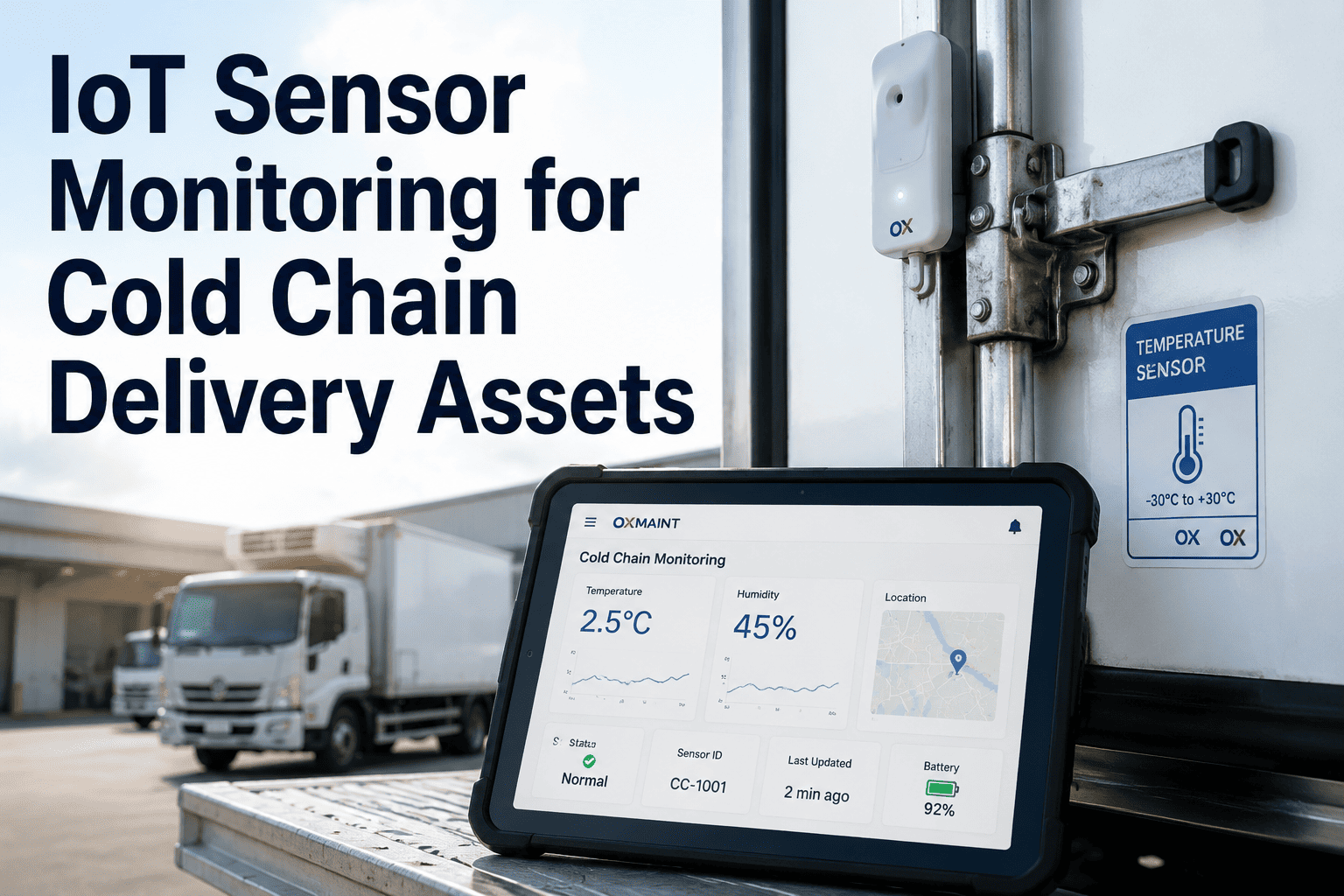
A single refrigeration failure in a cold storage warehouse can destroy hundreds of thousands of dollars of perishable inventory in hours — and you may not know it happened until a driver opens a trailer door at the delivery point. IoT-connected CMMS systems change this entirely: temperature sensors, door monitors, and compressor diagnostics feed live data into a maintenance platform that acts before a breach becomes a loss. Sign in to OxMaint to connect your cold storage IoT data to maintenance workflows, or book a demo to see how predictive cold chain maintenance works in practice.

Cold Chain / IoT Maintenance

Cold Storage IoT Maintenance for Cold Chain Reliability

How IoT-connected CMMS platforms monitor refrigeration systems in real time, predict failures before they cause cold chain breaches, and protect perishable inventory through automated maintenance workflows.

$35B
Annual global food spoilage loss from cold chain failures
72 hrs
Average time from refrigeration fault to detectable spoilage — IoT reduces this to minutes
25%
Energy cost reduction in refrigeration systems maintained through IoT-driven preventive schedules

Why Cold Storage Maintenance Cannot Wait for Symptoms

Traditional cold storage maintenance relies on scheduled inspections and manual temperature logs. The problem is that refrigeration failures give almost no visible warning — a compressor running 15% below efficiency, a condenser coil partially blocked, or a door seal degraded by 20% will not trigger an alarm until the temperature in the chamber has already risen above safe limits. By then, the breach has happened.


Week 1–3
Compressor efficiency drops gradually — undetectable without IoT sensors. Energy consumption rises 10–15%.

Week 4
Chamber temperature fluctuates 1–2°C above setpoint during peak load periods. Manual logs miss the pattern.

Week 5
Compressor fails under load. Chamber temperature rises above compliance threshold. Inventory breach begins.

Discovery
Failure discovered on next manual check or at delivery. Inventory write-off, compliance incident, and customer claim follow.
With IoT CMMS
Efficiency drop detected in Week 1. Maintenance work order generated automatically. Compressor serviced before failure. No breach. No spoilage.
Prevent Cold Chain Breaches

Connect Your Cold Storage Sensors to Maintenance Action

OxMaint links IoT sensor data to automated work orders — so when a compressor shows anomalous behaviour, a technician is already assigned before the chamber temperature moves.

IoT Sensors That Drive Cold Chain Maintenance Decisions

Temperature & Humidity Sensors
Placement: Chamber interior, evaporator coil, product zones
Continuous ambient and product-zone temperature monitoring. Multi-point mapping reveals stratification and hot spots that single-point probes miss. Triggers maintenance work order when trend deviation exceeds defined threshold.
Alert: Temp deviation >0.5°C from setpoint trend over 30 min
Compressor Vibration & Current Monitors
Placement: Compressor housing, motor terminals
Vibration spectrum analysis detects bearing wear, refrigerant charge issues, and valve degradation weeks before failure. Current draw monitoring flags efficiency loss caused by dirty condenser coils or refrigerant leaks.
Alert: Vibration RMS increase >15% from baseline or current draw >105% rated
Door & Seal Monitors
Placement: All access doors, dock seals, pass-through hatches
Open-door duration alerts prevent thermal infiltration from operational errors. Seal degradation is detected through differential temperature readings at door frames — a failing gasket shows as a localised temperature anomaly before visible deterioration.
Alert: Door open >3 minutes or frame delta-T >2°C above baseline
Condenser & Evaporator Pressure Sensors
Placement: High and low side refrigerant circuits
Pressure ratio monitoring reveals coil fouling, refrigerant charge loss, and expansion valve degradation. Trend analysis in the CMMS identifies slow refrigerant leak trajectories that point readings miss because the system still operates within normal range.
Alert: Compression ratio deviation >8% from seasonal baseline
Power Quality Monitors
Placement: Main refrigeration panel, compressor circuit breakers
Voltage sag, harmonic distortion, and phase imbalance cause premature compressor motor failure — the most expensive single-point failure in a cold store. Power quality monitoring creates early warning for electrical infrastructure issues before mechanical damage follows.
Alert: Phase imbalance >2% or voltage sag below 95% of nominal for >10 sec
Refrigerant Leak Detectors
Placement: Compressor rooms, evaporator coil zones, pipe penetrations
Continuous refrigerant concentration monitoring for regulatory compliance and early refrigerant loss detection. Leak detection triggers a maintenance response before refrigerant charge drops enough to affect system performance or create safety and environmental compliance issues.
Alert: Refrigerant concentration above 25% of IDLH threshold

Cold Storage Maintenance Schedule: IoT-Triggered vs Calendar-Based

System Calendar Maintenance IoT-Triggered Maintenance Cold Chain Benefit
Refrigeration Compressor Service every 6 months regardless of condition Service triggered by vibration trend, current draw, or efficiency deviation Service happens when needed — before failure, not on a schedule that may be too late or too early
Condenser Coils Clean quarterly — often delayed or deferred Cleaning triggered when pressure ratio deviation detected Coils cleaned when fouled, not on a schedule that misses mid-cycle fouling
Door Seals & Gaskets Visual inspection on annual walkthrough Replacement triggered by frame delta-T anomaly or open-duration increase Failing seals replaced before thermal infiltration causes temperature exceedances
Refrigerant Charge Checked during scheduled service visits Top-up triggered by pressure ratio and efficiency trend Charge maintained continuously — no slow leak goes undetected between annual checks
Evaporator Defrost Cycle Fixed defrost intervals set at commissioning Defrost frequency adjusted by actual ice accumulation rate from humidity data Optimal defrost reduces temperature fluctuation and extends evaporator coil life

How OxMaint Connects IoT Data to Cold Chain Maintenance

Step 1
Sensor Integration
Temperature, vibration, pressure, and power sensors connect to OxMaint via API, MQTT, or direct integration. Sensor readings are streamed against the asset record — each reading is linked to the specific compressor, chamber, or circuit it belongs to.
Step 2
Threshold & Trend Rules
Maintenance engineers configure alert thresholds and trend rules per asset in OxMaint. A compressor showing a 12% increase in vibration RMS over 14 days triggers a maintenance work order automatically — no manual review required.
Step 3
Automatic Work Order Generation
When a sensor threshold is breached or a trend rule fires, OxMaint generates a work order with the asset ID, anomaly description, sensor readings attached, and a suggested maintenance action — based on the maintenance procedure linked to that asset type.
Step 4
Technician Response
The assigned technician receives the work order on mobile with the asset location, fault description, and sensor evidence. On completion, they log findings, parts used, and resolution — building the asset history that improves future maintenance decisions.
Step 5
Compliance Documentation
Every sensor reading, alert, and maintenance response is timestamped and stored against the asset in OxMaint. This creates the HACCP-ready temperature monitoring record and maintenance audit trail that regulatory inspections and food safety certifications require.
Step 6
Trend & Reliability Reporting
OxMaint reports on cold chain reliability KPIs — temperature exceedance frequency, mean time between failures for refrigeration assets, maintenance compliance rate, and energy consumption trend per chamber — turning IoT data into operational intelligence.

Cold Chain Compliance: What IoT Maintenance Records Prove

HACCP Monitoring
Continuous temperature data linked to maintenance records demonstrates that cold points were monitored and equipment was serviced to maintain compliance — the documented evidence HACCP audits require.
FDA 21 CFR Part 11
Electronic maintenance records with technician attribution, timestamps, and sensor attachments meet FDA audit trail requirements for pharmaceutical cold storage operations subject to federal regulation.
Insurance Claims
When spoilage does occur, IoT maintenance records showing equipment was proactively maintained, alerts were responded to, and the failure was outside the operator's control are critical documentation for insurance recovery.
Customer SLA Evidence
Food retail, pharmaceutical, and logistics customers increasingly require 3PL cold store operators to demonstrate continuous temperature monitoring and documented maintenance programs as a condition of contract renewal.

Frequently Asked Questions

What IoT sensors are most critical for cold storage maintenance monitoring?
Temperature sensors with multi-point chamber mapping and compressor vibration monitors are the highest-priority investments — they detect the two most common failure modes before a breach occurs. Door seal monitors and refrigerant detectors add compliance and containment coverage. Sign in to OxMaint to configure sensor-triggered maintenance workflows for any cold store asset.
How does an IoT CMMS differ from standalone temperature monitoring systems?
Standalone monitoring alerts you when a temperature threshold is breached — after the fact. An IoT CMMS like OxMaint connects sensor trends to maintenance work orders, so compressor efficiency drops and coil fouling patterns trigger maintenance action before the temperature moves at all. Monitoring tells you what happened. A CMMS prevents it.
Can existing cold store refrigeration systems be connected to IoT maintenance monitoring?
Yes — retrofit IoT sensor kits are available for most commercial refrigeration systems. Wireless temperature, vibration, and pressure sensors can be installed on existing compressors and chambers without system modification and integrated into OxMaint via standard connectivity protocols. Book a demo to discuss integration options for your existing cold storage infrastructure.
What compliance documentation does IoT-connected CMMS maintenance produce?
OxMaint stores sensor readings, alert histories, work orders, technician completions, and parts records against each asset — producing a continuous, timestamped audit trail that satisfies HACCP documentation requirements, FDA cold chain records, and customer SLA evidence for third-party audits.
Protect Your Cold Chain

Stop Cold Chain Breaches Before They Start

OxMaint connects IoT sensor data from your cold storage refrigeration systems to automated maintenance work orders — so every compressor anomaly, coil fouling trend, and door seal failure triggers a maintenance response before your inventory is at risk.

Share This Story, Choose Your Platform!