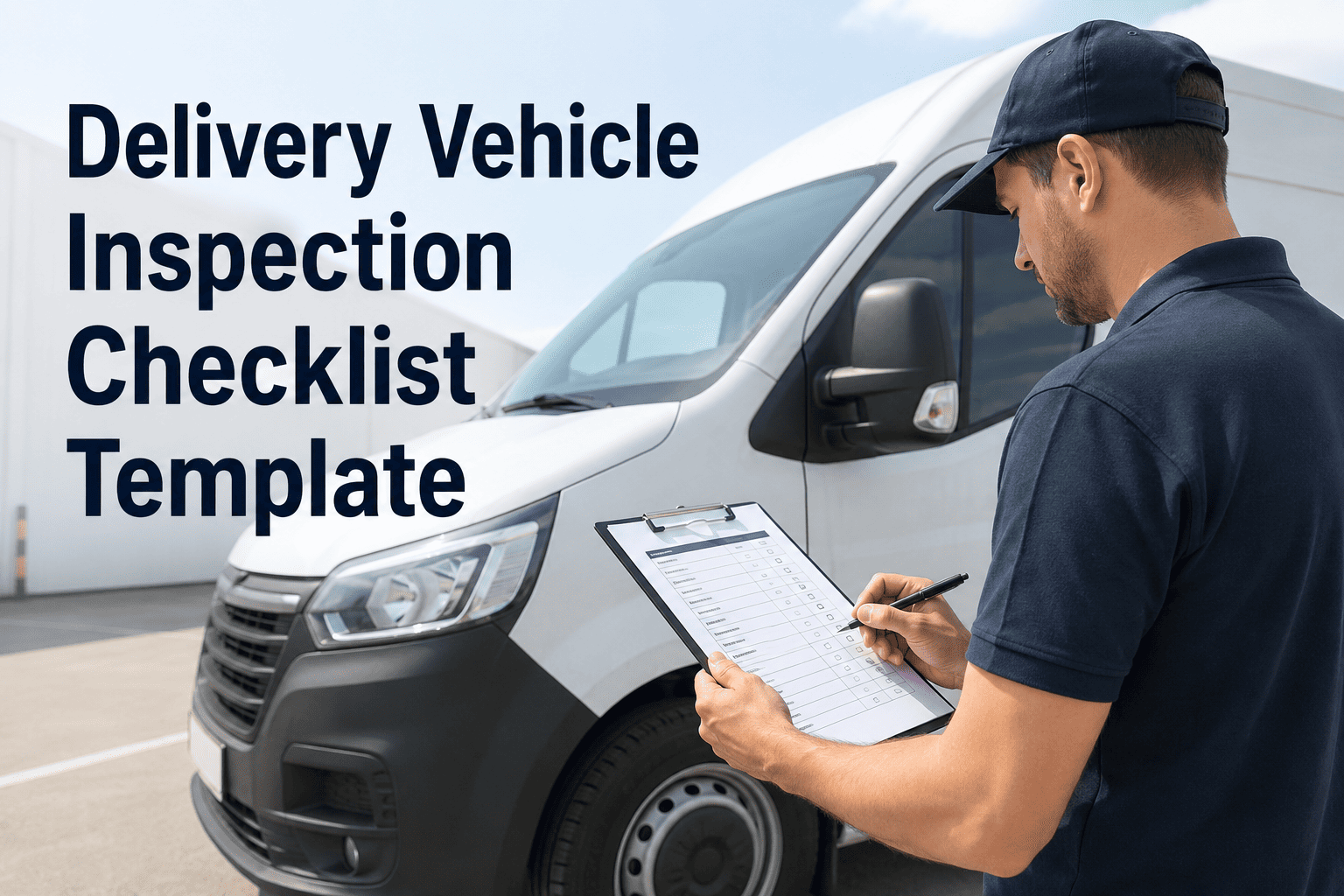
In 2025, 93% of motor carriers audited received at least one compliance violation. The most common cause was not mechanical failure — it was missing or expired paperwork. DOT fines now average over $5,000 per case, with individual violations climbing as high as $16,000. For delivery fleets operating on razor-thin margins, a single failed audit can wipe out months of profit. The problem is not that fleet managers do not care about compliance — it is that paper-based inspection processes and manual tracking make it nearly impossible to stay audit-ready across a growing fleet. In 2026, FMCSA has overhauled its CSA scoring system, made electronic medical certification mandatory, and the Federal Register has now explicitly codified electronic DVIRs as the standard path forward. The shift from paper to digital compliance is no longer optional — it is regulatory strategy. This guide walks delivery fleet operators through every critical DOT compliance requirement, shows where automation eliminates risk, and maps a clear path to building an audit-proof operation. It starts with centralizing your fleet inspections and maintenance records in one digital platform.
Why 2026 Changes Everything for Fleet Compliance
The DOT compliance landscape has shifted more in the past 12 months than in the previous decade. FMCSA has restructured its entire Safety Measurement System, split Vehicle Maintenance into two separate scoring categories, and consolidated over 2,000 violation codes into roughly 100 broader groups. Off-site audits have surged by over 8,400% since 2017, meaning carriers must now produce digital records within 48 hours of an audit request — paper filing cabinets will not survive that timeline.
For delivery fleets, the message is clear: manual compliance tracking is now a liability, not just an inconvenience. The carriers who automate their inspection, documentation, and maintenance workflows today are the ones who will avoid fines, protect their CSA scores, and keep their operating authority intact.
Key 2026 DOT Regulatory Changes Delivery Fleets Must Know
Staying compliant in 2026 means understanding several critical changes that directly affect how delivery fleets operate, inspect, and document their vehicles and drivers.
CSA Safety Measurement System Overhaul
The old 1-10 violation severity scale has been replaced with a simple two-tier system: Out-of-Service violations receive a weight of 2, all others receive 1. Vehicle Maintenance is now split into two categories — standard maintenance issues and driver-observed defects. Your DVIRs now directly impact a separate compliance score.
Electronic Medical Certification (June 2025+)
DOT medical certificates must now be transmitted electronically to FMCSA. Paper medical cards are no longer sufficient for compliance. Expired medical certificates account for 35% of all audit violations — automated expiration tracking eliminates this risk entirely.
Electronic DVIRs Officially Codified
As of February 2026, FMCSA published the final rule in the Federal Register explicitly authorizing and encouraging electronic DVIRs. This formal codification signals the regulatory expectation: digital is the standard. Fleets still using paper inspection forms are operating on borrowed time.
ELD Removals and Fentanyl Testing
Several ELD devices have been removed from the FMCSA registered list — carriers must replace them by February 2026. Additionally, fentanyl is being added to DOT drug testing panels, the most significant expansion of testing requirements in years.
The Real Cost of Non-Compliance for Delivery Fleets
Non-compliance is not just a fine — it is an operational shutdown risk. When a vehicle fails a roadside inspection or an audit uncovers documentation gaps, the consequences cascade quickly through your entire delivery operation.
| Violation Category | Fine Range | Operational Impact |
|---|---|---|
| Missing/Incomplete DVIR | $1,270 - $15,420 | Vehicle Out-of-Service |
| Falsifying Inspection Report | Up to $12,700 | Criminal Liability Risk |
| Maintenance Record Gaps | $13,300 - $53,203 | CSA Score Increase |
| Operating OOS Vehicle | Up to $19,277 | Fleet Shutdown Risk |
| HOS Violation | Up to $16,000 | Driver Placed OOS |
| Missing DQ File Documents | $5,000+ avg per case | Audit Failure Trigger |
Paper vs. Digital: How Inspection Automation Transforms Compliance
The gap between paper-based compliance and digital automation is not marginal — it is the difference between scrambling during audits and being audit-ready 365 days a year.
Handwritten DVIRs that are hard to read, easy to lose, and impossible to search. Fleet managers spend 30-40% of their time chasing documents. Expired medical certificates go unnoticed for weeks. Audit requests require days of manual file assembly.
Guided mobile inspections completed in minutes with photo verification. Every DVIR is instantly searchable and audit-ready. Automated alerts flag expiring documents 90, 60, and 30 days in advance. Defects route directly to maintenance with auto-generated work orders.
The Complete DOT Compliance Checklist for Delivery Fleets
Every delivery fleet must maintain compliance across five core areas. Here is what each requires and where automation makes the critical difference.
How a CMMS Automates the Entire Compliance Workflow
A modern CMMS does not just store records — it actively manages your compliance lifecycle across every component of DOT requirements.
Drivers complete guided inspections on mobile devices with photo capture. Defects auto-generate maintenance work orders. Repair certifications flow back to the driver before next dispatch. Every record stored with searchable, exportable audit trails.
90/60/30-day reminders for expiring medical certificates, registrations, insurance policies, and annual inspections. Missed inspection flags raised instantly. No deadline passes unnoticed.
Preventive maintenance auto-scheduled based on mileage, engine hours, or calendar intervals. Every repair logged against the vehicle history. Annual inspection compliance automated with reminders and status dashboards.
Pull any driver's complete DQ file, vehicle maintenance history, or inspection record with a single click. Generate compliance reports in seconds — not days. Response time becomes minutes instead of filing cabinet searches.
Your Compliance Automation Roadmap
Building an audit-proof delivery fleet follows a clear, sequential path. Each phase builds on the previous one — and the first step delivers the fastest ROI.
| Phase | Timeline | Actions | Outcome |
|---|---|---|---|
| Phase 1: Digitize | Days 1-30 | Move DVIRs, DQ files, and maintenance records to a cloud CMMS. Replace paper with mobile checklists. | Audit-ready records |
| Phase 2: Automate | Days 30-90 | Set up automated alerts for document expirations, PM schedules, and annual inspections. | Zero missed deadlines |
| Phase 3: Integrate | Months 3-6 | Connect telematics, ELD data, and fuel systems to your CMMS for a single compliance dashboard. | Full fleet visibility |
| Phase 4: Optimize | Months 6-12 | Use AI analytics to identify violation patterns and prioritize high-risk vehicles for inspection. | Proactive compliance |