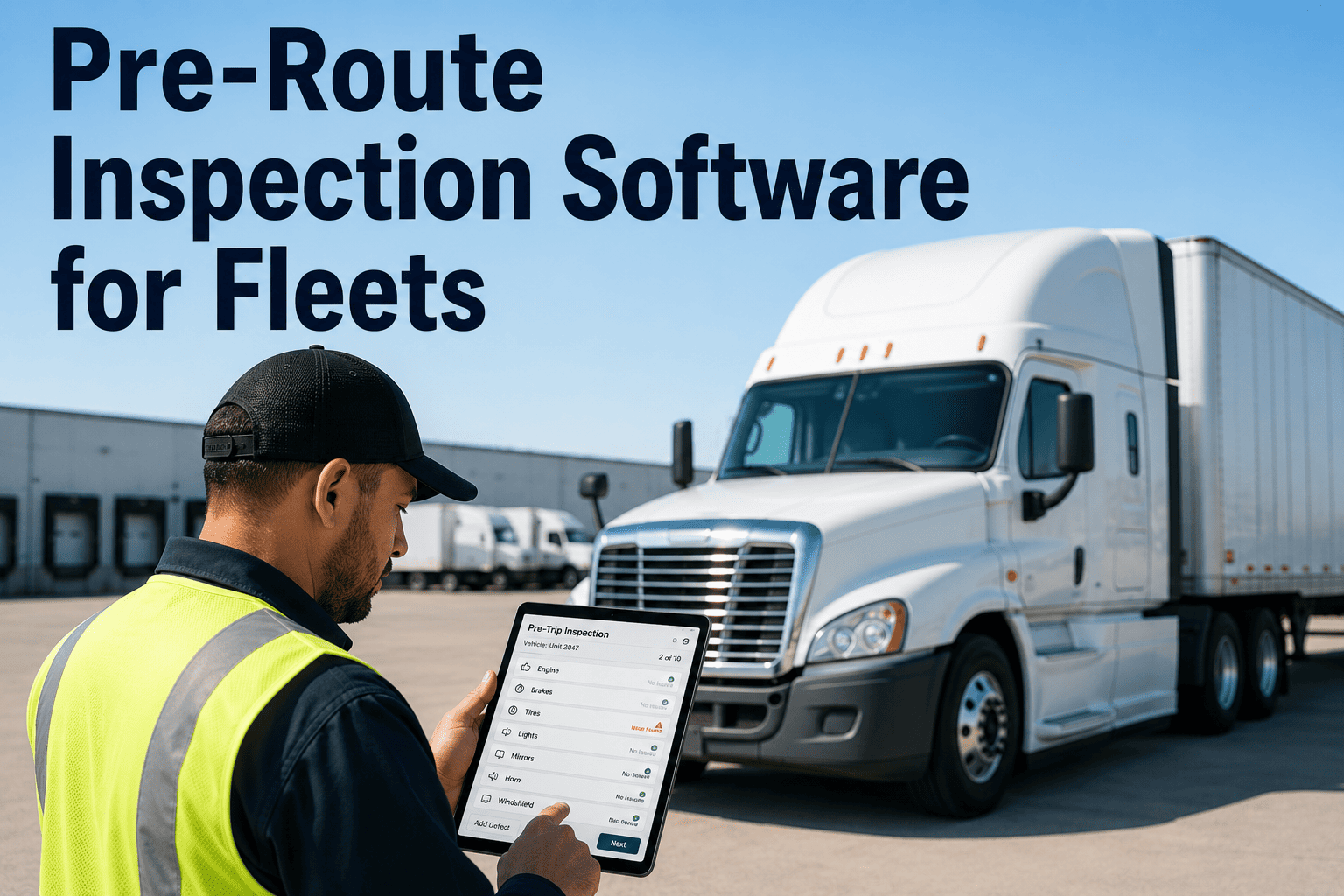
Driver Reported Defect Management With Mobile Capture and Automated Escalation
By Alex Jordan on March 25, 2026
Paper defect reporting systems produce systematic under-reporting, delayed escalation, and compliance gaps that DVSA and FMCSA inspectors find in almost every fleet audit. OxMaint replaces the paper defect book with a mobile app any driver can complete in under 90 seconds — photo capture, severity tagging, and immediate escalation — generating a timestamped, GPS-verified digital record that satisfies operator licence compliance obligations from the moment it is submitted.
OxMaint · Driver Defect Management · Mobile Capture
Every Defect. Reported Instantly. Escalated Automatically. Resolved and Closed.
Mobile defect capture with photo upload, severity tagging, and automated escalation to maintenance — with closed-loop resolution tracking and compliance records generated per report.
Time for a driver to complete a full defect report on OxMaint mobile — including photo and severity tag
67%
More defects reported per vehicle per month when drivers switch from paper to OxMaint mobile
<4 hrs
Average time from critical defect report submission to work order completion — overnight window
100%
DVSA-compliant digital defect records — timestamped, GPS-verified, driver-signed, audit-ready
How the Mobile Defect Report Works: Four Steps, Under 90 Seconds
The fastest way to eliminate under-reporting is to make reporting faster than not reporting. OxMaint's driver app guides any driver through a complete defect report in four taps — no training required, no technical vocabulary needed, no connectivity dependency (reports sync when signal returns). Every report generates a timestamped, GPS-tagged, driver-signed digital record that satisfies DVSA daily inspection requirements and FMCSA pre-trip documentation standards. Start free and deploy the OxMaint driver app across your fleet within 48 hours — no hardware required.
MOBILE DEFECT REPORT WORKFLOW — 4 STEPS FROM NOTICE TO ESCALATION
Step
Driver Action
Data Captured
What OxMaint Does
Time
01
Select defect type from guided list
Vehicle ID, defect category, location on vehicle (tap diagram)
Timestamps the report. Assigns defect category and vehicle automatically.
20 sec
02
Take photo of the defect
Photo with EXIF metadata — GPS coordinates, timestamp, device ID
AI analyses photo — confirms defect type, flags severity mismatch if detected.
25 sec
03
Tag severity level
Severity selection: Critical / Amber / Monitor — with guided descriptions per level
Digital driver signature, submission timestamp, GPS location
Generates DVSA/FMCSA-compliant record. Work order raised. Driver receives confirmation.
15 sec
Works offline — reports queue locally and sync automatically when connectivity is restored. No signal, no problem.
Defect Severity Framework: Three Levels, Three Escalation Paths
Not all reported defects require the same response. A cracked windscreen wiper blade and a brake fluid leak are both defects — one is a scheduled replacement, the other is a vehicle hold. OxMaint's three-tier severity framework removes the ambiguity from escalation decisions. The driver selects from guided options with plain-English descriptions — the system handles the routing automatically. Fleet managers never need to manually triage an incoming defect report at 05:30. Book a demo to see the defect severity framework configured for your vehicle types and operational requirements.
DEFECT SEVERITY FRAMEWORK — THREE TIERS, AUTOMATED ESCALATION
S1
Critical — Do Not Dispatch
Vehicle must not depart. Immediate hold applied. Work order raised and fleet manager alerted within 3 minutes.
Most Reported Defect Categories: Where Fleet Risk Concentrates
Across OxMaint's deployed fleet base, six defect categories account for 81% of all driver-reported issues. Understanding which categories generate the most reports — and how many escalate to critical — is the foundation of a proactive maintenance programme. Fleets that analyse their defect category distribution and adjust PM intervals accordingly consistently reduce S1 critical reports by 40–60% within 90 days. OxMaint generates your fleet's defect category breakdown automatically — start free and see your first category report within 30 days.
DEFECT CATEGORY FREQUENCY — % OF ALL DRIVER REPORTS · INDUSTRY AVERAGE 2024–25
Defect Category
Share of All Reports
Frequency
% Escalate to S1
PM Action
Brakes & Tyres
26%
38% critical
Shorten brake inspection interval
Lights & Electrics
19%
11% critical
Add electrical check to PM checklist
Doors & Load Security
16%
22% critical
Latch and seal inspection quarterly
Engine & Drivetrain
13%
44% critical
OBD alert calibration adjustment
Body & Panel Damage
11%
4% critical
Cosmetic — schedule at next PM
Wipers & Visibility
8%
16% critical
Add to pre-winter PM cycle
Engine and drivetrain defects have the highest S1 escalation rate (44%) — highest priority for predictive PM investment.
Escalation to Resolution: The Full Defect Lifecycle in OxMaint
A defect report is only valuable if it is acted on. OxMaint tracks every report from submission through triage, work order creation, repair completion, and driver confirmation of resolution — creating a closed loop that DVSA and FMCSA inspectors regard as the gold standard for operator licence compliance. No defect is ever marked closed without a linked work order and a technician sign-off. Start free — closed-loop defect tracking active from day one of deployment.
DEFECT LIFECYCLE — FROM DRIVER REPORT TO CLOSED RESOLUTION
Stage
S1 Critical
S2 Amber
S3 Monitor
Who Receives
01
Report Submitted
Immediate — real time
Immediate — real time
Queued — batch
Vehicle record + driver app confirmation
02
Alert Fired
Push + SMS to fleet manager and tech
Dashboard alert — end of route
Next morning summary
Fleet manager · Workshop supervisor
03
Work Order Raised
Auto-generated — P1 — within 3 min
Auto-generated — P2 — overnight queue
Linked to next scheduled PM
Technician mobile app · Workshop queue
04
Repair Completed
Technician signs off — same shift
Technician signs off — overnight
Technician signs off — at PM
Technician — digital sign-off required
05
Driver Confirmation
Driver confirms before next dispatch
Driver confirms at next pre-trip
Driver confirms at next inspection
Driver app — mandatory before vehicle release
06
Record Closed
Full audit trail sealed — PDF available
Full audit trail sealed — PDF available
Linked to PM record — archived
Fleet director compliance dashboard
Technology Integration: How OBD, AI Camera, SAP, Digital Twin, and PLC Enhance Defect Management
Driver reports are one data source. OxMaint enriches every report with data from additional technology layers — cross-referencing driver observations with OBD sensor readings, AI camera inspection results, and service history records. A driver reports brake noise: OxMaint cross-checks OBD brake pressure data and AI camera tyre inspection from the morning gate scan and presents the technician with a complete picture before they touch the vehicle. Connect all five technology layers through one OxMaint deployment — each layer makes driver reports more actionable.
HOW EACH TECHNOLOGY ENHANCES DRIVER DEFECT REPORTS
OBD
Sensor Correlation
OBD readings cross-referenced with every defect report. Brake noise report matched against brake pressure sensor data. Engine warning confirmed against fault codes.
Confirms or upgrades driver severity assessment
AI Camera
Visual Evidence
Gate camera images from departure and return are automatically attached to the defect record — providing visual context before the repair begins and confirming post-repair condition.
Photo evidence without driver effort
SAP
Cost & Record Sync
Every defect-generated work order writes to SAP PM/MM with parts cost, labour time, and vehicle ID — defect resolution costs tracked at vehicle and fleet level automatically.
Zero manual SAP entry per defect repair
Digital Twin
Pattern Recognition
Recurring defect patterns analysed across the virtual fleet model — when 8 vehicles report the same issue within 30 days, the digital twin identifies a systemic cause and recommends a fleet-wide PM update.
Converts repeat reports into PM schedule changes
PLC
Workshop Readiness
Workshop bay and lift availability data ensures that when a critical defect work order is raised, the depot knows immediately which bay is available for the repair — no queuing on arrival.
Critical repairs start the moment the vehicle returns
Preventive PM
Defect-to-PM Linkage
Repeat S2/S3 defects in the same category automatically trigger a PM interval review recommendation — linking reactive driver reports to proactive schedule improvements.
Reduces S1 critical rate by up to 55% in 90 days
"Our DVSA traffic examiner visit in March asked for defect records going back 12 months across all 43 vehicles. With our old paper system that would have been a box of handwritten books. With OxMaint I exported the entire record for every vehicle in the relevant period in about four minutes. The examiner commented that it was an exceptionally well-organised operation. We had zero improvement notices."
Transport Manager
Regional Grocery Distributor — 43 HGVs and vans · UK
Frequently Asked Questions
Q1 Does the OxMaint driver app satisfy DVSA daily walkaround check requirements?
Yes — OxMaint generates a timestamped, driver-signed digital DVIR that satisfies DVSA daily walkaround check requirements under the Goods Vehicles (Licensing of Operators) Act. For USA operators, the equivalent FMCSA pre-trip inspection documentation is produced automatically. Records are exportable on demand for examiner visits. Book a demo to confirm your jurisdiction's requirements are covered.
Q2 What happens if a driver reports a critical defect while out on route?
An immediate push notification and SMS is sent to the designated fleet manager and workshop supervisor. OxMaint generates a P1 work order automatically and displays the vehicle location. The fleet manager can instruct the driver to return, wait for roadside assistance, or continue to the nearest depot depending on the defect type.
Q3 Can a defect report be submitted without mobile signal?
Yes — the OxMaint driver app works fully offline. Reports including photos are stored locally and sync automatically the moment connectivity is restored. The timestamp applied is the time of submission, not the time of sync, preserving accurate compliance records.
Q4 How does OxMaint prevent a vehicle being dispatched with an unresolved critical defect?
A vehicle with an open S1 critical work order is flagged as "Hold — Do Not Dispatch" in the pre-dispatch dashboard. The fleet manager cannot clear the vehicle until the technician signs off the repair and the driver confirms resolution. The hold cannot be manually overridden without a documented management authorisation reason.
Q5 How quickly can the driver app be deployed across a 100-vehicle fleet?
Drivers download the app and are active within 10 minutes — no hardware, no IT project. Vehicle profiles are pre-loaded so drivers select their assigned vehicle and start reporting immediately. Fleet-wide deployment of 100 drivers typically completes within one working day. Start your free trial — driver app deployment support included from day one.
Every Defect Reported. Every Risk Resolved. Every Record Compliance-Ready.
Mobile capture, automated escalation, and closed-loop resolution — deployed across your fleet in one day.