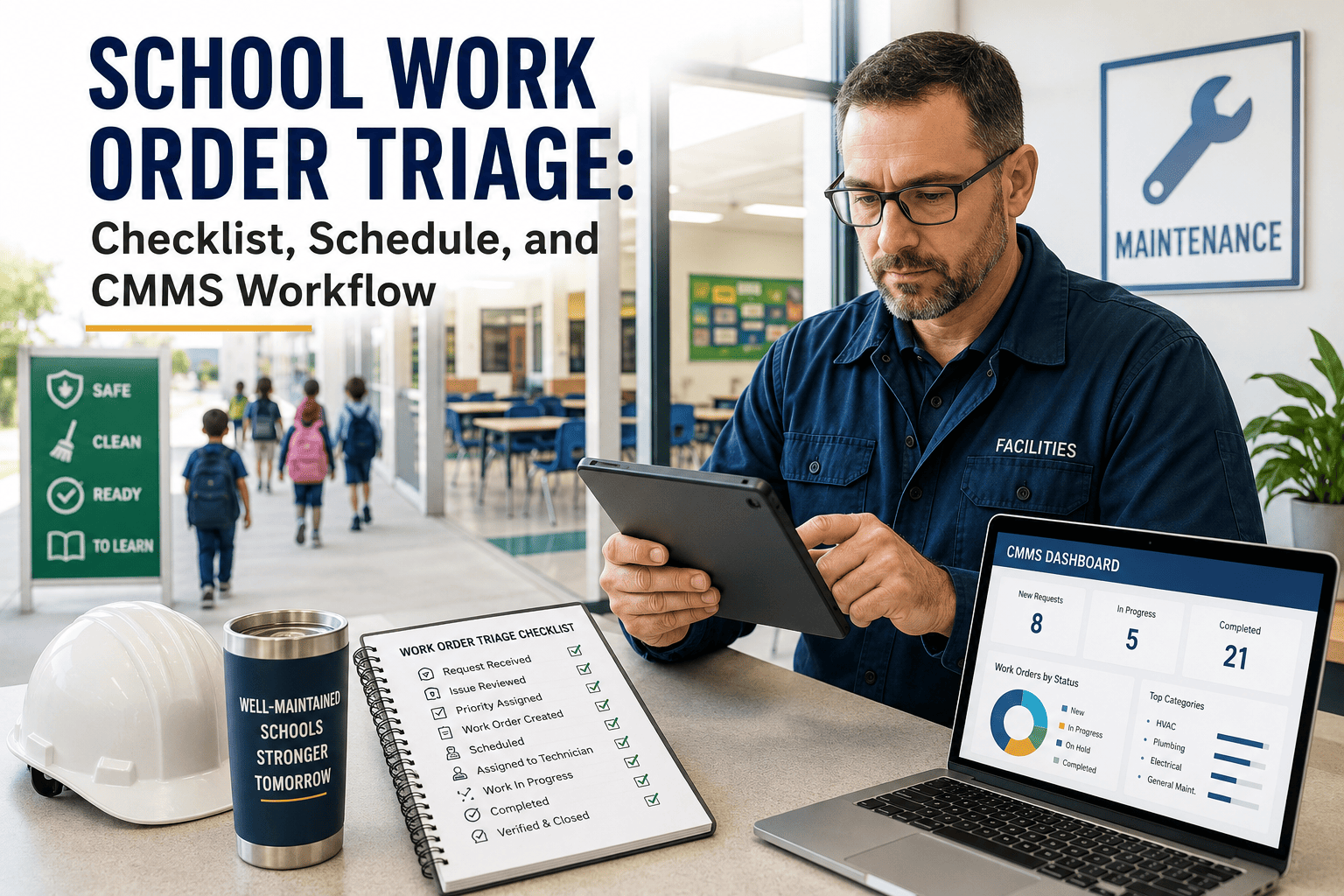
Every morning, somewhere on your campus, a facility director opens an inbox of 30 to 80 unstructured work requests and spends the next two to three hours manually reading, categorizing, prioritizing, and assigning them. This triage ritual is the most wasteful routine in facilities management — repetitive, error-prone, and entirely unnecessary. AI-powered work order auto-classification completes the same task in under five seconds per request, with greater consistency and zero manual intervention. What your supervisor currently burns two and a half hours on before 10 AM can be eliminated entirely. Start a free trial with Oxmaint and eliminate manual triage from your team's day, or book a demo to see AI work order classification running live on campus requests.
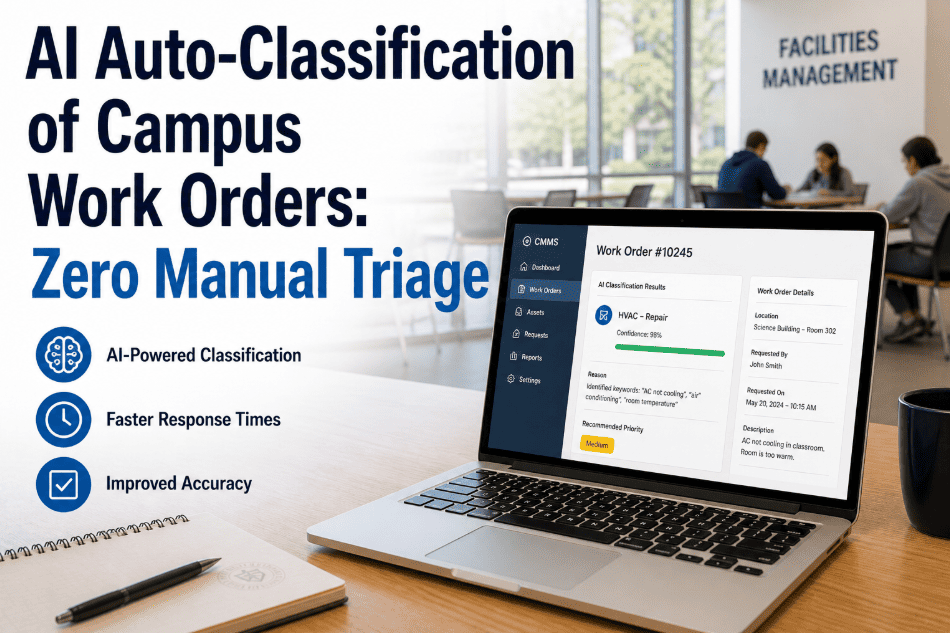
AI Auto-Classification of Campus Work Orders: Zero Manual Triage
Manual work order triage wastes 2.5 hours every morning for campus facility directors. Oxmaint's AI classifies, prioritizes, and routes every incoming campus work request in under 5 seconds — without a human in the loop. Your team stops sorting and starts fixing.
What AI Work Order Auto-Classification Actually Does
AI work order auto-classification is the application of machine learning and natural language processing to the incoming stream of unstructured maintenance requests submitted by students, faculty, and staff. When a request comes in — via mobile portal, email, QR code scan, or IoT sensor trigger — the AI engine reads the request text, identifies the problem type, determines urgency based on asset criticality and campus rules, and routes it to the correct technician with the right skill set and the lightest current workload. This happens in under five seconds, with no human reading the request. The result is faster response, more consistent prioritization, and a supervisor who gets to spend their morning on planning and stakeholder management rather than email triage. Start a free trial with Oxmaint to experience zero-triage operations from day one, or book a demo and bring a sample of your real campus work orders for a live classification walkthrough.
Any channel — mobile app, portal, email, QR code scan, IoT sensor alert. The AI ingests the raw text and any attached metadata (location, building, asset ID).
Natural language processing identifies the problem category (HVAC, plumbing, electrical, structural, grounds, IT infrastructure) and the specific issue type within that category.
Priority is assigned based on: asset criticality tier, safety risk keywords, SLA rules by building and request type, and historical response patterns for similar issues on that asset.
The AI matches the request to the technician with the right skill certification, available capacity in their current queue, and closest physical location to the reported building.
A complete digital work order is created with asset history pre-attached, parts checklist populated from historical similar repairs, and expected completion window set by SLA rules.
The assigned technician receives a mobile push notification with the full work order. They can accept, flag for review, or request a reassignment — without the supervisor needing to initiate any of it.
Why Manual Work Order Triage Is Silently Damaging Your Operation
The triage cost is not occasional — it repeats every single working day. Over a year, a single facility director loses 650+ hours to manual request sorting. That is 16 full working weeks spent on a task AI completes in minutes.
Human triage is subject to cognitive bias, inbox order effects, and fatigue. A safety-critical request buried in a long inbox gets lower priority than a visible one at the top. AI applies the same decision rules consistently — every request, every time.
Manual assignment relies on the supervisor knowing each technician's current workload and skill certifications from memory. When this knowledge is incomplete or out of date, tasks are routed to technicians who cannot complete them — creating return trips and delays.
During high-volume periods — beginning of semester, post-storm, post-event — manual triage cannot keep pace. High-priority requests get delayed because the supervisor is still working through the queue. AI processes the entire queue simultaneously.
Inside Oxmaint's AI Work Order Engine
Oxmaint's AI classification system is trained on millions of campus maintenance requests across all facility types — residential, academic, athletic, administrative, and utility. It understands the specific language of campus maintenance and applies institutional rules your team configures to ensure the AI routes work the way your operation requires. Try it free and configure your classification rules in your first week, or book a demo to see how the AI handles your actual request types.
Whether the request says "the thing in the bathroom is leaking" or "P-trap failure at Rm 214 lavatory," the AI correctly classifies it as a plumbing issue, applies the right priority tier, and routes it to a plumbing-certified technician.
Every campus has unique SLA requirements. Configure rules for residential vs. academic buildings, for safety-critical asset categories, for event-day priority windows, and for after-hours escalation — all applied automatically by the AI.
The AI sees every technician's current open work order queue in real time. New assignments go to the best-matched technician who has capacity — not just the first available name on a rotation list.
When an IoT sensor reports a threshold breach — temperature, humidity, pressure, power draw — Oxmaint auto-creates a classified, prioritized work order tied to the specific asset, with no human in the loop at any point.
Every supervisor override, reassignment, or priority adjustment trains the AI on your institution's specific patterns. Classification accuracy increases continuously — typically reaching 94%+ within the first 90 days of operation.
When multiple students report the same broken elevator or the same leaking pipe, the AI identifies and consolidates duplicate requests into a single work order — preventing technicians from responding to the same issue twice.
Manual Triage vs. Oxmaint AI Classification
| Dimension | Manual Triage | Oxmaint AI |
|---|---|---|
| Time to classify and assign one request | 3–5 minutes average (reading, deciding, typing) | Under 5 seconds, fully automated |
| Consistency of prioritization | Variable — affected by inbox order, mood, context | 100% consistent — same rules applied every request |
| Technician skill matching | Relies on supervisor memory and familiarity | Real-time skill certification and availability matching |
| Peak volume handling (50+ requests in one morning) | Triage backlog grows — priority requests delayed | All requests processed simultaneously — no queue delay |
| IoT sensor alert routing | Manual — requires someone to see the alert | Auto-classified and assigned in real time, 24/7 |
| Duplicate request handling | Manual review — often missed, same job done twice | Auto-detected and consolidated into single work order |
| Supervisor time cost (daily) | 2.5 hours minimum per facility director | Near zero — spot-check and override only when needed |
| Classification accuracy | Subjective — no formal measurement | 94%+ measured accuracy with continuous improvement |
What Zero Manual Triage Delivers to Campus Operations
2.5 hours per day times 260 working days — returned to planning, vendor management, and strategic campus improvement.
AI assigns high-priority work orders the moment they arrive — not after the morning triage session concludes two hours later.
Consistently outperforms human triage for priority-critical requests, where cognitive load and fatigue create the highest error rate.
After-hours IoT alerts, weekend student submissions, and early-morning reports are classified and assigned without waiting for a supervisor to arrive.
Frequently Asked Questions
How does the AI know the priority rules specific to our campus?
Oxmaint's AI priority engine is configurable at the institutional level. During onboarding, your facilities team inputs your SLA rules by building type, asset category, and request type. For example, you can configure that any HVAC failure in a residential hall during the first month of semester triggers a same-day response requirement, while a non-urgent grounds request carries a five-day window. These rules are then applied automatically by the AI to every incoming request. As your team makes adjustments over time, the AI learns from those overrides and refines its rule application accordingly.
What happens when the AI makes a classification error?
Supervisors can override any AI classification or routing decision with a single tap in the Oxmaint interface. Each override is logged and fed back into the learning model, improving future classification accuracy for similar requests. The system is designed with a human-in-the-loop override capability precisely because edge cases and unusual requests will occasionally require human judgment. The goal is not to eliminate supervisor judgment — it is to eliminate the need for supervisors to apply judgment to the 90% of requests that are routine and predictable.
Can the AI handle work order requests submitted via multiple channels simultaneously?
Yes. Oxmaint's AI engine processes requests from all configured submission channels — mobile portal, web form, email, QR code scan, and IoT sensor triggers — in a unified queue with a single classification and routing logic applied consistently across all sources. The channel of origin does not affect priority or routing — only the content and configured rules determine how each request is handled. This eliminates the common problem of email requests getting lower priority than portal submissions simply because of the submission method.
How long does it take for the AI to reach high accuracy on our specific campus request patterns?
Oxmaint's AI starts with a baseline model trained on millions of campus maintenance requests from institutions across all size categories. Most campuses see 85%+ classification accuracy from day one, reaching 94%+ within 60 to 90 days as the model trains on institution-specific patterns and supervisor feedback. The accuracy improvement is measurable and tracked in Oxmaint's AI performance dashboard, which shows classification accuracy rates, override frequency by category, and improvement trajectory over time.
Your Morning Triage Routine Should Not Exist. Oxmaint Eliminates It.
The two and a half hours your facility director spends sorting work orders every morning is not a necessary cost of running a campus maintenance operation. It is the cost of not having AI. Oxmaint's auto-classification engine handles every incoming request in under five seconds — with greater accuracy and consistency than any manual process — and routes it to the right technician before your supervisor has finished their first coffee. That time goes back to your team, permanently.