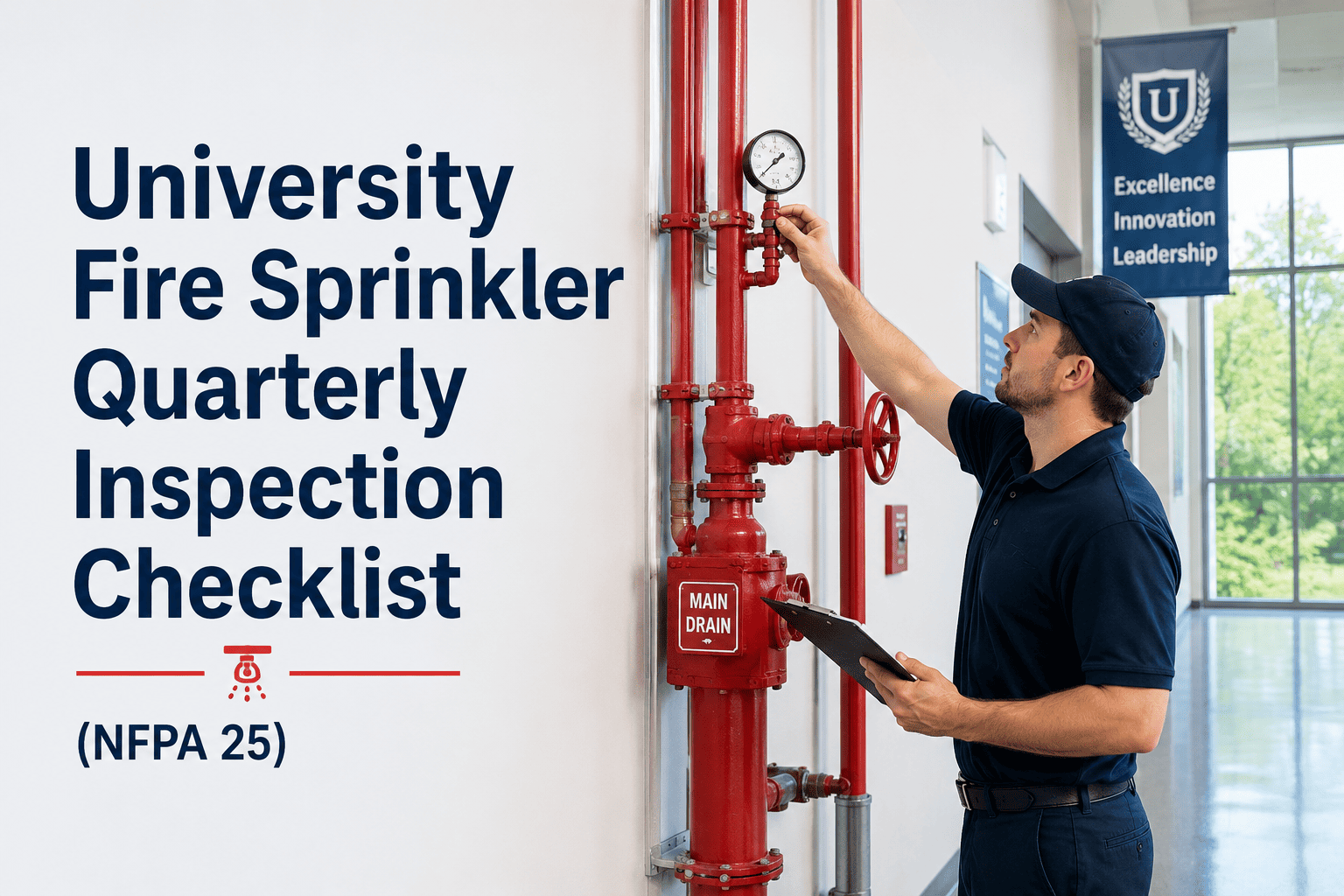
University Fire Sprinkler Quarterly Inspection Checklist (NFPA 25)

By Corin Hale on June 13, 2026

university-fire-sprinkler-quarterly-inspection-checklist-nfpa-25

A campus fire sprinkler system that passes an annual visual check but skips NFPA 25 quarterly inspections is one corroded gauge or seized control valve away from a failed suppression event. University facilities teams managing residence halls, laboratories, libraries, and administrative buildings must complete quarterly sprinkler inspections under NFPA 25 Chapter 5, with every gauge reading, control valve status, and alarm device verification documented before the next inspection cycle opens. Insurance carriers — including FM Global and Hartford Steam Boiler — treat unlogged quarterly rounds as coverage gaps, not oversights. This page gives your campus fire protection and environmental health and safety teams a complete NFPA 25 quarterly inspection framework covering gauges, control valves, alarm devices, waterflow switches, and tamper supervision — built for CMMS sign-off tracking with the timestamped records that state fire marshals and authority having jurisdiction reviewers expect to see. Use OxMaint to digitize every round and generate audit-ready compliance reports on demand.

University · Fire Protection · NFPA 25

University Fire Sprinkler Quarterly Inspection Checklist (NFPA 25)

NFPA 25 quarterly sprinkler inspection framework for campus buildings — gauges, control valves, alarm devices, waterflow switches, and tamper supervision with CMMS-tracked sign-off documentation built for university AHJ review.

5 Inspection Areas
35+ Check Points
NFPA 25 Standard Reference
Q Quarterly Frequency
Why Quarterly Inspections Matter

What Goes Wrong Between Annual Inspections

Gauge Drift
System pressure gauges that read in range at the annual inspection can drift out of tolerance within 90 days due to vibration, thermal cycling, and Bourdon tube fatigue — leaving operators unable to detect an impaired supply.
Control Valve Tampering
OS&Y and butterfly control valves on campus systems are frequently closed by contractors performing unrelated building work and never fully reopened — a condition invisible until a waterflow test or a fire event.
Alarm Device Fouling
Waterflow alarm switches and mechanical water motor gongs accumulate corrosion byproducts and biological growth in university buildings with intermittent occupancy, producing delayed or absent alarms on activation.
Tamper Switch Failure
Electronic tamper supervision that was verified at commissioning can lose its signal path through corrosion, wiring damage, or panel firmware updates — sending no alert when a valve is partially closed.
WWeekly
MMonthly
QQuarterly
AAnnual
Area 01

System Pressure Gauges

NFPA 25 Section 5.3.2 requires gauges on wet pipe systems to be inspected quarterly to confirm pressure readings are within the normal operating range established by the system's hydraulic design. A gauge reading below design pressure may indicate a supply failure, a partially closed valve, or a system leak that has not yet triggered a low pressure alarm.


System supply pressure gauge read and logged against the hydraulic nameplate design pressure — pressure within acceptable operating range; readings more than 10 psi below design pressure require immediate investigation of supply valve position and municipal supply status
QFire Protection Technician · Gauge reading log with date and system ID

Gauge face condition verified — gauge glass uncracked, dial legible, and pointer not pegged at zero or full scale; a gauge with a fogged lens or a bent pointer cannot provide a reliable reading and must be replaced before the next inspection cycle
QFire Protection Technician · Gauge condition log

Pressure gauge accuracy verified against calibrated test gauge — permanent system gauges must be replaced or recalibrated if they deviate more than 3 psi from a calibrated reference gauge; gauge accuracy log updated with calibration date and technician ID
AFire Protection Technician · Gauge calibration record

Air pressure gauge on dry pipe or pre-action system read and compared to supervision pressure setpoint — air pressure within 5 psi of design supervision pressure; any slow-declining trend over successive quarterly inspections indicates a system air leak requiring localization
QFire Protection Technician · Dry pipe supervision pressure log
Area 02

Control Valves

NFPA 25 Section 13.3.3.1 requires control valves to be inspected quarterly to confirm they are in the normal open position, properly supervised, and free from physical damage. A closed or partially closed control valve on a campus sprinkler riser serving a dormitory, laboratory, or lecture hall eliminates the building's fire suppression coverage entirely — the most preventable cause of full fire loss in university buildings.


OS&Y gate valve position confirmed open — handwheel back-seated with stem fully extended; number of exposed stem threads checked against baseline count taken at commissioning; any partial closure must be documented and the valve returned to full open immediately
QFire Protection Technician · Control valve position log

Butterfly valve indicator position verified — indicator plate showing open position; butterfly valves with post indicator plates require the plate to read OPEN with the target visible in the window; any intermediate position is treated as partially closed until physically confirmed
QFire Protection Technician · PIV position log

Control valve lock or seal integrity checked — seal wire, strap lock, or electronic tamper supervision device intact and undisturbed; a broken seal or removed lock without a corresponding work order and valve re-inspection is treated as an impairment event requiring notification to the campus fire marshal
QFire Protection Technician · Valve seal log

Control valve external condition inspected — no leakage at packing gland, no physical damage to handwheel or valve body, no unauthorized painting over stem or threads; corrosion on valve body documented with photograph for trend tracking across quarterly inspections
QFire Protection Technician · Valve condition log

University AHJ reviewers and insurance inspectors arrive unannounced. OxMaint captures every NFPA 25 quarterly check with timestamped records, technician signatures, and impairment alerts — so your campus fire protection program is always ready for review, not scrambling to reconstruct paper logs.

Area 03

Alarm Devices & Waterflow Switches

NFPA 25 Section 5.3.3 requires alarm devices, including waterflow switches and mechanical water motor gongs, to be inspected quarterly for physical condition. A waterflow switch that has not been inspected since the last annual test may have a corroded paddle, a seized retard chamber, or a failed wiring connection that produces no signal to the fire alarm panel when water flows in the sprinkler piping.


Waterflow switch body inspected — enclosure cover secured, conduit entry sealed, no evidence of corrosion or water infiltration inside the switch housing; a corroded terminal connection inside a waterflow switch housing is a common cause of delayed or absent alarm signal on a sprinkler activation
QFire Protection Technician · Alarm device condition log

Waterflow switch retard chamber and paddle condition verified — where accessible, retard chamber drain confirmed clear and not blocked by sediment; a blocked retard chamber drain extends alarm delay beyond the NFPA 72 required response window and must be cleaned
QFire Protection Technician · Retard chamber inspection log

Mechanical water motor gong (where installed) inspected — gong body free of debris, clapper unobstructed, drain clear, external piping to gong free of corrosion; mechanical gongs on exterior walls of university buildings are particularly vulnerable to bird nesting and debris accumulation between inspection visits
QFire Protection Technician · Gong condition log

Pressure alarm switch (pressure-actuated alarm) setpoint label confirmed legible and matching the system design document — a setpoint label that has been painted over or is missing creates ambiguity during inspection and requires field verification against the original hydraulic calculation document
QFire Protection Technician · Alarm switch label log
Area 04

Tamper Supervision & Electronic Monitoring

Electronic valve supervision devices feed a continuous signal to the campus fire alarm panel confirming every monitored control valve is in the open position. A tamper switch that was installed and commissioned correctly can lose its supervision signal through panel programming changes, battery failure, or wiring corrosion — and the loss of supervision is often not visible to facilities staff unless the panel is specifically queried for supervisory trouble signals.


Electronic tamper switch supervision signal confirmed active at fire alarm panel — panel supervisory zone for each monitored valve queried and showing normal status; any supervisory trouble signal for a tamper zone must be traced to its source before the inspection record is closed
QFire Protection Technician · Tamper supervision log with panel zone ID

Tamper switch enclosure and wiring connection inspected — conduit fittings tight, no exposed conductors, terminal screws tight and corrosion-free; a loose terminal in a tamper switch enclosure on a cold-weather sprinkler riser vault can intermittently clear a supervisory trouble signal at the panel, masking an actual loss of supervision
QFire Protection Technician · Tamper switch wiring log

Valve supervision device functional test performed by partially closing and reopening the control valve — panel must annunciate a supervisory signal within the NFPA 72 required two turns of valve travel; failure to annunciate is an immediate impairment requiring notification to the campus fire marshal and the insurance carrier
AFire Protection Technician · Tamper device functional test record
Area 05

Sprinkler Head Condition & Spare Inventory

NFPA 25 Section 5.3.1 requires sprinkler heads to be inspected annually, but campus buildings with laboratory fume hoods, dining hall steam equipment, and mechanical room heat sources expose heads to conditions that can cause paint loading, corrosion, and heat bulb failure between annual rounds. Quarterly visual inspection of sprinkler heads in high-risk occupancies is a recognized best practice that catches deterioration before a full annual inspection triggers an expensive replacement requirement.


Sprinkler heads in high-hazard areas visually inspected — laboratory fume hood areas, dining kitchen hoods, mechanical rooms, and loading docks checked for paint overspray, corrosion deposits, physical damage, and missing escutcheon plates; any head showing paint loading or physical damage tagged for replacement
QFire Protection Technician · Sprinkler head condition log with location

Sprinkler spare inventory verified — spare cabinet stocked with the minimum NFPA 25-required quantity of each head type and temperature rating installed in the building; spare head wrench present and in serviceable condition; inventory count logged and compared against the system's installed head schedule
QFire Protection Technician · Spare head inventory log

Sprinkler head clearance from storage or obstructions checked — 18-inch clearance below heads in storage areas maintained; laboratory shelving or equipment added since the last inspection that reduces head clearance below 18 inches requires immediate corrective action and a notification to the campus fire marshal
QFire Protection Technician · Clearance obstruction log
Compliance KPIs

Five Metrics That Prove Your Campus Sprinkler System Is NFPA 25 Compliant

Metric How to Measure Target Frequency
Control Valve Position Compliance Valves confirmed open / Total monitored valves 100% Quarterly
Gauge Reading Within Design Range Gauges in range / Total gauges inspected 100% of readings Quarterly
Alarm Device Condition Pass Rate Devices passing visual inspection / Total devices 100% Quarterly
Tamper Supervision Signal Integrity Active supervision zones / Total tamper zones 100% Quarterly
Inspection Round Completion Rate Signed quarterly logs / Required quarterly inspections 100% Quarterly
NFPA 25 Quick Reference

Key NFPA 25 Chapter References for University Quarterly Inspections

NFPA 25 Ch. 5
Wet Pipe Systems
Governs quarterly inspection of gauges, control valves, alarm devices, and sprinkler heads in standard wet pipe campus buildings
NFPA 25 Ch. 7
Dry Pipe Systems
Covers quarterly supervision pressure gauge inspection for dry systems in unheated campus parking structures and loading docks
NFPA 25 Ch. 8
Pre-Action Systems
Defines quarterly inspection requirements for pre-action system gauges and detection devices in campus server rooms and archives
NFPA 25 Ch. 13
Valves, Valve Components
Establishes quarterly control valve inspection requirements and the documentation standard for all valve position and seal checks
NFPA 25 Ch. 14
Obstruction Investigation
Triggers investigation requirements when quarterly inspections identify conditions suggesting internal pipe obstruction or microbiologically influenced corrosion
NFPA 25 Ch. 15
Impairment Procedures
Defines notification, hot work permit, fire watch, and restoration procedures when a quarterly inspection identifies a system impairment condition
FAQs

Frequently Asked Questions

What does NFPA 25 require specifically for quarterly sprinkler inspections on university campuses?

NFPA 25 Section 5.3 requires wet pipe system gauges to be inspected quarterly to confirm pressure is within the normal operating range. Control valves must be inspected quarterly under Section 13.3.3.1 to confirm they are in the open position with supervision intact. Alarm devices require quarterly visual inspection under Section 5.3.3. All findings must be documented in a written record retained for a minimum of one year and available to the authority having jurisdiction on request. OxMaint tracks all quarterly inspection records automatically with date, technician, and system ID.

Who is qualified to perform NFPA 25 quarterly inspections on a university campus?

NFPA 25 Section 4.1 requires inspections, testing, and maintenance to be performed by qualified personnel who have knowledge of the system, its components, and the applicable standards. In practice, most universities use licensed fire protection contractors or in-house technicians who hold NICET Fire Protection Systems certifications at Level II or above. Some state fire codes impose additional licensing requirements for personnel performing ITM on life safety systems in educational occupancies. Book a demo to see how OxMaint manages technician qualification records alongside inspection logs.

How long must quarterly sprinkler inspection records be retained under NFPA 25?

NFPA 25 Section 4.3.1 requires all inspection, testing, and maintenance records to be retained for a period of one year after the next inspection, test, or maintenance activity of the same type. For quarterly inspections, this means at least four consecutive quarterly records must be on file at any given time. Insurance carriers typically require the last three years of ITM records as a condition of coverage renewal, and state fire marshals conducting code compliance reviews may request records going back five years for university buildings classified as high-rise or assembly occupancies.

What happens if a quarterly inspection identifies a control valve that is not fully open?

A partially or fully closed control valve is an impairment under NFPA 25 Chapter 15. The finding must be immediately reported to the campus fire marshal and the building fire alarm monitoring center. A fire watch must be established for all areas served by the impaired system before the valve is returned to the open position. The impairment must be documented with the time discovered, area affected, corrective action taken, and restoration confirmation before the fire watch is lifted. OxMaint generates impairment notifications automatically when a quarterly inspection finding is flagged as a critical deficiency.

Can quarterly sprinkler inspections be performed by campus facilities staff or must a contractor be used?

NFPA 25 does not mandate contractor status — it mandates qualified personnel. A university facilities employee who is trained, certified, and knowledgeable in NFPA 25 requirements can legally perform quarterly inspections. However, the documentation standard is identical regardless of who performs the inspection: written records must identify the inspector, the date, the system inspected, the findings, and the corrective actions taken. Many universities use a hybrid model — in-house staff perform quarterly visual inspections while licensed contractors perform the more technically demanding annual tests.

Digitize NFPA 25 Quarterly Compliance

Every Gauge Logged. Every Valve Confirmed. Every Quarterly Record Ready for AHJ Review.

OxMaint converts your NFPA 25 quarterly sprinkler rounds into mobile inspection workflows with structured data entry, automatic deficiency escalation, and one-click compliance reports — so the next fire marshal or insurance inspection finds a program, not a pile of paper logs.

Share This Story, Choose Your Platform!