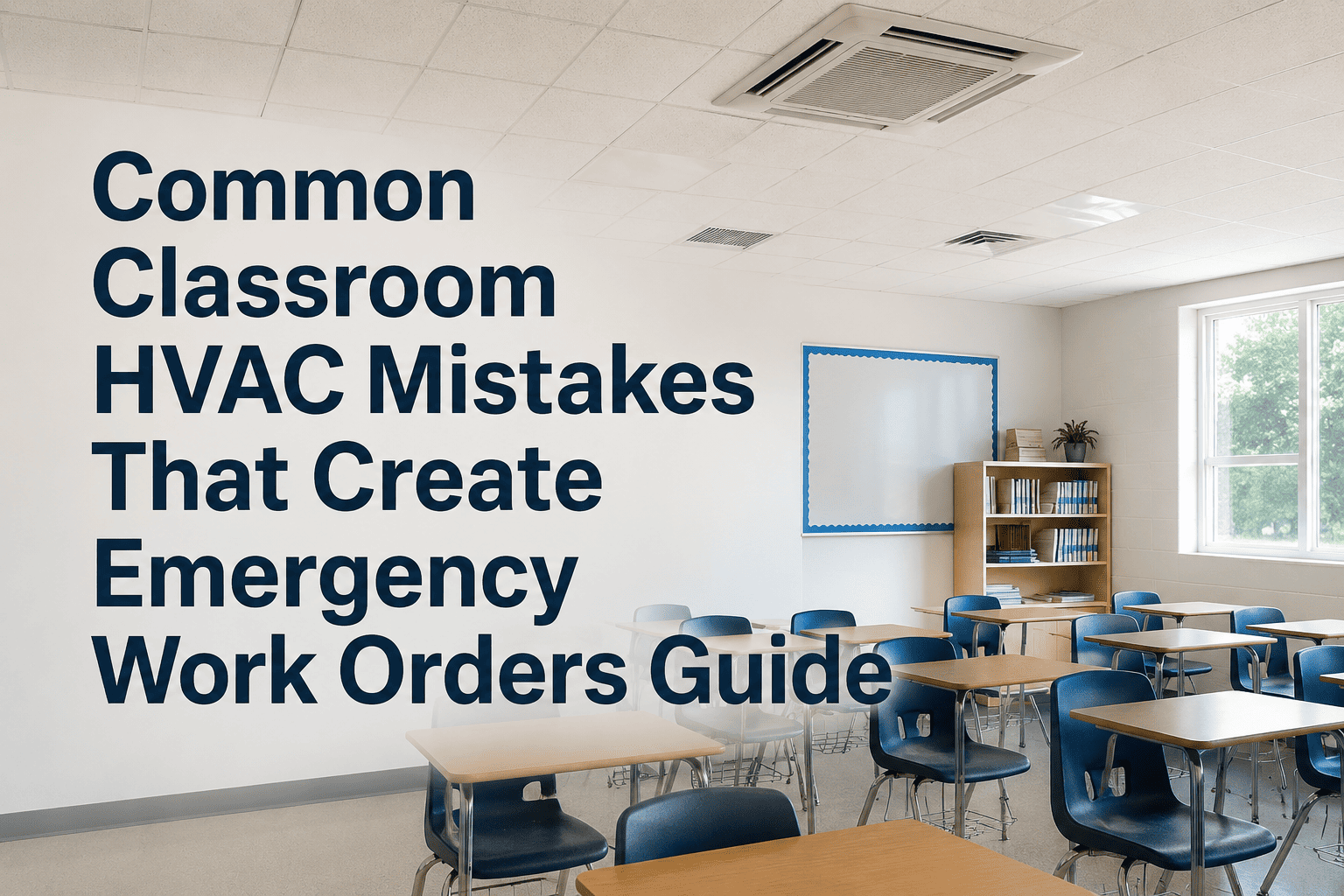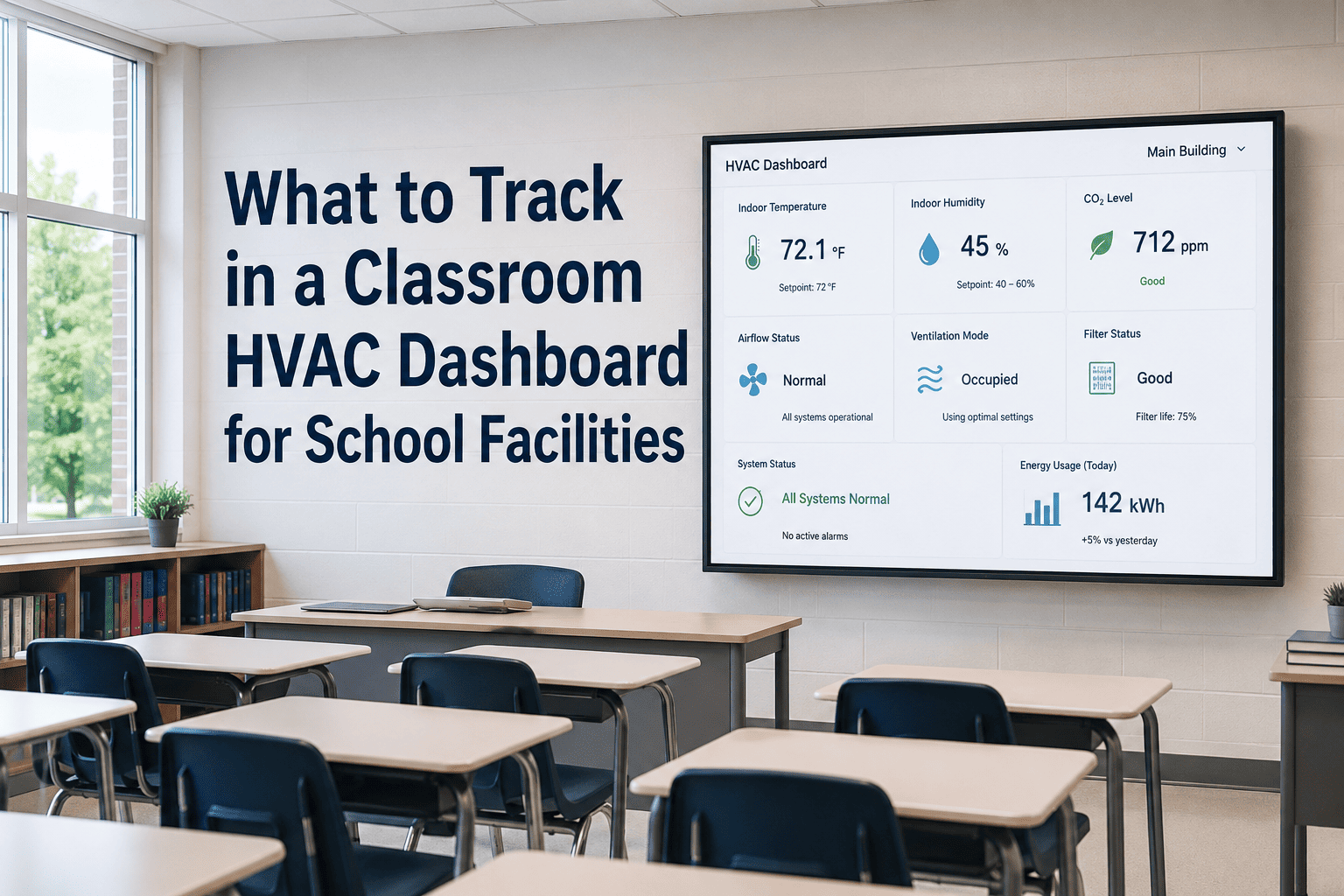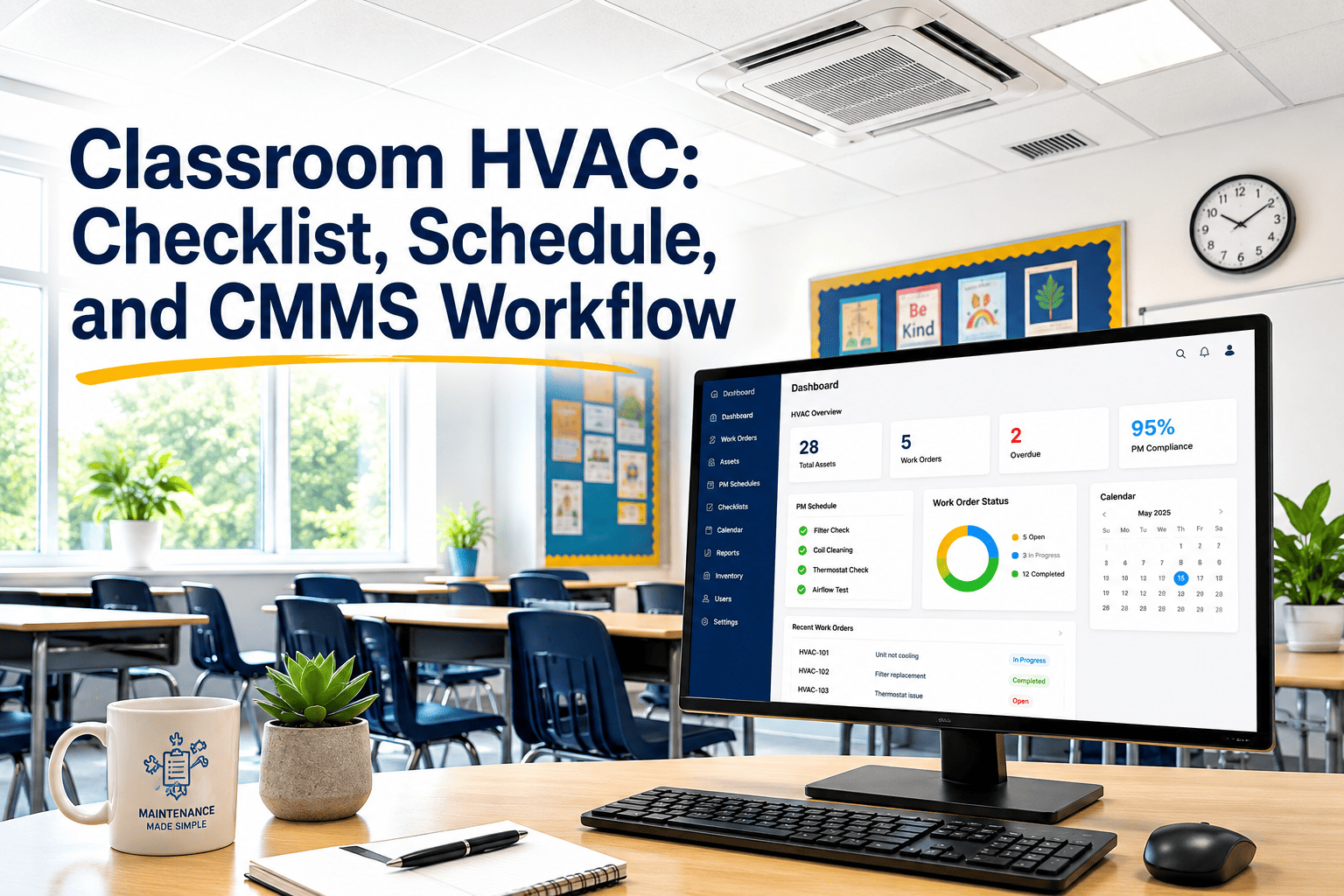
Classroom air quality is not a comfort issue — it is a cognitive performance issue. Studies consistently show that CO2 levels above 1,000 ppm in enclosed classrooms reduce student decision-making speed and test scores, and that temperature swings beyond 2°F from the thermal comfort zone increase disciplinary incidents and reduce time-on-task. The HVAC systems responsible for preventing those conditions — rooftop units, fan coil units, unit ventilators, and central air handling units — fail silently through clogged filters, failing belts, dirty coils, and refrigerant leaks that develop between reactive maintenance calls. A structured preventive maintenance program built on a documented checklist is the only reliable way to keep classroom air quality in the range where learning actually happens. This checklist gives K-12 districts and higher education facilities teams a complete PM framework covering filters, coils, belts, drains, controls, and refrigerant systems — structured for CMMS-tracked scheduling with the timestamped records that facilities directors, school boards, and state accreditation reviewers expect. Run every task on schedule using OxMaint's AI predictive maintenance platform and generate audit-ready compliance reports without rebuilding spreadsheets.
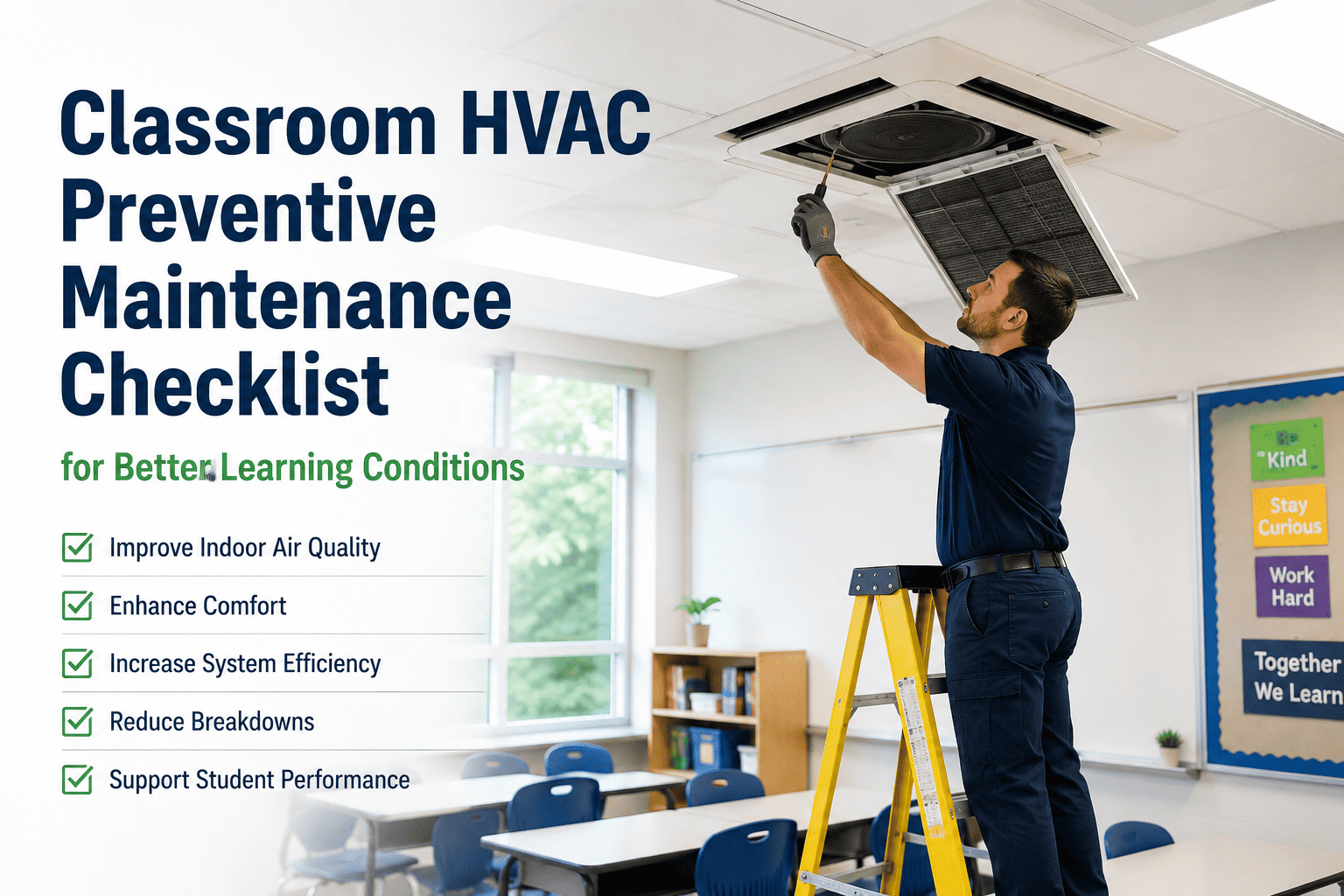
Classroom HVAC Preventive Maintenance Checklist for Better Learning Conditions
A complete PM framework for school and campus HVAC systems — filters, coils, belts, condensate drains, controls, and refrigerant — structured so every task is scheduled, tracked, and documented before air quality affects student performance.
How Your HVAC System Tells You PM Is Overdue
Air Filtration
Filters are the single highest-impact, lowest-cost PM task in a school HVAC system. A MERV-8 filter loaded beyond its design capacity does not just reduce air quality — it collapses system airflow, starves the evaporator coil of air, and causes coil freeze-up that shuts down classroom cooling on the hottest days of the school year.
Coil Cleaning
Evaporator and condenser coils that accumulate even a thin layer of dust, biological growth, or cottonwood debris lose heat transfer efficiency in proportion to the fouling depth. A coil that is 20% fouled can increase compressor runtime by 30% and reduce cooling capacity below the level needed to maintain 75°F in a classroom with 30 occupants generating heat loads the system was never designed to handle without clean coil surfaces.
Belts, Bearings & Drives
Belt-driven air handling units and unit ventilators in school buildings experience the highest belt wear during the first and last months of the school year, when systems operate at full load during temperature extremes. A belt that breaks at 7 AM on the first day of school in September leaves a classroom of 30 students in an unconditioned room while the district's reactive maintenance queue fills up simultaneously across multiple buildings.
OxMaint's AI predictive maintenance engine analyzes HVAC run-hours, filter change history, and coil cleaning records to predict the next failure before a classroom goes offline — giving your facilities team a work order before the complaint call, not after.
Condensate Drains & Drain Pans
A blocked condensate drain pan is the most predictable mold source in a school building and the most preventable. Drain pans in humid climates fill with biological growth within 60 to 90 days of the last cleaning. When the pan overflows into the ceiling plenum or the classroom ceiling tile, the resulting mold remediation cost consistently exceeds the entire year's HVAC PM budget for the affected building.
Controls, Thermostats & Outdoor Air Dampers
The outdoor air damper on a classroom unit ventilator is the most important component for CO2 control and ASHRAE 62.1 compliance, and the most commonly found failed-closed in a school PM audit. A damper actuator that loses its signal defaults to the closed position in most installations, eliminating outdoor air delivery entirely while the classroom thermostat continues to maintain temperature — making the classroom feel normal while CO2 climbs above 2,000 ppm.
Refrigerant System & Electrical Connections
Section 608 of the EPA Clean Air Act prohibits knowing releases of refrigerant and requires leak inspection any time an appliance is opened for service. A classroom split system or rooftop unit that has lost 10% of its refrigerant charge operates with degraded cooling capacity, elevated compressor discharge temperature, and — in a low-charge condition — a compressor that will fail within one to three cooling seasons if the leak is not found and repaired.
Annual Classroom HVAC Maintenance Calendar
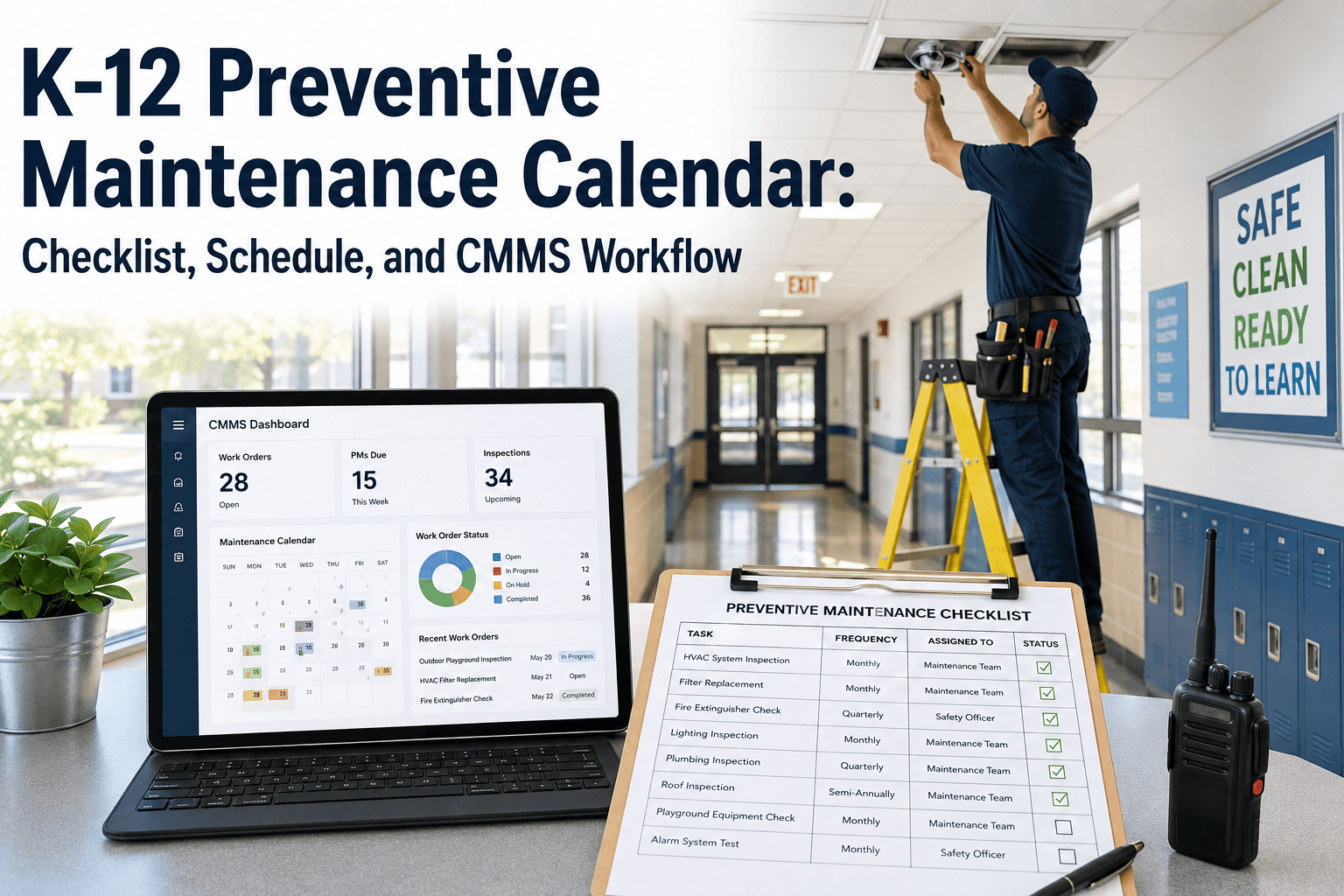
- Filter inspection and replacement
- Thermostat setpoint confirmation
- Visual unit condition check
- Condensate drain pan cleaning
- Bearing temperature check
- Outdoor air damper verification
- Filter housing seal inspection
- Coil cleaning (evaporator and condenser)
- Belt inspection and replacement
- Drain line treatment
- Overflow switch test
- Refrigerant pressure check
- CO2 sensor calibration
- Electrical connection torque check
- Coil approach temperature measurement
- Pulley alignment
- Filter specification review
Frequently Asked Questions
How often should classroom HVAC filters be changed in a school building?
ASHRAE Standard 62.1 does not set a fixed filter change interval — it requires that systems maintain design airflow and outdoor air delivery rates. In practice, MERV-8 filters in classrooms with 30 occupants in urban or suburban locations typically require monthly inspection and replacement every 30 to 60 days during occupied months. Schools near construction, highways, or wildfire smoke zones should inspect filters every two weeks during high-particulate events. OxMaint tracks filter change history by unit and flags overdue replacements automatically.
What is the ASHRAE standard for classroom ventilation and how does HVAC maintenance affect compliance?
ASHRAE Standard 62.1 Table 6-1 requires a minimum of 10 cfm per person plus 0.12 cfm per square foot of classroom floor area for educational occupancies. A clogged filter, failed outdoor air damper actuator, or dirty coil that reduces supply airflow below design will directly reduce the outdoor air fraction delivered to the classroom and push CO2 above the 1,100 ppm level that most state IAQ guidelines identify as the threshold for corrective action. Preventive maintenance is the operational mechanism that keeps the system delivering what the standard requires. Book a demo to see how OxMaint maps PM tasks directly to ASHRAE compliance outcomes.
What does it cost when classroom HVAC PM is skipped for a school year?
The most common cost consequence is a compressor or air handler motor failure during the first heat wave of summer school or the first week of fall semester, when reactive repair demand peaks and contractor availability drops. A typical K-12 rooftop unit compressor replacement runs $1,800 to $4,500 in parts and labor, compared to a full annual PM visit cost of $150 to $350 per unit. Districts that track reactive-to-preventive maintenance ratios consistently find that every skipped PM generates $3 to $6 in reactive repair cost within 12 months.
Can school district facilities staff perform classroom HVAC PM or does it require a licensed contractor?
Filter changes, condensate pan cleaning, belt inspections, and visual checks can be performed by trained in-house facilities staff in all U.S. states. Refrigerant handling requires an EPA Section 608 certification held by the technician performing the work. Electrical work on HVAC equipment above 50 volts requires a licensed electrician in most states. Many districts use a hybrid model — in-house staff complete monthly and quarterly tasks while licensed contractors perform semi-annual refrigerant and electrical checks. OxMaint assigns tasks to the right technician role automatically based on the PM schedule.
How does poor HVAC maintenance affect student learning outcomes?
Research from Harvard's T.H. Chan School of Public Health and multiple state education department studies documents measurable cognitive performance reductions at CO2 levels above 1,000 ppm — a condition directly caused by failed outdoor air delivery from poorly maintained HVAC systems. Temperature deviations above 77°F in classrooms are associated with reduced time-on-task in published education research. Absenteeism increases significantly in buildings with documented IAQ complaints. The link between HVAC maintenance quality and measured student outcomes is well-established enough that several state legislatures have funded dedicated school IAQ improvement programs tied to maintenance compliance documentation.
Stop Reactive Calls. Start Predictive PM. Keep Every Classroom in the Learning Zone.
OxMaint's AI predictive maintenance platform schedules every filter change, coil cleaning, and belt inspection automatically — assigns the right technician, captures the result on mobile, and alerts facilities managers before a missed PM becomes a classroom shutdown or an IAQ complaint.