AI-Based Risk Scoring for University Facilities: Predicting Failures Before They Happen
By Oxmaint on March 5, 2026
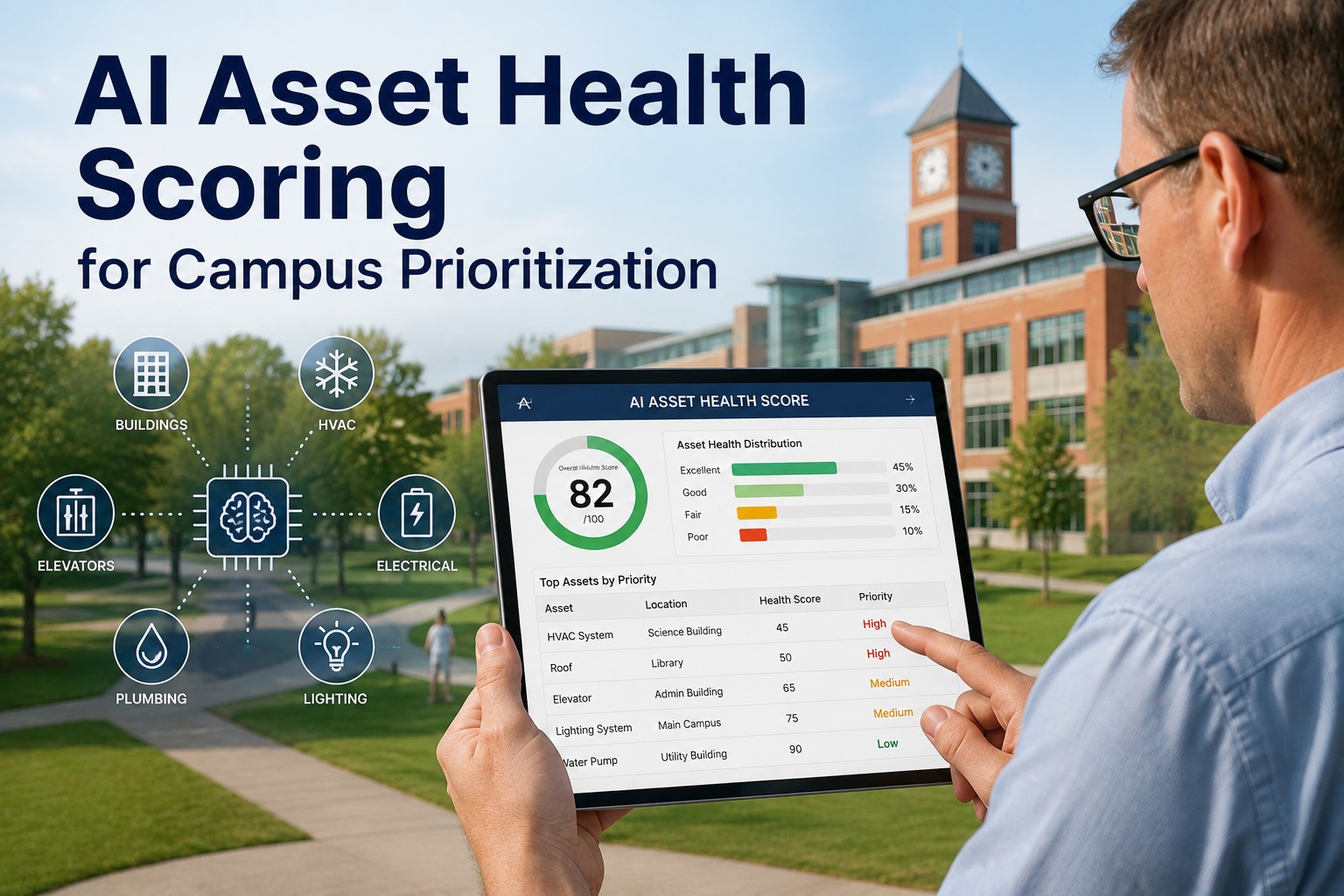
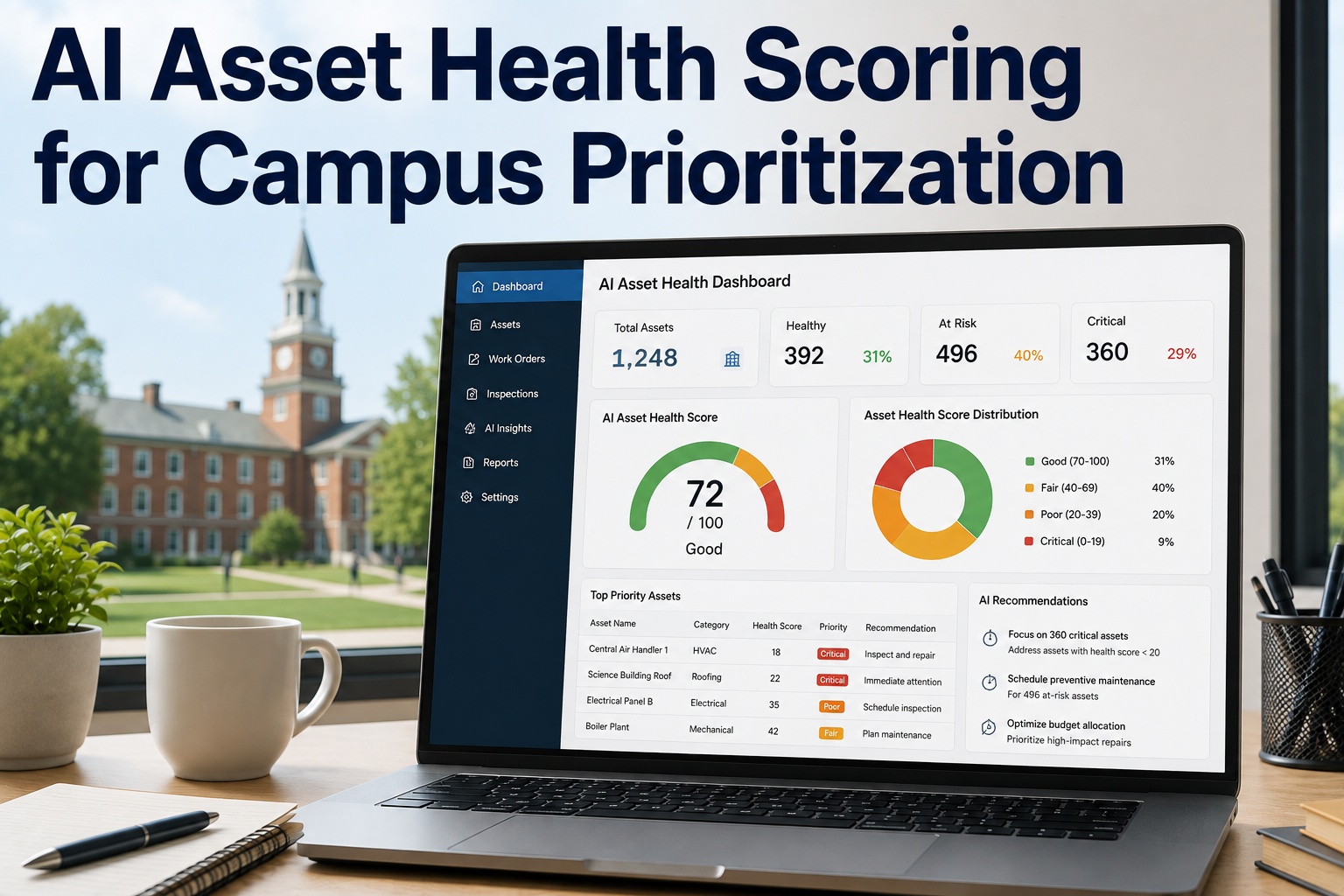
Every university campus has assets that are weeks from failure right now — chillers with degrading bearings, switchgear with loosening connections, elevator controllers with thermal stress, air handling units with fouling coils — and the facilities team does not know which ones. AI-based risk scoring solves this by assigning every maintainable asset a continuously updated failure probability score based on age, condition data, maintenance history, sensor readings, and operating environment. The highest-risk assets surface to the top of the work queue automatically. The result: maintenance budgets stop being allocated by squeaky-wheel politics or calendar schedules and start being allocated by quantified risk — directing every dollar and every technician hour to the assets most likely to fail, most expensive to repair, and most disruptive to students when they go down. Schedule a demo to see AI risk scoring running on campus infrastructure data.
AI Risk Scoring for University Facilities: The Intelligence Layer
Quantified failure probability replaces guesswork in maintenance prioritization and capital planning
2,500+Major maintainable assets at a mid-size university — each with a unique failure probability trajectory
65%Reduction in emergency failures when maintenance is driven by AI risk scores vs. calendar schedules
3–6 WksAdvance warning before high-risk assets reach critical failure threshold — enough to plan and schedule
5–8×First-year ROI from risk-directed maintenance vs. reactive or calendar-based approaches
What AI Risk Scoring Actually Means in Campus Facilities
Risk scoring is not a single number pulled from asset age. It is a continuously computed probability that synthesizes multiple data streams into a failure likelihood for each specific asset, updated with every new sensor reading, work order, and operating cycle. Understanding what goes into the score — and what comes out — is essential to deploying it effectively.
The Five Inputs That Build an Asset Risk Score
Each input contributes a weighted factor to the composite failure probability
Input 1
Asset Age & Lifecycle Position
Where the asset sits on its expected lifecycle curve. A 15-year-old chiller with a 20-year design life carries higher base risk than a 5-year-old unit — but age alone is insufficient. A well-maintained 18-year chiller can be lower risk than a neglected 8-year unit.
Data sources: Installation date, manufacturer rated life, industry benchmark curves, Facility Condition Index per building
Input 2
Maintenance History & Failure Patterns
How frequently the asset has required repair, what types of failures have occurred, whether failure frequency is increasing, and whether the same failure mode is recurring — indicating a systemic issue rather than random events.
Data sources: Work order history, failure codes, parts replacement records, mean time between failures, repair cost trajectory
Input 3
Real-Time Sensor & BAS Data
Live operating data from building automation systems: temperature differentials, pressure readings, vibration amplitude, energy consumption, motor amperage — compared against the asset's behavioral model to detect deviation from expected performance.
Data sources: BAS feeds, IoT vibration sensors, energy meters, power quality analyzers, IAQ monitors
Input 4
Operational Context & Load Profile
How hard the asset is working relative to its design capacity. A chiller running at 95% load 18 hours per day degrades faster than the same model at 60% load for 10 hours. Academic calendar events, occupancy surges, and weather extremes create peak stress periods.
Not just how likely the asset is to fail, but how bad it will be when it does. A chiller serving a research building with $2M in active grants scores higher consequence than the same unit serving an administrative office. Student-facing assets carry enrollment-weighted severity multipliers.
Data sources: Space type classification, occupancy density, academic function, research value, enrollment-impact weighting
How the Risk Score Is Computed: The Failure Cascade Model
The AI does not simply add up five inputs. It models the interaction between them — because risk compounds nonlinearly. An aging asset with increasing failure frequency that is also showing sensor deviation under high load conditions is not 4× higher risk than a single-factor concern — it is 10–20× higher risk because the factors are correlated and reinforcing. The model captures these multiplicative interactions.
Risk Score Computation: From Raw Data to Prioritized Action
How five inputs become a single actionable score updated continuously
Layer 1
Base Risk: Age & Lifecycle Position
Every asset starts with a base failure probability derived from its position on the manufacturer's reliability curve. A chiller at 75% of rated life has a base probability of 12–18%. At 100%, it jumps to 35–50%. This establishes the starting position.
Base score: 0–100
↓
Layer 2
History Modifier: Maintenance Pattern Analysis
The base score is adjusted by maintenance history. Increasing failure frequency adds a multiplier. Recurring failure modes add a higher multiplier. Recent emergency repairs within the last 90 days significantly elevate the score. Well-maintained assets with decreasing failure rates get score reductions.
Modifier: 0.5×–3.0×
↓
Layer 3
Condition Signal: Real-Time Sensor Deviation
Live sensor data compares actual performance against the asset's behavioral model. Deviations in vibration, temperature, pressure, or energy consumption that exceed statistical thresholds add condition-based risk. This is where the score becomes predictive rather than historical.
Modifier: 1.0×–5.0×
↓
Layer 4
Impact Weight: Consequence Severity Multiplier
The probability score is multiplied by consequence severity: student-facing spaces (2.0×), research labs with active grants (2.5×), residence halls during occupancy (2.0×), and admissions tour routes during visit season (1.5×). A high-probability failure in a low-consequence space scores lower than a moderate-probability failure in a high-consequence one.
Final risk score: prioritized work queue position
The final score is not a static number — it updates with every sensor reading, every completed work order, and every change in operating conditions. An asset that was score 45 yesterday can jump to 78 today if a vibration sensor detects a step-change in bearing amplitude. The work queue re-sorts automatically.
See Every Campus Asset Ranked by Failure Risk — Updated in Real Time
Oxmaint computes risk scores for every maintainable asset using your BAS data, maintenance history, and building classifications. Your team stops guessing which assets need attention and starts working from a continuously updated priority queue backed by data.
Risk Score Tiers: What the Numbers Mean Operationally
A raw risk score is meaningless unless it drives action. The scoring model maps every asset into operational tiers that directly determine maintenance response — from routine monitoring to emergency intervention. Here is how the tiers translate to campus operations:
Risk Score Tiers and Operational Response Protocol
Every tier triggers a specific maintenance action — no ambiguity
Risk Tier
Score Range
Operational Response
Timeline
Critical
85–100
Immediate work order generated. Auto-escalation to facilities director. Student-impact notification if applicable. Emergency repair scheduled within 24–48 hours or asset taken offline.
24–48 hours
High
65–84
Predictive work order generated with failure mode and recommended repair. Scheduled for next available maintenance window — academic break, weekend, or sequence gap. Parts pre-ordered.
1–3 weeks
Elevated
40–64
Added to watch list with increased monitoring frequency. Sensor thresholds tightened for early warning. Included in next scheduled PM cycle with enhanced inspection scope.
1–2 months
Moderate
20–39
Normal PM schedule maintained. Standard sensor monitoring. Included in quarterly condition review. No additional action unless score trends upward for two consecutive reporting periods.
Quarterly review
Low
0–19
Asset in good condition with no developing issues. Standard PM schedule. Baseline monitoring only. Resurfaces for review at next annual condition assessment or if any input parameter changes significantly.
Annual review
Campus Systems Where Risk Scoring Prevents the Most Expensive Failures
Risk scoring delivers the highest ROI on assets that are expensive to repair, critical to operations, and generate sufficient data for accurate scoring. These six system categories represent 85%+ of preventable emergency spending at universities:
Emergency Cost Exposure by Campus System — Preventable Through Risk Scoring
Each bar represents the cost range when the asset reaches failure without predictive intervention
Central plant chillers (compressor seizure, refrigerant loss)
$150K–$500K
Electrical switchgear (arc flash, bus failure, transformer)
$200K–$1M
Boiler systems (tube failure, combustion fault, feedwater)
$100K–$400K
Steam/hydronic distribution (pipe failure, water damage)
$100K–$680K
Elevators (controller failure, door operator, hydraulic)
$5K–$15K/day
Air handling units (fan bearing, coil fouling, damper failure)
15–25% energy waste
Risk scoring identifies the specific assets within each category approaching failure — not just the category average. A campus with 12 chillers may have 2 scoring above 75 while the other 10 score below 30. The maintenance budget targets the 2, not all 12.
Risk Scoring vs. Calendar PM vs. Reactive: The Three Models Compared
Three Maintenance Approaches: Detection, Cost, and Outcome Comparison
Why risk-scored maintenance outperforms both reactive and calendar-based PM
Reactive (Break-Fix)
$4.50–$7.00/sf
• Zero advance warning — failures are surprises
• Emergency labor: 2–3× planned rates
• Expedited parts: 40–80% premium
• Average asset life: shortest possible
45% of work is emergency. 6+ day response.
Calendar PM (Fixed Intervals)
$3.00–$4.50/sf
• Services healthy assets unnecessarily
• Misses degraded assets between intervals
• 20–30% of PM spend is wasted on low-risk
• No prioritization by consequence severity
Better than reactive — but still 25% emergency rate.
AI Risk-Scored
$2.10–$3.50/sf
• 3–6 week advance warning on high-risk assets
• Budget directed to highest-risk assets first
• Healthy assets run longer without unnecessary PM
• Student-impact weighting protects enrollment
Under 15% emergency rate. Under 24hr response.
Risk-scored maintenance costs 40–50% less than reactive, catches 65% more developing failures than calendar PM, and directs every dollar to the assets that matter most
Stop Spreading Budget Evenly Across 2,500 Assets. Start Targeting the 200 That Are Actually at Risk.
AI risk scoring identifies the 8–12% of your asset portfolio that carries 80%+ of your failure probability at any given time — directing maintenance budgets, technician hours, and capital planning to the assets that need it most.
Risk Scoring for Capital Planning: From Anecdotes to Algorithms
The most strategically valuable application of risk scoring is not daily maintenance prioritization — it is capital planning. Every CBO faces the same question each budget cycle: which assets should we replace, which can we maintain, and how do we justify the decision? Without risk scoring, the answer relies on asset age and complaints. With risk scoring, the answer is a data-driven priority ranking that boards actually approve. Schedule a demo to see risk-scored capital planning built from your campus data.
Risk-Scored Capital Planning Workflow
From asset risk data to board-approved capital budget
Step 1
Portfolio Risk Assessment
Every major asset receives a continuously updated risk score. The portfolio is ranked from highest to lowest risk, revealing the 8–12% of assets that carry 80%+ of total failure probability. This becomes the candidate list for capital investment.
↓
Step 2
Replace-vs-Repair Simulation
For each high-risk asset, the system models continued maintenance cost against replacement — including energy savings from new equipment, warranty value, reduced failure probability, and remaining useful life projection. NPV calculations provide defensible financial analysis.
↓
Step 3
Scenario Modeling
CBOs simulate different investment scenarios: "What happens to total portfolio risk if we replace the 5 highest-scoring chillers vs. the 10 highest-scoring AHUs?" The model projects failure probability reduction, maintenance cost savings, and energy impact for each scenario.
↓
Step 4
Board-Ready Capital Request
The platform generates capital request packages with risk score data, failure probability curves, financial projections, and scenario comparisons. Boards approve funding because the analysis is specific to each asset, defensible by data, and tied to financial outcomes — not anecdotes.
Without risk scoring:
"We need more money because things are breaking"
With risk scoring:
"These 12 assets have 70%+ failure probability — here is the NPV for each"
Measurable Outcomes: What Risk-Scored Maintenance Delivers
Performance Improvements With AI Risk-Scored Campus Maintenance
Documented outcomes within 90–180 days of deployment
65%↓
Emergency Failures
High-risk assets caught 3–6 weeks before failure
30%
Asset Life Extension
Maintenance timed by condition, not calendar
15%
Energy Cost Reduction
Risk scoring includes energy anomaly detection
<24h
Response Time
Down from 6.3-day average
100%
Audit Readiness
OSHA, NFPA, ADA, ASHRAE — instant export
5–8×
First-Year ROI
$200K–$500K investment vs. $1.3M–$4.4M savings
Annual Financial Impact: Risk-Scored vs. Unscored Operations
Annual Savings From Risk-Scored Campus Maintenance
Mid-size university, 2–3M GSF, 2,500+ major assets
$1.2M
Emergency Failure Prevention
65% fewer emergency events × $28K–$340K per event depending on asset type and consequence
$500K
PM Budget Optimization
Redirecting 20–30% of calendar PM spend from low-risk assets to high-risk assets — same budget, better outcomes
$350K
Energy Anomaly Correction
15% energy savings from risk-flagged HVAC faults: stuck dampers, simultaneous heating/cooling, after-hours operation
Platform investment: $200K–$500K · ROI: 5–8× in year one · Capital avoidance: $2M–$8M over 5 years from 30% asset life extension
Implementation: From Zero to Risk-Scored Operations in 90 Days
90-Day Deployment Timeline for AI Risk Scoring
Weeks 1–2
Data Foundation
✓ Import asset registry with age, type, criticality
✓ Migrate maintenance history and work orders
✓ Connect BAS feeds and energy meters
✓ Classify spaces by student-impact weighting
Weeks 3–4
Score Activation
✓ Base risk scores computed for all assets
✓ History modifiers calibrated from work orders
✓ Sensor deviation models begin learning
✓ First high-risk assets identified and queued
Weeks 5–8
Predictive Intelligence
✓ Full multi-variable scoring reaches accuracy
✓ Energy anomaly detection activates
✓ Compliance risk factors integrated
✓ AI work order routing deployed to technicians
Weeks 9–12
Capital Intelligence
✓ Portfolio risk dashboard for CBO and board
✓ Replace-vs-repair models for high-risk assets
✓ Scenario simulation for capital planning
✓ Continuous improvement benchmarks set
By day 90, every major asset on campus has a continuously updated risk score, the highest-risk assets are being addressed proactively, energy waste is being corrected, compliance documentation is generating automatically, and the CBO has the data-driven capital plan that transforms the next board presentation from a request into a recommendation. Start your free trial and begin the 90-day path from guesswork to quantified risk intelligence.
Your Campus Has 2,500 Assets. Right Now, You Don't Know Which Ones Are About to Fail.
Oxmaint's AI risk scoring engine assigns every maintainable asset a continuously updated failure probability — surfacing the highest-risk assets to the top of your work queue, directing every maintenance dollar to maximum impact, and giving your CBO the data-backed capital plan that boards approve. 90 days to full deployment.
How accurate are the risk scores, and how do we know they are trustworthy?
Production-deployed risk scoring models on campus infrastructure achieve 82–94% precision depending on system type — meaning 82–94 out of every 100 high-risk alerts identify assets with genuine developing failures. Each score includes a confidence level, the specific input factors driving the score, and the data sources behind each factor. Technicians and managers can review the evidence behind every score before acting. The models also learn from outcomes: when a high-scored asset is repaired and the predicted failure mode is confirmed, or when a score is challenged and found to be a false positive, the model adjusts for future accuracy. Over time, precision increases as campus-specific patterns accumulate. Book a demo to see risk score transparency and evidence traceability in the platform.
Do we need sensors on every asset to use risk scoring?
No. Risk scoring works with whatever data you have. Assets connected to BAS with live sensor feeds receive the most accurate and responsive scores because real-time condition data provides the strongest predictive signal. But assets without sensors still receive scores based on age, maintenance history, failure patterns, and operational context — which alone deliver significantly better prioritization than calendar-based PM or reactive maintenance. Targeted sensor additions on the highest-value assets enhance accuracy where it matters most, while the rest of the portfolio benefits from history-based scoring that improves with every work order completed. Start a free trial to see risk scoring on your assets using the data you already have.
How does student-impact weighting work in the risk scores?
Every space on campus is classified by its impact on student experience and enrollment. Residence halls, classrooms, dining facilities, labs, and admissions tour routes receive the highest consequence multipliers. When two assets have identical failure probability, the one serving a 300-seat lecture hall will always score higher than the one serving a storage closet. During critical academic calendar events — finals, move-in, admissions tours — the consequence multipliers increase further, ensuring that the spaces most visible to students and prospective families receive priority maintenance attention. The weighting is configurable per institution to match your specific enrollment strategy.
Can risk scoring help justify capital requests to our board of trustees?
This is one of the highest-value applications. Risk scoring transforms capital requests from "we need $2M for chillers because they are old" into "these 5 specific chillers have risk scores above 78 with 72–85% failure probability within 24 months — continued maintenance costs $340K while replacement costs $1.2M but saves $180K in annual energy and eliminates $800K in annual failure risk." The platform generates board-ready packages with risk score data, failure probability curves, NPV calculations, and scenario comparisons. Institutions presenting risk-scored capital requests report 3–5× higher approval rates than those using traditional age-based or complaint-based justifications.
What is the realistic timeline and budget for deploying risk scoring?
The platform deploys in 90 days through four phases: weeks 1–2 build the data foundation, weeks 3–4 activate initial scores, weeks 5–8 bring full predictive capability online, and weeks 9–12 deploy capital planning intelligence and board dashboards. A mid-size university (50–100 buildings, 2,500+ major assets) can deploy for $200K–$500K annually against $1.3M–$4.4M in documented annual savings — a 5–8× first-year ROI. Most institutions see positive returns within the first 60 days through emergency failure prevention and energy anomaly correction alone. Schedule a demo to model the ROI projection for your specific campus portfolio.