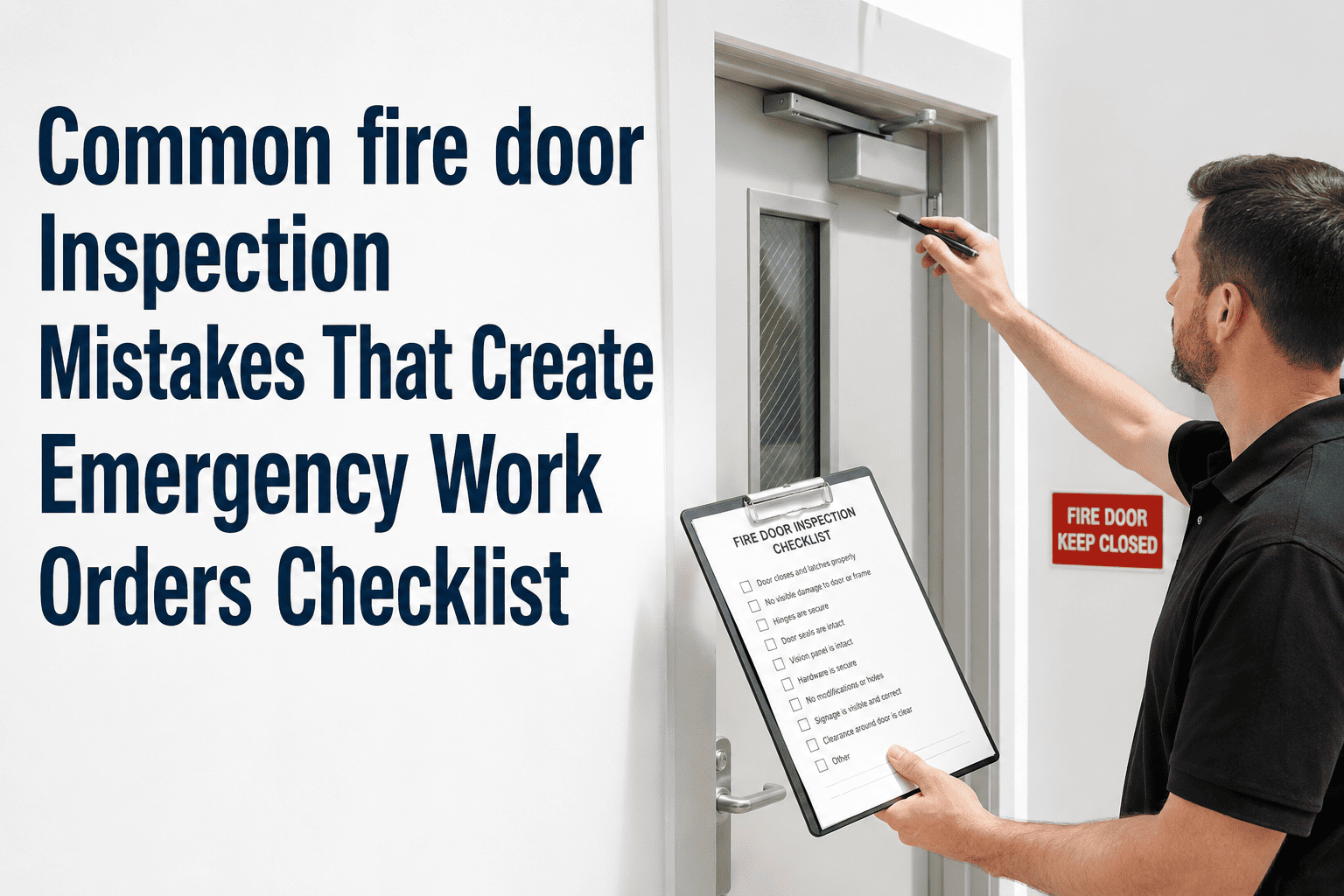
Every campus fire door that sticks, fails to latch, or sits propped open is a life-safety failure that building codes and NFPA 80 cannot excuse with good intentions. University and K-12 facilities teams face hundreds of fire doors across aging building stock, high-traffic corridors, and stairwells that see daily abuse — yet most inspections still run on spreadsheets and paper forms that cannot prove compliance when a fire marshal or accreditation auditor arrives. This checklist gives your team a structured, field-ready framework covering door hardware, closing mechanisms, frame integrity, labeling, and corridor clearance — so every inspection produces a defensible record, not just a walked hallway. For facilities teams that need compliance tracking at scale, OxMaint's inspection management platform digitizes every check with timestamped records and auto-scheduled recurring inspections.
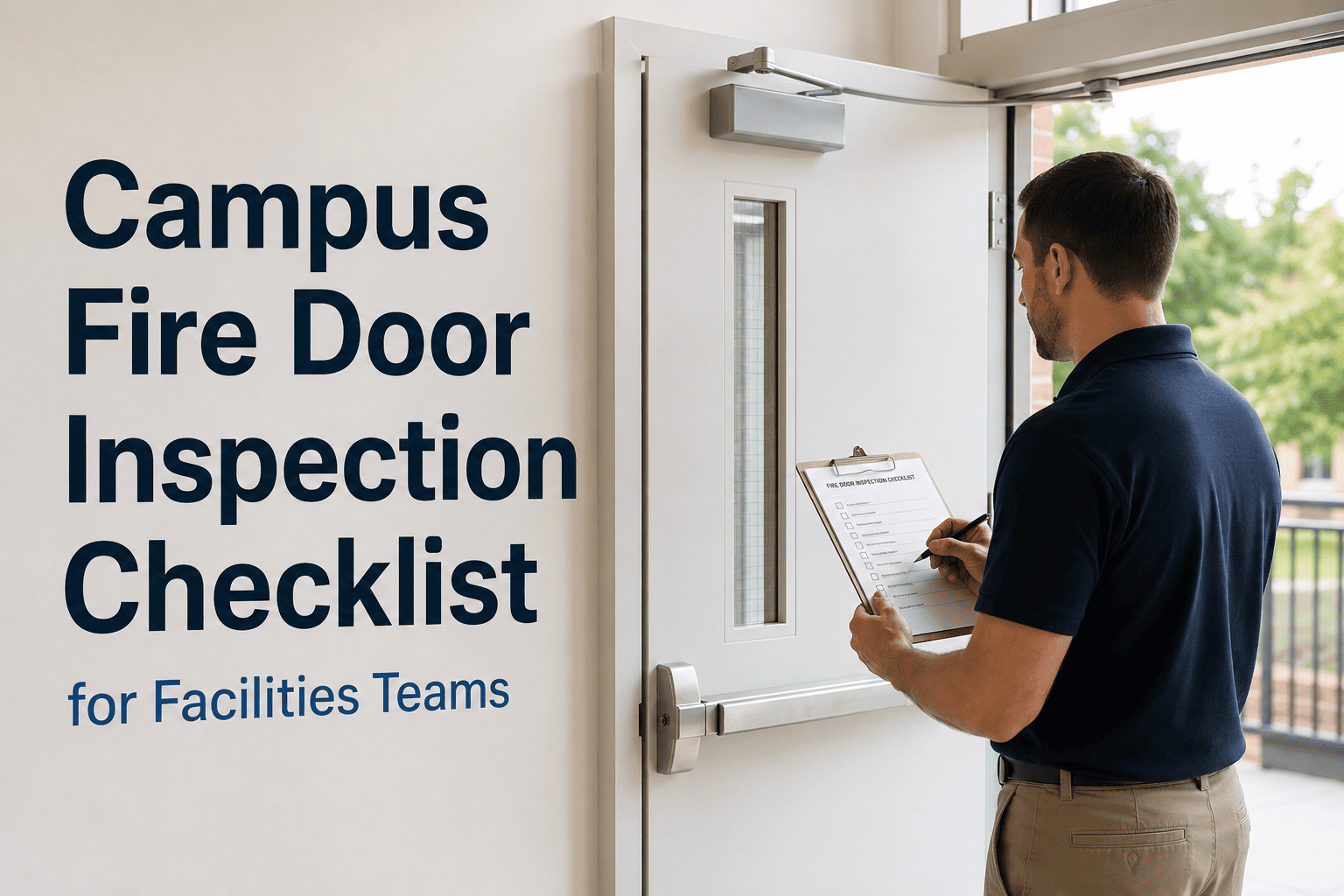
Campus Fire Door Inspection Checklist for Facilities Teams
A field-ready NFPA 80 framework for K-12 and university facilities teams — covering hardware, closers, seals, labeling, and corridor compliance across every building on campus.
What a Failed Fire Door Actually Costs Your Campus
A door that fails to latch allows smoke to travel between compartments within minutes, extending evacuation time and increasing injury risk.
NFPA 80 requires annual inspection. A single undocumented door can trigger a campus-wide finding from the Authority Having Jurisdiction.
AAALAC, ABET, and regional accreditors treat lapsed life-safety inspections as institutional compliance failures, not facilities oversights.
An insurance claim following a fire incident may be contested if inspection records cannot prove the door assembly was tested and compliant.
High-traffic campus corridors lead to habitual door propping — a daily compliance failure that compounds undetected without digital monitoring.
Closer tension, latch geometry, and seal compression degrade slowly. Annual visual inspection catches the drift before doors fail in an emergency.
Door Leaf and Frame Integrity
The door leaf and frame form the primary physical barrier between fire compartments. Warping, damage to the door face, or a frame that has shifted from its original alignment reduces the fire resistance period and invalidates the door assembly's listing — regardless of how well all other components function.
Door Closing and Latching Mechanisms
NFPA 80 requires that every fire door close and latch fully from any open position without manual assistance. A door that swings 90 degrees and stops, a latch that misses the strike, or a closer that is adjusted open beyond its rated angle is not a fire door — it is an open wall penetration dressed as a door.
Tracking fire door inspections across a campus of 50, 100, or 300 buildings on paper creates gaps that show up only when an auditor arrives. OxMaint converts your inspection checklist into scheduled mobile work orders — with photo capture, deficiency flagging, and one-click compliance reports ready for your next fire marshal visit.
Hinge and Pivot Hardware
Hinges on a fire door must be listed fire-rated hardware installed in the quantities required by the door weight and height. A door hung on standard residential hinges, missing a hinge, or installed with loose fasteners will sag progressively until the latch misses the strike — and no amount of closer adjustment compensates for a hinge that cannot keep the door leaf in its frame geometry.
Smoke and Intumescent Seals
A fire door without functioning smoke seals stops flames but allows smoke to migrate through the gap between door and frame within seconds of ignition. Intumescent seals that have been painted over, smoke seals that have compressed permanently, or threshold sweeps that have been removed leave a gap that smoke exploits long before temperature becomes the primary hazard to occupants.
Panic Hardware and Access Control
Exit hardware on fire doors in campus buildings must allow egress in a single motion without requiring knowledge of a device or the use of two hands. Access control hardware added after the original installation — card readers, electric strikes, or electromagnetic locks — must be configured so that a fire alarm or power failure defaults the door to the fail-safe egress position.
Documentation and Corrective Action Records
An inspection that produces no written record did not happen in the eyes of the Authority Having Jurisdiction, your insurer, or an accreditation body. The record of a deficiency found and corrected is as valuable as the record of a compliant door — it shows a functioning facilities programme, not just a clean building.
Five KPIs Every Campus Facilities Team Should Track
| Metric | How to Measure | Target | Review Frequency |
|---|---|---|---|
| Inspection Completion Rate | Doors inspected on schedule / Total doors in inventory | 100% annually | Monthly |
| Deficiency Rate | Doors with at least one finding / Doors inspected | Track trend, target decline | After each inspection cycle |
| Corrective Action Closure | Closed deficiency work orders / Total opened | 100% within 30 days | Weekly post-inspection |
| Repeat Deficiency Rate | Doors failing same item two cycles in a row / Total deficiencies | 0% | Annual |
| Documentation Completeness | Doors with complete per-door records / Total inspected | 100% | Monthly |
Frequently Asked Questions
What standard governs fire door inspection on campuses in the United States?
NFPA 80 — Standard for Fire Doors and Other Opening Protectives — is the primary standard. It requires annual inspection of all listed fire door assemblies, with records retained and available to the Authority Having Jurisdiction. The International Fire Code and local building codes reference NFPA 80 as the required basis. OxMaint tracks inspection due dates across your entire campus door inventory automatically.
How often does NFPA 80 require campus fire door inspections?
NFPA 80 requires a minimum annual inspection of every listed fire door assembly. Additional inspections are required after any repair, hardware replacement, or modification to the door or frame. High-traffic doors in student unions, dining halls, and gymnasium corridors should be assessed quarterly due to accelerated hardware wear. Book a demo to see how OxMaint schedules multi-frequency inspection routes.
Can campus facilities staff perform fire door inspections or must a third party be hired?
NFPA 80 allows inspections to be performed by any qualified individual — which the standard defines as someone with knowledge of fire door assemblies and the applicable codes. Most campus facilities teams can train their staff to perform annual inspections. A third-party specialist is advisable for initial program setup, complex assemblies, or when the AHJ has specifically required it.
What happens when a campus fire door fails inspection?
A failed door must be tagged with a visible out-of-service notice or placed under an active corrective action plan accepted by the AHJ. The deficiency must be repaired by a qualified contractor and verified before the tag is removed. Open deficiencies at the time of an AHJ inspection constitute a code violation that can result in a notice of violation and a remediation deadline. OxMaint generates corrective action work orders automatically on any failed checkpoint.
How long must campus fire door inspection records be retained?
NFPA 80 requires that inspection records be retained and available for review by the AHJ. Most campuses retain records for a minimum of three years, with many institutions maintaining digital records indefinitely as part of their asset management programme. Physical records stored in building binder systems are vulnerable to loss during renovation or water damage and should be digitally archived.
Every Fire Door Inspected. Every Deficiency Tracked. Every Audit Ready.
OxMaint converts your campus fire door inventory into a scheduled inspection programme — mobile work orders, photo documentation, deficiency flagging, and corrective action tracking — so your next AHJ visit or accreditation audit produces records, not scrambling.