A biotech startup in a university incubator has a leaking fume hood at 11 PM. Their lab technician searches a university facilities website, finds a general contact email, sends a message, and waits. The next morning, the request finally reaches a facilities coordinator who cannot tell from the email whether the fume hood fault is a safety issue or a convenience issue — so it sits in the general queue with every other campus work order. Research institutes and incubator tenants generate 3.2x more maintenance requests per square foot than standard office occupants, and they have zero tolerance for ambiguous response timelines when experiments and compliance are at stake. A dedicated tenant maintenance portal changes the entire dynamic. Start a free trial of OxMaint and deploy a branded tenant portal for your research tenants in under a week, or book a demo to see how multi-tenant CMMS works across a live university campus portfolio.
Campus Maintenance Tenant Portal for Research Institutes and Incubators: Give Tenants Visibility, Not Phone Numbers
Research institutes, biotech startups, and incubator tenants submit 3.2x more maintenance requests per square foot than standard campus occupants — and every unanswered request carries real compliance and research continuity risk. A dedicated tenant portal gives them direct access, real-time status, and documented SLAs without flooding the central helpdesk.
Your Research Tenants Need More Than an Email Address
OxMaint's tenant portal gives research institutes, startups, and incubator occupants real-time request tracking, direct SLA visibility, and a direct line to your facilities team — without adding headcount or manual administration overhead.
Why Research and Incubator Tenants Are a Unique Maintenance Challenge
Standard office tenants submit a maintenance request when a light burns out or a tap drips. Research institute tenants submit maintenance requests when a centrifuge vibrates abnormally, when a -80°C freezer temperature deviates by 2 degrees, when a fume hood airflow drops below certification threshold, or when a DI water system pressure is inconsistent. These are not convenience requests — they are operational and compliance-critical issues with time constraints tied to live experiments, GMP protocols, and equipment warranties. Routing them through a general campus helpdesk alongside AC complaints and broken door handles is a system design failure. Want to build a tiered portal that serves your research tenants and your facilities team without doubling headcount? Start a free trial for 30 days and configure your first tenant workspace, or book a demo to walk through a live research campus configuration.
Tenant Types and Their Distinct Maintenance Profiles
GMP-compliant environments, controlled-temperature storage, specialized ventilation, calibration records for regulated equipment. Every maintenance event requires documented chain-of-custody and technician certification verification.
Small team, high-value equipment, critical uptime needs. A broken biosafety cabinet or failed autoclave can halt an entire program. Startups need fast response and transparent SLAs to plan around maintenance windows.
Heavy equipment — laser cutters, CNC machines, 3D printers — with high failure frequency and specific trade requirements. Usage-based PM scheduling is essential; reactive repair on fabrication equipment costs 4x planned maintenance.
FDA-regulated environments requiring audit-ready documentation, calibration records, and validated maintenance procedures. Work order documentation must satisfy 21 CFR Part 11 and NHS building compliance requirements simultaneously.
Pain Points When Research Tenants Use a General Campus Helpdesk
A -80°C freezer alarm in a gene therapy lab sits behind 40 general maintenance tickets with no priority differentiation. Without tenant-specific routing, life-science compliance events are invisible until it is too late and samples are lost.
Researchers submit a request and hear nothing for days. They follow up by phone, get a different answer each time, and eventually lose confidence in the facilities team entirely — damaging the tenant relationship and the university's reputation for supporting its innovation ecosystem.
Research tenants often have service agreements that define what the university covers versus what the tenant pays. Without tenant-level work order tracking, monthly billing reconciliation takes 3 to 5 hours of manual labor cost code matching per tenant.
Research tenants own or lease high-value equipment that sits inside campus facilities. When a piece of tenant-owned equipment needs maintenance, there is often no clear record of who is responsible, what service history exists, or what the warranty terms specify.
How OxMaint Tenant Portal Works for Research Campuses
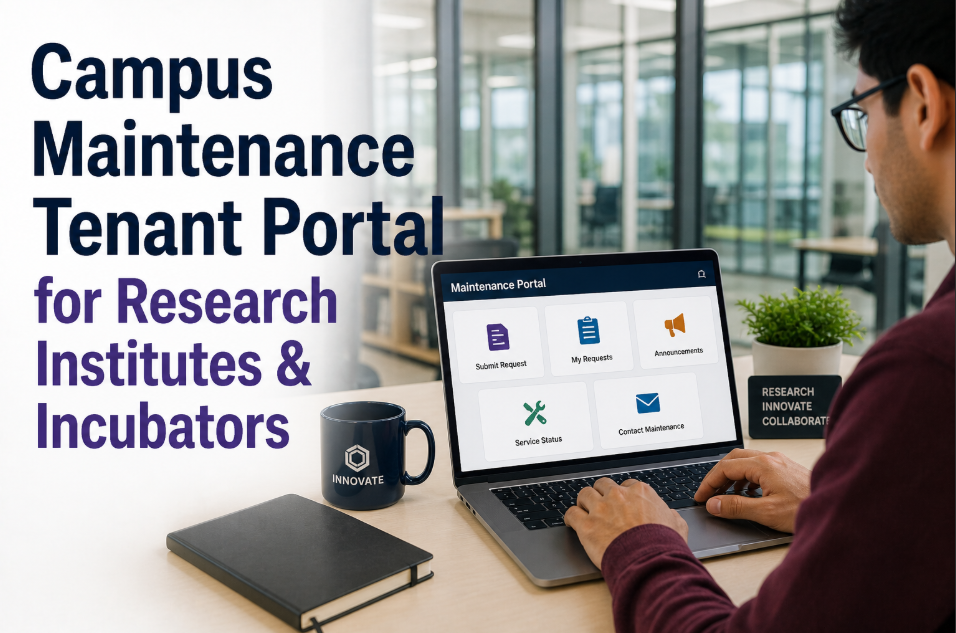
Each tenant organization gets their own branded portal — no app download, accessible via QR code or URL. Requests are categorized by equipment type, urgency, and compliance flag at submission, not after triage.
Tenants see their request status in real time: submitted, assigned, in-progress, completed. Automated notifications update them at every stage. No more follow-up calls. No more "let me check and call you back" conversations.
GMP-flagged, FDA-relevant, and life-safety requests automatically route to certified technicians with the right documentation workflow. Research emergencies bypass the general queue entirely and go straight to the priority dispatch channel.
Tenant-owned equipment is tracked in OxMaint with full service history, calibration records, warranty status, and PM schedules. Both the tenant and the facilities team can see asset condition — no more handwritten logs inside equipment panels.
Work orders are coded to the correct tenant, cost category, and service agreement line at creation. Monthly billing reports generate automatically — breaking down university-covered vs tenant-responsibility costs with zero spreadsheet assembly.
Every maintenance event for regulated tenant equipment produces a digital record: technician certification, work performed, parts installed, calibration readings, and digital signature. Exports satisfy FDA, GMP, and internal audit requirements on demand.
General Helpdesk vs OxMaint Tenant Portal for Research Tenants
| Tenant Need | General Campus Helpdesk | OxMaint Tenant Portal |
|---|---|---|
| Request Submission | Email or phone only, no structured intake | QR-accessible portal with categorization and priority flag at submission |
| Status Updates | No updates until closure, tenant must follow up | Real-time status notifications at every workflow stage |
| Compliance Routing | General queue, compliance events may wait days | GMP and life-safety flags bypass general queue automatically |
| Monthly Billing | 3–5 hours manual spreadsheet reconciliation per tenant | Automated billing report broken down by cost category and responsibility |
| Equipment Records | Handwritten logs inside panels or no record at all | Full digital asset registry with service history, calibration, warranty |
| Audit Documentation | Manual assembly, often incomplete, compliance risk | One-click export per event, certified technician signature, regulatory-ready |
Outcomes for Research Campus Facilities Teams Using Tenant Portals
Frequently Asked Questions
Can different tenant organizations have separate portals with their own branding?
How does OxMaint handle tenant-owned equipment that is maintained by campus facilities?
Can GMP and FDA compliance documentation be generated directly from OxMaint work orders?
How does tenant billing and cost allocation work in OxMaint?
Give Your Research Tenants the Portal They Actually Need
OxMaint's tenant portal platform supports research institutes, biotech startups, and incubator occupants with dedicated request portals, compliance documentation, real-time tracking, and automated billing reports — all within your existing campus CMMS. No additional headcount. No separate systems.


.png)