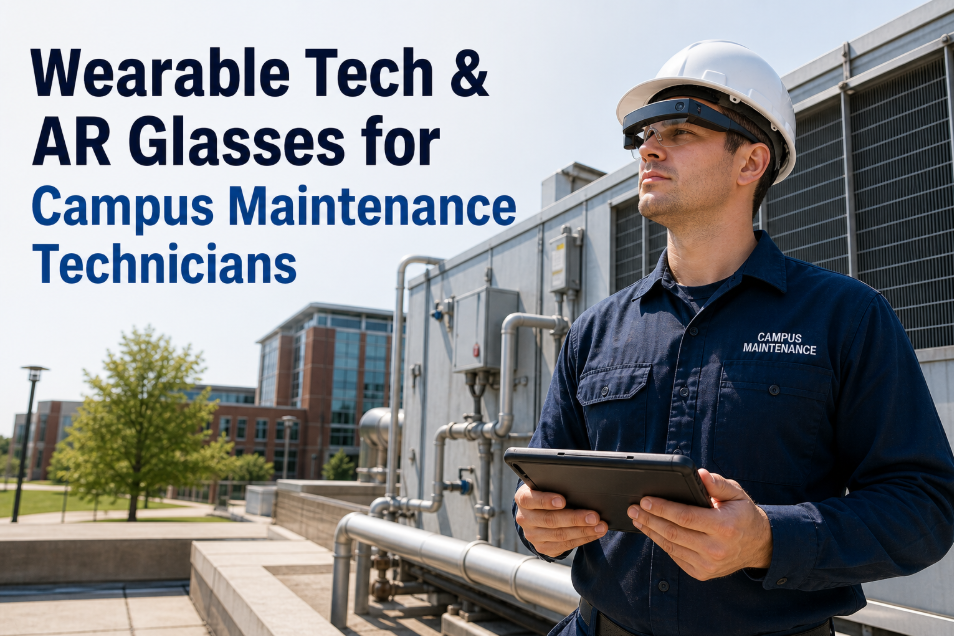
A senior HVAC technician at a large research university is inside a mechanical penthouse replacing a variable frequency drive. Both hands are occupied. The wiring schematic he needs is pinned to a wall behind him — printed from a PDF last updated in 2019. Above his right eye, a line of text appears in his smart glasses: "AHU-12 VFD last replaced March 2021, rated 75HP, compatible replacement confirmed in current work order." He has not touched his phone. He has not put down a tool. And he has just confirmed, hands-free, that the part he is about to install is correct. This is not a future scenario — wearable CMMS integration for campus maintenance is operational today, and campuses deploying it are reporting 30 to 45% reductions in technician error rates on complex repair tasks. Start a free trial of OxMaint to explore wearable-compatible workflows, or book a demo and see AR-assisted maintenance in action for campus facility teams.
Wearable Tech and AR Glasses for Campus Maintenance Technicians: Work Orders Without the Screen Time
Campus technicians working in confined spaces, on elevated platforms, or inside live electrical panels cannot safely use a phone or tablet to access work order instructions. AR smart glasses deliver schematic overlays, asset history, and step-by-step guidance hands-free — reducing task errors by up to 45% and completing complex repairs 28% faster.
The Work Order of the Future Is Hands-Free
OxMaint's mobile-first architecture connects directly with AR wearable platforms — delivering work order context, asset history, and step-by-step instructions to a technician's field of view while their hands stay on the work. Zero screen time. Full documentation. Every job.
What AR Smart Glasses Actually Do for a Campus Maintenance Technician
AR smart glasses worn by a maintenance technician overlay digital information onto their physical view of a machine or building system. In a campus maintenance context, that means: the asset tag and condition score appear as the technician approaches the equipment; the current work order steps appear as a checklist in their peripheral field; the wiring schematic for the panel they are working inside is overlaid on the panel itself without requiring a separate screen. When connected to OxMaint via API, every step the technician confirms updates the work order record in real time — creating a live digital record of the repair as it happens, without a separate data-entry step at the end. Fewer errors. Faster completion. Better compliance documentation. Want to see how OxMaint connects to AR wearable platforms for campus facilities? Start a free trial for 30 days and explore the wearable integration framework, or book a demo for a live walkthrough of AR-connected CMMS in a campus maintenance scenario.
Six High-Impact Use Cases for AR Wearables on Campus Maintenance
Technician views the current work order task list, required parts, and priority level as a heads-up display overlay while both hands remain on the equipment. Step confirmation via voice command or hand gesture updates the CMMS record without touching a device.
Electrical panel or mechanical schematic is overlaid directly onto the equipment in the technician's view. No more unfolding printed diagrams in confined spaces or scrolling through PDFs on a dusty phone screen inside an active plant room.
Technician approaches an asset and sees the last 3 service events, condition score, and open work order count in their field of view — without pulling out a phone. Relevant service history is visible before the first tool is picked up.
A junior technician encountering an unfamiliar fault can activate a live video share from their AR glasses to a senior engineer or OEM specialist viewing from anywhere. The remote expert sees exactly what the technician sees and can annotate directly on their field of view — eliminating costly site visits for consultation.
Before accessing a confined space, electrical panel, or pressurized system, the AR glasses display the required safety procedure checklist and LOTO (lockout/tagout) steps. Each step requires confirmation before the overlay advances — creating a real-time compliance record with timestamp and technician attribution.
Glasses camera captures the fault condition, mid-repair state, and completed installation automatically on voice command. Photos and video clips attach directly to the CMMS work order record — providing post-repair documentation without a secondary device and without stopping the repair workflow.
The Hidden Costs of Screen-Dependent Field Operations
A technician stopping a multi-step repair to consult their phone for the next step loses task context every time. Research in industrial settings shows task errors spike 34% when technicians alternate between physical work and screen consultation — especially on jobs with 8 or more sequential steps.
When complex repair procedures live only in the head of a senior technician, every vacation, illness, or retirement creates a critical knowledge gap. Campuses report losing 40 to 60% of institutional repair knowledge per senior retirement when procedures are not digitized and wearable-accessible.
OEM service calls and specialist consultations that could be resolved remotely if the remote expert could see through the technician's eyes cost campus maintenance teams an average of $850 to $2,400 per unnecessary site visit. Remote AR collaboration eliminates most of these calls.
Safety procedure compliance — LOTO confirmation, confined space checks, pressure test results — documented after the repair from memory is inherently unreliable and legally weak. Real-time step confirmation via AR creates a timestamped compliance chain during the actual procedure, not reconstructed afterward.
How OxMaint Connects to AR Wearable Platforms
OxMaint's documented REST API allows AR platforms — including RealWear, Google Glass Enterprise Edition, and Vuzix — to pull work order data, asset history, and maintenance procedures in real time. Two-way sync means completed steps in the glasses update the CMMS record simultaneously.
OxMaint's procedure builder creates structured step-by-step maintenance guides with photos, embedded schematics, required tools, and confirmation gates. These procedures feed directly to the AR overlay — so the glasses display exactly the right step at the right moment, with no formatting adjustment needed for the wearable device.
Technicians say "confirm step" or "take photo" to advance the AR work order and attach documentation without touching a screen. Voice commands map to OxMaint API calls that update the live work order record in real time — creating a complete documented repair sequence from voice alone.
Work order procedures are cached to the wearable device before the technician enters areas with poor connectivity — mechanical penthouses, below-grade plant rooms, shielded server spaces. Completed steps sync to OxMaint when connectivity is restored, with timestamps reflecting actual completion times.
Traditional Screen-Based Field Tools vs AR-Wearable CMMS Integration
| Field Scenario | Tablet or Phone CMMS Access | OxMaint via AR Smart Glasses |
|---|---|---|
| Complex Multi-Step Repair | Alternate between tool and screen, 34% higher error rate | Work order steps visible in HUD, hands never leave equipment, 45% fewer errors |
| Schematic Consultation | Printed diagram or PDF on phone, poor readability in field | Schematic overlaid on actual equipment in field of view, always current version |
| Junior Technician on Unfamiliar Fault | Phone call to senior, often requires a second site visit | Remote AR collaboration — senior sees exactly what junior sees, annotates live |
| Safety Compliance Documentation | Post-task form from memory, legally weak, unreliable | Real-time step confirmation with timestamp during the procedure — legally defensible |
| Photo Documentation | Stop work, photograph with phone, manually attach to work order | Voice-triggered glasses camera, auto-attached to CMMS work order record mid-repair |
Measured Outcomes: AR-Wearable Campus Maintenance Operations
Frequently Asked Questions
Which AR smart glass platforms does OxMaint integrate with?
How are maintenance procedures formatted for AR display?
What happens when the AR glasses lose connectivity in a shielded or below-grade area?
Is remote AR collaboration available for complex repairs requiring expert consultation?
The Best Work Order Interface Is No Interface at All
OxMaint's open API architecture connects your maintenance procedures, asset history, and work order workflows directly to AR smart glasses — delivering the right information to your technicians' field of view, hands-free, at the exact moment they need it. Less screen time. Fewer errors. Complete compliance documentation. Automatically.