A university museum receives a loan notification for a traveling exhibition valued at $4.2 million. The lending institution's facility report requires documented proof of UV filtration below 75 microwatts per lumen, temperature stability within ±2°F over the previous 12 months, relative humidity maintained between 45-55% RH, and a functioning security loop with timestamped alarm logs for every door, case, and gallery zone. The campus facilities team has 60 days to produce this documentation — and discovers that climate data lives in one system, security alarm logs in another, lighting maintenance records in a paper binder, and the last HVAC filter change date for the gallery AHU is unknown. This is not an unusual scenario. Over 60% of campus museums report that facility documentation gaps have delayed or jeopardized loan agreements. The solution is not more systems — it is one CMMS that connects lighting, climate, and security maintenance into a single, audit-ready record. See how Oxmaint manages museum facility compliance across all three systems — start a free trial or book a demo to walk through a gallery configuration.
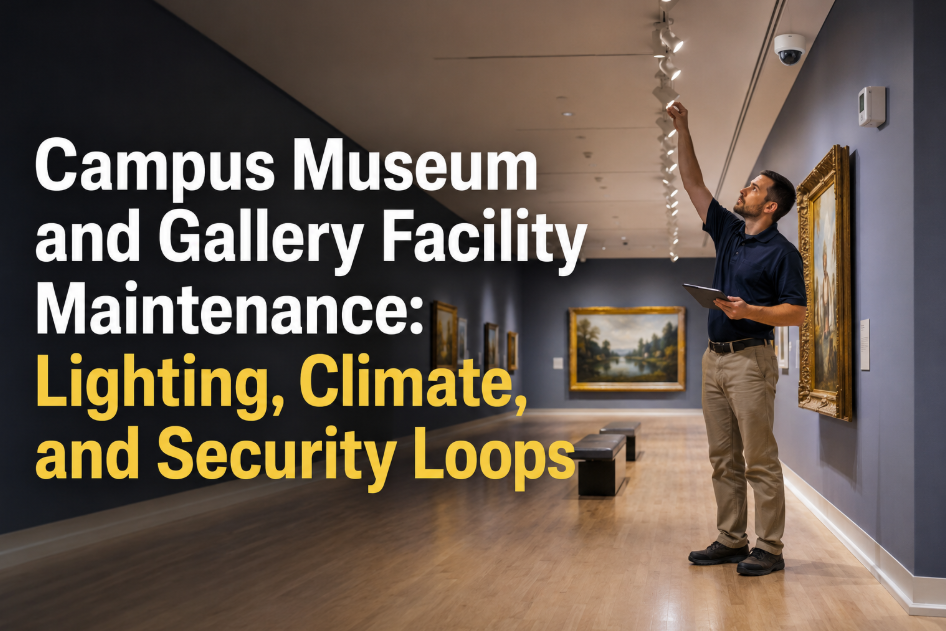
Campus Museum and Gallery Facility Maintenance: Lighting, Climate, and Security Loops
UV/IR lighting management, climate envelopes, security loop monitoring, alarm logs, and CMMS-tracked compliance for exhibition spaces and loaned works on university campuses.
What Does Museum-Grade Facility Maintenance Actually Require?
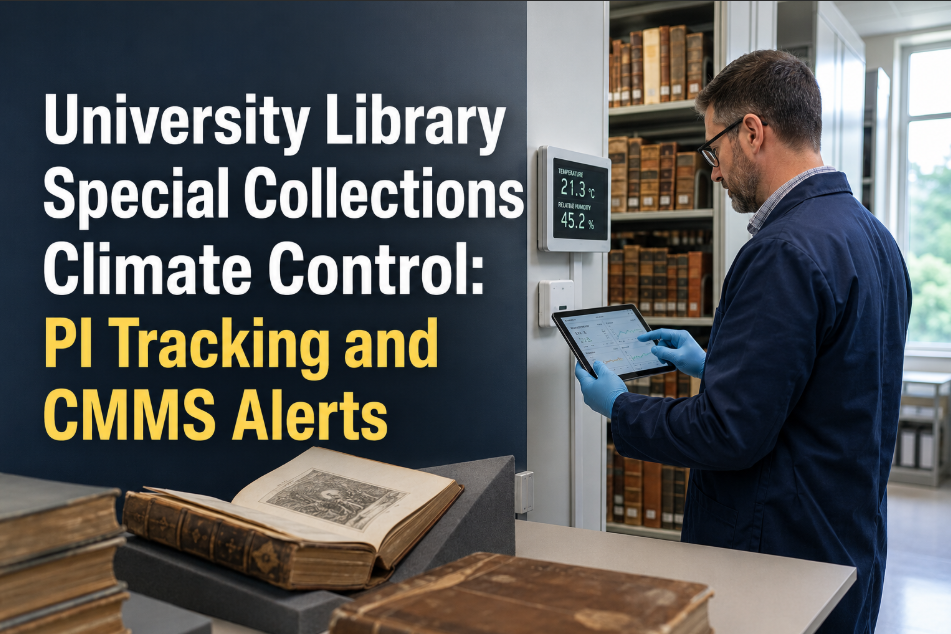
Campus museum and gallery maintenance operates at the intersection of three interconnected facility systems — lighting, climate, and security — each with standards far more demanding than typical academic building operations. A standard classroom HVAC tolerance of ±5°F becomes ±1-2°F in a gallery. Standard corridor lighting at 300 lux becomes 50-200 lux with UV/IR filtration in an exhibition space. Standard building security with card access becomes a multi-zone intrusion detection loop with tamper monitoring on individual display cases. When any one of these three systems fails, collections are at risk and loan agreements are in jeopardy.
The operational challenge for campus facilities teams is that museum maintenance requires different standards than the rest of campus — but it is managed by the same team, using the same systems, under the same budget constraints. Oxmaint solves this by allowing facilities managers to configure museum-specific tolerance bands, PM frequencies, and compliance documentation requirements within their existing campus-wide CMMS — book a demo to see how museum zones are configured alongside standard campus buildings.
Why Lending Institutions Reject Campus Museum Facility Reports
When a museum or private collector considers lending works to a university gallery, they require a Standard Facility Report (based on the AAM template) documenting the gallery's environmental, lighting, and security capabilities. Rejection reasons are almost always operational documentation failures — not actual facility inadequacy. These are the four most common rejection categories reported by university museum registrars.
How Oxmaint Manages All Three Museum Facility Systems in One Platform
Oxmaint provides a unified maintenance layer that connects lighting, climate, and security assets into a single CMMS record — with preventive maintenance schedules, automated alerts, and audit-ready documentation that satisfies lending institution requirements without requiring museum staff to compile reports from multiple disconnected systems.
Unify Lighting, Climate, and Security Maintenance in One Gallery-Ready CMMS
Oxmaint connects your museum's environmental sensors, lighting assets, and security systems into a single platform — so every PM, every alert, and every compliance record is linked to the gallery zone it serves. No more compiling facility reports from four different systems.
Without CMMS vs With Oxmaint: Campus Museum Operations
| Without Unified CMMS | With Oxmaint CMMS |
|---|---|
| Facility reports take 3-4 weeks to compile from multiple disconnected systems | One-click facility report with 12-month climate, lighting PM, and security data |
| UV filter replacement dates unknown — filters may be 3+ years past effective life | Automated PM reminders for annual UV filter replacement with installation date tracking |
| Climate excursions discovered when conservator notices visible damage | Real-time alerts with work order generation within minutes of environmental drift |
| Security sensor testing happens "when someone remembers" — no documented schedule | Monthly security loop testing with timestamped completion records per zone |
| Gallery HVAC issues reported to central facilities — no priority differentiation | Museum zones flagged as high-priority assets with escalated response times |
| Loan request denied due to incomplete documentation — exhibition rescheduled | Loan approval on first submission with audit-ready compliance documentation |
Impact of CMMS-Integrated Museum Facility Management
Frequently Asked Questions
Can Oxmaint handle museum-specific PM schedules that differ from standard campus maintenance?
Yes. Oxmaint supports asset-level PM scheduling, which means gallery HVAC units, lighting fixtures, and security sensors can each have their own maintenance frequency and checklist — independent of the campus-wide schedule. A gallery AHU can be on a quarterly filter change while standard campus AHUs are on semi-annual schedules. Each PM is tied to the specific asset in the gallery zone hierarchy.
Does Oxmaint generate reports formatted for AAM Standard Facility Reports?
Oxmaint generates comprehensive environmental, maintenance, and security compliance reports that contain all data fields required by the AAM Standard Facility Report template — including 12-month climate data, HVAC PM history, lighting specifications, and security system documentation. Museum registrars can export this data directly into their facility report submissions without manual compilation. Book a demo to see a sample facility report output.
How does Oxmaint track UV filter degradation and replacement schedules?
UV filters are registered as components within each gallery lighting fixture asset. Installation dates are recorded, and PM schedules trigger replacement reminders based on manufacturer-recommended intervals (typically 12-18 months). Technicians document replacement with photo verification and UV meter readings, creating a timestamped compliance record for each filter in the gallery.
Can campus security alarm logs be integrated into Oxmaint for gallery compliance documentation?
Oxmaint integrates with campus security platforms via API to pull alarm event logs, response timestamps, and resolution records for gallery-zone sensors. This creates a unified audit trail where security events, HVAC maintenance, and lighting PMs are all documented within the same gallery asset record — eliminating the need to compile security data from a separate system. Start a free trial to evaluate the security integration for your campus gallery.
Your Next Loan Agreement Depends on Your Facility Documentation
Oxmaint gives campus museums the audit-ready maintenance records that lending institutions require — climate data, lighting PM history, security logs, and HVAC documentation, all in one platform. Stop compiling facility reports from four systems. Start producing them in one click.