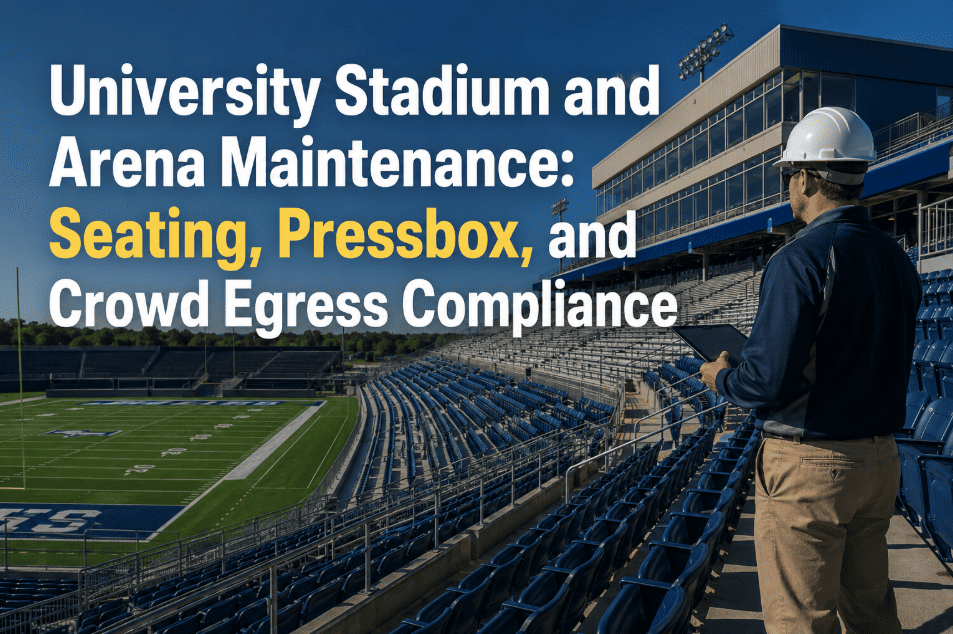
A university stadium with 42,000 seats hosts 6 football games, 3 concerts, 2 commencement ceremonies, and 15 special events per year. Each event brings a crowd that depends on 47 exit doors functioning correctly, 12 elevators operating under load, 2 escalators moving at code-compliant speed, 8 concession ventilation hoods exhausting grease-laden air, and a scoreboard with 2.4 million LED pixels displaying real-time content. Between events, there are 340 idle days where corrosion advances on exposed steel, UV degrades seat materials, and drainage systems accumulate debris. The maintenance challenge is not complexity — it is periodicity. Stadium systems must perform flawlessly on game day after weeks or months of inactivity, and 63% of game-day equipment failures trace back to deferred maintenance during the off-season. That press box elevator that fails 90 minutes before a nationally televised game was serviceable 4 months ago — it just was not on anyone's schedule. See how Oxmaint manages event-driven and off-season stadium maintenance in a single platform — start a free trial or book a demo to walk through a stadium configuration.
University Stadium and Arena Maintenance: Seating, Pressbox, and Crowd Egress Compliance
Seating inspections, press box systems, scoreboard maintenance, vertical transportation, crowd egress compliance, and CMMS-tracked audit records for university stadiums and arenas.
What Makes Stadium Maintenance Different from Standard Campus Facilities
University stadiums and arenas are event-driven facilities. Unlike academic buildings that operate continuously, stadiums cycle between peak-load events (where every system must perform simultaneously under maximum capacity) and extended dormant periods (where weather exposure, pest intrusion, and material degradation occur unchecked). This event-idle-event pattern creates a maintenance challenge that standard time-based PM schedules cannot address effectively.
A stadium requires two maintenance calendars operating simultaneously: an event-triggered calendar (pre-event inspections, post-event damage assessments, and game-day equipment verification) and a condition-based calendar (off-season structural inspections, corrosion treatment, drainage clearing, and seat replacement programs). Oxmaint manages both calendars in a single platform, so every pre-game checklist and every off-season PM is tracked against the same asset registry — book a demo to see how event-driven and time-based maintenance schedules coexist in one system.
Pre-Event Inspection: The 48-Hour Readiness Protocol
Every stadium event requires a documented pre-event inspection that verifies life-safety systems, crowd management infrastructure, and guest-facing amenities are operational. The authority having jurisdiction, the university's risk management office, and the insurance carrier all require evidence that this inspection occurred. Without a CMMS, pre-event inspections are paper checklists completed once and filed in a binder that no one references until an incident investigation.
How Oxmaint Manages Stadium Maintenance at Scale
Game Day Starts with Last Week's Maintenance
Oxmaint gives university stadium operations teams event-triggered inspections, off-season PM scheduling, and audit-ready compliance records in one platform. Every exit door, every elevator, every scoreboard — documented and ready when 42,000 people arrive.
Measurable Impact of CMMS-Tracked Stadium Operations
Frequently Asked Questions
Can Oxmaint auto-schedule pre-event inspections based on our game and event calendar?
Yes. Oxmaint integrates with your event scheduling system to automatically generate pre-event inspection work orders at configurable lead times (default: 48 hours before event). Each event triggers the appropriate inspection template based on event type — a football game triggers the full stadium protocol; a concert triggers stage and concourse protocols. Post-event damage assessments auto-generate at event end time. Start a free trial to configure event-triggered inspection scheduling.
How does Oxmaint handle seating bowl maintenance across tens of thousands of individual seats?
Seating is managed at the section-row level rather than individual seat level. Each seating section is an asset with its own inspection history and condition score. Technicians conduct section-by-section inspections on mobile devices, documenting individual seat issues (broken anchor bolt, damaged cup holder, missing seat) as work order items within the section asset. This provides detailed tracking without creating 42,000 individual seat assets. Annual seat replacement programs are planned based on section condition scores and age data.
Does Oxmaint track vertical transportation compliance for stadium elevators and escalators?
Oxmaint tracks each elevator and escalator as a distinct asset with its own compliance schedule — state elevator inspection dates, load test records, maintenance contractor service history, and ADA accessibility verification. The system generates advance notifications for upcoming state inspections and flags any unit that has passed its inspection deadline. Elevator shutdown during an event due to expired inspection is a preventable compliance failure that Oxmaint eliminates. Book a demo to see vertical transportation compliance tracking.
Can Oxmaint generate CapEx forecasts for stadium renovation and replacement planning?
Yes. Oxmaint's asset lifecycle tracking generates rolling 5-10 year CapEx forecasts based on asset age, condition scores, replacement costs, and remaining useful life estimates. For stadiums, this includes seat replacement programs (typically 15-20 year cycles), scoreboard technology upgrades (8-12 year cycles), structural coating and waterproofing renewals (10-15 year cycles), and concession equipment replacement. These forecasts provide the athletic department and university administration with data-driven capital planning for budget requests.
42,000 Seats. 47 Exit Doors. Zero Excuses on Game Day.
Oxmaint gives university stadium operations the event-triggered maintenance platform that generic campus CMMS tools cannot provide. Pre-event inspections, off-season PM, CapEx forecasting, and audit-ready compliance — all managed in one system across every athletic venue on campus.