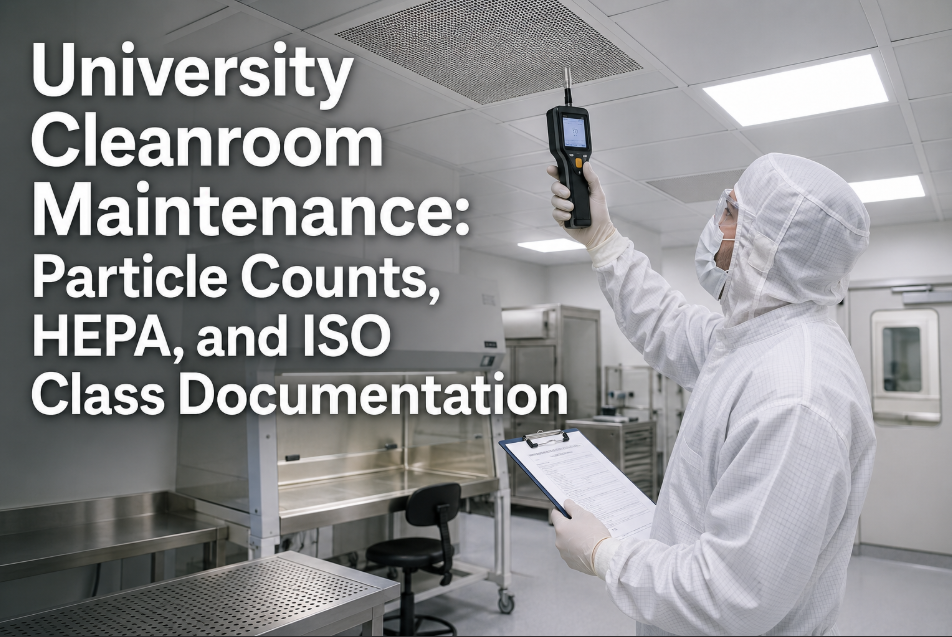
University cleanrooms supporting nanotechnology, semiconductor, photonics, and MEMS research operate at ISO Class 5, 6, 7, and 8 classifications where a single particle larger than 0.5 microns can destroy a wafer run worth $15,000 or invalidate 6 months of a doctoral student's fabrication results. Yet 58% of university nanofab cleanrooms still manage particle count documentation, HEPA filter certification records, and gowning protocol compliance on spreadsheets and paper logs — creating gaps that surface during ISO 14644-2 monitoring audits and grant-funded equipment reviews. The difference between a cleanroom operating at specification and one drifting out of class can be invisible to the naked eye but devastating to research outcomes: a single contamination event in an electron beam lithography tool can cost $40,000 in rework and delay publications by months. Universities that have implemented CMMS platforms designed for cleanroom operations — including Oxmaint's research facility module — maintain 99.2% uptime on cleanroom-critical systems and produce ISO 14644 compliance documentation in under 10 minutes. If your cleanroom operations team is managing particle count logs, HEPA replacement schedules, and tool PM on separate systems, this guide consolidates every maintenance requirement into a single operational framework. Get a firsthand look at how it works — start a free trial or book a demo.
University Cleanroom Maintenance: Particle Counts, HEPA, and ISO Class Documentation
ISO Class 5/7/8 particle count verification, HEPA filter certification tracking, gowning protocol enforcement, tool PM scheduling, and CMMS-tracked compliance for university nanofabrication and semiconductor research labs.
Keep Your Cleanroom at Classification — Not Just at Commissioning
See how Oxmaint tracks particle counts, HEPA certifications, tool PM schedules, and gowning compliance in one platform. 30-minute demo tailored to your cleanroom class and tool inventory.
What Makes University Cleanroom Maintenance Unique?
University cleanrooms are not semiconductor fabs with dedicated maintenance teams and $100M operating budgets. They are shared-user research facilities where 50-200 graduate students, postdocs, and faculty members access tools daily under varying levels of training and cleanroom discipline. The maintenance challenge is threefold: maintaining ISO classification in a high-traffic, multi-user environment; keeping 30-100 research tools in calibration and PM compliance simultaneously; and documenting everything to satisfy ISO 14644-2 monitoring requirements, NSF MRI grant equipment compliance, and university EHS audits. Unlike commercial fabs where maintenance is a cost center with dedicated staff, university cleanrooms typically share maintenance resources with the broader campus facilities organization — meaning the HVAC technician servicing the cleanroom fan filter units on Tuesday is servicing a residence hall air handler on Wednesday. The CMMS must bridge this operational gap by providing cleanroom-specific PM templates, particle count tracking, and gowning protocol documentation within a platform that campus facility teams can actually use. Interested in seeing how other universities have solved this? Start a free trial or book a demo.
The Four Pillars of University Cleanroom Maintenance
Each pillar maps to specific ISO 14644 requirements, equipment manufacturer specifications, and grant compliance documentation needs.
ISO 14644-2 requires periodic monitoring of cleanroom particle concentrations to verify ongoing classification compliance. For ISO Class 5, particle counts at 0.5 micron must remain below 3,520 per cubic meter; ISO Class 7 allows up to 352,000. University cleanrooms must establish monitoring plans with defined sampling locations, frequencies (typically weekly or biweekly for at-rest conditions, and event-triggered for operational conditions), and action limits. Particle counter calibration must be current with NIST-traceable certificates.
Cleanroom HEPA (99.97% at 0.3 micron) and ULPA (99.999% at 0.12 micron) filters in fan filter units require annual integrity testing via DOP/PAO aerosol challenge, monthly differential pressure monitoring to track loading, and pre-filter replacement every 3-6 months depending on ambient air quality. FFU motor maintenance includes annual bearing lubrication, vibration analysis, and speed verification to confirm design airflow velocity (typically 90 feet per minute for ISO Class 5 unidirectional flow). A single failed FFU in a cleanroom ceiling grid can create a contamination plume affecting 6-8 adjacent process bays.
University cleanrooms typically house 30-100 research tools — sputter systems, e-beam evaporators, RIE etchers, PECVD systems, photolithography steppers, wet benches, and metrology equipment. Each tool has manufacturer-specified PM schedules (target replacement, chamber cleaning, gas line purging, vacuum pump oil changes) and calibration requirements (deposition rate verification, etch rate uniformity, alignment accuracy). Tool downtime in a shared facility affects every user — a single sputter system serving 40 researchers generates cascading schedule impacts when PM is deferred.
Gowning protocol compliance is the single largest controllable variable in university cleanroom contamination. Users must follow proper gowning sequences (coverall, hood, boots, gloves, face mask) in the correct gowning room zones. Documentation requirements include initial gowning qualification records, refresher training dates, and incident reports for protocol violations. University cleanrooms with 100+ authorized users must track training currency for each individual and restrict access when training expires.
Cleanroom Maintenance Challenges at Universities
Particle count data lives in one spreadsheet maintained by a staff scientist. Tool PM schedules are on a whiteboard in the cleanroom office. HEPA certification records are in a filing cabinet maintained by facilities. Gowning training records are in an EHS database. When an NSF program officer asks for a comprehensive equipment maintenance and environmental compliance report, assembling it takes 40+ hours across 4 departments.
A sputter system PM requiring 8 hours of downtime is deferred repeatedly because the tool has a 3-week waitlist of users. After 6 months of deferred PM, target erosion causes deposition rate drift of 18% from specification, contaminating 3 users' wafer runs before the drift is detected by a metrology check that was also behind schedule.
A university cleanroom commissioned as ISO Class 6 has not conducted formal ISO 14644-2 monitoring in 14 months. Particle counts taken during an equipment troubleshooting exercise reveal the cleanroom is now operating at ISO Class 7 in 3 of 8 sampling zones due to a failed FFU and two bypassed pre-filters. Research conducted during this period may have been compromised without anyone knowing.
A graduate student whose gowning certification expired 5 months ago continues accessing the cleanroom because the training database is not linked to the access control system. Multiple particle count excursions in the photolithography bay are eventually traced to improper gowning technique by this user and two others with expired certifications.
How Oxmaint Delivers Cleanroom Maintenance Excellence
Particle count data from portable and fixed counters is logged against specific cleanroom zones in the asset registry. Trend dashboards show ISO classification compliance over time with configurable action and alert limits. Excursion events auto-generate investigation work orders with root cause analysis templates.
Every FFU in the cleanroom ceiling grid is an individual asset with pressure drop trending, HEPA certification dates, pre-filter replacement schedule, and motor maintenance history. Annual DOP test results attach directly to the FFU asset. Dashboard views show all filters by certification status — current, upcoming, and overdue — sorted by cleanroom zone.
Tool PM schedules are configured with manufacturer-specified intervals, auto-generated work orders, and advance user notifications so researchers can plan around downtime windows. PM completion triggers calibration verification work orders where applicable. Tool availability dashboards show uptime percentage by tool over any date range.
User gowning qualification records are tracked in the CMMS with expiration dates and automated renewal alerts. Training status links to cleanroom access permissions — expired certifications trigger access restriction notifications to cleanroom management. Gowning protocol violation reports attach to user records for pattern identification.
Generate ISO 14644-2 monitoring reports showing particle count data, sampling locations, frequencies, action limit exceedances, and corrective actions over any date range. Reports are formatted for submission to ISO registrars, NSF program officers, and university EHS auditors — exportable in under 10 minutes.
Oxmaint supports cleanroom asset hierarchies: Campus, Building, Cleanroom Bay, Zone (lithography, etch, deposition, wet bench, metrology), Individual Tool, and Tool Subsystem. Each level carries its own PM templates, environmental parameters, and compliance documentation. Portfolio-level dashboards aggregate cleanroom metrics across multiple campus research facilities.
Spreadsheet-Based vs. CMMS-Tracked Cleanroom Maintenance
- Particle data in one spreadsheet, tool PM on whiteboard
- HEPA certifications in filing cabinets by vendor name
- Gowning training in EHS database, not linked to access
- Tool PM deferred with no visibility into impact
- ISO 14644-2 reports assembled manually over 30+ hours
- Classification drift undetected for months
- All particle, HEPA, tool, and training data in one platform
- HEPA certs attached to FFU asset records with auto-alerts
- Gowning expiration triggers access restriction notifications
- Tool PM automated with user downtime notifications
- ISO 14644-2 reports generated in under 10 minutes
- Real-time classification status dashboards by zone
Cleanroom Maintenance Performance Metrics
Frequently Asked Questions
Can Oxmaint track particle count data from multiple cleanrooms across campus?
How does the platform handle tool PM scheduling in a shared-user research cleanroom?
Does the CMMS support NSF MRI grant equipment compliance documentation?
Can we implement Oxmaint for just our cleanroom without affecting the rest of campus facilities?
Your Cleanroom Classification Is Only as Reliable as Your Maintenance Records
Every particle count, HEPA certification, tool PM, and gowning qualification in your cleanroom exists to protect research outcomes worth millions of dollars and years of graduate student effort. Oxmaint gives your cleanroom operations team a single platform for environmental monitoring, filtration management, tool PM, and ISO 14644 compliance documentation. See it running on your cleanroom in a 30-minute working demo.

![university-property-insurance-underwriting-cmms-documentation[1]](./manage-post-2k26/uploads/university-property-insurance-underwriting-cmms-documentation[1].png)