A single 2°F temperature drift sustained over 72 hours in a university special collections vault can accelerate cellulose degradation by up to 25% annually. Most campus HVAC systems were never designed for the precision climate control that rare books, manuscripts, and archival materials demand — yet 78% of university libraries still rely on building-wide HVAC settings rather than dedicated environmental monitoring for their most irreplaceable holdings. The difference between a climate-controlled archive and an archive that thinks it is climate-controlled is continuous Performance Index tracking, dew point management, and automated alerting when conditions drift outside preservation-grade tolerance bands. When your HVAC system drifts at 2 AM on a Saturday, the question is whether anyone knows before Monday morning — or whether three days of uncontrolled humidity have already begun damaging collections worth millions. Want to see how Oxmaint tracks climate compliance for university archives — start a free trial or book a demo to walk through a live configuration.
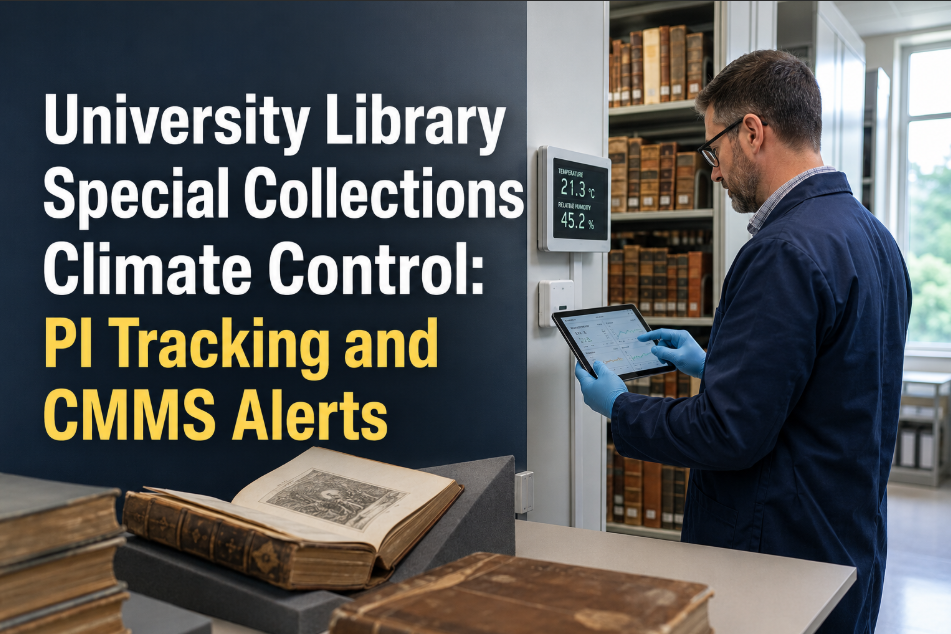
University Library Special Collections Climate Control: PI Tracking and CMMS Alerts
Performance Index monitoring, dew point control, HVAC tolerance bands, and automated CMMS alerts — the operational framework for protecting irreplaceable archival holdings.
What Is Performance Index (PI) Tracking for Special Collections Climate Control?
Performance Index (PI) is a quantitative metric that measures the percentage of time a climate-controlled space remains within its defined environmental tolerance band. For university special collections, this means tracking how consistently temperature stays within the 68-72°F range and relative humidity stays within 30-50% RH — the parameters established by the Image Permanence Institute and ASHRAE Chapter 24 for long-term preservation of paper, parchment, photographic materials, and magnetic media. A PI score of 100 means perfect compliance. A PI score of 85 means 15% of monitored time fell outside acceptable ranges — and that 15% is where cumulative, irreversible damage occurs.
Most university facilities teams track temperature and humidity as building-level comfort metrics, not as preservation-grade compliance data. The difference is precision: comfort HVAC operates within ±3°F tolerance. Preservation HVAC operates within ±1°F tolerance with dew point control. When your CMMS tracks PI scores alongside HVAC work orders, every maintenance decision — filter replacement timing, chiller capacity, AHU coil cleaning — connects directly to measurable preservation outcomes rather than subjective comfort complaints. Facilities teams managing special collections can use Oxmaint to tie every climate excursion to a work order with full asset context — start a free trial to see how PI tracking integrates with your preventive maintenance schedule.
Critical Climate Variables for University Archival Spaces
Preservation-grade climate control goes beyond simple thermostat settings. University special collections require monitoring and controlling six interrelated environmental variables — each with its own tolerance band, measurement frequency, and failure consequence. Missing any one of these creates conditions where irreversible damage accumulates silently, often undetected until a conservator identifies physical deterioration months or years later.
What Goes Wrong Without CMMS-Tracked Climate Monitoring
University facilities teams manage hundreds of building systems across campus. Special collections climate control failures rarely announce themselves with alarms — they manifest as slow drifts that go unnoticed until physical damage is visible. These are the four most common failure scenarios in university archives, each preventable with CMMS-integrated environmental monitoring.
Track Every Climate Excursion with Automated Work Orders
Oxmaint connects to your building automation system and environmental sensors to generate work orders the moment conditions drift outside preservation tolerance bands — with the sensor reading, vault location, and HVAC asset history attached. No more Monday morning surprises from weekend drift events.
How Oxmaint Manages Special Collections Climate Compliance
Oxmaint provides the operational layer between your environmental sensors, HVAC systems, and preservation standards — turning raw sensor data into actionable maintenance intelligence with full audit documentation for accreditation reviews and insurance requirements.
Manual Monitoring vs CMMS-Integrated Climate Management
The operational difference between manual environmental monitoring and CMMS-integrated tracking is the difference between discovering damage and preventing it. Here is what changes when university facilities teams connect their preservation climate systems to Oxmaint.
| Manual / Datalogger-Only Monitoring | Oxmaint CMMS-Integrated Monitoring |
|---|---|
| Dataloggers downloaded monthly — excursions discovered weeks after they occurred | Real-time threshold monitoring with work orders generated within minutes of drift |
| No connection between climate data and HVAC maintenance records | Every excursion linked to the HVAC asset, its maintenance history, and the assigned technician |
| PI scores calculated manually in spreadsheets — if calculated at all | Automated PI scoring at daily, weekly, monthly, and annual intervals per zone |
| Weekend and holiday drift events discovered Monday morning | After-hours alerts routed to on-call HVAC staff with remote diagnostics |
| Accreditation audits require weeks of data compilation from multiple sources | One-click compliance reports with full sensor-to-work-order documentation chain |
| Sensor calibration tracked on paper logs or not tracked at all | Automated calibration reminders with verification records attached to sensor assets |
Results from CMMS-Integrated Preservation Climate Control
University libraries that implement CMMS-integrated environmental monitoring consistently report measurable improvements in both preservation outcomes and operational efficiency. These results reflect published data from institutions that moved from manual datalogger monitoring to automated, work-order-linked climate management.
Frequently Asked Questions
What environmental sensors does Oxmaint integrate with for special collections monitoring?
Oxmaint integrates with any sensor platform that provides API access or data export — including HOBO MX series, Delphin Expert Logger, Hanwell Pro, Conserv, and BMS-integrated sensors from Siemens, Johnson Controls, and Honeywell. The integration reads temperature, relative humidity, and dew point values at configurable intervals (typically 5 minutes for preservation-grade monitoring) and evaluates them against tolerance bands configured per zone. Want to verify compatibility with your current sensor infrastructure — book a demo to review your setup with our integration team.
How does Oxmaint prevent alert fatigue from minor climate fluctuations?
Alert fatigue is managed through sustained-duration filtering — a threshold must be crossed for a configurable period (default: 15 minutes) before a work order is generated. This eliminates nuisance alerts from door openings, brief occupancy spikes, or transient HVAC cycling. Additionally, dead-band configuration prevents repeated alerts from readings oscillating near a threshold boundary, and work order deduplication ensures only one open work order exists per zone per excursion type.
Can Oxmaint generate reports for ALA accreditation and insurance audits?
Yes. Oxmaint generates environmental compliance reports that include PI scores by zone and time period, excursion logs with duration and severity, corresponding HVAC work orders with resolution records, sensor calibration history, and preventive maintenance completion rates for all HVAC assets serving special collections spaces. These reports satisfy documentation requirements for ALA accreditation reviews, APPA benchmarking, and insurance carriers that require proof of environmental monitoring for high-value collections coverage.
What is the typical implementation timeline for a university library?
Most university libraries complete implementation in 3-5 weeks: 1 week for sensor inventory and tolerance band configuration, 1-2 weeks for API integration and data bridge setup, 1 week for HVAC asset mapping and work order template creation, and 1 week for threshold tuning with live data. Libraries with existing BMS-integrated sensors can often complete integration in under 3 weeks. Start a free trial to begin your sensor inventory and tolerance band configuration immediately.
Protect Irreplaceable Collections with Data-Driven Climate Management
Oxmaint connects your environmental sensors to your maintenance workflow — so every climate excursion generates a work order, every HVAC PM links to preservation outcomes, and every accreditation audit is answered with one report. Your special collections deserve more than a monthly datalogger download.

![university-sustainability-initiatives-carbon-tracking-scope-1-2-3-cmms[1]](./manage-post-2k26/uploads/university-sustainability-initiatives-carbon-tracking-scope-1-2-3-cmms[1].png)