Generator testing feels routine — until a missed step turns into a $40,000 emergency work order and a school without power. Across K-12 districts and higher education campuses, the same preventable mistakes show up again and again: tests run without load, fuel levels unchecked, battery voltage ignored, and corrective actions left open for months. OxMaint's preventive maintenance scheduling tools help facilities teams build a generator testing program that eliminates these gaps before they become emergencies. To see how it works for your district, book a demo or start a free trial today.
Emergency Preparedness
Preventive Maintenance
School Facilities
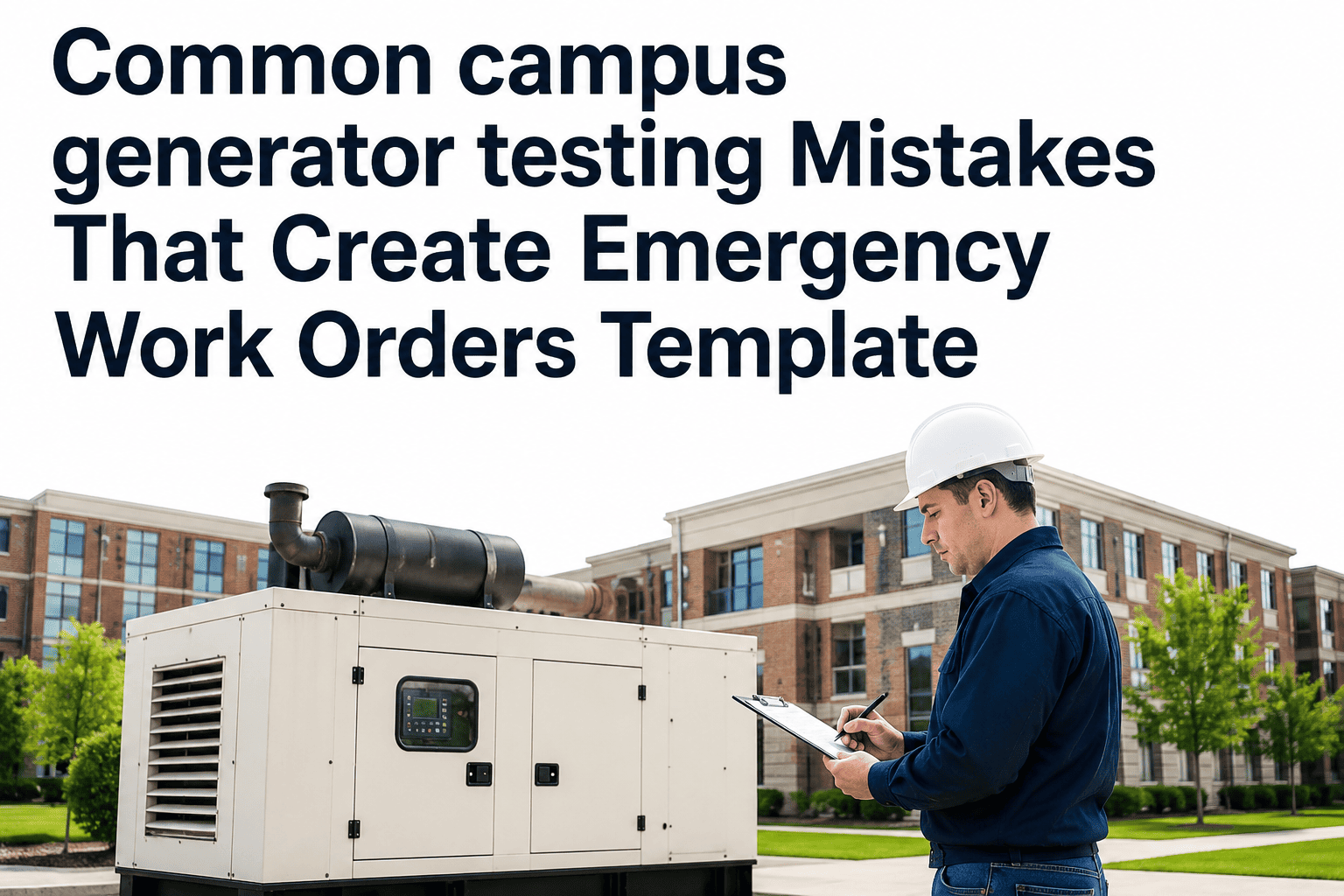
Common Campus Generator Testing Mistakes That Create Emergency Work Orders
A practical template for school facilities teams — identify the mistakes your program is making right now, and the exact corrective steps to eliminate them with a structured PM schedule.
41%
Of school generators fail their first full-load test after a paper-based maintenance program
$40K
Average cost of an emergency generator repair versus $600 for a planned PM intervention
67x
More expensive to fix a failed generator mid-emergency than to prevent the failure with PM
The Problem
Why School Generator Programs Keep Generating Emergency Work Orders
Most school facilities teams are not skipping generator maintenance on purpose. They are managing 40 other priorities, relying on a technician who keeps the schedule in their head, or inheriting a paper-based system that has no visibility. The result is a pattern of reactive work orders that cost 10 to 60 times more than the preventive maintenance that would have stopped them. Below is the template — every common mistake, mapped to its root cause and the OxMaint PM solution.
Mistake Template
10 Generator Testing Mistakes and How to Eliminate Each One
The Mistake
Running a generator unloaded (no-load test) does not verify that the unit can carry its rated capacity. It leaves carbon deposits and glazes cylinder walls. NFPA 110 requires load bank testing at 30% or more of rated load for 30 minutes minimum. An unloaded test that passes on paper can fail catastrophically when real load hits during an outage.
PM Solution
Schedule a monthly 30-minute exercise test and an annual full-load bank test. OxMaint's PM template for NFPA 110 compliance auto-schedules both intervals, requires load percentage to be recorded, and blocks completion unless the load field is filled in.
The Mistake
Generators run during tests. Without a fuel check before and after, teams miss slow leaks, consumption trends, and depleted tanks. A generator at 40% fuel during a 72-hour storm outage will shut down mid-event — creating an emergency work order and a safety incident.
PM Solution
Build a mandatory fuel level field into every inspection form — pre-test and post-test. OxMaint's mobile form enforces this with a required field before the technician can mark the work order complete. Fuel level trends are graphed automatically over time.
The Mistake
Battery failure is the number-one cause of generator no-starts. Most school programs check voltage once a year at an annual service. A battery dropping from 12.6V to 11.8V over three months is invisible without a logged trend — until the generator will not start.
PM Solution
Record voltage at every monthly inspection. OxMaint flags a downward trend automatically and creates a predictive corrective action when voltage drops below a set threshold — giving you weeks of lead time to replace a battery for under $100.
The Mistake
The generator can start perfectly, but if the automatic transfer switch (ATS) fails to transfer load, the building stays dark. ATS testing is frequently skipped because it requires coordination with the utility — but a skipped ATS test is a silent failure point.
PM Solution
Include an ATS transfer verification step in the monthly PM checklist. OxMaint's template records transfer time, confirms load pick-up, and flags any transfer longer than 10 seconds as a corrective action requiring follow-up.
The Mistake
An oil leak noted in March still open in August is not unusual in a paper-based system. Without a tracked corrective action with an owner and a due date, findings from inspections evaporate. The generator runs degraded until something fails expensively.
PM Solution
OxMaint automatically converts failed inspection items into work orders with an assignee, priority, and due date. Supervisors see all open corrective actions per asset in one dashboard view — no finding ever disappears between inspection and repair.
The Mistake
Waiting for the annual service to check coolant and oil levels means running a generator for up to 11 months with low or degraded fluids. Engine damage from low coolant is expensive and immediate — and entirely preventable with a monthly visual check that takes two minutes.
PM Solution
Add coolant level, coolant condition, and oil level as required fields on the monthly inspection form. OxMaint's mobile checklist captures a photo of each fluid sight glass and flags any low reading as a corrective action before the technician leaves the site.
Stop Generating Emergency Work Orders. Start Preventing Them.
OxMaint's preventive maintenance scheduling tools give school facilities teams auto-scheduled generator tests, mobile inspection forms that enforce required fields, and automatic corrective action tracking — so nothing falls through the cracks between inspection and repair.
The Template
Campus Generator Testing PM Template: Monthly Checklist
Use this as your starting point. OxMaint ships with this template pre-built — your team can be live on it within one week of signup.
Pre-Test Checks
Fuel level (% of capacity) — record value
Oil level — sight glass check, photo required
Coolant level — sight glass check, photo required
Battery voltage — record in volts
Visual leak inspection — engine, fuel lines, exhaust
Air filter condition — clean or replace
Test Execution
Start generator — record start time
Load percentage applied — record value (NFPA 110 minimum 30%)
Runtime duration — 30 minutes minimum
Verify ATS transfer — record transfer time in seconds
Operating voltage — record output voltage
Operating frequency — record Hz
Post-Test and Documentation
Post-test fuel level — record value
Any abnormal sounds or vibrations — note or flag
Corrective actions identified — create work order per finding
Technician digital signature — required to close
Photo documentation — minimum one photo per finding
Next test date — auto-set by OxMaint PM scheduler
FAQ
Frequently Asked Questions
How often should school generators be tested under NFPA 110?
NFPA 110 requires monthly exercise tests (minimum 30 minutes at 30% or more of rated load) and annual full-load bank tests. OxMaint auto-schedules both intervals and alerts your team when a test window opens. Start a free trial to see the pre-built NFPA 110 template.
What is the most common cause of generator failure in schools?
Starter battery failure accounts for the highest share of generator no-starts in school facilities. It is preventable with monthly voltage logging and trend-based alerts — exactly what OxMaint's inspection forms capture. Book a demo to see how trend alerts work.
Can OxMaint create corrective work orders automatically from failed inspection items?
Yes. Any inspection field marked as failed automatically generates a work order with an assignee, priority, and due date. Supervisors see all open corrective actions per generator in one dashboard view — nothing is forgotten between inspection and repair.
Does OxMaint work for districts with generators at multiple campuses?
Yes. OxMaint supports a district-level portfolio view where every generator at every campus is visible in one dashboard. Each campus team manages their own assets while district leadership sees compliance scores across all locations.
How do I get this generator testing template set up for my district?
OxMaint ships the generator PM template pre-built and ready to customize. Most districts are fully live within 3 to 4 weeks. Book a demo to scope your implementation and see the template library.
Build a Generator Testing Program That Prevents Emergency Work Orders
OxMaint's preventive maintenance scheduling, mobile inspection forms, and automatic corrective action tracking give school facilities teams the structure to stop the same six mistakes from generating expensive emergency work orders year after year.