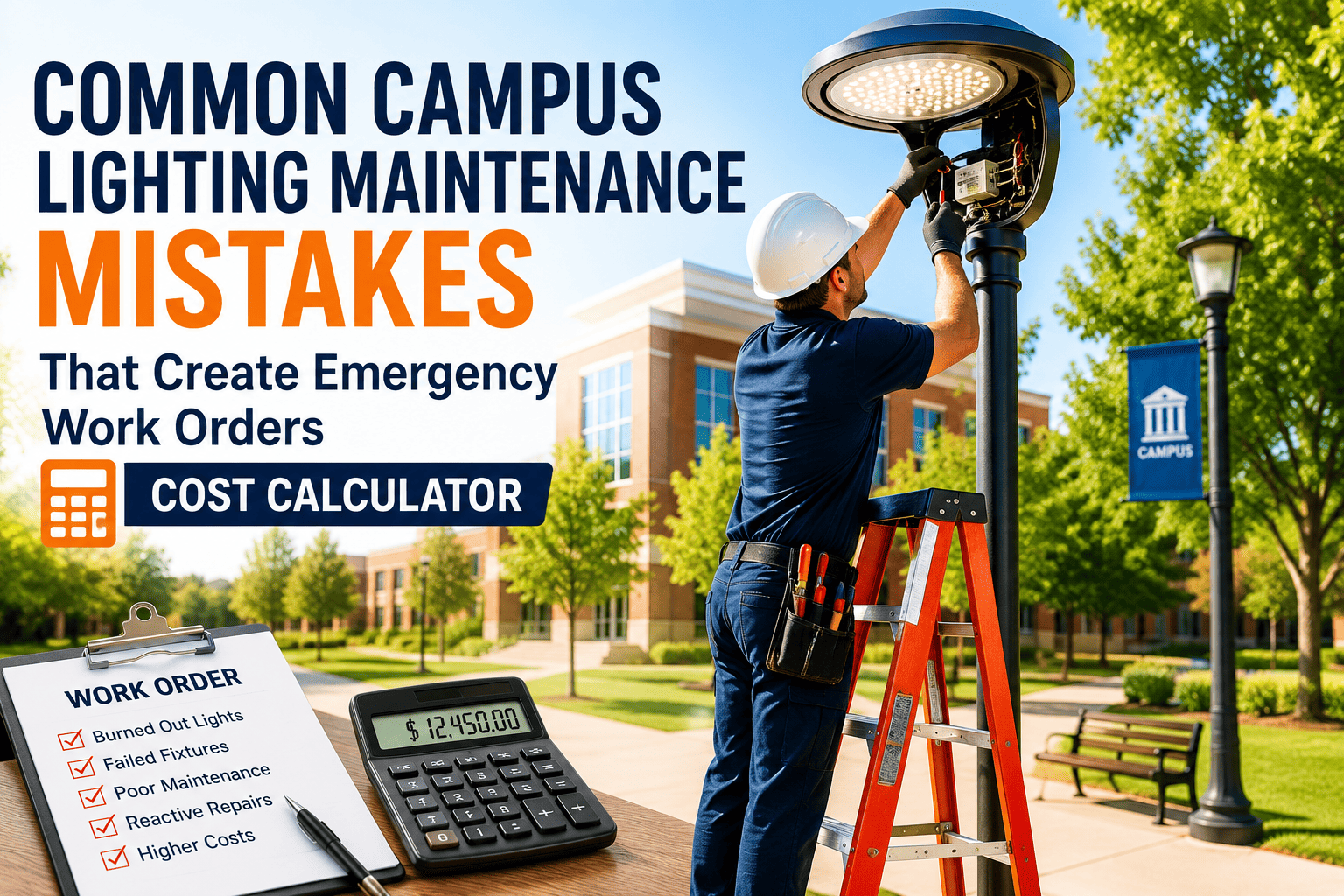
Campus lighting systems are among the most neglected assets in K-12 and higher education facilities — yet they generate a disproportionate share of reactive work orders. Burned-out fixtures, failed ballasts, and untracked lamp-end-of-life cycles create emergency calls that cost 3 to 5 times more than planned replacements. Facilities directors who lack a structured PM program spend an average of $18,000 to $42,000 per year in avoidable emergency lighting costs per campus building. The five mistakes below account for over 70% of emergency lighting work orders at educational institutions. If your team is still reacting instead of scheduling, start a free trial with OxMaint or book a demo to see how AI-driven preventive maintenance eliminates these costs.
Common Campus Lighting Maintenance Mistakes That Create Emergency Work Orders
Five systemic errors that drain your facilities budget — and a cost calculator to show exactly how much they're costing your campus right now.
5 Mistakes That Generate Emergency Work Orders
Each of these mistakes is preventable with a structured CMMS program. Each one costs far more than the PM that would have stopped it.
No Lamp End-of-Life Tracking
LED fixtures have a rated lumen output life of 50,000 to 100,000 hours. Without tracking installation dates, facilities teams have no warning before lamps fail in classrooms, hallways, or parking areas. A single untracked parking lot fixture failure triggers a safety work order at emergency labor rates — often 2.4x standard labor cost.
Skipping Ballast and Driver PM
Electronic ballasts and LED drivers fail silently — a driver operating at elevated temperature fails in 3 to 5 years instead of 10. Campuses that do not test drivers during scheduled PM discover failures only when entire fixture banks go dark, turning a $40 PM task into a $900 emergency replacement project with contractor markup.
Ignoring Lighting Control System Firmware
Networked lighting control systems — occupancy sensors, daylight harvesting panels, and DALI controllers — require firmware updates for building management system compatibility. Outdated firmware causes false-off events in occupied classrooms, generating complaint-driven emergency calls that average 3.2 hours of technician time each.
Reactive Exit and Emergency Light Testing
NFPA 101 requires monthly 30-second and annual 90-minute emergency lighting tests. Campuses that skip scheduled testing discover battery failures only during real emergencies or fire marshal inspections — resulting in code violation fines ranging from $500 to $5,000 per building plus expedited replacement costs.
No Seasonal Exterior Lighting Inspection
Exterior pole-mounted and pathway fixtures take the greatest environmental stress. Gasket degradation, moisture ingress, and photocell sensor drift accumulate over 12 months — but are only caught with a structured semi-annual walkthrough. Without it, entire parking lot circuits fail in winter, creating safety liability events and weekend emergency contractor callouts at 1.8x labor rates.
How Much Are These Mistakes Costing Your Campus?
Enter your facility details below. The calculator estimates your current annual emergency lighting cost and what structured PM could save.
Estimates based on industry averages. Actual savings vary by campus size, fixture mix, and current PM maturity. PM program cost assumes 30% of current emergency spend to implement structured maintenance.
Stop Paying Emergency Rates for Predictable Failures
OxMaint tracks every fixture, ballast, emergency light battery, and lighting control panel with its own PM schedule — automatically triggering work orders before failures occur, not after. Facilities teams using OxMaint reduce reactive lighting work orders by an average of 68% in the first year.
Reactive Lighting Management vs. OxMaint PM
Campus Lighting PM Interval Reference
| Asset / System | Maintenance Action | Recommended Interval | Common Mistake | Emergency Cost If Skipped |
|---|---|---|---|---|
| Interior LED Fixtures | Lumen output check and lamp-life tracking | Annual | No install date recorded | $280–$620 per call |
| Electronic Ballasts / LED Drivers | Temperature test and driver health check | Every 24 months | Only replaced on full failure | $400–$900 per bank |
| Emergency / Exit Lighting | 30-second monthly test + 90-minute annual test | Monthly / Annual | Tested only during fire inspections | $500–$5,000 fine + replacement |
| Occupancy Sensors | Sensitivity calibration and firmware check | Semi-annually | Calibration never performed after install | $190–$380 per complaint call |
| Lighting Control Panels | Firmware update and zone configuration audit | Quarterly | Firmware last updated at commissioning | $300–$600 per control event |
| Exterior Pole / Pathway Fixtures | Gasket inspection, photocell test, moisture check | Semi-annually | Inspected only after reported outage | Weekend callout at 1.8x labor rate |
| Gymnasium / Large Space Fixtures | High-bay lamp replacement and fixture re-aim | Every 36 months | Replaced one fixture at a time reactively | 3x labor vs. bulk group replacement |
Frequently Asked Questions
How often should campus lighting be inspected to avoid emergency work orders?+
What does an emergency lighting work order actually cost vs. a planned replacement?+
Can OxMaint track emergency lighting compliance for NFPA 101 inspections?+
Does the cost calculator account for code violation fines?+
How long does it take to set up a lighting PM program in OxMaint?+
Your Lighting Budget Is Paying for Mistakes That Should Never Happen
Every emergency lighting work order is a PM that did not happen. OxMaint gives your facilities team the structured AI-driven PM program that tracks every fixture, schedules every inspection, and eliminates the five mistakes that drain your campus lighting budget — before they generate another emergency call.