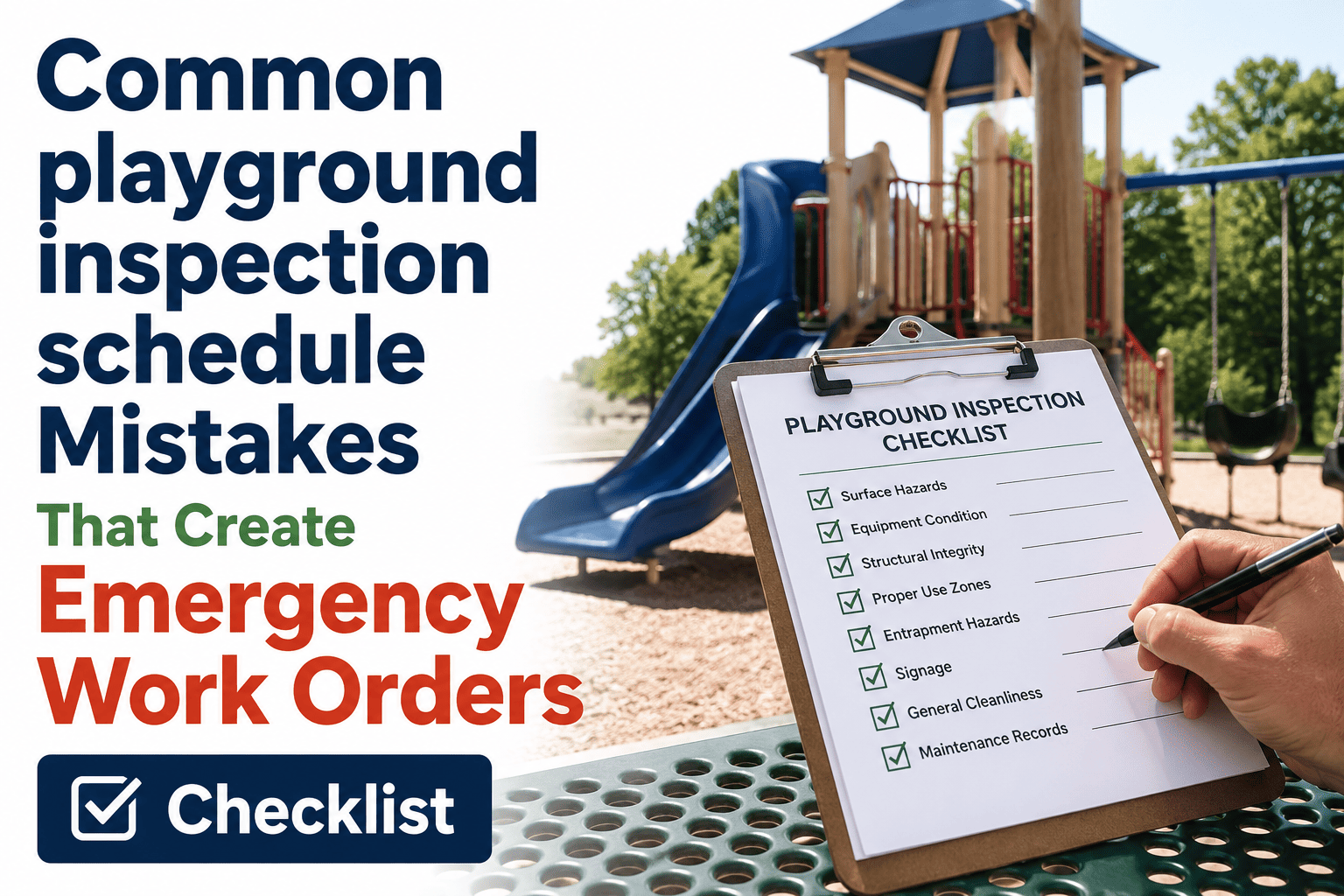
Common playground inspection schedule Mistakes That Create Emergency Work Orders Checklist

By Corin Hale on June 24, 2026

common-playground-inspection-schedule-mistakes-that-create-emergency-work-orders-checklist

A missed playground inspection rarely shows up as a missed inspection — it shows up three weeks later as an emergency work order after a child gets hurt on a loose bolt or a low spot in the surfacing. Most schools don't lack an inspection schedule; they lack a schedule that survives staff turnover and busy weeks. This checklist flags the five mistakes that most often turn a routine check into a costly, reactive repair, with a verification item for each one. If your current process depends on someone remembering to check a clipboard to automate your playground inspection schedule, or book a demo to see how a missed-check alert works before the next recess bell.

Grounds & Safety

Playground Inspection Mistakes Checklist

Verify your program against the five recurring gaps that turn a five-minute scheduled check into an emergency work order.

Why Small Scheduling Gaps Become Big Liability Problems

CPSC and ASTM F1487 set out a layered inspection rhythm for a reason — skip one layer and the next is supposed to catch what slipped through. In practice, the layers fail together. Use the checklist below to confirm your program avoids each of the five most common failure points.

01
Visual Scans Are Not Treated as a Passed Inspection
Inspection uses a structured checklist with measurable items, not a general visual scan
Gap widths, surfacing depth, and bolt thread protrusion are recorded as numbers, not pass/fail impressions
Chain stretch and hairline weld cracks are checked specifically, not assumed fine if nothing looks obviously wrong
02
Surfacing Depth Checks Don't Slide Between Top-Offs
Depth measured at every high-use zone on a fixed schedule, not only when it visibly looks low
Readings logged against the required minimum for that equipment's fall height
Swings and slide exits checked more frequently, since displacement happens fastest there
03
Findings Reach Maintenance Without Delay
Every logged finding converts into a work order immediately, not after someone revisits a binder
Each work order has an assigned owner and a due date
Hazardous equipment is taken out of service the moment a serious finding is logged
04
Inspection Frequency Matches Actual Usage
High-traffic playgrounds checked more often than low-traffic satellite play areas
Frequency is set per site based on usage and equipment age, not one blanket district-wide schedule
Older equipment is checked against its manufacturer-rated service life
05
Entrapment Gauge Testing Is Never Skipped
A physical entrapment probe is used at every comprehensive inspection, not visual estimation
Every gap measurement is documented, not just a pass or fail note
Ladder rungs, barrier gaps, and cargo nets are tested specifically, since these are the most common entrapment points
Stop Findings From Getting Lost Between Inspections

OxMaint converts every playground checklist item into a tracked, owned, time-stamped work order automatically — no finding sits in a binder waiting to be noticed.

Emergency Work Order Triggers — Ranked by How Often They Occur

Scheduling Mistake Typical Discovery Point Resulting Emergency
Missed weekly hardware check Reported by a parent or teacher Equipment taken out of service same-day
Surfacing depth not measured between top-offs Injury incident review Emergency re-surfacing and incident report
Finding logged but not converted to a work order Follow-up inspection weeks later Equipment closure pending urgent repair
Generic frequency on high-use equipment Visible accelerated wear Unplanned structural assessment

Frequently Asked Questions

How do most playground inspection failures actually happen?
They rarely happen because no one checked. They happen because a check was casual, the finding wasn't logged into a tracked system, or the next person never saw the note. Sign up free to see a tracked workflow in action.
What is the single biggest gap in school playground inspection programs?
Findings that don't convert into a tracked, owned task. A hazard noted on paper with no follow-up system is functionally the same as a hazard that was never found.
Should every playground be inspected on the same schedule?
No. Usage level, equipment age, and surfacing type should set the frequency per site rather than one blanket schedule across an entire district.
Can a digital checklist actually prevent emergency work orders?
It prevents the ones caused by missed or lost findings, since every check is timestamped and every hazard becomes a tracked task automatically.
How does OxMaint help fix these scheduling mistakes?
OxMaint sets per-site inspection frequency, auto-generates work orders from every finding, and alerts staff before a check becomes overdue. Book a demo to see it against your own site list.
Replace the Clipboard Before the Next Incident Report

Every item on this checklist is a process gap, not a staffing problem. OxMaint closes the gap with automated scheduling, mobile checklists, and work orders that no one has to remember to create.
Share This Story, Choose Your Platform!