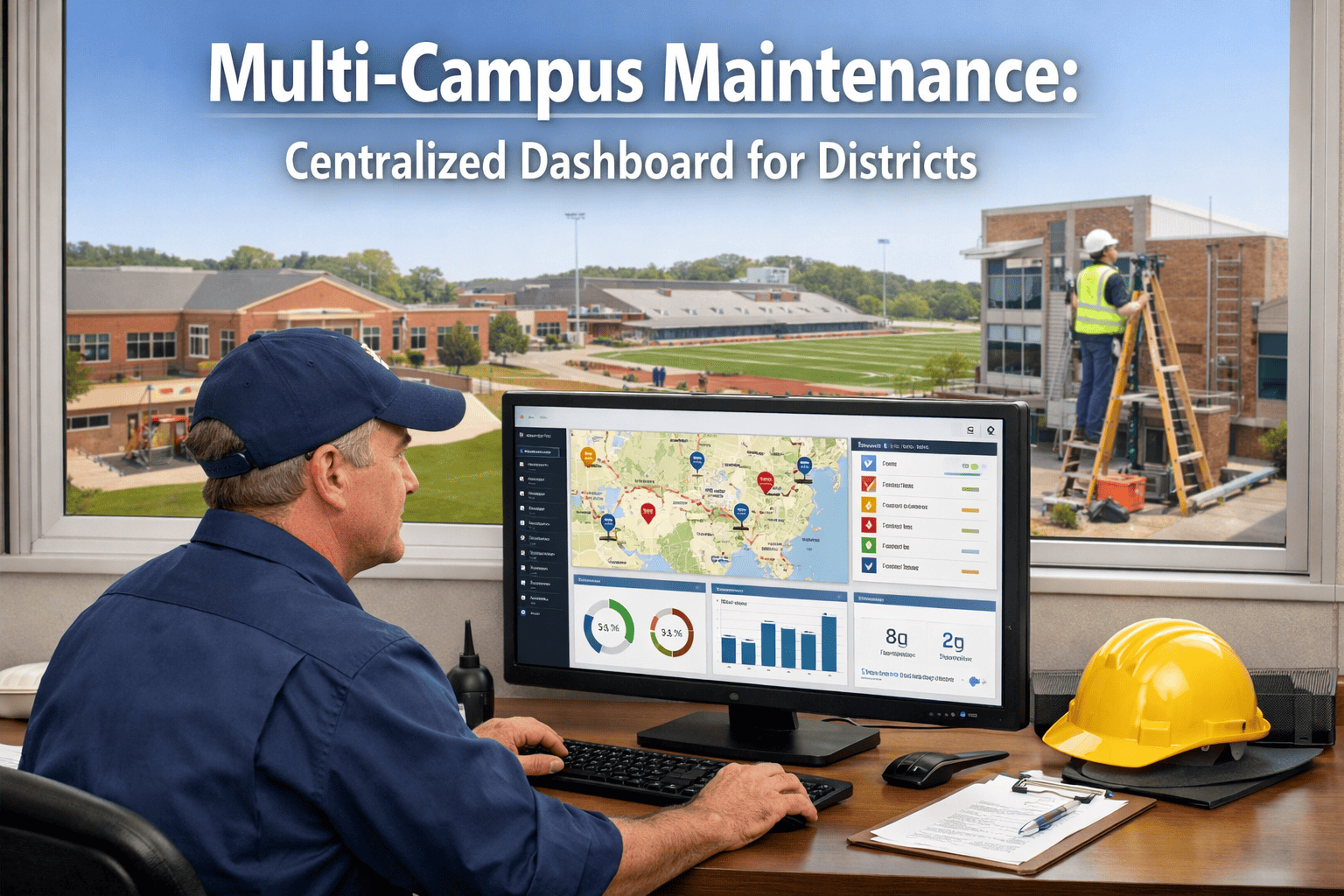
Multi-campus education systems — K–12 districts, university systems, state college networks — manage 5,000 to 50,000+ maintainable assets across dozens or hundreds of buildings, yet the average system has documented condition data on only 35% of those assets. The other 65% are invisible: no condition record, no replacement cost projection, no lifecycle tracking. Capital decisions covering $10M–$80M annually are made with less than half the picture. Deferred maintenance backlogs grow silently because nobody can quantify them across campuses using different systems, different naming conventions, and different condition scales. Accreditation reviewers find documentation gaps. Moody’s credit analysts see unquantified infrastructure risk. Boards approve capital requests at 62% because the data is anecdotal rather than defensible. A centralized asset management platform solves this by creating one asset registry, one condition scoring methodology, one replacement cost model, and one capital planning framework across every campus — building the database progressively from every work order, every inspection, and every sensor reading rather than requiring a $2M–$4M one-time consultant survey that begins aging the day it is delivered. The result is 100% asset visibility, 91% board approval rates on data-backed capital requests, 15–30% savings on consolidated vendor contracts, and a living database that gets more accurate every day instead of less. Schedule a demo to see centralized multi-campus asset management running across a university system.
Assets Tracked
Average multi-campus visibility
Deferred Maintenance
US education backlog (2026)
Target Visibility
Every asset, every campus, live
The Multi-Campus Asset Management Problem
Single-campus asset management is difficult enough. Multi-campus asset management — across districts, university systems, or state college networks — introduces a layer of complexity that no collection of spreadsheets, standalone CMMS instances, or consultant reports can solve. The core problem is not technology. It is fragmentation: different campuses using different systems, different naming conventions, different condition assessment methods, and different definitions of what constitutes an “asset.”
Fragmented Registries
Every campus maintains its own system — or no system at all
Typical:
3–5 different tracking methods across a 10-campus system
Impact:
No unified view of total asset condition or replacement need
What breaks:
Capital planning becomes guesswork. The central office cannot compare building condition across campuses. Board presentations rely on incomplete data. Accreditation reviewers find documentation gaps.
What centralization fixes:
One asset hierarchy, one naming convention, one condition scale, one replacement cost methodology — applied consistently across every campus, every building, every asset.
Inconsistent Condition Data
Campus A rates condition 1–5. Campus B uses Good/Fair/Poor. Campus C has no ratings.
Typical:
Condition data exists for 30–50% of assets, using 2–4 different scales
Impact:
FCI calculations are unreliable. Capital requests lack defensible data.
What breaks:
A chiller rated “Fair” at Campus A might be in worse condition than one rated “3/5” at Campus B — but nobody can compare them. Capital funds flow to the campus with the best storyteller, not the greatest need.
What centralization fixes:
Standardized condition scoring driven by maintenance data (failure frequency, repair cost trajectory, sensor readings) rather than subjective assessment — updated continuously, not once per consultant cycle.
Siloed Maintenance Operations
Each campus runs its own maintenance program with no shared learning
Typical:
Campus teams solve the same problems independently, repeatedly
Impact:
Best practices stay local. Failures repeat across campuses.
What breaks:
When Campus A discovers that a specific chiller model fails at the compressor bearing after 8 years, Campuses B through K have no mechanism to learn from that discovery. The same failure surprises them independently — at emergency cost each time.
What centralization fixes:
Shared failure data, shared PM best practices, shared vendor performance metrics, and shared predictive models that learn from every asset across every campus simultaneously.
48,000 Assets. 11 Campuses. One Platform. One Source of Truth.
Oxmaint centralizes asset management across unlimited campuses — with standardized registries, unified condition scoring, cross-campus analytics, and role-based access that gives each campus autonomy while giving the central office complete visibility.
Asset Condition Benchmarks: Where Multi-Campus Systems Stand in 2026
Asset condition varies dramatically across campuses within the same system — and across asset categories within the same campus. A centralized platform reveals these disparities for the first time, enabling capital allocation based on quantified need rather than political influence.
Annual emergency cost: $800K–$2M/system
Preventable: 65%
Key finding:
HVAC represents 35–45% of total maintenance spend across education systems. Centralized tracking reveals which campuses have aging chillers and boilers approaching simultaneous end-of-life — enabling staggered replacement planning instead of capital crises.
Arc flash risk: unquantified at most campuses
Safety critical
Key finding:
Electrical systems are the most under-documented asset category in education. 42% past useful life with only 30% data coverage means the majority of highest-risk electrical assets have no condition record at all. Centralized tracking surfaces this invisible risk.
Out-of-service cost: $5K–$15K/day per elevator
ADA liability: $150K–$500K/incident
Key finding:
Elevator failures are the most frequent ADA compliance trigger in higher education. Centralized tracking enables system-wide elevator modernization planning and contract consolidation across campuses — typically saving 15–25% on service contracts through volume negotiation.
Leak-to-mold escalation: $1,200 → $34,000
28× cost multiplier
Key finding:
Roof failures generate the highest collateral damage ratio of any asset category — a $1,200 flashing repair becomes a $34,000 mold remediation when deferred. Centralized tracking enables system-wide roof condition mapping and replacement sequencing across campuses.
Current multi-campus average
Centralized management target
What Centralized Asset Management Enables
A centralized platform is not just a shared database. It is the intelligence layer that transforms fragmented campus maintenance into a unified operation with system-wide visibility, cross-campus learning, and capital planning precision that no collection of standalone systems can achieve.
Unified Asset Registry Across All Campuses
One naming convention, one hierarchy, one condition scoring methodology applied to every asset on every campus. The central office sees the complete portfolio. Each campus sees its own assets with system-wide context. Asset records build progressively from every work order, every inspection, and every sensor reading.
Cross-Campus Failure Pattern Learning
When a specific chiller model fails at Campus A, the AI flags every identical unit across the system for proactive inspection. Failure patterns discovered at one campus protect all 10. PM schedules adjust system-wide based on the accumulated failure data from the entire fleet — not just the local campus experience.
Data-Driven Capital Allocation
Capital requests backed by quantified asset condition, failure probability, and replacement cost projections — standardized across all campuses. The board sees a prioritized list of capital needs ranked by risk, not by which campus director presents most persuasively. Scenario modeling shows the consequence of funding or deferring each project.
Consolidated Vendor and Contract Management
When 11 campuses each negotiate their own elevator service contract, HVAC maintenance agreement, and fire alarm inspection vendor, the system pays 15–30% more than necessary. Centralized asset data enables system-wide vendor negotiation: one RFP covering all campuses, standardized SLAs, and performance metrics compared across sites.
Compliance Standardization Across All Sites
Every campus faces the same 7 compliance domains: OSHA, NFPA, ADA, EPA, ASHRAE, elevator, and playground/athletic. Centralized compliance management ensures identical inspection frequencies, identical checklists, identical documentation standards, and system-wide audit readiness — eliminating the campus-by-campus variation that creates citation exposure.
Total Annual Value of Centralized Multi-Campus Asset Management
$2.5M–$8M
10-campus system · Emergency prevention + contract savings + capital optimization + compliance avoidance + labor productivity
What +1% Asset Visibility Is Worth
In multi-campus education systems, every percentage point of asset visibility improvement translates to better capital decisions, fewer surprises, and lower total cost of ownership. Here is what increasing asset data coverage means at different system sizes.
System Size
Current Visibility
Target: 100%
Annual Value of Full Visibility
Small district (5–15 buildings)
60–70%
+30–40% coverage
$200K–$600K
Mid-size university (50–100 buildings)
35–50%
+50–65% coverage
$1.5M–$3.5M
Multi-campus system (200–400 buildings)
25–40%
+60–75% coverage
$2.5M–$8M
“
You cannot manage what you cannot see. A multi-campus system with 35% asset visibility is making 65% of its capital decisions blind — funding the wrong projects, deferring the wrong assets, and discovering failures only when they become emergencies. Full visibility does not cost more. It costs dramatically less.
The Role-Based Access Architecture
Centralization does not mean one-size-fits-all. Each role — from the campus technician to the system-wide CBO — needs a different view of the same data. The platform provides hierarchical access that gives each campus full operational autonomy while giving the central office complete analytical visibility.
Start your free trial and configure role-based access for your first campus within the first week.
Sees:
Work orders assigned to them, asset history for their campus, mobile checklists, parts inventory at their location.
Does not see:
Other campus operations, financial data, system-wide analytics.
Value:
Full context at point of repair without information overload from other campuses.
Sees:
All work orders, assets, KPIs, and compliance status for their campus. Cross-campus benchmarks showing how their metrics compare to peer campuses.
Does not see:
Other campus operational details.
Value:
Full campus management plus competitive context that drives improvement.
Sees:
System-wide asset condition, FCI by campus, total replacement value projections, capital scenario modeling, deferred maintenance trajectory, compliance status across all sites, vendor performance comparison, and Moody’s credit factor documentation.
Value:
The complete financial picture of the physical plant portfolio for board presentations and bond issuance.
Sees:
Executive dashboard with portfolio-level metrics: FCI trending, deferred maintenance ratio vs. peers, capital investment ROI, compliance summary, and enrollment-risk correlation. Scenario comparison for capital funding options.
Value:
Governance-level oversight of the institution’s largest physical investment in a format that supports fiduciary decision-making.
Implementation: From Fragmented to Centralized in 6 Months
Phase 1 · Months 1–2
Pilot Campus Deployment
Deploy on 1–2 pilot campuses: import asset registry, configure work orders, activate mobile app
Establish the standardized naming convention and condition scoring methodology
Begin building the asset registry progressively from work order data and technician documentation
Activate compliance calendars for pilot campuses
Milestone:
Pilot campuses operational with digital work orders, mobile technician workflows, and compliance tracking within 30–60 days
Phase 2 · Months 3–4
System-Wide Rollout
Expand to all remaining campuses using the pilot-proven configuration as a template
Migrate existing campus data from spreadsheets, legacy CMMS, and consultant reports
Configure role-based access for every user level from technician to board
Enable cross-campus analytics and peer benchmarking dashboards
Milestone:
All campuses operational on a single platform with unified asset hierarchy and standardized reporting
Phase 3 · Months 5–6
Intelligence Layer Activation
Activate AI risk scoring across the entire asset portfolio
Deploy predictive maintenance on critical systems at high-priority campuses
Generate the first system-wide capital plan with data-backed prioritization
Present the first board-ready portfolio dashboard with scenario modeling
Milestone:
System-wide asset intelligence operational. Board receives data-driven capital request with risk scores, NPV projections, and peer benchmarks for every recommended investment.
35% → 100%
Asset visibility improvement across all campuses within 6 months of deployment
$2.5M–$8M
Annual value from emergency prevention, contract consolidation, capital optimization, and compliance
91%
Board capital approval rate with data-backed presentations vs. 62% with traditional requests
6 months
From fragmented campus operations to fully centralized system-wide asset intelligence
The asset data gets better every day. Every work order closed, every inspection completed, every sensor reading collected adds to the system-wide intelligence. After 12 months, the platform contains more accurate, more current, and more actionable data than any one-time consultant survey could deliver — and it never goes stale.
Sign up free and begin building the centralized asset registry for your first campus from the first work order.
You Cannot Manage 48,000 Assets Across 11 Campuses with Spreadsheets. Stop Trying.
Oxmaint centralizes multi-campus asset management into one platform with standardized registries, unified condition scoring, cross-campus failure learning, data-driven capital planning, consolidated vendor management, and board-ready analytics. 6 months from fragmented to centralized. ROI from the first board meeting.
Frequently Asked Questions
How do we build an asset registry without a formal facility condition assessment?
The platform builds the registry progressively from three sources. First, existing data: import whatever asset lists, spreadsheets, consultant reports, or legacy CMMS data each campus has — regardless of format. The platform normalizes naming conventions and maps assets to the standardized hierarchy. Second, work order enrichment: every work order completed by a technician adds data to the asset record — condition observations, photos, parts used, failure modes. After 6–12 months of work orders, the asset database contains more current information than any one-time survey. Third, targeted audits: the AI identifies which assets have the least data and generates audit work orders that prioritize filling gaps on the highest-risk assets first.
Start free to see how the progressive registry builds from your first work order.
Can campuses maintain operational autonomy while being part of a centralized system?
Yes — this is a core design principle. Each campus operates its own maintenance program: scheduling work, dispatching technicians, managing vendors, and running their daily operations independently. The central office does not approve individual work orders or manage daily campus maintenance. Centralization provides standardized asset data, system-wide analytics, consolidated vendor contracts, and unified capital planning — the strategic layer. Each campus retains full operational autonomy within that framework. Role-based access ensures campus teams see only their own operations while the central office sees the portfolio view.
How does cross-campus failure learning work in practice?
When a chiller compressor fails at Campus A and the technician documents the failure mode (bearing spalling at 8 years on a Carrier 23XRV model), the AI identifies every identical unit across all 11 campuses. Campuses B through K receive proactive inspection recommendations for their Carrier 23XRV chillers that are approaching 7–8 years of operation. The inspection is generated as a work order with the specific failure mode to check for. This cross-pollination means the entire system learns from every failure at every campus — an intelligence advantage that no individual campus could achieve alone.
Book a demo to see cross-campus failure pattern detection running on multi-site asset data.
What does implementation cost for a multi-campus system?
A 10-campus university system typically deploys for $200K–$500K annually against $2.5M–$8M in documented annual value — a 5–16× ROI. This compares to $2M–$4M for a one-time consultant facility condition assessment that produces a static report, begins aging immediately, and needs to be repeated in 3–5 years. The platform approach costs 10–15% of the consultant approach and produces data that improves continuously. Most systems fund the platform from the first year’s savings: emergency failure prevention, contract consolidation, and capital allocation improvement cover the annual cost multiple times over.
How does centralized asset data support Moody’s credit assessments?
Moody’s evaluates deferred maintenance ratios and facility condition as credit factors for higher education. A system that can demonstrate quantified asset condition, a declining deferred maintenance trajectory, and a data-driven capital investment strategy presents materially stronger credit credentials than one presenting anecdotal capital requests. The centralized platform generates the documentation that rating agencies evaluate: FCI trending, replacement cost projections, investment scenarios, and peer benchmarking. Institutions presenting this data report improved bond ratings that reduce borrowing costs by 25–75 basis points on future issuances.