A sewage ejector pump fails at 2 AM in a freshman residence hall housing 240 students. Raw sewage backs up into ground-floor bathrooms and common areas. Students are displaced to temporary housing while hazmat crews clean the mess. The emergency plumber replaces the pump for $4,800, and everyone moves on. Three weeks later, it happens again. And then again in a different dorm building. Your maintenance budget is hemorrhaging emergency repair costs, student satisfaction scores are plummeting, and you still don't know why pumps that should last 7-10 years are failing after 18 months.
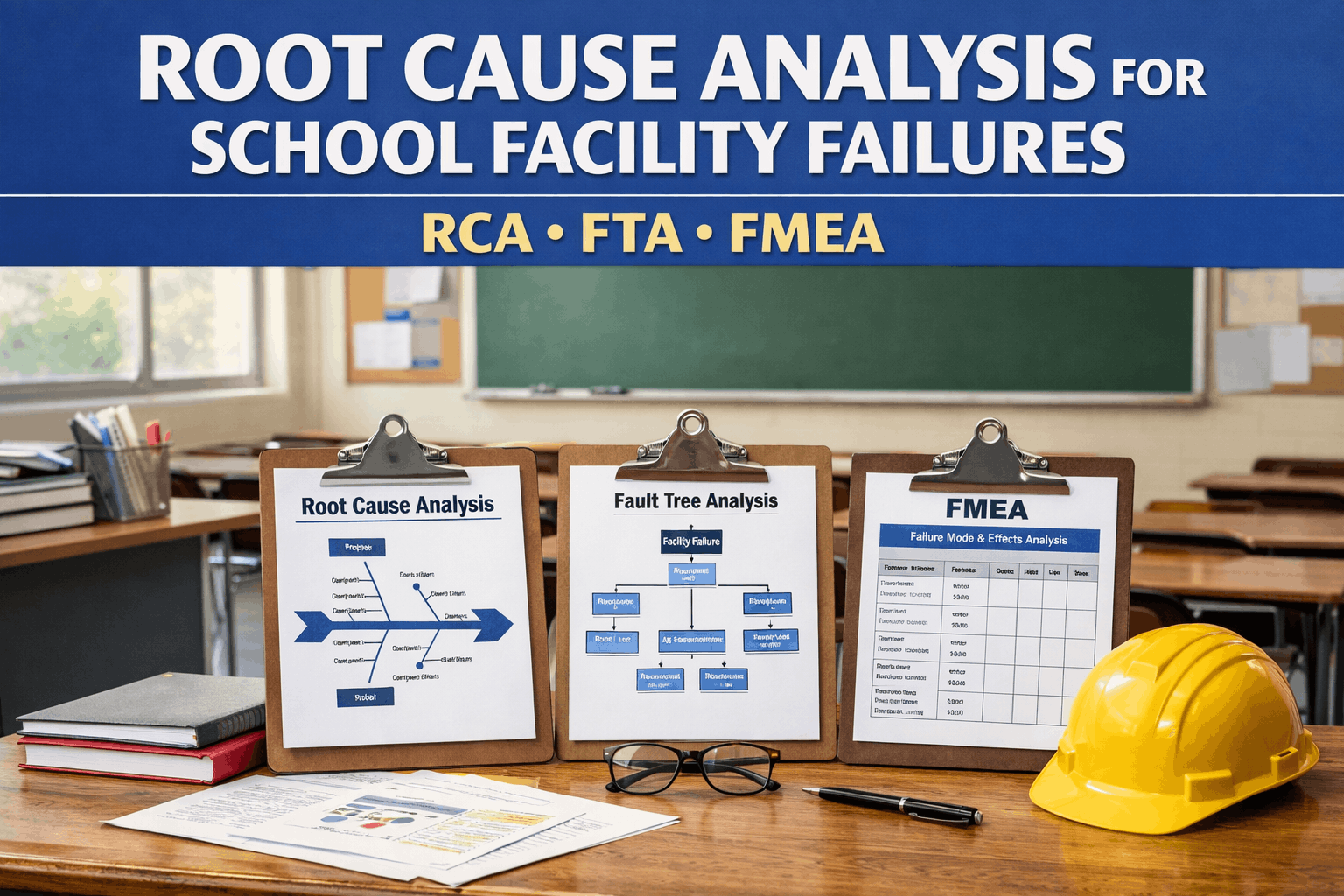
This scenario plays out on college campuses every semester, and the pattern reveals a fundamental problem with how most facilities teams approach equipment failures. They fix what's broken and move on, never asking the deeper question: why did this happen in the first place? Root cause analysis transforms this reactive cycle into strategic reliability improvement. RCA isn't about fixing the immediate problem—it's about understanding why the problem exists and eliminating the underlying causes so it never happens again. Schedule a demo to see how CMMS supports RCA workflows.
Stop replacing the same pumps over and over. Start building a maintenance program that learns from every failure.
Why Campus Plumbing Pumps Fail Prematurely
Campus housing creates uniquely demanding conditions for plumbing infrastructure. Unlike commercial buildings with controlled occupancy and professional cleaning staff, residence halls house hundreds of young adults who may have never lived away from home. They flush items that should never enter a drain, ignore warning signs of problems, and create usage patterns that differ dramatically from design assumptions. A dormitory bathroom serving 40 students sees more daily use than a typical family bathroom sees in a month.
Sewage ejector pumps bear the brunt of this abuse. These pumps sit in underground pits, grinding and pumping waste from below-grade bathrooms up to the main sewer line. When students flush feminine hygiene products, so-called "flushable" wipes, paper towels, or even clothing items, these materials wrap around the impeller and gradually choke the pump. The motor works harder, draws more current, overheats, and eventually fails. But the foreign objects are just the immediate cause—the root cause often lies in inadequate student education, signage that only works for English speakers, or building designs that make proper waste disposal inconvenient.
Sump pumps face different challenges. These pumps remove groundwater that seeps into basement mechanical rooms and elevator pits. When they fail, water accumulates and damages electrical equipment, creates slip hazards, and promotes mold growth. Root causes often trace back to inadequate maintenance—float switches that stick because no one tests them, check valves that fail because no one inspects them, or discharge lines that freeze because no one insulates them. The pump itself rarely fails spontaneously; something in the system or maintenance program creates the conditions for failure.
Hot water circulation pumps present yet another failure pattern. These pumps keep hot water moving through building piping so students don't wait minutes for warm water at distant fixtures. When circulation pumps fail, the immediate complaint is cold showers—but the hidden risk is Legionella bacteria growth in stagnant warm water. Root causes often involve seal failures from water chemistry issues, bearing failures from misalignment during installation, or motor failures from electrical problems that no one documented.
Common Root Causes of Pump Failures
After analyzing hundreds of campus pump failures, clear patterns emerge. Understanding these common root causes helps investigators know where to look and what questions to ask during RCA investigations.
Foreign object obstruction accounts for approximately 38% of sewage ejector failures. The immediate cause is always the same—something that shouldn't be in the system jams the impeller. But the root cause varies. Sometimes it's inadequate signage that students ignore or can't read. Sometimes it's building design that forces students to walk past trash cans to reach toilets, making flushing more convenient than proper disposal. Sometimes it's a complete absence of sanitary product disposal options in bathroom stalls. Effective RCA looks past the clogged impeller to understand why prohibited items keep entering the system.
Design and sizing inadequacy causes about 22% of recurring failures. When buildings are renovated to add bathrooms or increase occupancy, the original pump systems often remain unchanged. A sewage ejector sized for a 50-student wing now serves 80 students after a renovation. The pump runs more frequently, the motor runs hotter, seals wear faster, and the pit fills faster between cycles. Short-cycling—when pumps turn on and off rapidly—accelerates wear on every component. The pump isn't defective; it's simply overwhelmed by demands it was never designed to handle.
Preventive maintenance gaps contribute to roughly 18% of premature failures. Many campus maintenance programs include pump inspections on paper, but the actual tasks performed may be superficial. A technician checks that the pump runs but doesn't test the high-water alarm. Someone verifies the motor is working but doesn't measure current draw to detect developing problems. The PM checklist says "inspect seals" but doesn't define what to look for or when to replace them. These gaps accumulate until a predictable, preventable failure occurs.
Electrical issues represent about 12% of failures. Voltage fluctuations from overloaded building electrical systems, phase imbalance in three-phase motors, and inadequate overload protection all damage pump motors over time. These problems often go undetected because no one monitors electrical parameters. The motor runs fine until it doesn't, and post-failure investigation reveals burned windings from chronic electrical stress.
Installation defects account for approximately 10% of failures, with higher rates in newly constructed or renovated buildings. Pumps installed without proper alignment create bearing stress. Missing check valves allow backflow that damages seals. Inadequate support allows vibration that loosens connections. Wrong pump orientation—installing a vertical pump horizontally, for example—causes premature failure. These defects often trace back to contractor oversight, inadequate commissioning, or missing installation specifications.
A modern CMMS captures every work order, tracks failure codes, and reveals patterns across buildings that manual systems miss entirely.
The 6-Step RCA Process
Effective root cause analysis follows a structured methodology that prevents investigators from jumping to conclusions or stopping at surface-level causes. Each step builds on the previous one, creating a logical chain from symptom to solution.
Step 1: Document the failure event. Capture everything about what happened, when, where, and the immediate circumstances. Who discovered the problem? What were the symptoms? What time did it occur, and what was happening in the building? This documentation must happen immediately—memories fade quickly, and evidence disappears as repairs proceed. Take photographs before anyone touches the equipment. Record the exact error codes or alarm conditions. Note environmental conditions like weather, building occupancy, and recent events.
Step 2: Collect evidence and maintenance history. Before the failed pump goes to the dumpster, preserve it for analysis. The impeller may show wear patterns that reveal misalignment. Seal faces may show scoring from abrasive particles. Bearings may show damage from electrical arcing. Pull the complete work order history for this asset—every PM performed, every repair made, every part replaced. Look for patterns like increasing repair frequency or repeated replacement of the same components. Interview the technicians who service this pump and ask what they've noticed over time.
Step 3: Analyze causal factors. Use structured methods like 5 Whys or Fishbone diagrams to identify all the factors that contributed to this failure. Don't stop at the first answer. If the impeller was jammed, ask why those objects were in the system. If the seal failed, ask why it wore out prematurely. If the motor burned out, ask why overload protection didn't prevent damage. Most failures involve multiple contributing factors, and effective RCA identifies all of them.
Step 4: Identify root causes. Root causes are the underlying organizational or design issues that, when corrected, prevent the failure from recurring. They're different from immediate causes (what directly triggered the failure) and contributing factors (conditions that enabled the failure). A root cause is something you can actually fix—a missing procedure, an inadequate specification, a training gap, or a design flaw. If your identified "root cause" is "the pump failed," you haven't dug deep enough.
Step 5: Develop corrective actions. Effective corrective actions address root causes, not just symptoms. They're specific, assignable, and verifiable. "Improve maintenance" is not a corrective action. "Develop a detailed seal inspection procedure with acceptance criteria and train all pump technicians by March 15" is a corrective action. Good corrective actions also consider how to apply the fix across all similar assets, not just the one that failed.
Step 6: Implement and verify. Assign responsibility for each corrective action with clear deadlines. Track completion through your CMMS. After implementation, monitor the results. Did the same failure occur again? Did similar assets show improvement? Verification closes the loop and confirms that your RCA actually worked. Start tracking RCA corrective actions—sign up free.
When to Conduct Formal RCA
Not every pump failure warrants a formal investigation. First-time failures with obvious causes—a clearly visible foreign object, a component that reached end of life, a one-time electrical surge—can be addressed with basic troubleshooting and repair. Focus your RCA resources on failures where systematic investigation will deliver high value.
Conduct formal RCA for recurring failures. When the same pump fails twice, or when similar pumps fail across multiple buildings, something systemic is happening. The pattern indicates a root cause that simple repairs won't address. Recurring failures are expensive not just in repair costs but in cumulative damage to building reputation and student satisfaction.
Conduct formal RCA for high-impact events. Any failure that displaces students, creates health hazards, triggers regulatory concerns, or costs more than $5,000 deserves thorough investigation. The cost of RCA is trivial compared to the cost of repeating a major incident.
Conduct formal RCA for mysterious early failures. When a pump fails well before its expected life—18 months instead of 7 years—something is wrong beyond normal wear. Early failures often reveal design problems, installation defects, or environmental conditions that will affect other assets too.
5 Whys Example: Sewage Pump Failure Investigation
The 5 Whys technique works by asking "why" repeatedly until you reach a root cause that's within your organization's control to fix. Here's how it played out for a real campus sewage pump failure:
| Problem | Sewage pump in Harrison Hall failed at 2 AM, causing backup into first-floor bathrooms and displacing 40 students |
| Why 1 | The impeller was jammed by an accumulation of feminine hygiene products and "flushable" wipes |
| Why 2 | Students flushed these items despite signage in bathrooms stating not to flush them |
| Why 3 | Signage is only posted in English, but 34% of residents are international students. Signs use small text that's easily ignored. No education occurs during move-in orientation. |
| Why 4 | Facilities and Residence Life departments don't coordinate on student education about building systems. No standard protocol exists for communicating proper waste disposal. |
| Why 5 | No cross-functional process exists for identifying building-specific student behaviors that impact critical systems. Organizational silos prevent information sharing between departments. |
| Root Cause | Lack of integrated student education process between Residence Life and Facilities Management regarding behaviors that impact critical building systems |
Notice how the investigation moved from a mechanical problem (jammed impeller) through a behavioral issue (students flushing prohibited items) to an organizational gap (departments not coordinating on education). The root cause isn't "students flush wipes"—that's a symptom. The root cause is the organizational failure to educate students effectively, which is something the university can actually fix.
From Root Causes to Effective Corrective Actions
The difference between weak and strong corrective actions determines whether RCA actually prevents recurrence or just creates paperwork. Weak corrective actions address symptoms and create a false sense of progress. Strong corrective actions address root causes and produce lasting improvement.
For design inadequacy: A weak response replaces the failed pump with an identical model—solving nothing because the same undersized pump will fail again under the same excessive load. A strong corrective action performs engineering calculations based on current building occupancy and usage patterns, right-sizes the pump and pit volume, and applies the correction to all buildings with similar configurations. The initial investment is higher, but the failures stop.
For preventive maintenance gaps: A weak response adds "inspect seals" to the PM checklist—a vague instruction that different technicians will interpret differently, if they do it at all. A strong corrective action develops a detailed seal inspection procedure with photographs showing acceptable and unacceptable conditions, specifies measurement criteria for seal face wear, establishes mandatory replacement intervals based on operating hours, trains all pump technicians on the new procedure, and verifies compliance through CMMS audit reports.
For user behavior issues: A weak response posts more "Do Not Flush" signs—the same approach that already failed. A strong corrective action redesigns signage with universal icons that communicate across language barriers, integrates plumbing system education into mandatory move-in orientation, installs sanitary product disposal units in every bathroom stall to make proper disposal more convenient than flushing, and tracks compliance through resident advisor reports and maintenance request patterns.
For parts quality problems: A weak response switches to a different parts vendor—addressing the symptom without understanding why bad parts entered the supply chain. A strong corrective action establishes OEM parts requirements for critical components, audits parts storage conditions to prevent degradation before installation, implements incoming quality inspection for critical spare parts, and updates procurement specifications to prevent future substitutions.
For installation errors: A weak response sends photos of the failed installation to the technician who did it—creating blame without preventing recurrence. A strong corrective action develops detailed installation work instructions with torque specifications, alignment tolerances, and verification checkpoints. It requires certification for pump installation work and implements quality control inspection by a second technician before commissioning. Future installations follow a defined process instead of individual judgment.
CMMS-based corrective action tracking assigns owners, sets deadlines, sends reminders, and verifies completion—pushing implementation rates above 90%.
The hardest part of RCA isn't finding root causes—it's making sure corrective actions actually get implemented. Without systematic tracking, studies show only 40% of identified actions ever get completed. The rest disappear into email threads and forgotten meeting notes.
Critical Evidence to Collect During Investigation
The quality of your root cause analysis depends entirely on the quality of evidence you collect. Once repairs begin, critical evidence disappears forever. Train your team to preserve evidence before fixing anything.
Photograph the failed equipment in place before anyone touches it. Capture the overall installation, the pump orientation, the piping connections, the electrical wiring, and any visible damage or contamination. Photograph the pit interior, the discharge piping, and the control panel. These images may reveal installation defects, environmental factors, or damage patterns that tell the failure story.
Preserve failed components for analysis. Don't throw away the failed pump, motor, or seal. Tag components and store them for later examination. The impeller may show wear patterns from misalignment or cavitation. Seal faces may show scoring from abrasive particles or heat damage from running dry. Bearings may show electrical discharge machining marks from current passing through the motor shaft. For unexpected material failures, request metallurgical analysis to identify manufacturing defects or chemical attack.
Pull complete maintenance history from your CMMS. Review every work order ever written for this asset—preventive maintenance, repairs, parts replacements, and complaints. Look for patterns like increasing PM frequency, repeated replacement of the same parts, or gradual degradation noted in technician comments. A pump that needed seal replacement every two years for a decade and then needed it every six months tells a story of changing conditions.
Document operating conditions at the time of failure. What was the motor current draw? Was voltage within specification? What was the water temperature and pH? Was the float switch operating correctly? Were there any unusual conditions in the building—a special event, a plumbing project, a chemical spill? Environmental factors often contribute to failures that appear purely mechanical.
Interview everyone who interacts with this equipment. The maintenance technician who services this pump may have noticed gradual changes—increased noise, vibration, or heat. The custodian who cleans nearby may have observed water on the floor or unusual odors. Building occupants may have noticed symptoms like slow drains or gurgling sounds before the failure. These observations provide context that physical evidence alone cannot reveal.
Compare to similar assets in other locations. Does the identical pump model in the building next door show similar wear? Are pumps installed by the same contractor all developing problems? Do buildings with certain water chemistry have higher failure rates? Comparative analysis often reveals systemic issues that investigating a single failure would miss.
Measuring RCA Program Effectiveness
A successful RCA program produces measurable improvements in equipment reliability and maintenance costs. Track these metrics to demonstrate value and identify opportunities for program improvement.
Track repeat failure rates. Before implementing systematic RCA, most organizations see the same failures recur 3-4 times before anyone investigates. Each occurrence costs money, disrupts operations, and damages credibility. An effective RCA program triggers formal investigation after the second occurrence, preventing the third, fourth, and fifth. Measure how many failures recur and how quickly investigations begin.
Monitor emergency repair costs. Campus housing operations without systematic RCA often spend $150,000-$200,000 annually on pump-related emergencies—after-hours callouts, emergency parts procurement, hazmat cleanup, and temporary student housing. Mature RCA programs can reduce this by 60% or more through prevention. Track emergency spending as a percentage of total maintenance budget.
Measure mean time between failures. When sewage ejector pumps are failing at 18-24 months instead of the expected 7-10 year lifespan, systemic problems exist. Effective RCA programs identify and eliminate these problems, extending equipment life toward design expectations. Track MTBF trends by equipment type and location to identify where RCA is working and where problems persist.
Track corrective action completion rates. The best root cause analysis is worthless if corrective actions aren't implemented. Without systematic tracking, only about 40% of identified actions actually get completed—the rest disappear into email threads and forgotten meeting notes. CMMS-based tracking with assigned owners, due dates, and verification requirements pushes completion rates above 90%. Measure what percentage of RCA corrective actions are completed on time.
Assess cross-campus learning. Reactive organizations rarely apply insights from one building to others. The same failure that was thoroughly investigated in Building A occurs in Building B six months later because no one shared the findings. Systematic RCA programs include protocols for applying corrective actions to all similar assets across campus. Measure how often RCA findings lead to campus-wide improvements versus single-building fixes.
Building an RCA Culture
Root cause analysis is more than a technique—it's a mindset that must permeate your maintenance organization. Building this culture takes time, leadership commitment, and consistent reinforcement.
Start with leadership commitment. If supervisors punish technicians for equipment failures, no one will report problems honestly. If managers demand quick fixes over thorough analysis, RCA will never take root. Leadership must communicate that understanding failures is valued, that blame is not the goal, and that time spent on proper investigation is time well invested.
Train broadly but start small. Everyone in the maintenance organization should understand RCA concepts, but start your formal program with a small team of experienced investigators. Let them develop expertise and demonstrate results before expanding. Early wins build organizational support for the investment RCA requires.
Celebrate successes publicly. When an RCA investigation prevents recurring failures and saves money, tell the story. Share the investigation process, the root cause discovered, the corrective actions implemented, and the results achieved. These success stories motivate participation and demonstrate value to skeptics.
Make RCA part of standard workflow. Integrate RCA triggers into your work order system so qualifying failures automatically flag for investigation. Build RCA documentation into asset records so future technicians can learn from past investigations. Include RCA metrics in regular management reporting so the program maintains visibility and accountability.
Frequently Asked Questions
Every pump failure contains lessons that can prevent the next one—but only if you capture the data, analyze the patterns, and track corrective actions to completion. Manual systems lose this institutional knowledge when technicians retire, files get misplaced, or memories fade.