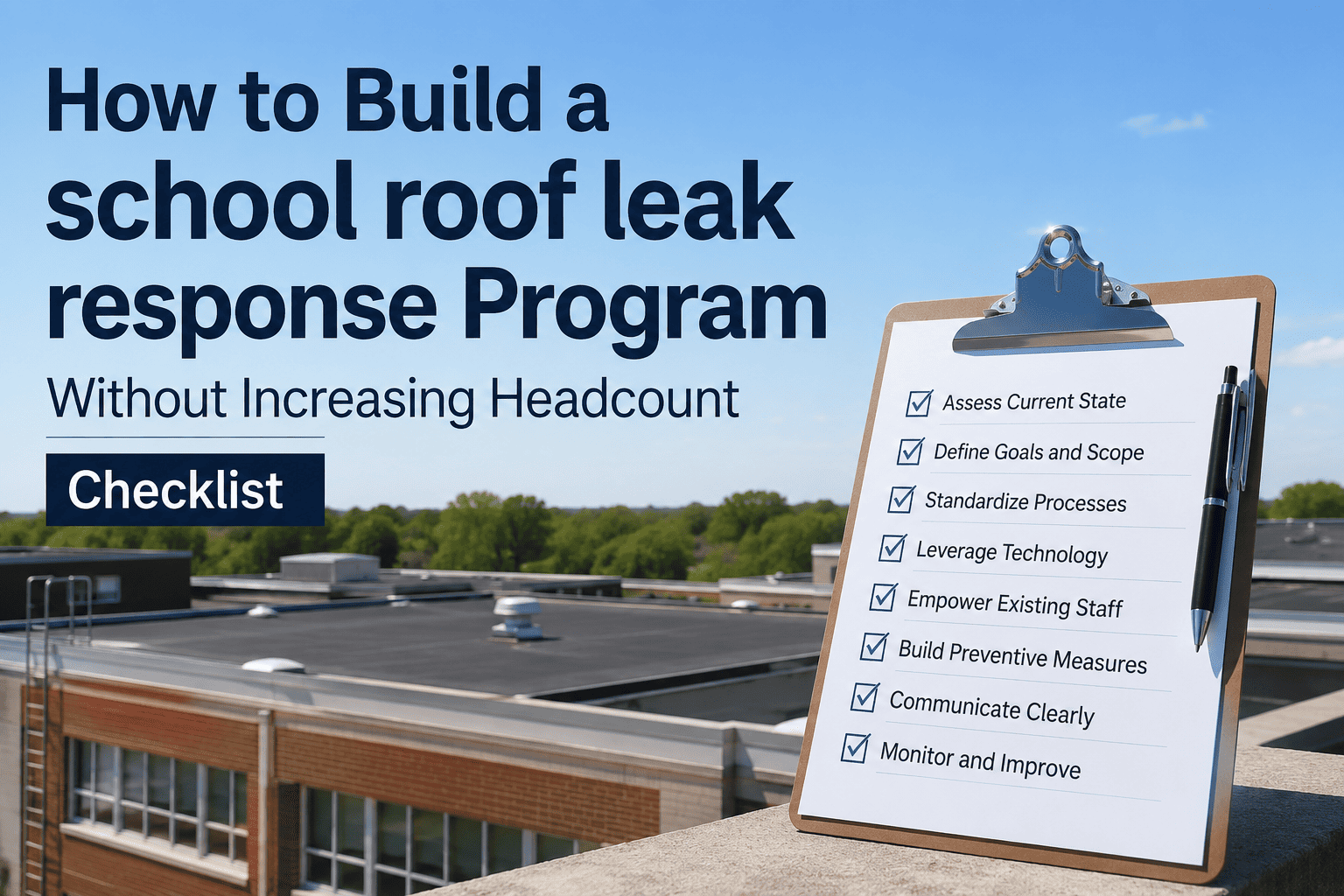
Most facility managers facing chiller reliability problems reach for the same solution: hire more technicians. But the facilities that run the most dependable chiller plants — sustained COP above 5.5, fewer than two unplanned shutdowns per year, and cooling costs 20 to 30 percent below industry average — are not staffed differently. They are structured differently. Their existing technicians inspect more consistently, escalate faster, and act earlier because a CMMS handles the scheduling, documentation, and alerting that paper-based systems leave to human memory. This checklist shows you exactly how to build that program with the team you already have. OxMaint is the CMMS built to run it.
HVAC Maintenance · Chiller Plant · No Headcount Increase
How to Build a Chiller Plant Maintenance Program Without Increasing Headcount
A structured implementation checklist for facility managers who need to improve chiller plant reliability, reduce energy consumption, and extend equipment life — using their existing technician team, digital checklists, and a CMMS that multiplies what each person can monitor and maintain.
30%
Energy Cost Reduction
3–4 wks
Earlier Fault Detection
2x
Technician Coverage Capacity
0
Additional Headcount Needed
The Core Problem
Why Chiller Plants Underperform Without Adding People
Without a Structured Program
Technician rounds are done from memory — missed equipment and inconsistent frequencies
Defects discovered only during breakdown — average detection lag of 3–6 weeks
No trending data — refrigerant loss, tube fouling, and oil degradation go undetected
Senior technicians spend time on routine tasks instead of complex diagnostics
Each unplanned shutdown costs $15,000–$80,000 in emergency repair and downtime
Result: Reactive operation with 2–4 emergency shutdowns per cooling season
With CMMS-Guided Program
CMMS auto-delivers checklists per technician — every equipment point covered every shift
Anomalies detected within 24 hours — trend-based alerts surface developing faults automatically
Performance data logged digitally — COP, approach temperature, and vibration trended over time
Junior technicians handle routine rounds — senior staff focus on analysis and improvement
Planned interventions replace emergency calls — average repair cost drops 60–70%
Result: Planned maintenance dominance with fewer than 1 unplanned shutdown per year
Implementation Roadmap
6-Phase Program Build — What to Do Each Month
A chiller maintenance program built without adding headcount requires you to structure your existing team's time more precisely. These six phases deploy in sequence and are designed to show measurable improvement within 90 days.
Complete asset register in CMMS — every chiller, cooling tower, pump, AHU, and sensor added with serial number, install date, and OEM specs
Document current performance baselines — design COP vs current COP, approach temperatures, suction/discharge pressures, and oil analysis results
Photograph all equipment nameplates, control panels, and current condition — stored in CMMS asset record as reference for future inspections
Map existing maintenance gaps — identify which equipment has no documented maintenance history and flag for priority assessment
Rank each asset by failure consequence — chiller compressors and primary cooling towers rated Critical; secondary pumps and AHUs rated Standard
Assign inspection frequencies based on criticality — Critical assets inspected daily, Standard assets weekly, Monitored assets monthly
Build technician inspection routes that minimize travel time between equipment — efficient routing increases coverage without adding shift hours
Review technician skill levels against assigned tasks — ensure route assignments match competency so no asset is inspected below the required standard
Build CMMS checklist templates for each equipment type — chiller, cooling tower, condenser water pump, chilled water pump, and plate heat exchanger
Set numerical threshold alerts for key readings — bearing temperature above 80°C, approach temperature above 3°C, oil pressure below 45 psi triggers escalation
Train technicians on mobile CMMS use — photo capture, reading entry, and escalation workflow completed in under 10 minutes of onboarding
Run 2-week parallel operation — paper forms and CMMS used simultaneously to verify checklist completeness and technician adoption
Annual PM schedule built in CMMS — seasonal oil changes, refrigerant checks, tube cleaning, and vibration analysis scheduled 12 months forward
Contractor work orders integrated into CMMS — specialist tasks assigned with required scope, certification, and completion criteria defined before dispatch
Planned vs emergency work order ratio set as a KPI target — below 20% emergency work orders within 6 months of program launch
Shutdown maintenance windows aligned with facility low-demand periods — maintenance scheduled during off-peak cooling season to minimize disruption
Weekly performance trend review by facility manager — COP trending, approach temperature drift, and vibration velocity changes reviewed against baselines
AI-based anomaly alerts configured in CMMS — readings that trend outside normal range for 3 consecutive inspections auto-escalate without manual review
Refrigerant log maintained digitally — every addition, removal, and analysis result recorded for EPA compliance and leak trending
Energy use correlation analysis — CMMS performance data cross-referenced with utility bills to validate efficiency gains from the maintenance program
Monthly reliability review meeting — all escalations, work orders, and near-misses reviewed, root causes documented, and standards updated
Technician certification matrix maintained — CMMS restricts advanced tasks to qualified technicians and alerts training lead when recertification is due
Quarterly KPI presentation to management — chiller availability, energy savings, and maintenance cost per ton documented against pre-program baseline
Annual program audit against ASHRAE 180 or equivalent standard — inspection compliance, documentation completeness, and performance improvements benchmarked
OxMaint builds your entire chiller maintenance program in the platform — asset register, inspection checklists, PM schedules, escalation workflows, and performance dashboards — so your existing team covers more equipment with fewer missed inspections and zero paper forms.
Daily Inspection Checklist
Critical Chiller Plant Checks Every Technician Should Run
These check points represent the minimum viable daily inspection for a chiller plant. Each reading should be entered into CMMS with the actual value — not just a pass/fail mark.
Compressor bearing temperature — log actual value; escalate if above 80°C or rise of more than 5°C in one shiftDaily
Refrigerant suction and discharge pressure — log and compare against operating curve; deviation above 5% triggers reviewDaily
Approach temperature across evaporator and condenser — fouling indicated by approach temperature rising above 3°C from baselineDaily
Oil pressure and temperature — confirm within OEM range; low oil pressure is a compressor protection shutdown triggerDaily
Chilled water supply and return temperatures — confirm delta-T within 10–14°F design range; narrowing delta-T indicates low flow or foulingDaily
Current draw on compressor motor — log and compare against baseline; rise above 5% at same load indicates mechanical degradationDaily
Condenser water supply and return temperatures — target 85°F supply in design conditions; rising supply temperature reduces chiller efficiency directlyDaily
Basin water level and makeup valve operation — low basin level causes pump cavitation; confirm makeup valve not continuously runningDaily
Fan motor current draw and blade condition — abnormal vibration or noise from fan section escalated immediatelyDaily
Water treatment chemical levels — conductivity, pH, and biocide levels within spec; drift below range allows Legionella proliferationDaily
Primary and secondary pump bearing temperature — both chilled and condenser water pumps checked; log actual temperature readingsDaily
Pump seal leakage inspection — minor drips logged and monitored; active seal failure escalated immediately with work order generatedDaily
Expansion tank pressure and level — confirm within operating range; abnormal level indicates refrigerant or water loop issueDaily
VFD status and drive temperature — confirm no fault codes present and drive cooling fan operational for all variable-speed pumps and fansDaily
Program KPIs
Six Numbers That Prove Your Program Is Working
Chiller Availability
Before:82–88%
Target:96–99%
COP Improvement
Before:3.8–4.5
Target:5.5–6.5
Emergency Work Orders
Before:60% of WOs
Target:Below 15%
Inspection Compliance
Before:Below 65%
Target:Above 98%
MTBF (Chiller)
Before:60–90 days
Target:180–365 days
Energy Cost/Ton
Before:$0.18–$0.26
Target:$0.12–$0.16
FAQs
Frequently Asked Questions
Can one technician manage a full chiller plant inspection without missing anything?
Yes — with a CMMS guiding the inspection route and delivering checklists to a mobile device, a single trained technician can cover an entire chiller plant in 60–90 minutes with no missed points. The system flags skipped items, so supervisors know immediately if a check was incomplete.
See how OxMaint manages multi-asset chiller inspections.
What is the most impactful early action in a new chiller maintenance program?
Documenting current performance baselines is the highest-value first step. Without knowing what normal looks like for your specific chillers, you cannot detect deviation. Logging approach temperature, COP, bearing temperatures, and oil pressure at optimal conditions gives you the reference point that makes all future readings meaningful and actionable.
How does CMMS help with EPA refrigerant compliance?
A CMMS maintains a digital refrigerant log — recording every charge, recovery, and oil analysis result — automatically linked to the equipment record. This creates the 30-day leak detection and reporting documentation required under EPA 608 without manual log books, and provides an instant audit trail if inspected.
Book a demo to see the refrigerant log workflow.
How long does it take to see measurable results from a new chiller PM program?
Most facilities see measurable inspection compliance improvement within 30 days. COP improvement from tube cleaning and coil maintenance typically appears within the first cooling season. Significant MTBF improvement and emergency cost reduction usually confirms by the 6-month mark when early detections begin preventing the failures that previously drove emergency repairs.
What should be the first equipment priority when building the program?
Start with the chiller compressor and cooling tower fan systems — these have the highest failure cost and the clearest early-warning indicators. Getting daily readings on bearing temperature, approach temperature, and refrigerant pressures on these two equipment types alone will detect the majority of developing failures before they become emergency shutdowns.
Build Your Program Today
Better Chiller Reliability. Same Team. Zero Extra Headcount.
OxMaint gives your existing technicians the tools to inspect more consistently, detect failures earlier, and escalate faster — turning a reactive chiller operation into a planned maintenance program without hiring a single additional person. Asset register, checklists, PM schedules, escalation workflows, and KPI dashboards included from day one.