Most campus facilities teams already know they need to inspect every fire door every year. What they do not have is a repeatable system that runs without a dedicated full-time inspector — one that distributes the work across existing staff, eliminates paper-based gaps, and produces audit-ready records without a last-minute scramble before every AHJ visit or accreditation review. A fire door inspection programme built on the right structure scales with your building count, survives staff turnover, and closes corrective actions faster than any spreadsheet-based approach. This guide gives your team the exact programme architecture — from door inventory to work order routing to documentation retention — that lets you achieve NFPA 80 compliance across a large campus without adding a single headcount. Facilities teams that have deployed this model on OxMaint's inspection management platform report full programme coverage with existing staff, and zero lapsed inspections in recurring AHJ reviews.
How to Build a Fire Door Inspection Program Without Increasing Headcount
A step-by-step programme architecture for campus facilities teams — from door inventory and route design to mobile work orders, corrective action tracking, and compliance reporting — built to run on your current team size.
Why Most Campus Fire Door Programs Break Down
Teams cannot inspect what they cannot count. Without a complete door-by-door asset list linked to buildings, floors, and corridors, inspection coverage is always approximate and always defensible under challenge.
Inspectors carrying printed checklists produce data that lives in a binder until a compliance request arrives — at which point aggregation and gap analysis require days of manual work rather than a single report pull.
A deficiency found by one inspector and written on a form reaches the repair technician only if the form is handed to the right person. Without a digital work order, deficiencies age on paper and doors stay non-compliant for weeks or months.
Annual cycles scheduled on a wall calendar depend entirely on the person who posted the calendar. When that person leaves, the schedule leaves with them — and the next AHJ visit reveals a silent compliance gap.
OxMaint replaces the binder with a digital inspection programme — scheduled work orders, mobile checklists, automatic deficiency routing, and compliance dashboards that show your entire programme status in one screen.
Seven Steps to a Scalable Fire Door Inspection Program
Each step below maps to a checklist of tasks your team executes once during programme setup — after which the programme runs on scheduled work orders with no coordinator overhead.
The programme starts with a defensible count. Walk every building, tag every fire door assembly with a unique identifier, and record the door's location (building, floor, corridor), rating (20-min, 45-min, 60-min, 90-min), hardware type, and last known inspection status. A door that is not in the inventory cannot be inspected or tracked.
Route design determines whether your existing team can complete campus-wide inspections in the time available — or whether the programme will always be behind. Group doors into logical building zones (stairwells, corridor sections, lab wings) so a single inspector can complete a route in one shift without backtracking. A campus of 500 doors distributed across 10 buildings requires roughly 10 to 15 routes, each completable in two to four hours.
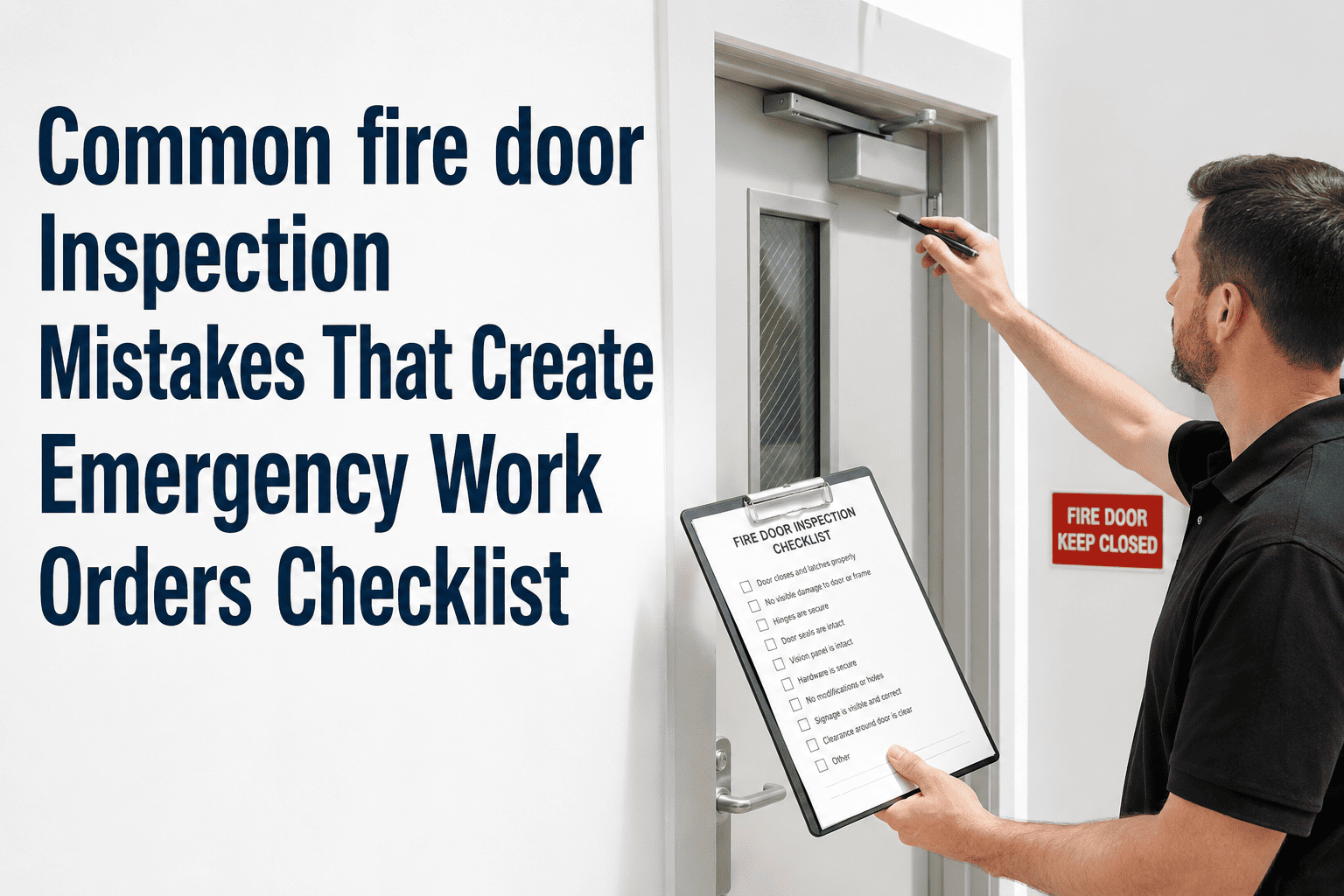
Every inspector must evaluate the same items in the same order to produce comparable, defensible records. Build a standardised checklist covering door leaf and frame condition, closing and latching function, smoke and intumescent seals, hinge hardware, sill gap, labeling, and hold-open compliance. A checklist that is too long causes field fatigue and skipped items — the optimal field checklist is 10 to 15 items per door, with each item answerable as pass, fail, or not applicable.
The single biggest efficiency gain in a headcount-neutral programme is eliminating manual scheduling coordination. When inspection work orders are generated automatically on the correct annual (or quarterly) cycle, assigned to the right inspector, and appear on their mobile queue without a coordinator sending emails, the programme runs without administrative overhead between cycles.
The time between a deficiency being identified and a technician receiving the repair assignment is where most programme efficiency is lost. When a failed checklist item automatically generates a corrective action work order — routed to the appropriate trades technician with the door asset ID, deficiency description, and inspection photo — repair cycle time drops from weeks to days without any coordinator involvement.
A well-designed mobile inspection tool and a clear checklist can be learned in a single two-hour training session. The goal is not to turn maintenance technicians into fire door specialists — it is to give them the judgment to distinguish a pass from a fail for each checklist item, and the process to document, photograph, and escalate correctly. Complex or unusual assemblies should be flagged for review by a qualified specialist rather than assessed in the field by a general inspector.
An AHJ visit or accreditation audit should require minutes of report generation, not hours of document assembly. When inspection data is captured digitally with per-door records, deficiency history, and corrective action closure timestamps, a complete NFPA 80 compliance report for any date range or building is a single export — not a manual compilation from multiple binders.
Paper Programme vs. Digital Programme at a Glance
| Programme Area | Paper-Based Approach | Digital Programme (OxMaint) |
|---|---|---|
| Door Inventory | Spreadsheet updated manually, gaps undetected | Centralised asset register with auto-sync and gap alerts |
| Inspection Scheduling | Calendar reminders, coordinator-dependent | Automatic recurring work orders with escalation rules |
| Field Data Capture | Paper form, transcribed later, photo not attached | Mobile checklist with timestamped photo capture per item |
| Deficiency Routing | Form handed to supervisor, delay common | Instant corrective action work order to correct trade |
| Compliance Reporting | Manual document assembly, hours to days | One-click report for any building, date range, or audit scope |
| Record Retention | Physical binders, loss risk during renovation | Digital archive, searchable by door ID or date |
| Staff Turnover Impact | Programme knowledge leaves with the person | Programme lives in the system, not in any individual |
Frequently Asked Questions
How many staff hours does a campus fire door inspection programme typically require per year?
A well-routed programme typically requires 15 to 20 minutes per door for inspection, documentation, and deficiency reporting. A campus of 400 doors requires roughly 100 to 130 inspector-hours annually — distributable across existing maintenance staff without dedicated headcount. Digital tools reduce per-door time by eliminating transcription and report assembly. See how OxMaint routes and tracks inspection time across your team.
Does NFPA 80 require a certified fire door inspector or can facilities staff perform inspections?
NFPA 80 requires inspections be performed by a "qualified person" — defined as someone with knowledge of fire door assemblies and applicable code requirements. Facilities staff who complete a recognised training programme (such as the DHI Fire Door Assembly Inspector credential) meet this standard. A third-party specialist is advisable for complex assemblies or when the AHJ specifically requires it. Book a demo to see how OxMaint tracks inspector qualification records alongside inspection data.
What is the typical deficiency rate for campus fire doors and how long do repairs take?
Industry data from campus facilities programmes suggests 20 to 35 percent of fire doors have at least one deficiency at initial inspection — most commonly failed closing function, damaged seals, or hardware issues. With a digital corrective action system, life-safety deficiencies are typically repaired within one to three days, versus one to four weeks for paper-based programmes where routing delays are common.
Can a digital inspection programme satisfy the AHJ's record-keeping requirements under NFPA 80?
Yes. NFPA 80 requires that inspection records be maintained and available for AHJ review — it does not specify paper format. Digital records with timestamped entries, inspector identification, and per-door inspection history satisfy the standard and are generally viewed more favorably by AHJs than handwritten binder records because they are more legible, searchable, and resilient to loss. OxMaint generates AHJ-ready compliance reports in one click.
How do we handle fire doors added or replaced during building renovation without disrupting the programme?
New or replaced doors should be added to the asset inventory immediately upon installation, with the listing label information, hardware type, and location recorded. A post-installation inspection should be triggered as a CMMS work order before the door is placed in service. Annual inspection cycles then pick up the new door automatically in the next scheduled route — no manual schedule update required when the programme is managed in a CMMS.
Run a Full Campus Fire Door Programme on the Team You Already Have
OxMaint gives your facilities team scheduled inspection routes, mobile checklists, automatic deficiency routing, and one-click compliance reporting — so NFPA 80 compliance runs as a system, not as a manual effort that depends on the right person being available.