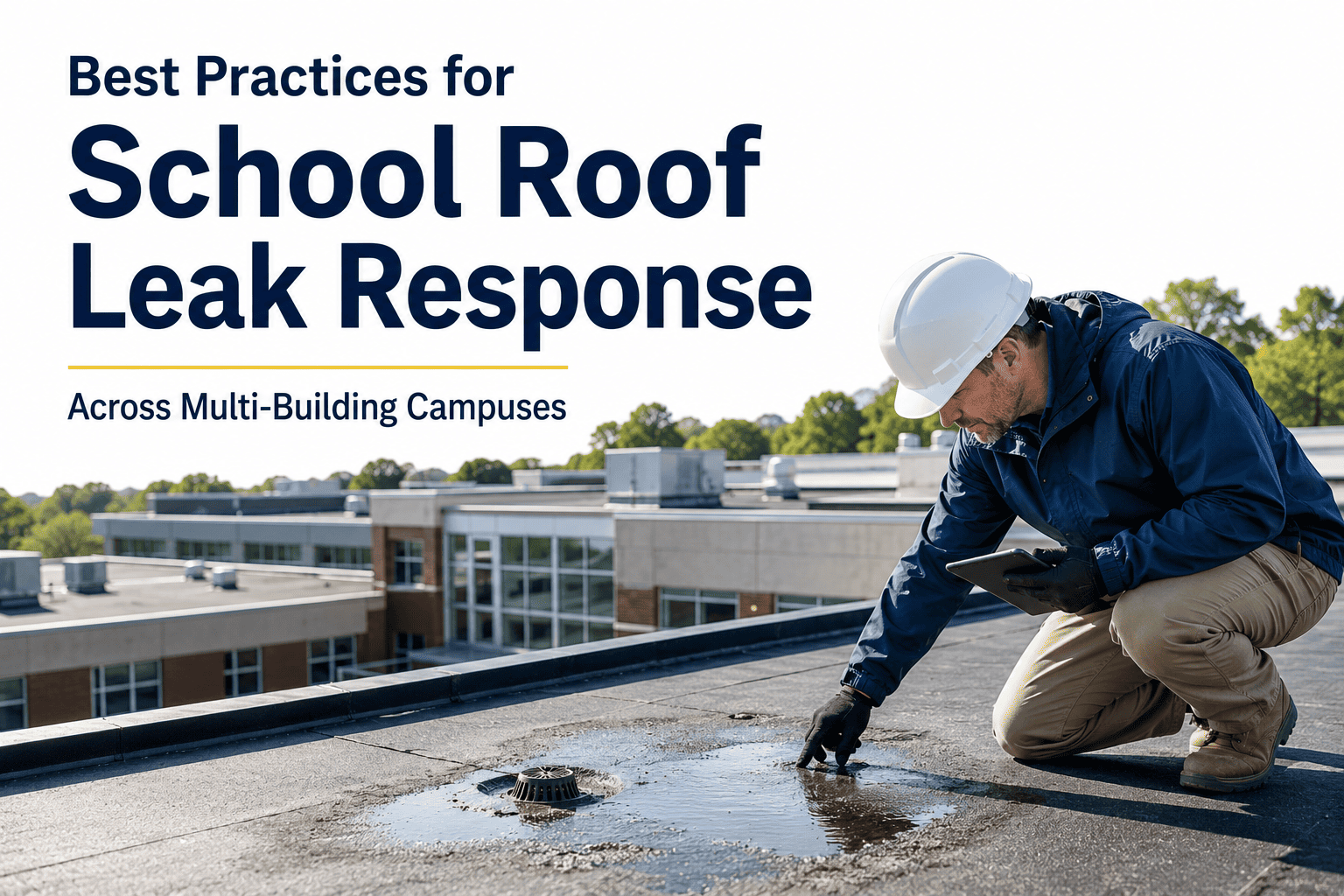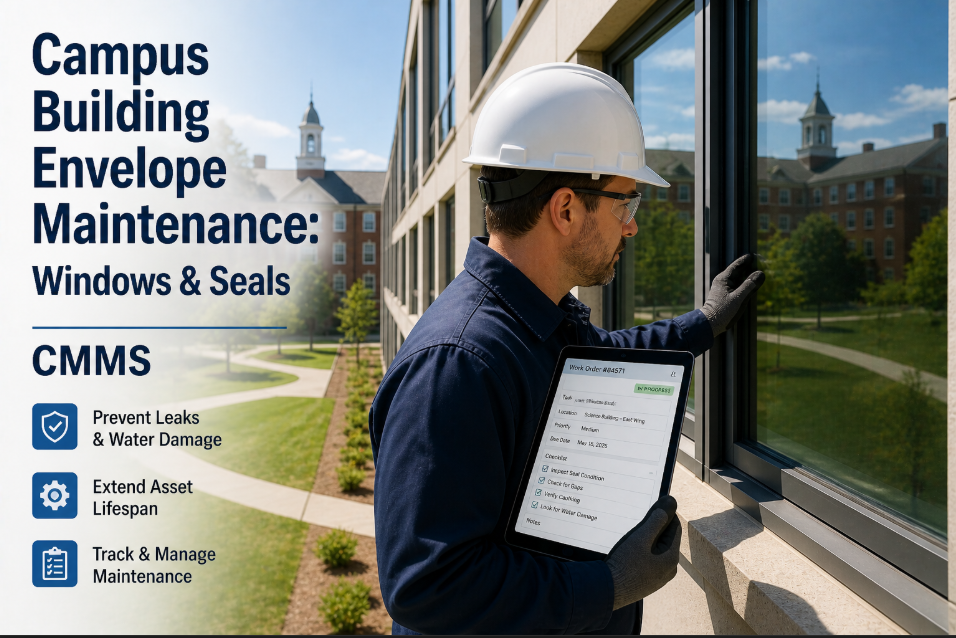
School building envelopes across the United States are aging faster than districts can fund replacements. The average K-12 school building in America is 44 years old, and more than 53% of districts report needing to update or replace multiple building systems including roofs, windows, and exterior sealants. When a roof membrane fails or a window seal deteriorates, the damage extends far beyond the envelope itself — moisture infiltration drives mold remediation costs that average $15–$30 per square foot, destroys interior finishes, and creates indoor air quality conditions that directly impact student health and attendance. The reality is that most districts operate their building envelopes reactively: they patch leaks when ceiling tiles stain, replace windows when drafts become unbearable, and re-caulk joints when visible daylight appears through exterior gaps. This reactive cycle costs 3–5x more per square foot over a 20-year period than a systematic preventive envelope maintenance program tracked through a CMMS. Oxmaint gives K-12 facility teams the ability to register every roof section, window assembly, and sealant joint as a tracked asset with condition scoring, automated PM scheduling, and rolling CapEx forecasting that turns deferred maintenance into a funded, sequenced capital plan. If your district is managing building envelope maintenance through emergency work orders and annual walk-throughs, start a free trial or book a demo to see how condition-based envelope tracking works across your entire building portfolio.
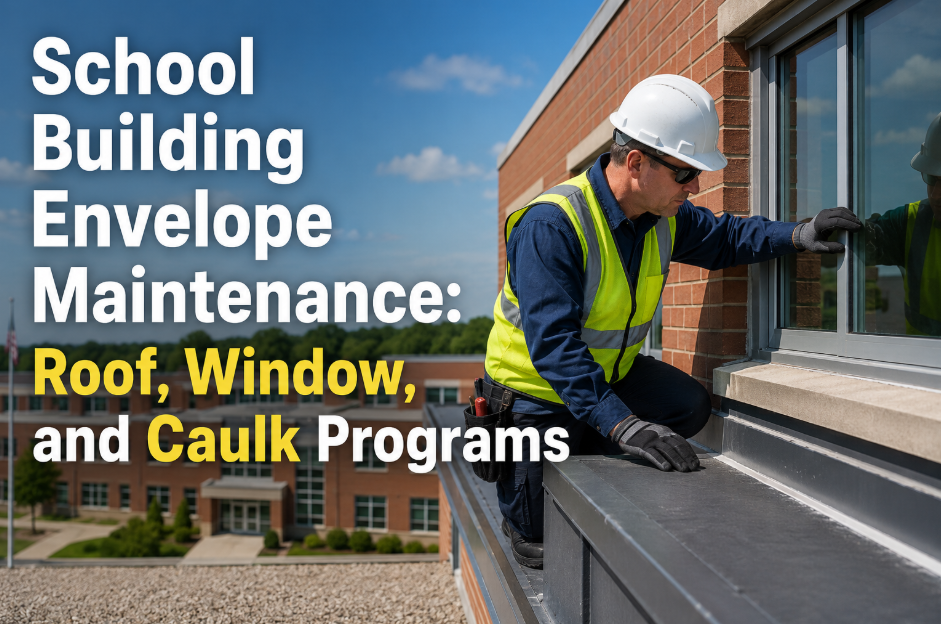
School Building Envelope Maintenance: Roof, Window, and Caulk Programs
TPO/EPDM roof inspections, single-pane to thermal window upgrades, caulk and sealant replacement cycles, and CMMS-tracked envelope programs that prevent moisture damage and extend building life by decades.
Your Building Envelope Is Your First Line of Defense — and Your Most Neglected Asset
Roofs, windows, and sealant joints form the protective shell that keeps water out, conditioned air in, and occupants safe. When that shell degrades without systematic inspection and maintenance, the damage cascades: structural deterioration, mold growth, HVAC inefficiency, and indoor air quality violations that put students and staff at risk. Oxmaint converts your entire building envelope — every roof section, every window bank, every caulk joint — into a tracked, scored, and scheduled asset portfolio with automated PM work orders and rolling capital forecasts. Want to see how it works for your building count? Start a free trial or book a demo to map your district envelope program today.
What Is a School Building Envelope — and Why Does It Matter?
The building envelope is every exterior component that separates conditioned interior space from unconditioned exterior conditions: roofing membranes, wall assemblies, window systems, door assemblies, sealant joints, flashing, and below-grade waterproofing. In K-12 schools, the envelope is typically the highest-value infrastructure category after the structural system itself — and the most directly responsible for occupant comfort, energy consumption, and moisture protection. A properly maintained envelope extends building useful life by 15–25 years, reduces annual energy costs by 20–35%, and prevents the cascading interior damage that generates the most expensive emergency work orders a school district processes.
The Four Critical Envelope Asset Categories in K-12 Schools
Each envelope component has different failure modes, different inspection intervals, different useful life expectations, and different CapEx replacement costs. Effective envelope maintenance treats them as separate asset classes within a unified program — not as a single budget line item labeled "building exterior."
K-12 Roof Maintenance: TPO, EPDM, and the Cost of Deferred Inspections
Roofing is the single largest envelope expenditure for most school districts — a full roof replacement on a 60,000 sq ft elementary school costs $420,000–$720,000 depending on membrane type and insulation requirements. Yet the difference between a roof that lasts 22 years and one that fails at 14 years is almost entirely determined by whether biannual inspections and minor repairs were performed consistently. Research from the National Roofing Contractors Association shows that every $1 spent on preventive roof maintenance saves $4–$8 in premature replacement costs.
| Roof Type | Expected Life | With PM Program | Common Failure Mode | Avg. Replacement Cost/sq ft | Oxmaint PM Approach |
|---|---|---|---|---|---|
| TPO Single-Ply | 20–25 years | 28–30 years | Seam weld separation, punctures at penetrations | $7–$12 | Semi-annual seam and flashing inspection, photo-documented |
| EPDM Rubber | 20–25 years | 25–30 years | Adhesive failure, shrinkage at edges, ponding water | $6–$10 | Bi-annual membrane tension check, drain flow test |
| Built-Up (BUR) | 15–20 years | 22–25 years | Blistering, alligatoring, gravel displacement | $8–$14 | Annual blister mapping, surface condition scoring |
| Modified Bitumen | 15–20 years | 20–25 years | Lap seam failure, granule loss, flashing pull-away | $7–$12 | Semi-annual lap seam and flashing adhesion check |
| Standing Seam Metal | 30–50 years | 45–60 years | Fastener back-out, panel expansion gap failure, coating fade | $10–$18 | Annual fastener torque and sealant condition check |
| Slate/Tile (historic) | 50–100 years | 75–100+ years | Individual tile cracking, flashing corrosion, underlayment failure | $15–$40 | Annual tile survey, flashing condition score, underlayment age tracking |
School Window Maintenance and Upgrade Prioritization
Approximately 14 million students in the US attend school in buildings with original single-pane windows. Single-pane glazing has an R-value of approximately 0.9 compared to R-3.1 for modern low-E insulated glass units — meaning single-pane windows lose heat at more than 3x the rate. Beyond energy performance, aging windows create security vulnerabilities, noise transmission problems, and condensation that damages interior finishes. Oxmaint helps districts score and prioritize window replacements building by building, track operable hardware maintenance, and build the phased CapEx plan that funding cycles require. Districts managing window programs reactively should start a free trial or book a demo to see condition-based window scoring in action.
Fogged insulated glass units indicate seal failure — thermal performance drops 30–40% and moisture between panes accelerates frame deterioration. Replace glazing unit, inspect frame for secondary damage.
Classrooms, offices, and libraries with original single-pane glass are the highest-ROI upgrade targets. Energy modeling shows 25–35% heating cost reduction per zone after thermal window upgrade.
Windows that do not open, close, or lock properly create ventilation, egress, and security issues. Hardware replacement at $40–$120 per window extends assembly life 10–15 years without full replacement.
Wood rot, aluminum oxidation, and vinyl warping compromise both thermal performance and structural integrity. Frame condition scoring in Oxmaint triggers replacement before water infiltration reaches the wall assembly.
Caulk and Sealant Replacement Cycles: The Most Overlooked Envelope PM
Exterior sealant joints are the lowest-cost, highest-impact envelope maintenance activity a district can perform — and the most frequently deferred. A typical school building has 2,000–5,000 linear feet of exterior sealant joints around windows, door frames, control joints, penetrations, and material transitions. When sealant fails, water enters the wall assembly and causes damage that costs 50–100x more to remediate than the sealant replacement would have cost. Silicone sealants last 15–20 years in ideal conditions but typically require replacement at 7–12 years in school environments due to UV exposure, thermal cycling, and building movement.
Sealant pulls away from the substrate at the top of window frames — the single most common point of water entry in school buildings. Water travels behind the frame into the wall cavity, causing hidden damage for months before visible interior staining appears. Annual visual inspection catches this at $2–$5 per linear foot of re-caulk versus $15–$30 per square foot of interior mold remediation.
Masonry and concrete control joints accommodate building movement. When the sealant in these joints loses elasticity — typically after 8–12 years of thermal cycling — the joint opens and water enters the wall assembly at the designed weak point. These joints are often at the back of the building where routine observation is minimal.
Sealant joints at the base of walls where the building meets grade-level surfaces are exposed to constant moisture, snow, ice, and mechanical damage from landscaping equipment. These joints fail 40% faster than above-grade joints and are the primary pathway for below-grade moisture infiltration into crawl spaces and basements.
Maintenance staff frequently apply the wrong sealant type over failed joints — silicone over polyurethane, acrylic latex over silicone — creating adhesion failure within 12–18 months. A CMMS-tracked sealant program records the original sealant type per joint location, ensuring compatible materials are specified for every re-application work order.
How Oxmaint Manages Your Entire Building Envelope Program
Oxmaint replaces fragmented envelope maintenance — a roof consultant's report here, a window contractor's estimate there, a maintenance worker's caulk gun when they see a gap — with a unified, condition-scored, CMMS-tracked envelope program that covers every roof section, window assembly, sealant joint, and wall system across your entire district. The result is a documented asset registry with automated PM scheduling, rolling CapEx forecasts, and the condition data that bond referenda and state funding applications require. Districts ready to build a real envelope program can start a free trial or book a demo to see the full envelope management workflow.
Register each roof section, window bank, and sealant zone in Oxmaint's hierarchy: District > School > Building > Elevation > Component. Each asset carries condition score, installation date, warranty status, material type, and remaining useful life — visible from the district-level dashboard.
Score every envelope component on a standardized 1–5 scale aligned with Facility Condition Index methodology. Condition data feeds CapEx prioritization, bond referendum documentation, and state funding applications — replacing subjective estimates with documented, timestamped assessments.
Configure roof inspections semi-annually, window hardware checks annually, sealant surveys on custom cycles, and post-storm rapid assessments on demand. Oxmaint generates the work order automatically, assigns the right technician, and escalates if overdue — eliminating the calendar management that causes deferred inspections.
Every inspection work order supports photo attachment with GPS location and timestamp. Inspectors document membrane blistering, sealant cracks, window fogging, and flashing pull-away with photos that create an undeniable condition record — essential for insurance claims, warranty disputes, and bond campaign communications.
Oxmaint's condition data and remaining useful life estimates feed rolling capital forecasts by building, by system, and by fiscal year. Facility directors present sequenced, data-backed replacement plans to school boards — not emergency funding requests when a roof fails mid-semester.
When an inspector identifies a deficiency — a separated roof seam, a broken window operator, a failed sealant joint — Oxmaint automatically creates a priority repair work order linked to the original inspection finding. The corrective action is tracked to completion, creating the closed-loop documentation that audit and insurance reviews require.
Reactive Envelope Management vs. CMMS-Tracked Envelope Program
Envelope Program Outcomes Districts Report After Switching to Oxmaint
Systematic semi-annual inspections catch membrane, sealant, and flashing failures before they become emergency leak events
NRCA data confirms that roofs under systematic PM programs consistently exceed rated life by 25–40%
Every scheduled envelope inspection generates a photo-documented record — no gaps, no missing assessments, no undocumented cycles
Systematic sealant replacement, flashing repair, and drain maintenance prevent cascading interior damage that costs multiples more
Frequently Asked Questions
How often should school roofs be inspected?+
What is the ROI of replacing single-pane windows in schools?+
How does Oxmaint help with bond referendum documentation for envelope projects?+
Can Oxmaint track warranty status for roof and window replacements?+
Your Building Envelope Is Either Getting Better or Getting Worse — There Is No Neutral
Every semester without a documented roof inspection, every year without a sealant survey, every deferred window replacement adds to a backlog that grows exponentially — because envelope failures cause cascading interior damage that multiplies the original repair cost. Oxmaint gives your district the tools to register every envelope component, schedule every inspection, score every condition, and forecast every replacement — so your buildings stay dry, efficient, and funded. No heavy implementation. First automated envelope work orders in week one.