School Bus Fleet Maintenance: CMMS Integration for Transportation Departments
By jamie lanister on March 25, 2026
A school district in Ohio received a DOT compliance audit on 38 buses. The auditor found 9 vehicles with expired annual inspection records, 14 with DVIR gaps in the 90-day retention window, and 6 where defects had been noted in pre-trip forms but had no documented repair sign-off. All 9 buses with expired inspection records were placed out of service on the spot — the district lost 24% of its fleet capacity for the first week of the school year. The buses had been serviced. The records had not been completed. The result was identical to if they had never been serviced at all. This is the documentation problem that OxMaint's fleet CMMS solves — and it is the same problem that affects transportation departments across the USA, Canada, UK, Germany, and Australia. Book a 30-minute demo to see how OxMaint integrates bus fleet maintenance with campus facility management for unified compliance.
Run DOT Compliance on Autopilot
Inspection records, DVIRs, and seasonal PMs — all automated in OxMaint
of DOT violations are documentation failures — not mechanical faults
$10K+
average fine per out-of-service bus without current inspection records
6×
more pre-trip defects found with digital vs paper inspection forms
The Four Documentation Gaps That Cause DOT Out-of-Service Orders
Most transportation directors know their buses are maintained. What they discover during a DOT audit is that maintained is not documented, and undocumented is indistinguishable from unmaintained. The four gaps below are the structural failures that paper-based fleet maintenance always produces — and the ones OxMaint eliminates from day one.
Gap Type
What Happens on Paper
DOT Consequence
OxMaint Solution
Annual Inspection Record
Paper certificate filed in a binder — no alert when it expires; fleet manager unaware until audit
Out-of-service order per vehicle · $10K+ fine · immediate route loss
60-day advance notification per vehicle · certificate stored in asset record · auto-reminder to schedule service
Pre-Trip / DVIR Record
Paper form submitted to office — filed without review; 90-day retention requires intact manual archive
Brake inspection intervals tracked per vehicle · inspector qualifications stored in technician profile · auto-alert when due
DOT Compliance & Audit Trail Management
The Audit Arrived. Every Record Ready. Every Bus In Service.
OxMaint stores every annual inspection certificate, DVIR, brake record, and out-of-service document against each vehicle asset — retrievable by vehicle ID, date, or inspection type in under 60 seconds. 90-day DVIR retention enforced automatically. Auditors answered in minutes, not hours.
DOT Inspection Requirements: The Five Records Every Auditor Checks
FMCSA regulations and state DOT requirements follow a consistent documentation pattern. Understanding exactly what an auditor requests before the audit arrives is the difference between a clean record and a fleet-wide out-of-service order. For districts in the UK, Germany, and Australia, equivalent national transport authority requirements follow the same five-record structure.
Inspection Type
Frequency
Documentation Required
Most Common Violation
Annual Safety Inspection
Every 12 months per vehicle
Signed report · inspector credentials · defect list with resolution documentation
Expired inspection · defects noted without resolution documentation
Pre-Trip Inspection / DVIR
Every operating day · every driver
Driver-signed report · defect notation · mechanic certification on all defect repairs
Missing pre-trip records · defects noted without repair sign-off
Overdue inspection · inspector not qualified for vehicle class
DVIR 90-Day Retention
Every trip · minimum 3-month retention
Driver ID · vehicle ID · date · defects or "none" · mechanic sign-off on any defect
Records not retained for full 3 months · mechanic sign-off absent on noted defects
Out-of-Service Documentation
Any removal from service
OOS date and reason · repair documentation · return-to-service authorisation with mechanic signature
Bus returned without documented repair · no return-to-service authorisation on file
Pre-Trip Inspection: Paper Kills Defect Reporting. Digital Fixes It.
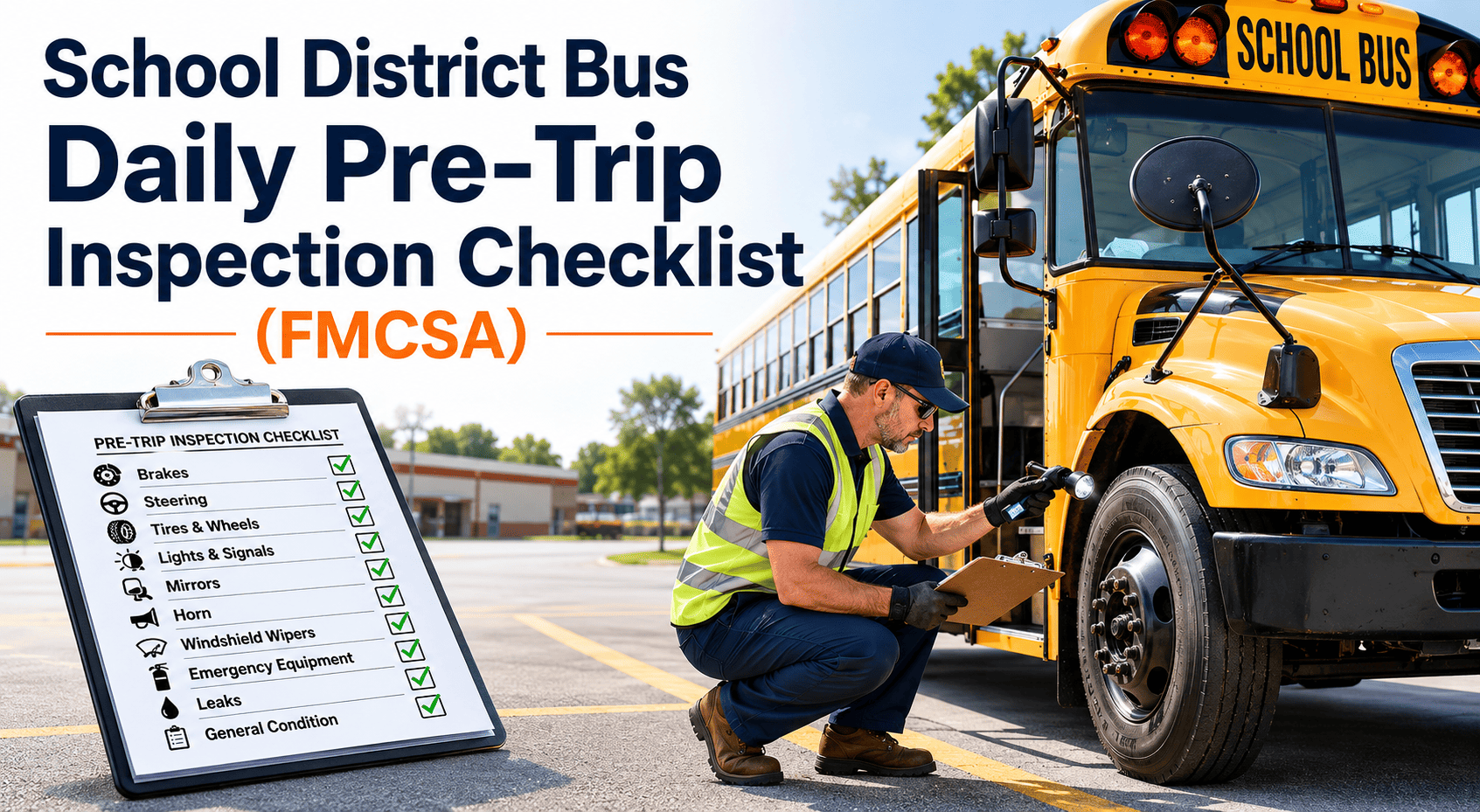
The daily pre-trip inspection is the most important safety tool in any school bus fleet and the most commonly compromised record in it. On paper, minor defects go unreported because the reporting process is cumbersome before a 5:45 AM route. On OxMaint's mobile platform, a defect takes 10 seconds to flag, the work order is automatic, and the documentation chain is unbroken.
Paper Pre-Trip
OxMaint Digital
❌ Driver has no visibility of prior open defects on the vehicle
✅ All prior open defects visible before inspection starts
❌ Minor defect noted but not reported — reporting delays a 5:45 AM route
✅ Defect photo and work order generated in under 60 seconds on mobile
❌ Form reaches Transportation office hours later — no real-time visibility
✅ Director sees live fleet status dashboard before first route departs
❌ Mechanic learns of defect 2–4 hours after driver discovery
✅ Mechanic assigned and notified in under 60 seconds via mobile
❌ DVIRs filed in binders — 90-day retention gaps near-certain
✅ Every DVIR retained automatically · exportable for DOT in 2 minutes
❌ Driver record and mechanic record in separate files — no linked audit trail
✅ Defect → work order → repair → sign-off: one unbroken record per vehicle
Seasonal PM Calendar for School Bus Fleets
The academic calendar creates four natural maintenance windows. Formalising them in OxMaint means every seasonal task is scheduled and assigned before the window opens — not triggered by the first breakdown of that season. The following structure is used by transportation departments across the US, Canada, UK, and Australia.
June – August
Summer Overhaul
Annual DOT safety inspection — all vehicles
Full brake inspection and adjustment
Coolant system service · hose replacement
AC recharge · cabin filter replacement
Tyre rotation · condition audit · spare review
◆ Book contractors in May — summer appointments fill by June
August – September
Fall Start-Up
Battery load test — every vehicle
Tyre pressure and tread depth — fleet-wide
Heating system test before first cold morning
Lights · signals · emergency equipment tested
First-day readiness sign-off per vehicle
◆ 3 weeks before first route — not the night before
November – February
Winter Protocol
Increased oil change frequency — high-idle routes
Monthly battery load test — full fleet
Door and window seal inspection
Weekly undercarriage wash — road salt control
Block heater scheduling for extreme cold
◆ Cold-start failures are preventable with August battery test
March – April
Spring Assessment
Full undercarriage inspection — salt damage
Brake inspection — winter wear assessment
Tyre assessment — winter wear patterns
AC system test before warm weather
Document summer work plan — book contractors
◆ Spring assessment = summer work plan — book in April not June
Seasonal PM Scheduling
Every Seasonal Task Scheduled Before the Season Begins — Not After the First Breakdown
OxMaint auto-generates seasonal PM work orders before each window opens — summer overhaul, fall start-up, winter cold weather protocol, and spring assessment all scheduled and assigned to the correct mechanic or contractor before the task is due.
Technology Transforming School Bus Fleet Maintenance
The transportation departments reducing maintenance costs and compliance failures fastest are not the ones with the biggest fleets — they are the ones integrating AI diagnostics, sensor data, and ERP systems into a single maintenance platform. The technologies below are being actively deployed in leading school districts across the USA, Canada, Germany, UAE, and Australia.
AI Vision
AI Camera Vision
ADAS cameras detect tyre wear, body damage, and driver behaviour in real time. AI flags defects automatically — converting visual anomalies into OxMaint work orders without manual inspection. Reduces pre-trip time from 10 minutes to under 2 minutes on equipped vehicles.
Digital Twin
AI Digital Twin
A virtual replica of each bus simulates wear and failure scenarios before they occur. Predicts which vehicle needs service next — before the driver reports a symptom. Reduces unplanned stops by modelling brake wear, tyre degradation, and engine health across the full fleet simultaneously.
OBD-II
OBD-II Integration
Real-time fault code reading from every bus engine. Diagnostic Trouble Codes trigger OxMaint work orders automatically — no manual logging, no missed codes. Fault-to-work-order in under 60 seconds. Supports all FMCSA-compliant vehicle diagnostic protocols including J1939 for heavy-duty buses.
SAP / ERP
SAP & ERP Integration
OxMaint connects to SAP and major ERP platforms for seamless procurement sync, work order data exchange, and asset lifecycle management. Fleet maintenance records, parts orders, and compliance certificates flow between OxMaint and the district's financial and operational systems automatically.
PLC / Sensors
PLC & Sensor Integration
Temperature, pressure, and system health data from onboard sensors feed OxMaint maintenance schedules directly. Sensor threshold breaches — brake fluid temperature, tyre pressure, engine coolant — automatically trigger PM tasks. No manual review step between sensor data and scheduled intervention.
Predictive PM
Predictive Maintenance
Scheduled intervention before failure — not after. Districts using structured PM programmes see 65% fewer reactive work orders within 6 months. OxMaint combines odometer triggers, calendar intervals, and sensor data to predict the optimal maintenance window for every vehicle in the fleet simultaneously.
Before OxMaint, our DOT audit took two full days to prepare — pulling binders, chasing mechanics for sign-offs. Last year the auditor requested our 90-day DVIR history for 12 vehicles. I had the complete export on his desk in 9 minutes. Zero findings. Zero out-of-service orders.
— Transportation Director, Mid-West School District · 38-bus fleet · OxMaint user since 2023
Tyre Management: The Highest-Consequence Consumable in Your Fleet
Tyre management is the highest-frequency, highest-consequence consumable programme in any school bus fleet. Under-inflated tyres raise blowout risk on a student transport vehicle and increase fuel consumption by up to 3% per 10 PSI under-inflation. OxMaint tracks every tyre across every vehicle — raising replacement alerts before failure, not after.
Tyre Management Programme: 4-Stage Tracking in OxMaint
01
Pressure Monitoring
Monthly · Per tyre
—Monthly pressure recorded per tyre in OxMaint against vehicle ID
—Any tyre 10%+ below rated cold inflation auto-raises mechanic work order
—Pre-trip visual tyre check feeds the same queue — no manual bridge
02
Tread Depth Tracking
Quarterly · Per position
—Quarterly measurement per tyre position — trended over time
—Replacement alert at legal minimum minus 10% — purchase window before emergency
—FMCSA minimum: 4/32" steer, 2/32" all others
03
Rotation Schedule
Odometer-triggered
—Rotation work order auto-generated at mileage threshold — 10K–15K miles
—Rotation history per position enables wear pattern analysis
—Identifies alignment issues before premature failure
04
Spare Inventory
Continuous tracking
—Minimum spare count tracked against fleet size and route criticality
—Any spare used triggers replacement purchase workflow automatically
—Supplier lead times recorded — orders placed before peak season coverage falls
The ROI: What Fleet Maintenance Prevents
The return on structured fleet maintenance is calculated against the cost of what it prevents — DOT fines, emergency repairs, unplanned route cancellations, and the liability exposure of a vehicle placed in service without complete documentation.
35× ROI — One Prevented DOT Audit Fine Pays for 3 Years of Fleet CMMS
Implementation: 3-Week Fleet Setup in OxMaint
A 20–50 bus district is fully operational in OxMaint within 3 weeks. The same structure that onboards a building's HVAC assets onboards a bus fleet — vehicle ID replaces asset ID, odometer replaces run-hours, and the compliance record structure is identical.
Week 1
Vehicle Asset Registration
Register each bus with VIN, vehicle ID, year, make, model, seating capacity, route assignment, and current odometer. Upload the most recent annual inspection certificate and all current compliance records against each vehicle. Import historical maintenance records. The vehicle asset record becomes the single source of truth for every compliance query about that bus — from annual inspection date to last tyre rotation.
Week 2
PM Schedules and Pre-Trip Form Configuration
Configure PM schedules using both calendar and odometer triggers per vehicle — annual inspection due dates, brake inspection intervals, oil change mileage triggers, and all four seasonal PM windows. Build the pre-trip inspection form using FMCSA-required items as the baseline (brakes, lighting, tyres, wipers, mirrors, horn, steering, emergency equipment) plus state and district-specific additions. Configure defect flagging to auto-generate work orders to the correct mechanic.
Week 3
Driver and Mechanic Onboarding — Go Live
Onboard drivers to the OxMaint mobile app — most complete their first digital pre-trip without training; the interface mirrors the paper form they already know. Mechanics receive and close work orders from pre-trip defects. Transportation Director receives the fleet status dashboard. Pilot 5 vehicles before fleet-wide rollout. Onboarding for a 40-bus fleet: typically one full day.
Frequently Asked Questions
Yes. Buses are registered as assets alongside buildings, HVAC, and playgrounds — same PM structure, same compliance record format, same dashboard. The Transportation Director and Facilities Manager work in one platform. Compliance certificate tracking, seasonal PM scheduling, and work order management are identical for vehicles and buildings. Book a demo to see fleet and facility management unified in OxMaint.
Odometer readings entered at each service event. OxMaint calculates mileage to next PM and raises a work order when the threshold approaches. Calendar-based backup triggers prevent PMs being deferred on low-mileage routes. Both mileage-primary and time-primary scheduling supported, configurable per vehicle type.
Vehicle ID · date and time · driver electronic signature · all inspection items with pass/fail status · defect photos and descriptions · mechanic sign-off on all repairs · return-to-service authorisation. Satisfies FMCSA DVIR requirements under 49 CFR Part 396. Tamper-evident, timestamped, retrievable by date and vehicle for any DOT auditor.
FMCSA requires DVIRs for 3 months and annual inspection records for 14 months. Most state requirements are stricter. OxMaint retains all records indefinitely by default. Best practice: retain for the life of the vehicle. A bus involved in an incident years later requires every preceding maintenance record.
Yes. OxMaint integrates with OBD-II diagnostic systems and AI camera platforms — automatically converting fault codes and visual anomalies into maintenance work orders. Supports J1939 for heavy-duty buses and standard OBD-II for lighter vehicles. No manual bridge between sensor data and the maintenance system. Book a demo to see integrations live.